You're viewing free preview questions — 6 questions previewing here — subscribe to unlock 74 more, plus the Full Question Bank, Mock Papers & Worksheets.Upgrade
Back

Conservation of Energy — Free MYP2 Sciences Practice Questions

Free questions

Open in full, with answers, mark scheme and examiner insights.

Question 1Criterion A · Easy · 2 marksrevisionprep.com

Explaining Why Energy is Never Lost Only Transferred
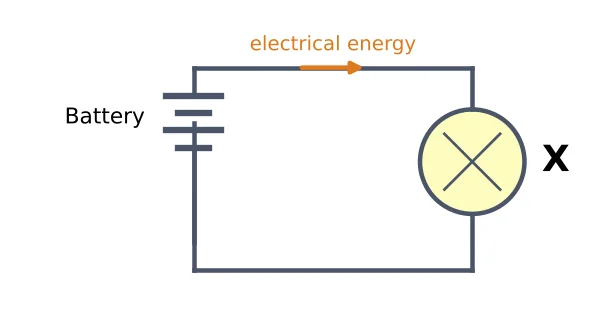
The diagram shows a simple circuit with a battery, wires and a bulb. The arrow shows electrical energy flowing from the battery. The bulb is labelled X.
Question diagram
(a)
Identify component X. [1]
(b)
Explain what happens to the electrical energy when it reaches X. [1]

revisionprep.com

Summary Answer

Not available for this question.

Model Answer

Not available for this question.

Marking Scheme

Not available for this question.

Examiner Insights

Not available for this question.

Question 2Criterion A · Easy · 2 marksrevisionprep.com

Examples in Pendulums and Roller Coasters
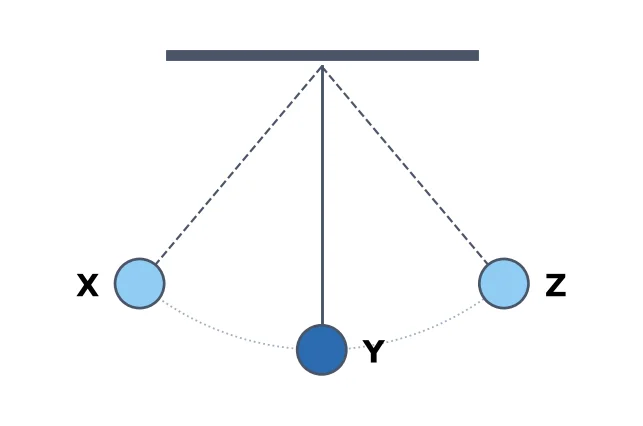
A pendulum bob is pulled aside to X and released. It swings through the lowest point Y to Z on the other side, as shown.
Question diagram
(a)
Identify the position where the pendulum is moving fastest. [1]
(b)
Identify the position or positions where the pendulum is stopped for a moment before it swings back. [1]

revisionprep.com

Summary Answer

Not available for this question.

Model Answer

Not available for this question.

Marking Scheme

Not available for this question.

Examiner Insights

Not available for this question.

Question 3Criterion C · Medium · 5 marksrevisionprep.com

Law of Conservation of Energy

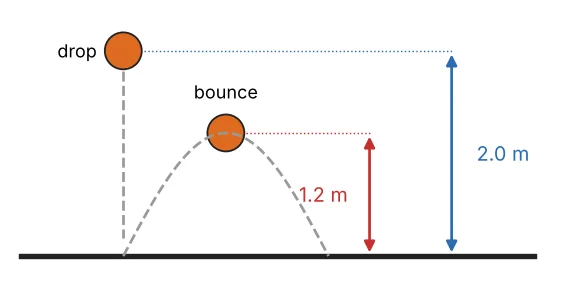
A student drops a basketball from a height of 2.0 m. It bounces and rises to only 1.2 m.
Question diagram
(a)
Calculate the percentage of the drop height that the ball reaches. Show your working. [1]
(b)
Explain why the basketball does not return to its original height of 2.0 m. [2]
(c)
The student cannot measure the heat and sound easily. Discuss whether this means the Law of Conservation of Energy is wrong. [2]

revisionprep.com

Summary Answer

Not available for this question.

Model Answer

Not available for this question.

Marking Scheme

Not available for this question.

Examiner Insights

Not available for this question.

Question 4Criterion B · Medium · 3 marksrevisionprep.com

Designing Simple Energy Investigations
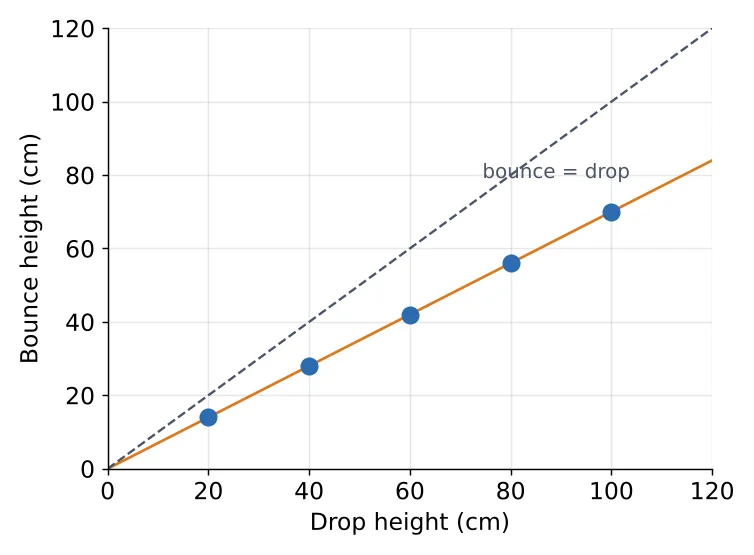
A student drops a rubber ball from different heights and measures the bounce height each time. The graph shows the results. The dashed line shows where the points would be if the ball bounced back to its drop height.
Question diagram
(a)
Identify the relationship between the drop height and the bounce height. [1]
(b)
Explain why the points are always below the dashed line. [1]
(c)
A ball is dropped from 80 cm and bounces to 56 cm. Compare the GPE at the start with the GPE at the top of the bounce and suggest where the missing energy has gone. [1]

revisionprep.com

Summary Answer

Not available for this question.

Model Answer

Not available for this question.

Marking Scheme

Not available for this question.

Examiner Insights

Not available for this question.

Question 5Criterion D + A · Challenge · 8 marksrevisionprep.com

Law of Conservation of Energy

A family compares two ways to heat a room. For every 100 J of electrical energy supplied:

- Heater A (electric bar, costs 50 dollars) gives 60 J of useful heat.
- Heater B (heat pump, costs 800 dollars) gives 90 J of useful heat.
(a)
Calculate the energy wasted by each heater for every 100 J supplied. [2]
(b)
Each heater must give 180 J of useful heat. Calculate the electrical energy each one needs. [4]
(c)
Evaluate which heater is the better choice for a family. Consider energy waste, running cost and the price of each heater. [2]

revisionprep.com

Summary Answer

Not available for this question.

Model Answer

Not available for this question.

Marking Scheme

Not available for this question.

Examiner Insights

Not available for this question.

Question 6Criterion D + A · Challenge · 8 marksrevisionprep.com

Closed Systems and Energy Accounting

A school's solar panels receive 500 units of light energy each day. They transfer 20% of this into electrical energy. The rest becomes thermal energy.
(a)
Calculate the electrical energy the panels produce each day. [2]
(b)
The school needs 400 units of electrical energy each day. Calculate the percentage of this need that the panels supply. [2]
(c)
Evaluate solar panels for the school. Refer to the environment and to cost. [4]

revisionprep.com

Summary Answer

Not available for this question.

Model Answer

Not available for this question.

Marking Scheme

Not available for this question.

Examiner Insights

Not available for this question.

That's every free question here — 6 of 80.

+74 more questions, plus Mock Papers & Worksheets, are waiting in Premium.

Upgrade