You're viewing free preview questions — 6 questions previewing here — subscribe to unlock 69 more, plus the Full Question Bank, Mock Papers & Worksheets.Upgrade
Back

Energy Efficiency and Real-Life Use — Free MYP2 Sciences Practice Questions

Free questions

Open in full, with answers, mark scheme and examiner insights.

Question 1Criterion B · Easy · 2 marksrevisionprep.com

Definition of Energy Efficiency

A student wraps three identical cups of hot water in a thin, a medium and a thick blanket. The student measures the water temperature every 2 minutes for 20 minutes.
(a)
Identify the independent variable (the one the student changes). [1]
(b)
Identify one variable the student must keep the same. [1]

revisionprep.com

Summary Answer

Not available for this question.

Model Answer

Not available for this question.

Marking Scheme

Not available for this question.

Examiner Insights

Not available for this question.

Question 2Criterion A · Easy · 3 marksrevisionprep.com

Calculating Efficiency Percent

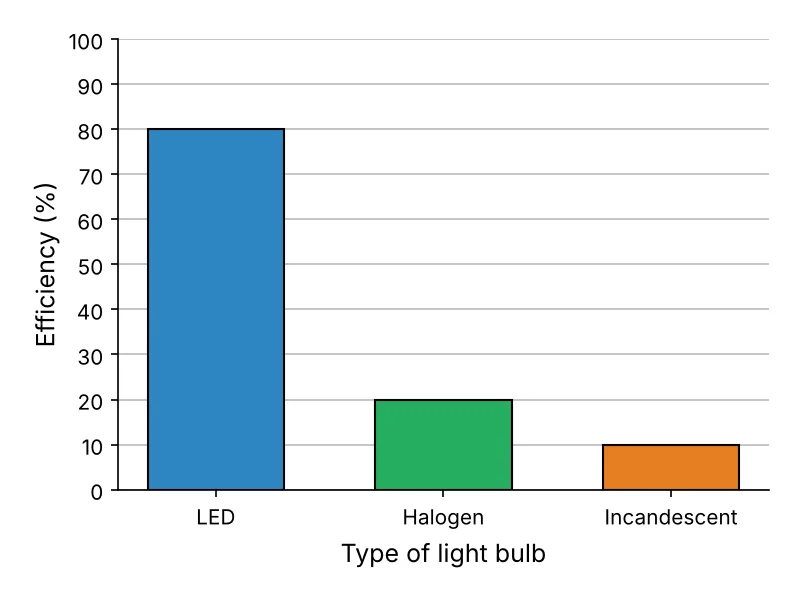
The bar chart shows the efficiency of three light bulbs. Efficiency is the percentage of the electrical energy that becomes useful light.
Question diagram
(a)
Identify the bulb with the highest efficiency. [1]
(b)
Read the efficiency of the halogen bulb from the chart. [1]
(c)
The incandescent bulb is 10% efficient. Explain what this means for every 100 J of electrical energy it receives. [1]

revisionprep.com

Summary Answer

Not available for this question.

Model Answer

Not available for this question.

Marking Scheme

Not available for this question.

Examiner Insights

Not available for this question.

Question 3Criterion C + A · Easy · 5 marksrevisionprep.com

Energy Labels and Appliance Ratings

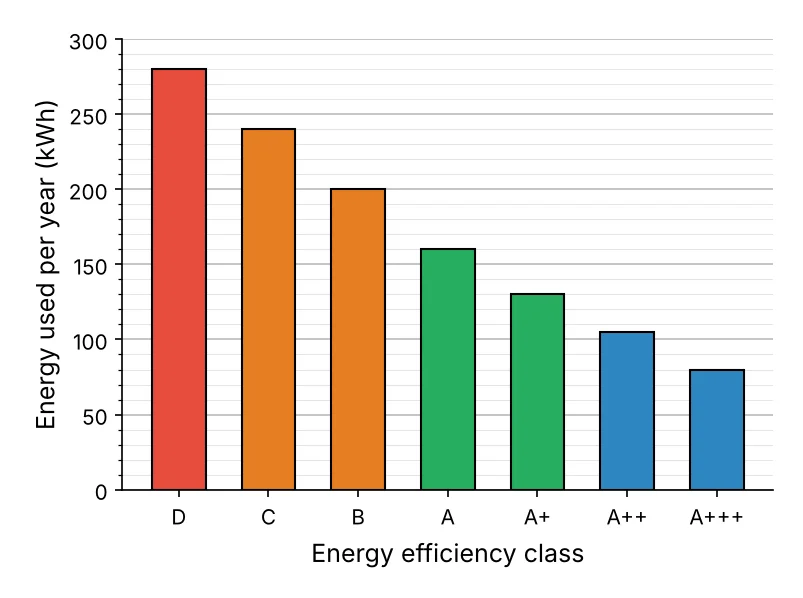
The bar chart shows the energy a washing machine uses in a year for different energy classes. Class D is the least efficient and class A+++ is the most efficient. Electricity costs 0.12 dollars per kWh.
Question diagram
(a)
Read the energy used each year by a class B machine. [1]
(b)
Describe the trend as the class changes from D to A+++. [1]
(c)
A family swaps a class D machine (280 kWh) for a class A+++ machine (80 kWh). Calculate the energy saved each year. [1]
(d)
Calculate the money saved in one year. [1]

(e) Calculate the money saved over 5 years. [1]

revisionprep.com

Summary Answer

Not available for this question.

Model Answer

Not available for this question.

Marking Scheme

Not available for this question.

Examiner Insights

Not available for this question.

Question 4Criterion A · Medium · 3 marksrevisionprep.com

Definition of Energy Efficiency

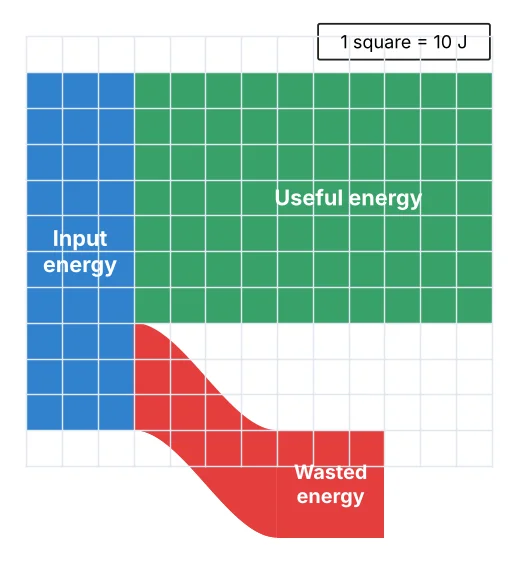
The Sankey diagram shows the energy transfers in a hairdryer-fan toy. Each grid square on the diagram stands for 10 J.
Question diagram
(a)
Use the diagram to state the total input energy. [1]
(b)
Use the diagram to state the wasted energy. [1]
(c)
Calculate the efficiency of the toy. [1]

revisionprep.com

Summary Answer

Not available for this question.

Model Answer

Not available for this question.

Marking Scheme

Not available for this question.

Examiner Insights

Not available for this question.

Question 5Criterion A + D · Medium · 6 marksrevisionprep.com

Improving Energy Efficiency at Home and School

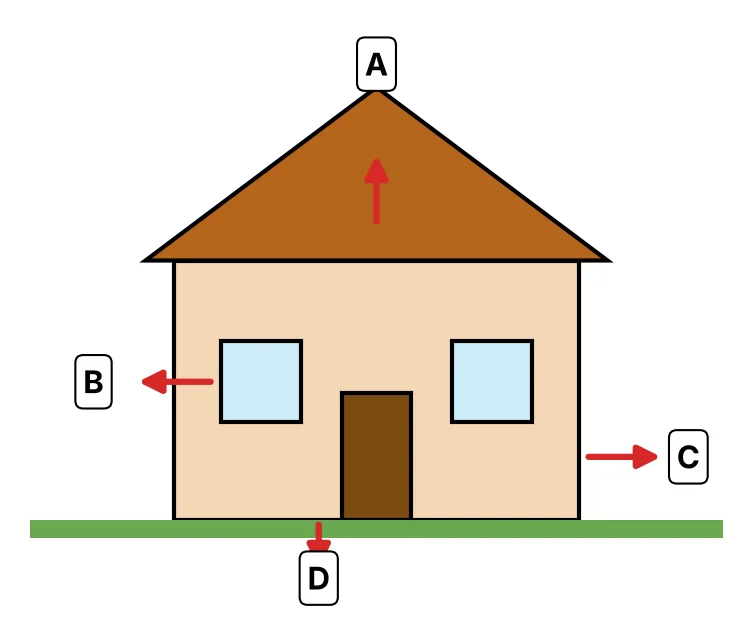
The diagram shows a house. Arrows A, B, C and D show where heat escapes: A is the roof, B is the windows, C is the walls and D is the floor. The table shows the share of heat lost through each part. The rest (15%) is lost through doors and draughts.

PartRoofWindowsWallsFloor
Heat lost (%)25103515
Question diagram
(a)
Identify the arrow that shows the biggest heat loss. [1]
(b)
Identify the arrow that shows the smallest heat loss. [1]
(c)
Calculate the total percentage lost through the roof and the walls. [1]
(d)
Suggest one way to reduce heat loss through the walls. [1]

(e) Loft insulation (roof) costs 300 dollars. Wall insulation costs 900 dollars. Evaluate which the family should do first. [2]

revisionprep.com

Summary Answer

Not available for this question.

Model Answer

Not available for this question.

Marking Scheme

Not available for this question.

Examiner Insights

Not available for this question.

Question 6Criterion D + A · Challenge · 7 marksrevisionprep.com

Evaluating Trade-Offs Between Efficiency and Cost

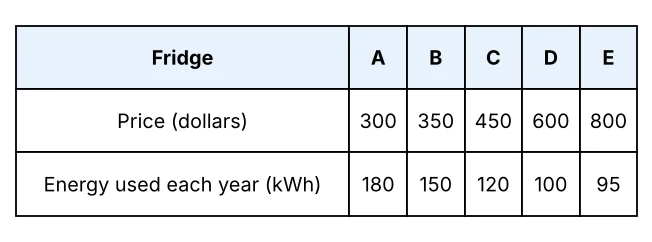
A family compares five fridges. Electricity costs 0.20 dollars for each kWh.

FridgeABCDE
Price (dollars)300350450600800
Energy used each year (kWh)18015012010095
Question diagram
(a)
Identify the fridge that uses the least energy. [1]
(b)
Calculate the cost of running fridge C for one year. [1]
(c)
Calculate the cost of running fridge E for one year. [1]
(d)
Describe the pattern between the price and the energy used. [1]

(e) Fridge E costs 200 dollars more than fridge D. Fridge E saves only 5 kWh each year. Evaluate whether it is worth paying the extra 200 dollars. [2]

(f) Recommend which fridge the family should choose. Give one reason. [1]

revisionprep.com

Summary Answer

Not available for this question.

Model Answer

Not available for this question.

Marking Scheme

Not available for this question.

Examiner Insights

Not available for this question.

That's every free question here — 6 of 75.

+69 more questions, plus Mock Papers & Worksheets, are waiting in Premium.

Upgrade