You're viewing free preview questions — 4 questions previewing here — subscribe to unlock 75 more, plus the Full Question Bank, Mock Papers & Worksheets.Upgrade
Balanced and Unbalanced Forces — Free MYP2 Sciences Practice Questions

1QuestionDefinition and Effects of Balanced ForcesConcept Practice
2 marks~3 minCriterion A
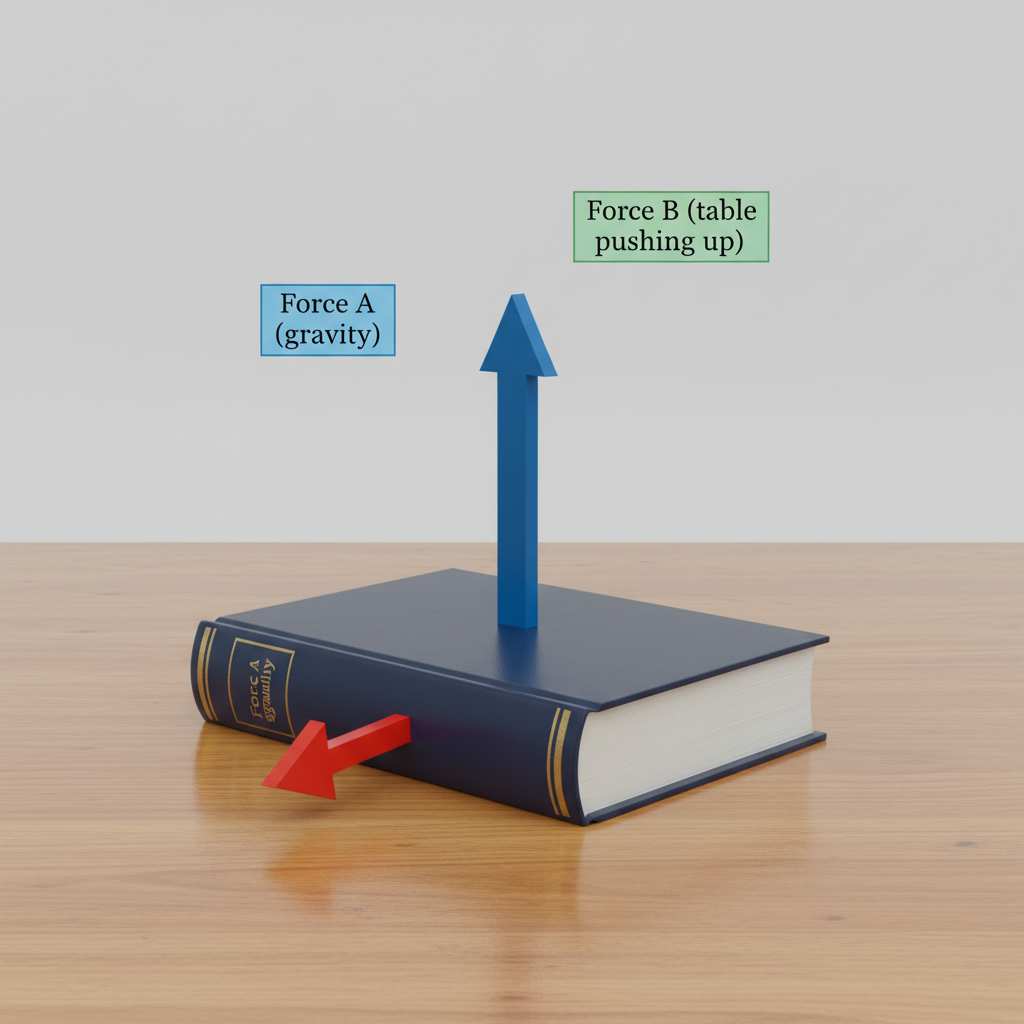
The diagram shows a book resting on a table. Force A (gravity — the downward pull of Earth) acts on the book. Force B (the normal force — the upward push from the table) also acts on the book.
a
Identify the two forces acting on the book. [1]
b
Explain why the book remains stationary. [1]

Solutions
2QuestionDefinition and Effects of Balanced ForcesAssessment Practice
5 marks~8 minCriterion C
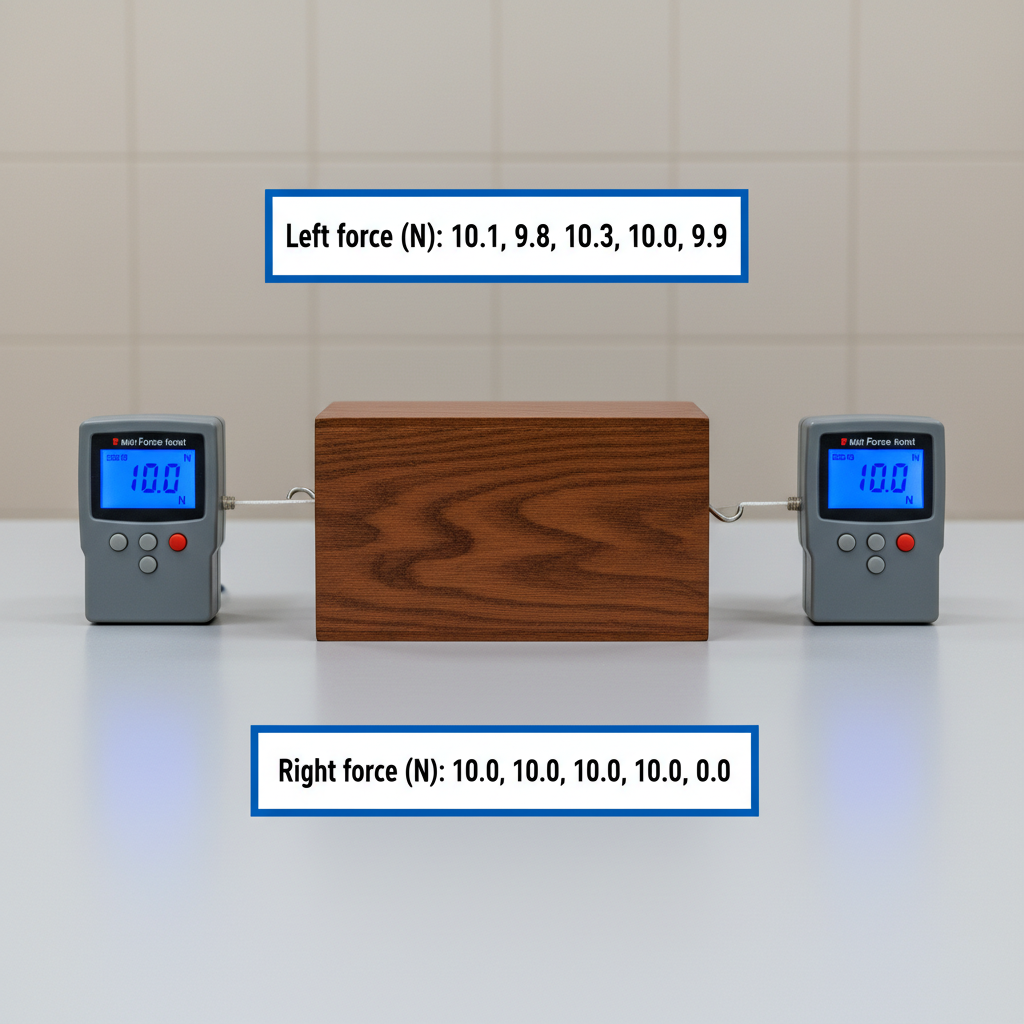
A student pushes a box on a table from both sides using force sensors. The readings (in Newtons) from five trials are:
The box does not move during any trial.
| Left force (N) | 10.1 | 9.8 | 10.3 | 10.0 | 9.9 |
|---|---|---|---|---|---|
| Right force (N) | 10.0 | 10.0 | 10.0 | 10.0 | 10.0 |
The box does not move during any trial.
a
Calculate the average left force and the average right force. [2]
b
Explain what the difference between the two averages tells you about whether the forces are balanced. [2]
c
The force sensor has a measurement uncertainty of ±0.1 N. Compare this uncertainty with the difference you found, and state whether the student's claim — that the forces are balanced — is valid. [1]
Solutions
3QuestionDefinition and Effects of Unbalanced ForcesConcept Practice
3 marks~5 minCriterion B
A student investigates how the mass added to a spring affects how much the spring stretches (its extension). The results are shown below.
| Mass added (g) | 50 | 100 | 150 | 200 |
|---|---|---|---|---|
| Spring extension (cm) | 2 | 4 | 6 | 8 |
a
Identify the independent variable in this investigation. [1]
b
Describe the relationship between mass added and spring extension shown by the data. [1]
c
Identify one variable that should be kept constant, and explain why keeping it constant makes the investigation fair. [1]
Solutions
4QuestionEquilibrium and Motion AnalysisAssessment Practice
8 marks~12 minCriterion D
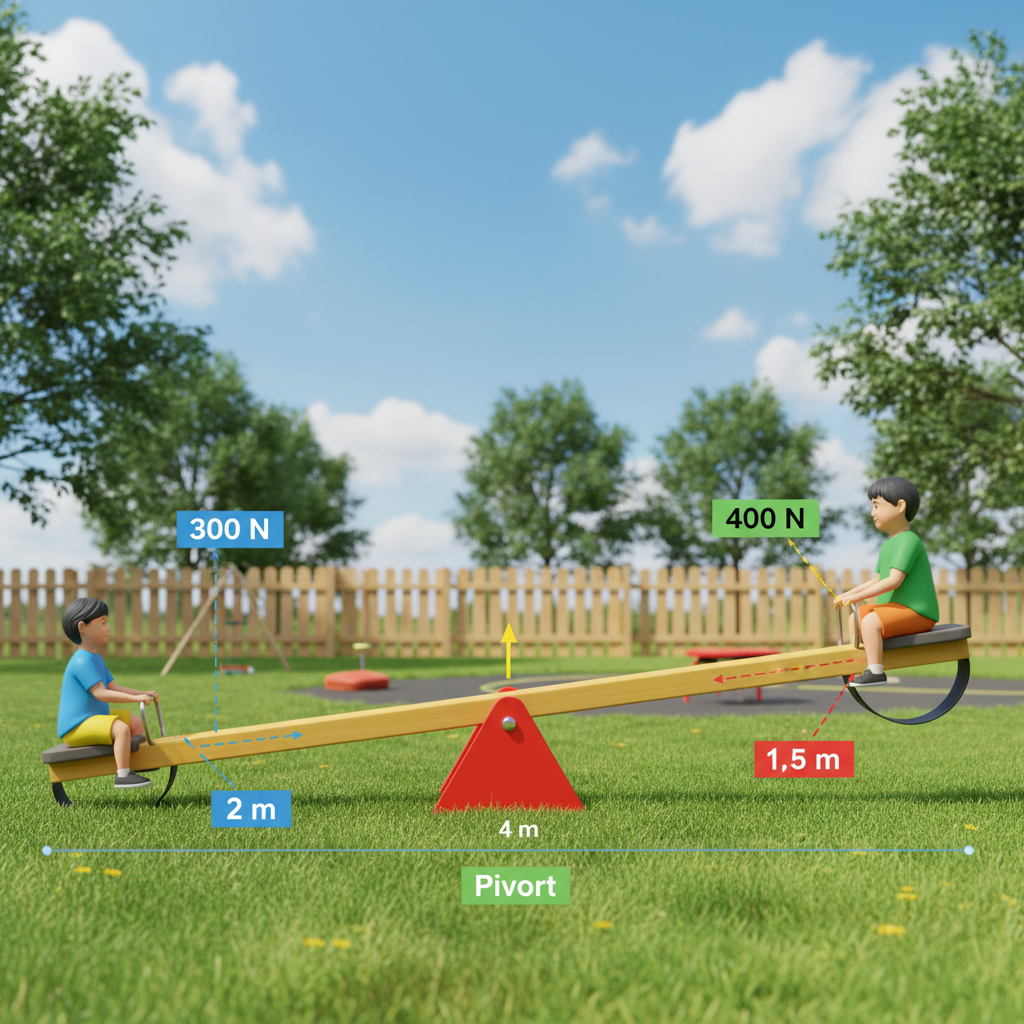
A school is choosing between two seesaws. The seesaw is 4 m long with the pivot at the centre. Child A weighs 300 N and sits 2 m from the pivot. Child B weighs 400 N and sits 1.5 m from the pivot.
A moment (turning effect) = weight × distance from pivot.
A moment (turning effect) = weight × distance from pivot.
a
Identify whether the seesaw is balanced or unbalanced. [1]
b
Calculate the moment produced by each child and explain whether the seesaw is in equilibrium. [3]
c
The metal seesaw costs 2 000 dollars and a spring model costs 3 500 dollars. The spring model reduces sudden tipping. Compare the trade-offs of choosing the cheaper metal seesaw against the more expensive spring model, considering safety for younger and lighter students and whether the cost saving justifies the risk. [4]
Solutions
That's every free question here — 4 of 79.
+75 more questions, plus Mock Papers & Worksheets, are waiting in Premium.