You're viewing free preview questions — 6 questions previewing here — subscribe to unlock 68 more, plus the Full Question Bank, Mock Papers & Worksheets.Upgrade
Back

Force Diagrams and Net Force — Free MYP2 Sciences Practice Questions

Free questions

Open in full, with answers, mark scheme and examiner insights.

Question 1Criterion A · Easy · 2 marksrevisionprep.com

Calculating Net Force on an Object

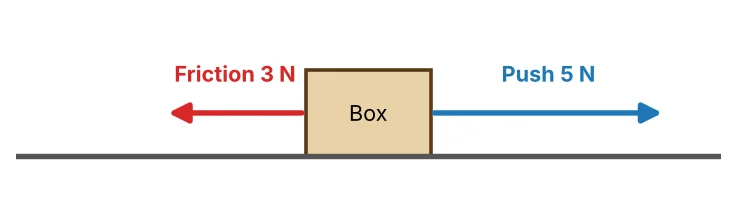
A box is pushed along a floor. The diagram shows the push and the friction force. Friction is a force that acts against motion.
Question diagram
(a)
Read the diagram and state the size and direction of each of the two forces. [1]
(b)
Calculate the net force on the box. Give its size and direction. [1]

revisionprep.com

Summary Answer

Not available for this question.

Model Answer

Not available for this question.

Marking Scheme

Not available for this question.

Examiner Insights

Not available for this question.

Question 2Criterion A · Easy · 2 marksrevisionprep.com

Determining Direction of Motion

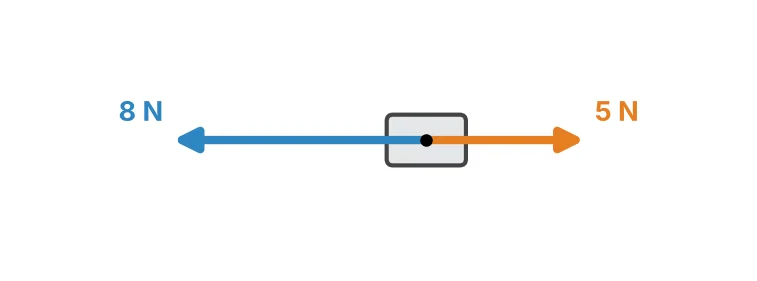
A box has two horizontal forces acting on it, as shown in the diagram.
Question diagram
(a)
Identify which force is larger. [1]
(b)
Explain, using the net force, which way the box will move. [1]

revisionprep.com

Summary Answer

Not available for this question.

Model Answer

Not available for this question.

Marking Scheme

Not available for this question.

Examiner Insights

Not available for this question.

Question 3Criterion A · Medium · 6 marksrevisionprep.com

Drawing and Labeling Force Diagrams

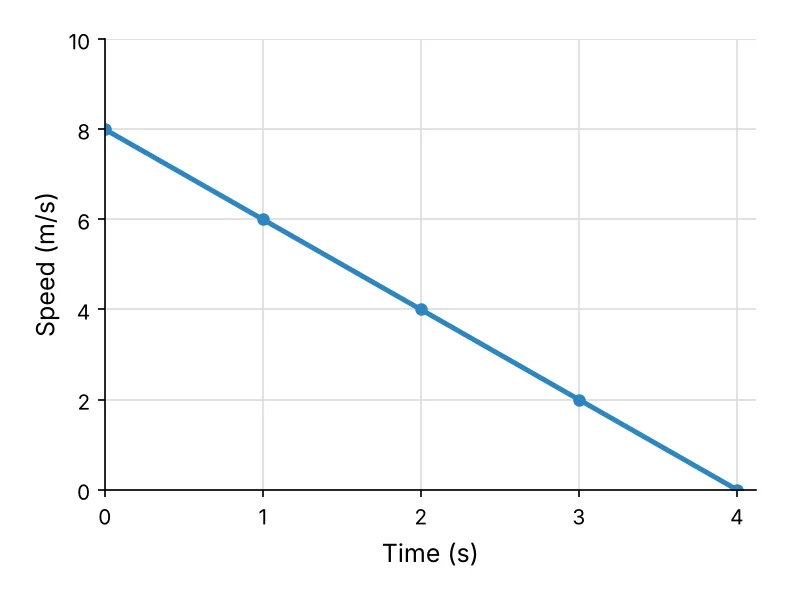
A 2 kg box slides across a rough floor and slows down until it stops. The graph shows its speed.
Question diagram
(a)
Use the graph to calculate how quickly the speed falls each second (the deceleration). [2]
(b)
Calculate the net force on the box using force = mass × acceleration. [2]
(c)
The box has four forces on it: weight, normal force, friction and no pushing force. Compare the sizes of the forces and explain how they make the box slow down. [2]

revisionprep.com

Summary Answer

Not available for this question.

Model Answer

Not available for this question.

Marking Scheme

Not available for this question.

Examiner Insights

Not available for this question.

Question 4Criterion B + A · Medium · 7 marksrevisionprep.com

Effect of Net Force on Acceleration and Speed
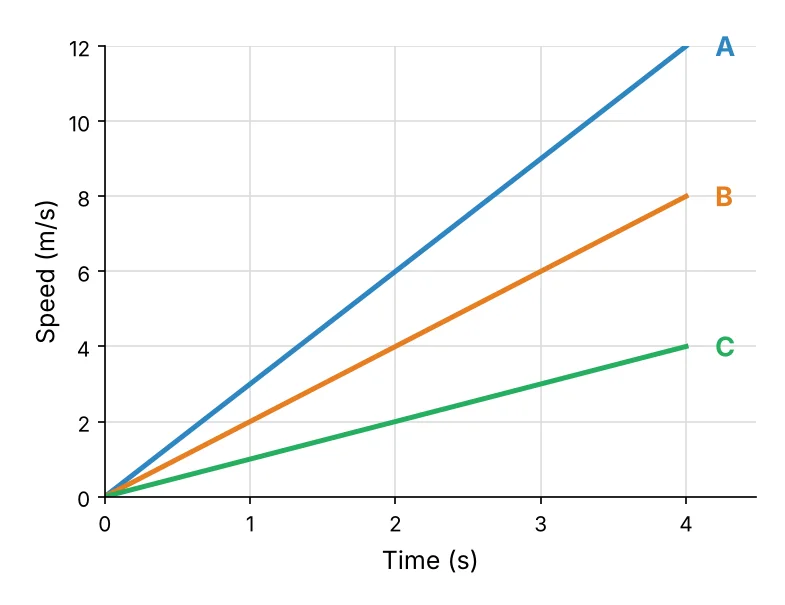
Three objects A, B and C each have a mass of 2 kg. The graph shows how the speed of each object changes over 4 seconds.
Question diagram
(a)
Use the graph to calculate the acceleration of each object. [3]
(b)
Calculate the net force on each object using F = m × a. [2]
(c)
Describe the pattern between net force and acceleration for the three objects. [2]

revisionprep.com

Summary Answer

Not available for this question.

Model Answer

Not available for this question.

Marking Scheme

Not available for this question.

Examiner Insights

Not available for this question.

Question 5Criterion C + A · Challenge · 8 marksrevisionprep.com

Drawing and Labeling Force Diagrams

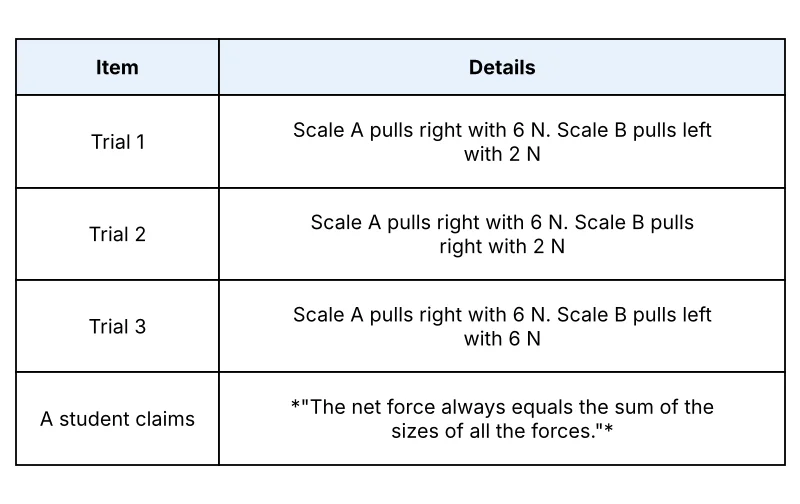
A cart on a smooth surface with no friction is pulled by two spring scales, A and B. The forces are shown below.

Trial 1: Scale A pulls right with 6 N. Scale B pulls left with 2 N.

Trial 2: Scale A pulls right with 6 N. Scale B pulls right with 2 N.

Trial 3: Scale A pulls right with 6 N. Scale B pulls left with 6 N.

A student claims: "The net force always equals the sum of the sizes of all the forces."
Question diagram
(a)
Identify the net force (size and direction) for each trial. [3]
(b)
Describe how you combined the forces in Trial 1, and explain why direction matters. [3]
(c)
Compare the student's claim with your results from all three trials. Is the claim correct? [2]

revisionprep.com

Summary Answer

Not available for this question.

Model Answer

Not available for this question.

Marking Scheme

Not available for this question.

Examiner Insights

Not available for this question.

Question 6Criterion D + A · Challenge · 7 marksrevisionprep.com

Free-Body Diagrams Introductory

A playground swing has two chains. A child of mass 45 kg sits still on the swing seat. The seat's weight is ignored. The child's weight is 450 N down. Each chain pulls up with a force called tension, 225 N in each chain.
(a)
Calculate the net force on the child and seat. [1]
(b)
A maker uses cheaper chains that can each hold 200 N. Calculate the biggest upward force the new chains can give and say if the swing is safe for the child. [3]
(c)
Evaluate the maker's decision to use cheaper chains. [3]

revisionprep.com

Summary Answer

Not available for this question.

Model Answer

Not available for this question.

Marking Scheme

Not available for this question.

Examiner Insights

Not available for this question.

That's every free question here — 6 of 74.

+68 more questions, plus Mock Papers & Worksheets, are waiting in Premium.

Upgrade