You're viewing free preview questions — 6 questions previewing here — subscribe to unlock 79 more, plus the Full Question Bank, Mock Papers & Worksheets.Upgrade
Back

States of Matter and Particle Theory — Free MYP2 Sciences Practice Questions

Free questions

Open in full, with answers, mark scheme and examiner insights.

Question 1Criterion A · Easy · 2 marksrevisionprep.com

Particle Model of Matter

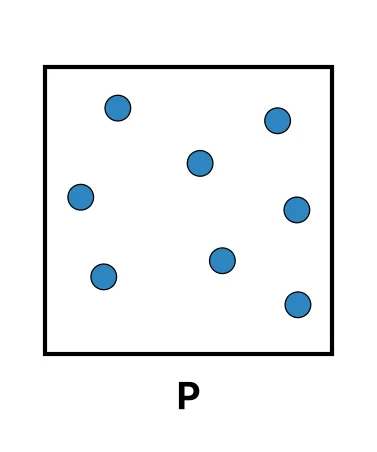
The diagram shows the particles in a sample of matter, labelled PP.
Question diagram
(a)
Identify the state of matter shown in the diagram. [1]
(b)
State one piece of evidence from the diagram that shows this. [1]

revisionprep.com

Summary Answer

Not available for this question.

Model Answer

Not available for this question.

Marking Scheme

Not available for this question.

Examiner Insights

Not available for this question.

Question 2Criterion D + A · Easy · 4 marksrevisionprep.com

Energy and Particle Movement in State Changes

A sports player puts an ice pack on a sore knee to cool it down.
(a)
State the direction in which heat flows between the knee and the ice pack. [1]
(b)
Explain, using particles, why the ice in the pack slowly melts. [1]
(c)
Give one advantage and one limitation of using an ice pack. [2]

revisionprep.com

Summary Answer

Not available for this question.

Model Answer

Not available for this question.

Marking Scheme

Not available for this question.

Examiner Insights

Not available for this question.

Question 3Criterion B + C · Medium · 5 marksrevisionprep.com

Solids Liquids and Gases Basic Properties

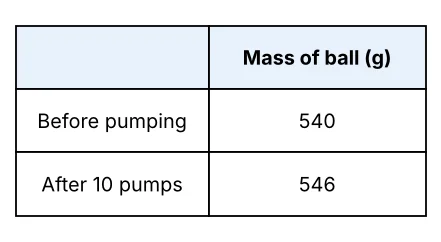
A student wants to find out if air has mass. She weighs a flat ball, pumps 10 pumps of air into it, and weighs it again.

| | Mass of ball (g) |
Before pumping540
After 10 pumps546
Question diagram
(a)
Identify the independent variable and the dependent variable. [2]
(b)
State what the results show about air. [1]
(c)
Explain, using particles, why adding air makes the ball heavier. [1]
(d)
Suggest one way to make her results more reliable. [1]

revisionprep.com

Summary Answer

Not available for this question.

Model Answer

Not available for this question.

Marking Scheme

Not available for this question.

Examiner Insights

Not available for this question.

Question 4Criterion A · Medium · 3 marksrevisionprep.com

Applications of Particle Theory in Real Life

Process 1: An ice cube melts in a warm drink, and the drink gets cooler.

Process 2: Sugar is stirred into cold water and dissolves, and the water stays at the same temperature.
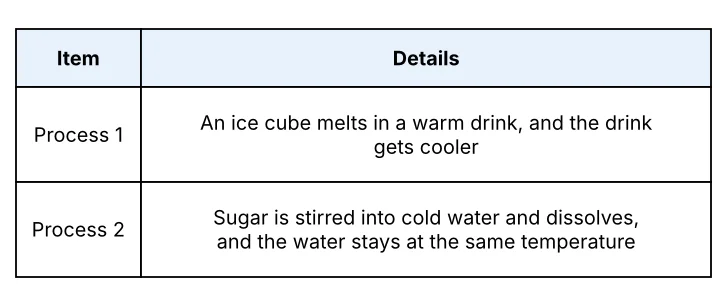
Question diagram
(a)
Identify which process is a change of state. [1]
(b)
Describe what happens to the particles of ice in Process 1. [1]
(c)
Describe what happens to the sugar particles in Process 2. [1]

revisionprep.com

Summary Answer

Not available for this question.

Model Answer

Not available for this question.

Marking Scheme

Not available for this question.

Examiner Insights

Not available for this question.

Question 5Criterion C + A · Challenge · 6 marksrevisionprep.com

Solids Liquids and Gases Basic Properties
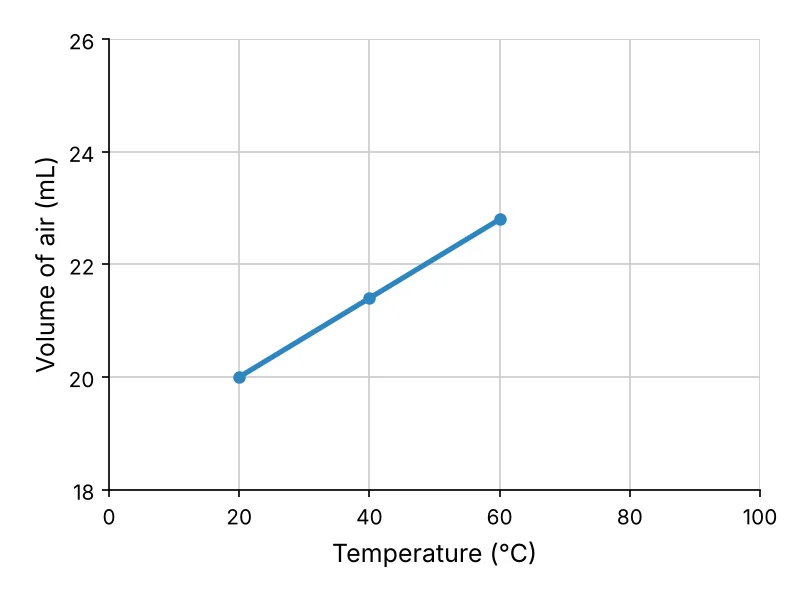
A student traps 20.0 mL of air in a syringe and puts it in a warm water bath. She records the volume at three temperatures. The graph shows her results.
Question diagram
(a)
Describe the pattern shown by the graph. [1]
(b)
Use the pattern to predict the volume at 80 °C. [2]
(c)
Explain, using particles, why heating the air makes its volume increase. [2]
(d)
Suggest why she used a warm water bath rather than holding the syringe over a flame. [1]

revisionprep.com

Summary Answer

Not available for this question.

Model Answer

Not available for this question.

Marking Scheme

Not available for this question.

Examiner Insights

Not available for this question.

Question 6Criterion C + A · Challenge · 6 marksrevisionprep.com

Changes of State Melting Boiling Condensation Freezing

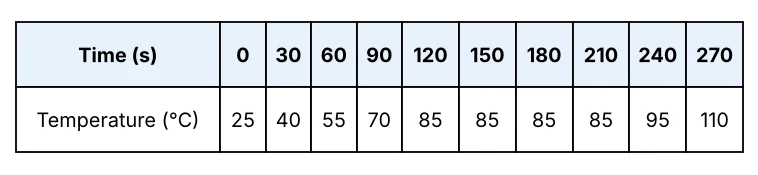
A student heats an unknown solid and records its temperature every 30 seconds.

Time (s)0306090120150180210240270
Temperature (°C)254055708585858595110


She says: "The solid is melting all the time, because the temperature is going up."
Question diagram
(a)
Identify the melting point of the solid. [1]
(b)
Describe what happens to the temperature between 120 s and 210 s and give the reason. [2]
(c)
Evaluate the student's statement. [2]
(d)
Suggest one change that would let her find the melting point more exactly. [1]

revisionprep.com

Summary Answer

Not available for this question.

Model Answer

Not available for this question.

Marking Scheme

Not available for this question.

Examiner Insights

Not available for this question.

That's every free question here — 6 of 85.

+79 more questions, plus Mock Papers & Worksheets, are waiting in Premium.

Upgrade