You're viewing free preview questions — 4 questions previewing here — subscribe to unlock 58 more, plus the Full Question Bank, Mock Papers & Worksheets.Upgrade
Translating Reflecting Rotating Shapes — Free MYP3 Mathematics Practice Questions

1QuestionCombining Multiple TransformationsConcept Practice
2 marks~3 minCriterion A
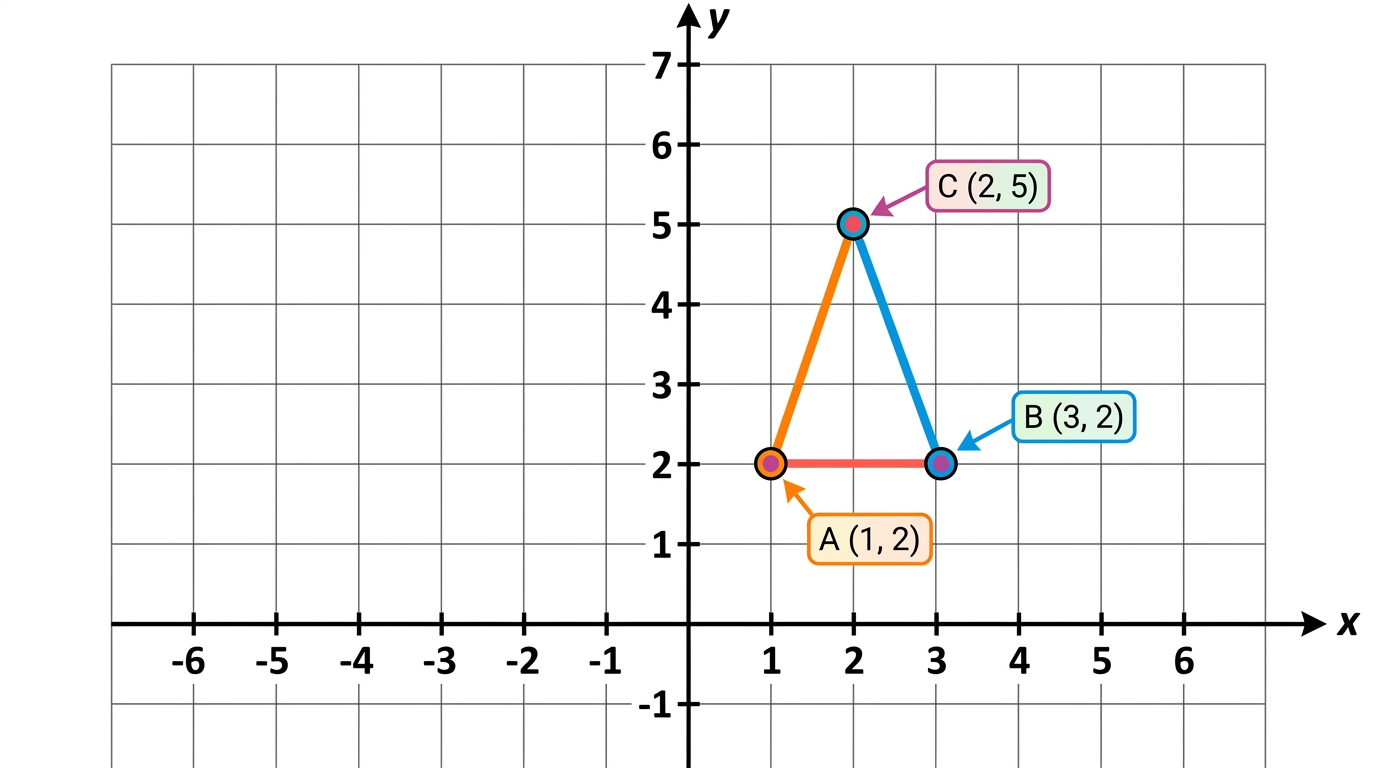
Triangle has vertices at , , and .
The triangle is first reflected in the -axis, then translated 2 units to the left.
The triangle is first reflected in the -axis, then translated 2 units to the left.
a
Apply the reflection in the -axis to find the image of point . [1]
b
Apply the translation to your answer from part (a) to find the final image of point . [1]

Solutions
2QuestionRotating Shapes Around the OriginAssessment Practice
6 marks~9 minCriterion B
Points , , , and are plotted on the coordinate grid provided.
a
Apply a 90° counterclockwise rotation about the origin to each point. Record the new coordinates and describe the pattern you observe. [2]
b
Explain how the pattern from part (a) predicts the image of after a 90° counterclockwise rotation, then calculate the image coordinates. [2]
c
A student claims that a 270° counterclockwise rotation about the origin maps to . Analyse whether this claim is correct by applying the rotation rule twice from part (a) and justifying your conclusion. [2]
Solutions
3QuestionTranslating Shapes on a GridConcept Practice
5 marks~8 minCriterion C
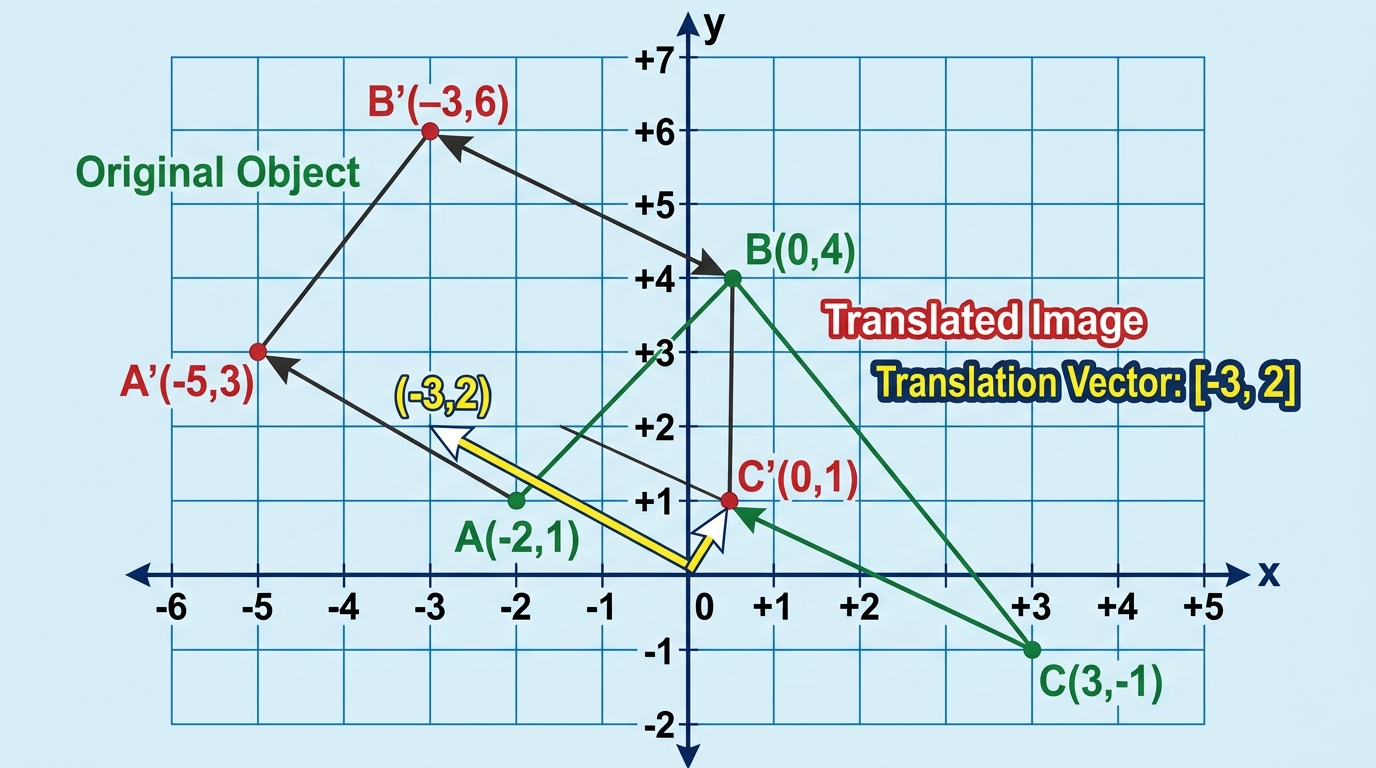
Triangle has vertices , , and . A student translates the triangle by the vector and claims the image vertices are , , and .
a
Calculate the coordinates of , , and after the translation. [3]
b
Compare your calculated coordinates with the student's claimed image points and state whether the claim is correct. [1]
c
A second student translates only vertex and records the image as . Explain what mistake this student likely made. [1]
Solutions
4QuestionDescribing Transformations in WordsAssessment Practice
6 marks~9 minCriterion D
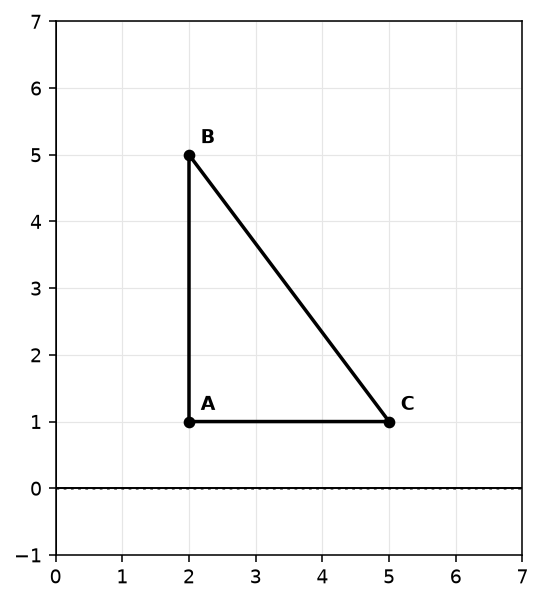
A city planner uses a coordinate grid to model a building's noon shadow. The building is triangle with vertices , , and . The model assumes the building is perfectly vertical, so the shadow is a reflection of triangle across the x-axis.
a
Apply the reflection rule to find the coordinates of , , and . [2]
b
Explain why a reflection across the x-axis correctly models the shadow of a perfectly vertical building. [2]
c
The building actually leans slightly to the right. Describe a transformation that would better model the real shadow, and explain why the reflection model is no longer sufficient. [2]
Solutions
That's every free question here — 4 of 62.
+58 more questions, plus Mock Papers & Worksheets, are waiting in Premium.