You're viewing free preview questions — 4 questions previewing here — subscribe to unlock 57 more, plus the Full Question Bank, Mock Papers & Worksheets.Upgrade
Understanding the Cartesian Plane — Free MYP3 Mathematics Practice Questions

1QuestionPlotting Points in All Four QuadrantsConcept Practice
3 marks~5 minCriterion A
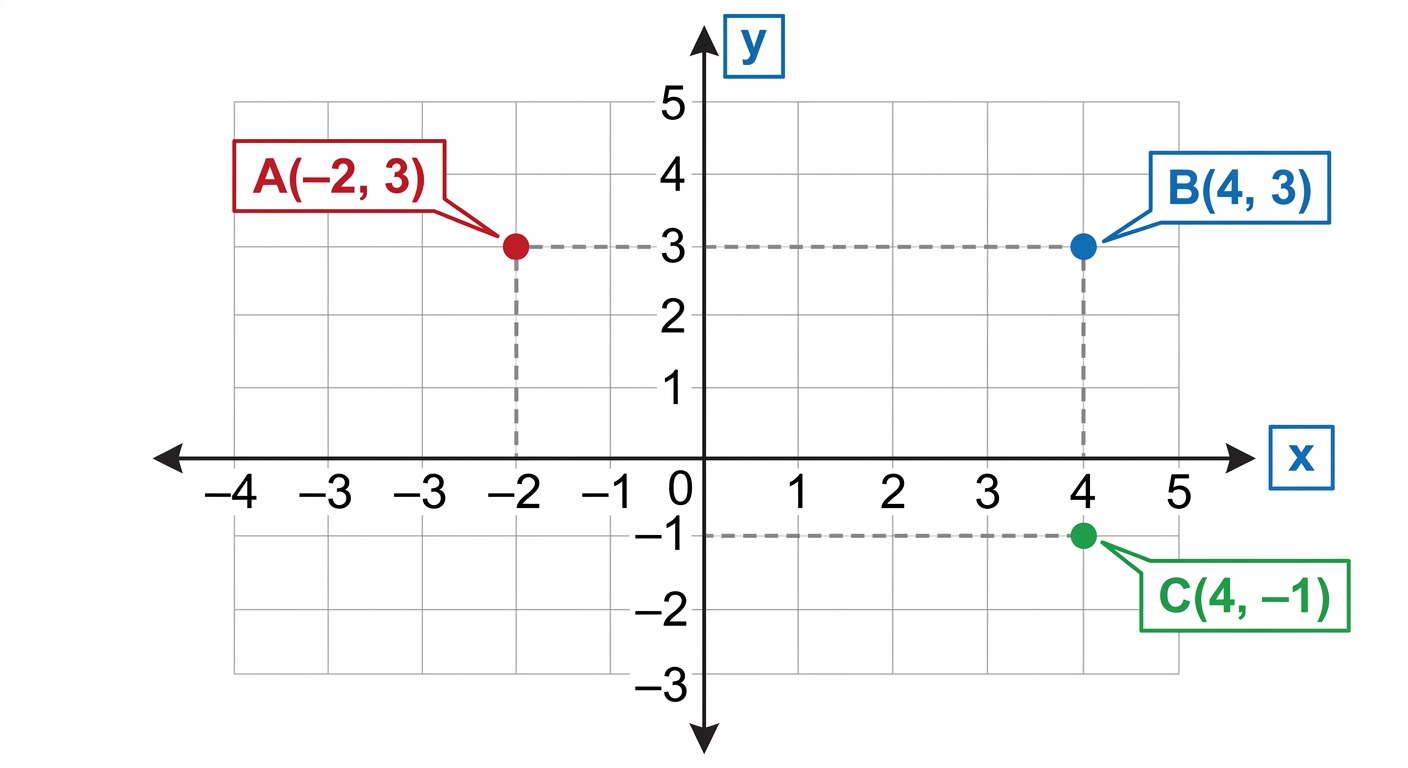
Three vertices of a rectangle are plotted on a Cartesian plane: , , and .
a
Calculate the coordinates of the fourth vertex, . [1]
b
Identify the quadrant in which each of the four vertices , , , and is located. [1]
c
Explain how the signs of the - and -coordinates of a point determine which quadrant it lies in, using two of the four vertices as examples. [1]

Solutions
2QuestionDescribing Positions Using CoordinatesAssessment Practice
4 marks~6 minCriterion D
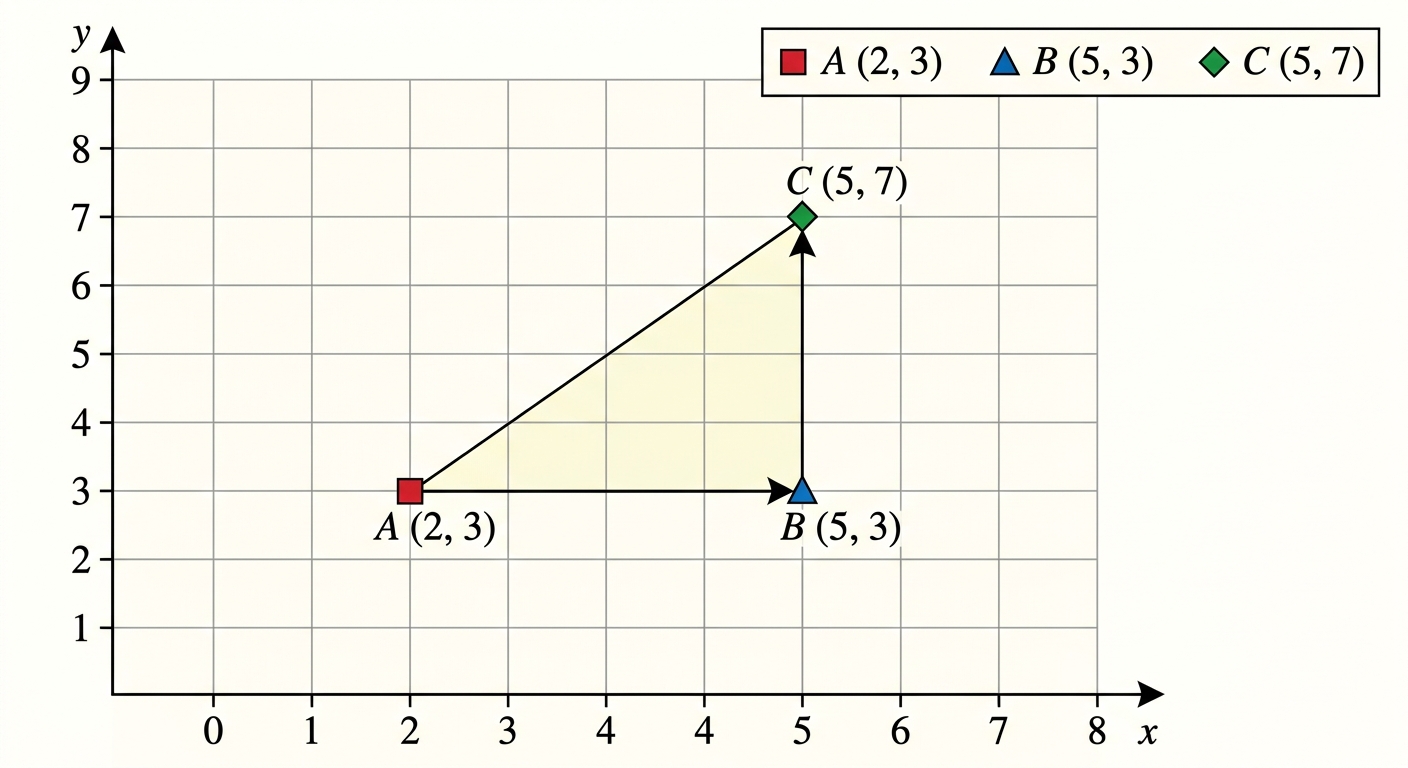
A city planner places three bus stops on a coordinate map at:
Each unit represents 100 metres. The actual road distances are: to = 350 m, and to = 500 m.
Each unit represents 100 metres. The actual road distances are: to = 350 m, and to = 500 m.
a
Calculate the straight-line distance, in metres, from to and from to . [2]
b
Explain why the coordinate model underestimates the actual walking distances, and suggest one way to improve the model. [2]
Solutions
3QuestionUnderstanding Axes Symmetry in CoordinatesAssessment Practice
5 marks~8 minCriterion C
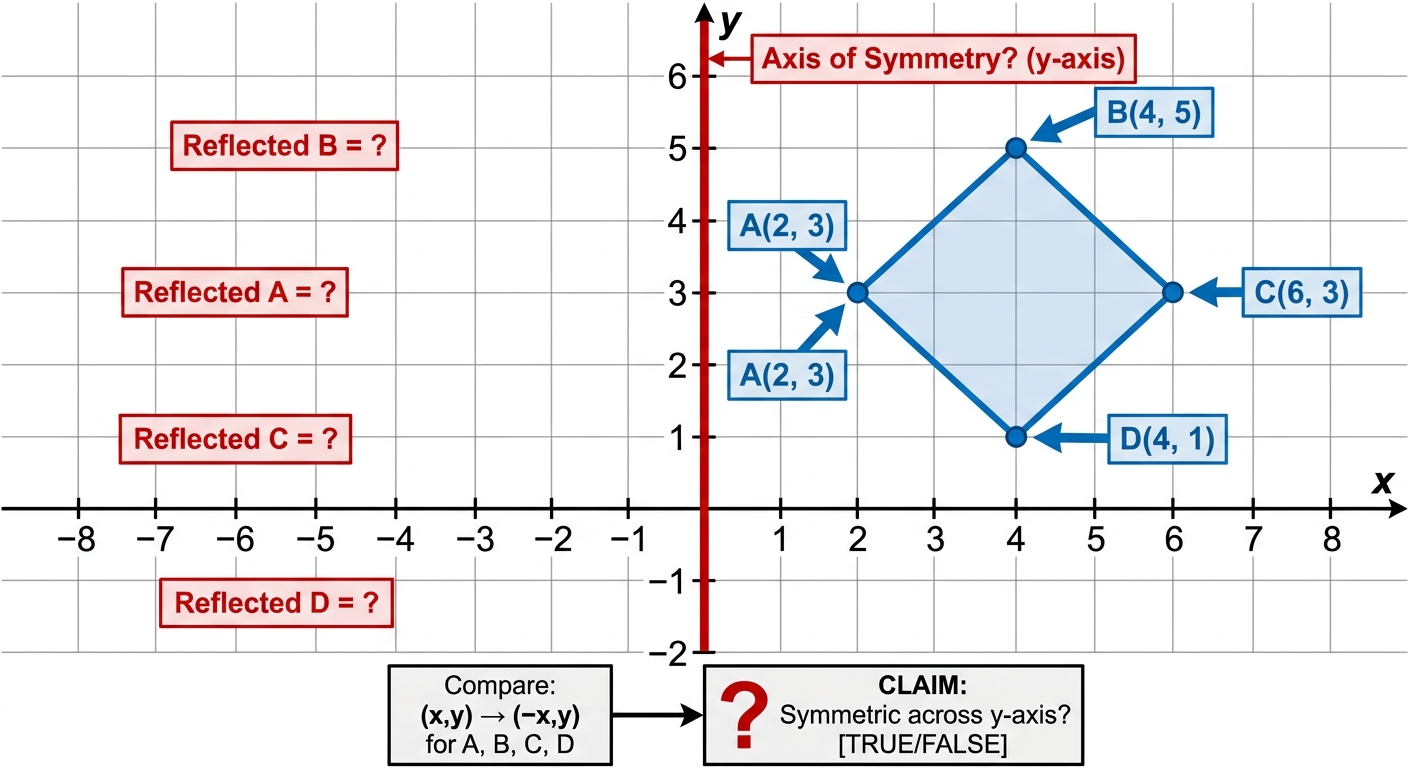
A student claims that quadrilateral , with vertices , , , and , is symmetric across the -axis.
a
Apply the transformation rule to calculate the reflected coordinates of , , , and . [2]
b
Explain why the reflected quadrilateral is or is not in the same position as the original. [1]
c
Justify whether the student's claim is true or false, using your results from part (a). [2]
Solutions
4QuestionUnderstanding Axes Symmetry in CoordinatesAssessment Practice
5 marks~8 minCriterion B
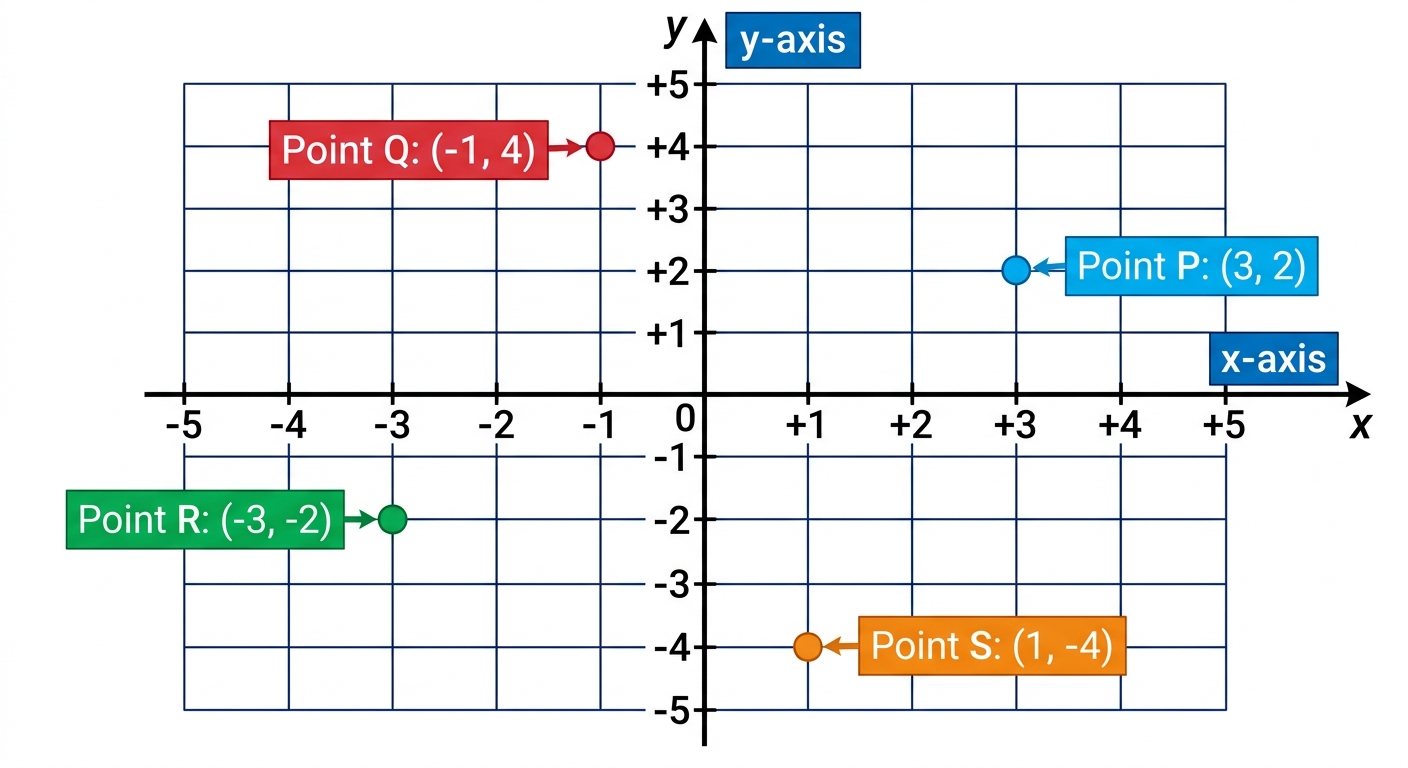
Four points are plotted on the Cartesian plane:
, , ,
, , ,
a
Calculate the coordinates of the reflections of , , , and across the -axis, the -axis, and the origin. [3]
b
Explain why reflecting any point across the -axis gives the image , referring to distance from the -axis in your answer. [1]
c
Using your results from part (a), justify whether the reflection of a point across the -axis and then across the -axis gives the same image as a single reflection across the origin. [1]
Solutions
That's every free question here — 4 of 61.
+57 more questions, plus Mock Papers & Worksheets, are waiting in Premium.