You're viewing free preview questions — 6 questions previewing here — subscribe to unlock 62 more, plus the Full Question Bank, Mock Papers & Worksheets.Upgrade
Back

Perimeter and area of 2D shapes — Free MYP3 Mathematics Practice Questions

Free questions

Open in full, with answers, mark scheme and examiner insights.

Question 1Criterion A · Band 1-4 · Easy · 2 marksrevisionprep.com

Calculating perimeter of squares and rectangles
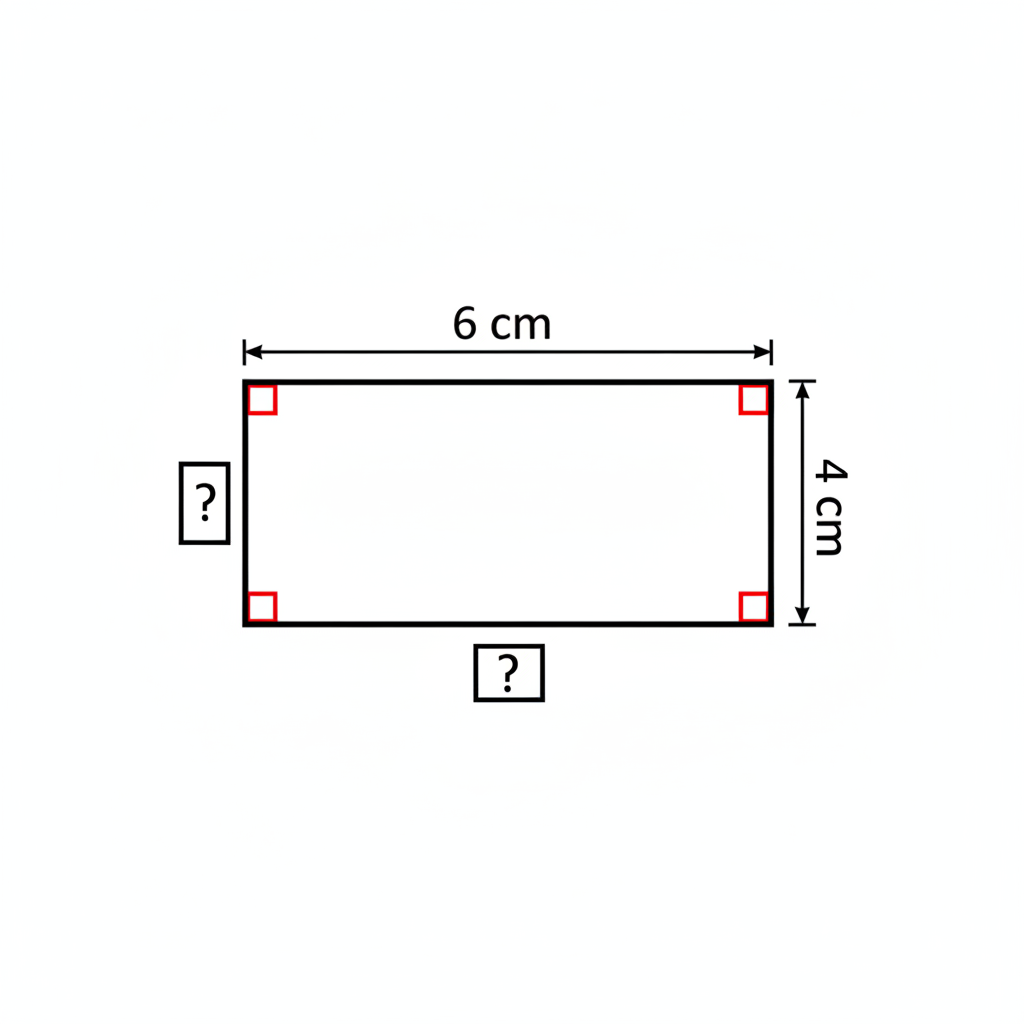
The diagram shows a rectangle with a length of 6 cm and a width of 4 cm.
Question diagram
(a)
Calculate the perimeter of the rectangle using P=2(l+w)P = 2(l + w). [1]Criterion A (ii) · Level 1-2
(b)
A second rectangle has the same perimeter but a length of 8 cm. Calculate its width. [1]Criterion A (iii) · Level 3-4

revisionprep.com

Summary Answer

Not available for this question.

Model Answer

Not available for this question.

Marking Scheme

Not available for this question.

Examiner Insights

Not available for this question.

Question 2Criterion A · Band 1-4 · Easy · 5 marksrevisionprep.com

Area of rectangles, triangles and parallelograms
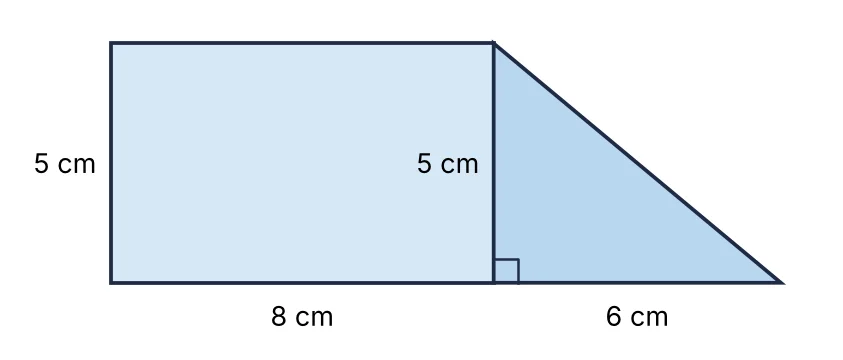
A shape is made by joining a rectangle and a right-angled triangle. The rectangle is 8 cm long and 5 cm wide. The triangle has a base of 6 cm and a height of 5 cm and is joined to the 5 cm side of the rectangle.
Question diagram
(a)
Calculate the area of the rectangle. [1]Criterion A (ii) · Level 1-2
(b)
Calculate the area of the triangle. Show your working. [2]Criterion A (ii) · Level 3-4
(c)
A second shape has the same rectangle and a bigger triangle. Its total area is 70 cm². Calculate the area of its triangle and say how many times bigger it is than the first triangle. [2]Criterion A (iii) · Level 3-4

revisionprep.com

Summary Answer

Not available for this question.

Model Answer

Not available for this question.

Marking Scheme

Not available for this question.

Examiner Insights

Not available for this question.

Question 3Criterion D · Band 3-6 · Medium · 5 marksrevisionprep.com

Calculating perimeter of squares and rectangles
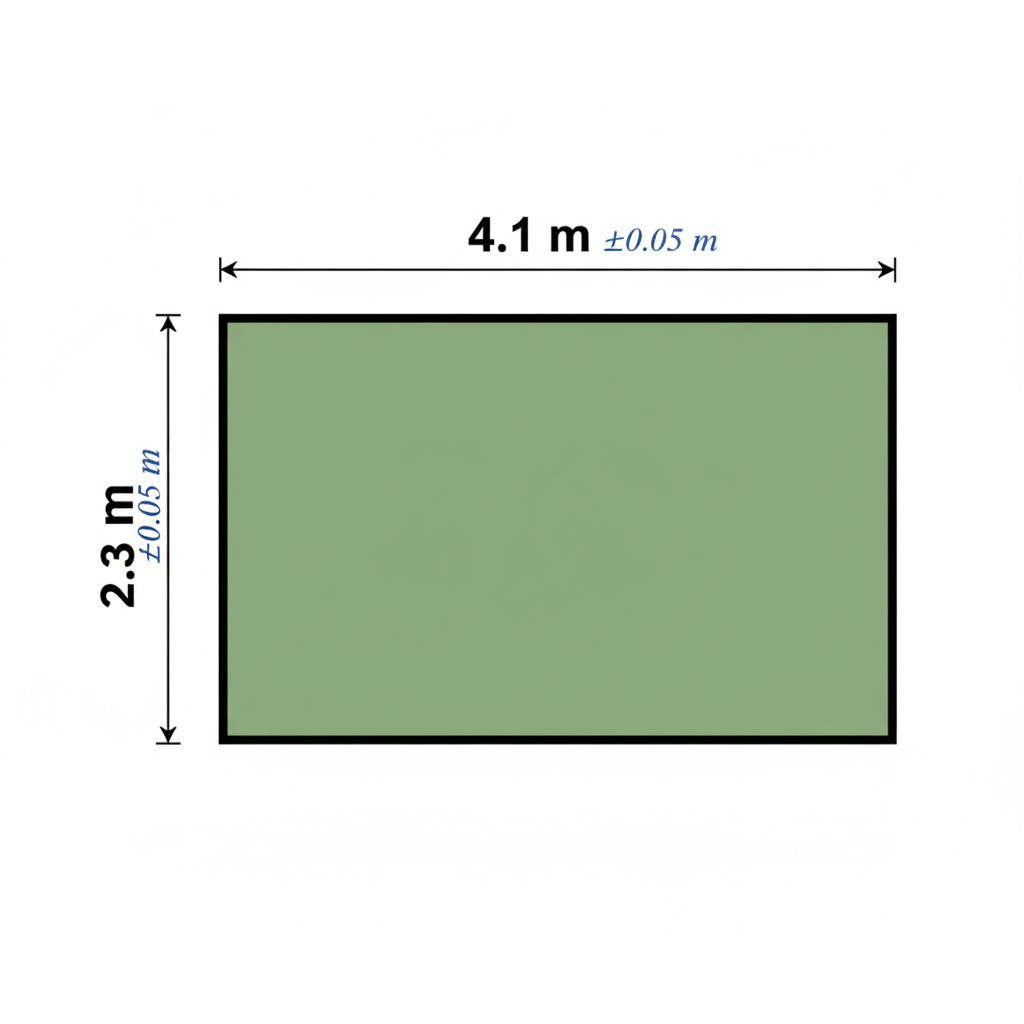
A student measures a rectangular garden bed as 2.3 m by 4.1 m. Each measurement could be wrong by up to 0.05 m. The student works out the perimeter as 12.8 m.
Question diagram
(a)
Calculate the greatest and least possible perimeter of the garden bed. [2]Criterion D (iii) · Level 3-4
(b)
Give one reason why 12.8 m is only an estimate of the real perimeter. [1]Criterion D (iv) · Level 3-4
(c)
The student says: 'My answer could be wrong by 0.2 m.' Is the student correct? Use your answers to part (a). [2]Criterion D (iv) · Level 5-6

revisionprep.com

Summary Answer

Not available for this question.

Model Answer

Not available for this question.

Marking Scheme

Not available for this question.

Examiner Insights

Not available for this question.

Question 4Criterion C + A · Band 3-6 · Medium · 6 marksrevisionprep.com

Area of trapeziums and compound shapes
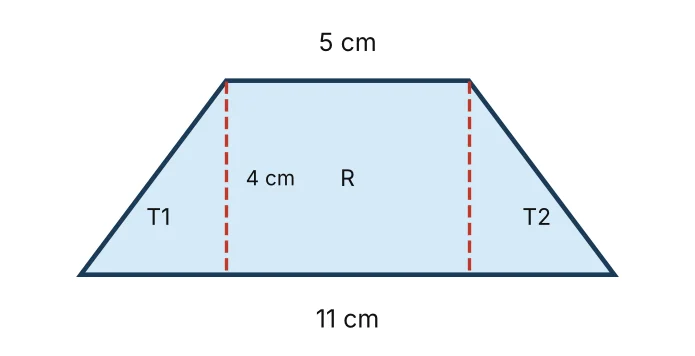
The diagram shows a trapezium with parallel sides of 5 cm and 11 cm and a height of 4 cm. The dashed lines split it into a rectangle R and two triangles, T1 and T2.
Question diagram
(a)
Calculate the area of R and the area of T1. Each triangle has a base of 3 cm. [2]Criterion A (ii) · Level 3-4
(b)
Use R, T1 and T2 to calculate the area of the trapezium. Check your answer with the trapezium formula. [2]Criterion C (iii) · Level 3-4
(c)
The average of the two parallel sides is 5+112=8\frac{5 + 11}{2} = 8 cm. Show that a rectangle 8 cm by 4 cm has the same area as the trapezium and explain why this works. [2]Criterion C (iv) · Level 5-6

revisionprep.com

Summary Answer

Not available for this question.

Model Answer

Not available for this question.

Marking Scheme

Not available for this question.

Examiner Insights

Not available for this question.

Question 5Criterion B · Band 3-8 · Challenge · 10 marksrevisionprep.com

Finding perimeter of irregular shapes

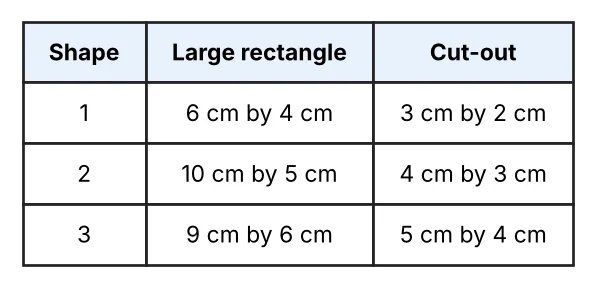
An L-shape is made by cutting a small rectangle out of the top-right corner of a large rectangle. The table gives the size of each large rectangle and of the cut-out.
Question diagram
(a)
Calculate the perimeter of each L-shape. [3]Criterion B (i) · Level 3-4
(b)
Compare each answer with the perimeter of its large rectangle. Describe the pattern and write a rule. [2]Criterion B (ii) · Level 5-6
(c)
A new L-shape is made by cutting a 7 cm by 5 cm rectangle from the top-right corner of a 12 cm by 8 cm rectangle. Use your rule to find its perimeter. Check your answer by adding all six sides. [3]Criterion B (iii) · Level 5-6
(d)
Prove that cutting an aa cm by bb cm rectangle out of the top-right corner of any large rectangle never changes the perimeter. [2]Criterion B (iii) · Level 7-8

revisionprep.com

Summary Answer

Not available for this question.

Model Answer

Not available for this question.

Marking Scheme

Not available for this question.

Examiner Insights

Not available for this question.

Question 6Criterion B · Band 3-6 · Challenge · 7 marksrevisionprep.com

Solving word problems involving perimeter and area
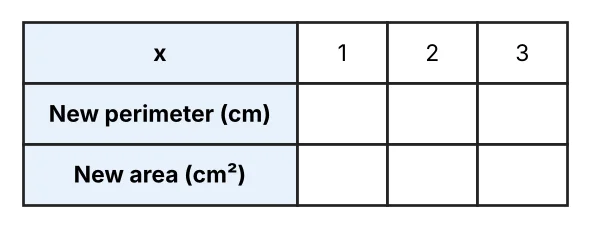
A rectangle is 3 cm by 5 cm. Both side lengths are made longer by xx cm, so the new rectangle is (3+x)(3 + x) cm by (5+x)(5 + x) cm.
Question diagram
(a)
Complete the table for the new perimeter and the new area. The table is shown below. [3]Criterion B (i) · Level 3-4
(b)
Describe the pattern in the perimeters and write a rule for the new perimeter PP in terms of xx. [2]Criterion B (ii) · Level 5-6
(c)
Use your rule to predict the perimeter when x=10x = 10. Check by working out the new sides. [2]Criterion B (iii) · Level 5-6

revisionprep.com

Summary Answer

Not available for this question.

Model Answer

Not available for this question.

Marking Scheme

Not available for this question.

Examiner Insights

Not available for this question.

That's every free question here — 6 of 68.

+62 more questions, plus Mock Papers & Worksheets, are waiting in Premium.

Upgrade