You're viewing free preview questions — 4 questions previewing here — subscribe to unlock 67 more, plus the Full Question Bank, Mock Papers & Worksheets.Upgrade
Surface Area of Cubes Cuboids and Prisms — Free MYP3 Mathematics Practice Questions

1QuestionSolving Surface Area Problems in ContextConcept Practice
2 marks~3 minCriterion A
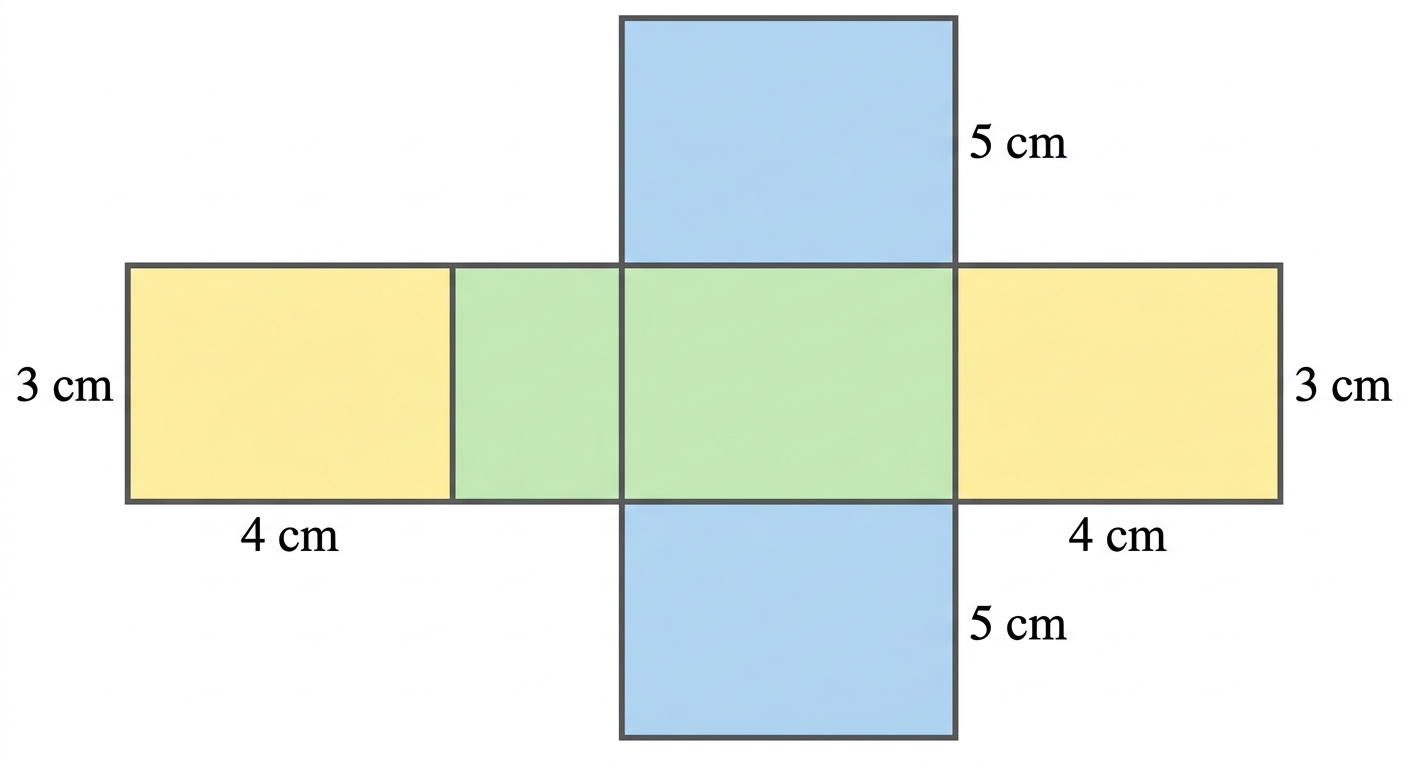
The net of a cuboid has side lengths of 3 cm, 4 cm, and 5 cm.
a
Calculate the area of each different rectangular face of the cuboid. [1]
b
Calculate the total surface area of the cuboid. [1]

Solutions
2QuestionUnderstanding Surface Area ConceptuallyAssessment Practice
3 marks~5 minCriterion B
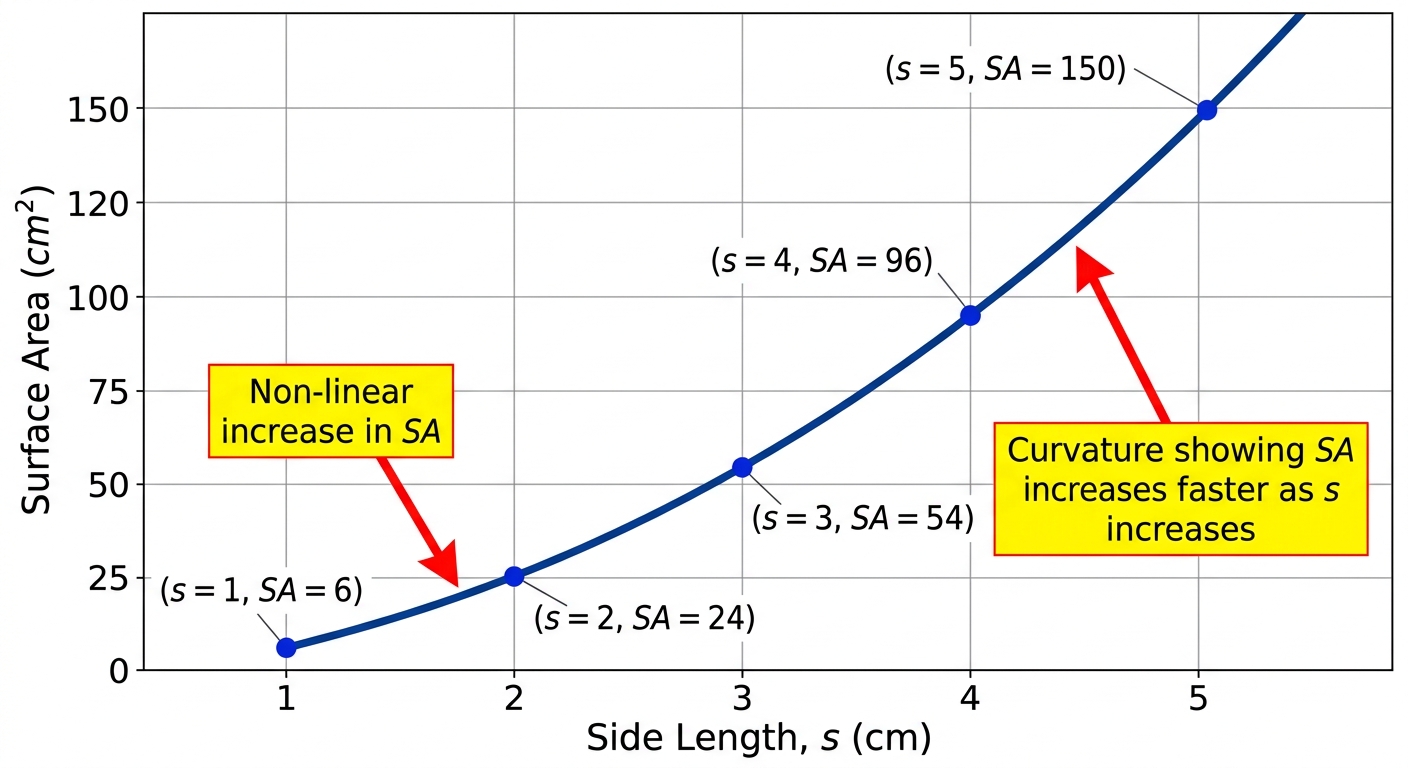
The graph shows how the surface area of a cube changes as its side length increases from 1 cm to 5 cm.
| Side length (cm) | 1 | 2 | 3 | 4 | 5 |
|---|---|---|---|---|---|
| Surface area (cm²) | 6 | 24 | 54 | 96 | 150 |
a
State the formula for the surface area of a cube with side length . Use it to calculate the surface area when cm. [1]
b
Explain why the surface area does not increase by the same amount each time the side length increases by 1 cm. [1]
c
The side length doubles from 2 cm to 4 cm. Analyse what happens to the surface area and explain why this result is not a surprise given the formula. [1]
Solutions
3QuestionUnderstanding Surface Area ConceptuallyAssessment Practice
5 marks~8 minCriterion C
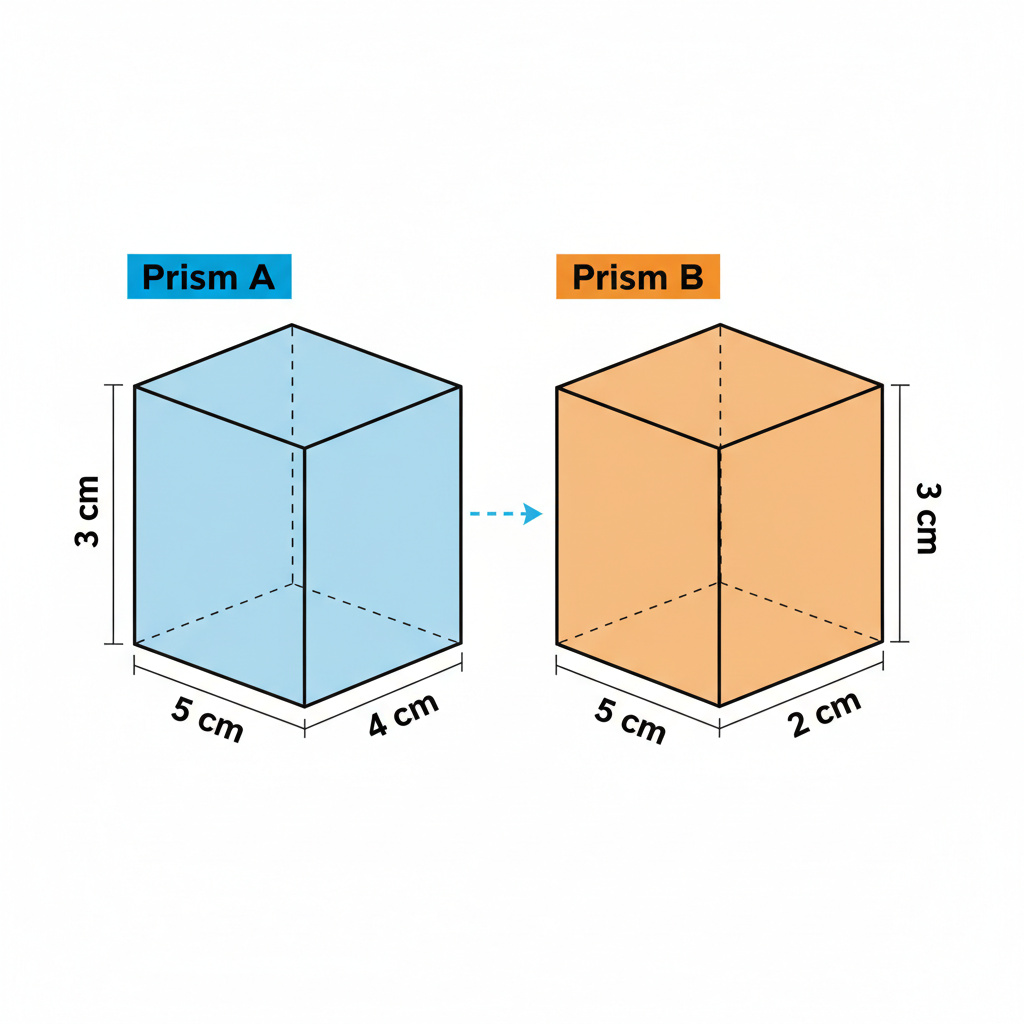
An L-shaped prism is formed by joining Prism A (dimensions ) and Prism B (dimensions ) along a face. The surface area of Prism A alone is and of Prism B alone is .
a
Calculate the area of the shared face. [1]
b
Explain why the total surface area of the L-shaped prism is not . [2]
c
Draw a net of the L-shaped prism, label the hidden faces, and calculate the correct surface area. [2]
Solutions
4QuestionSolving Surface Area Problems in ContextAssessment Practice
6 marks~9 minCriterion D
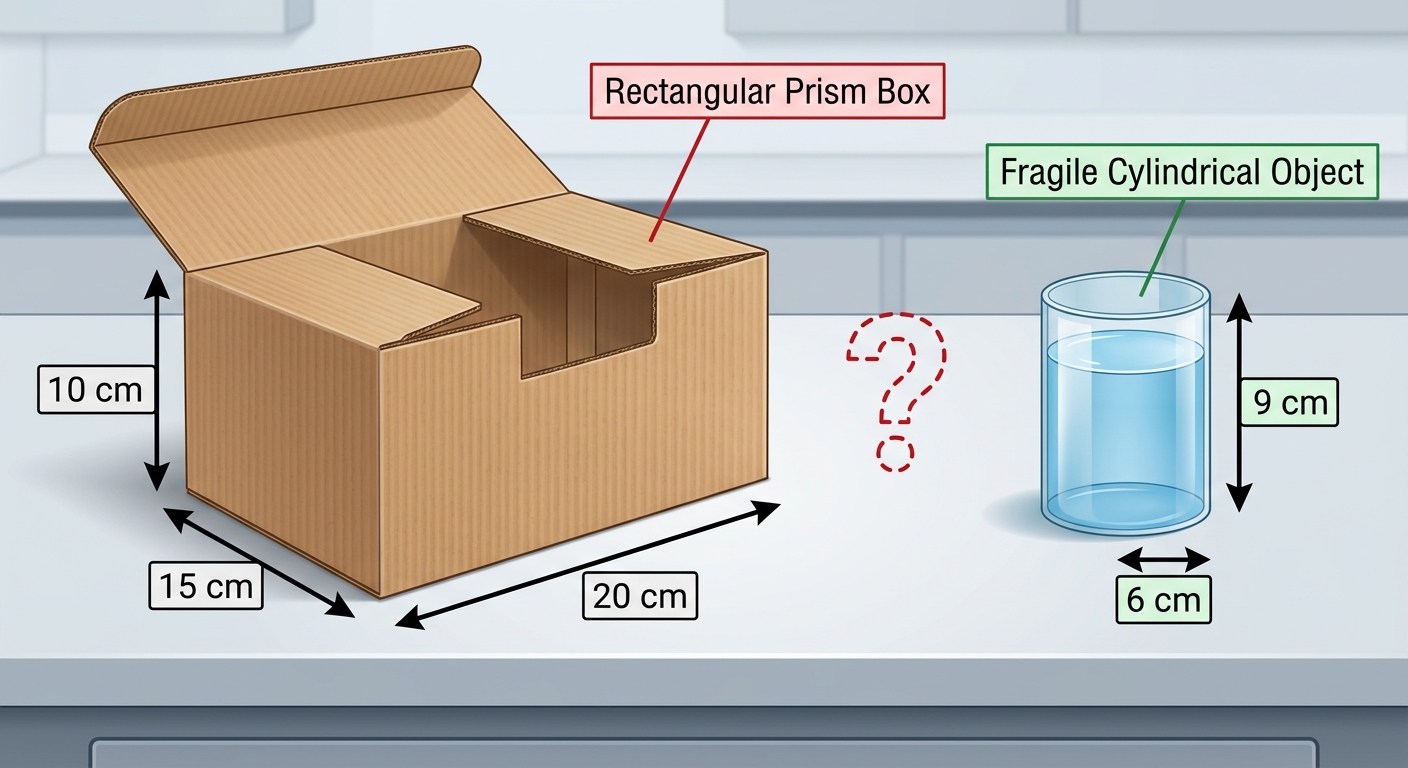
A packaging company designs a rectangular box with length 20 cm, width 15 cm, and height 10 cm to hold a fragile cylindrical object with radius 6 cm and height 9 cm. The surface area of the box is found using:
a
Calculate the total surface area of the box. [2]
b
Explain why the box dimensions are sufficient to contain the cylinder. [1]
c
Explain two reasons why the surface area formula alone may underestimate the amount of cardboard needed to manufacture this box. [3]
Solutions
That's every free question here — 4 of 71.
+67 more questions, plus Mock Papers & Worksheets, are waiting in Premium.