You're viewing free preview questions — 4 questions previewing here — subscribe to unlock 54 more, plus the Full Question Bank, Mock Papers & Worksheets.Upgrade
Triangles, Quadrilaterals, and Polygons — Free MYP3 Mathematics Practice Questions

1QuestionProperties of Isosceles Equilateral and Right TrianglesConcept Practice
2 marks~3 minCriterion A
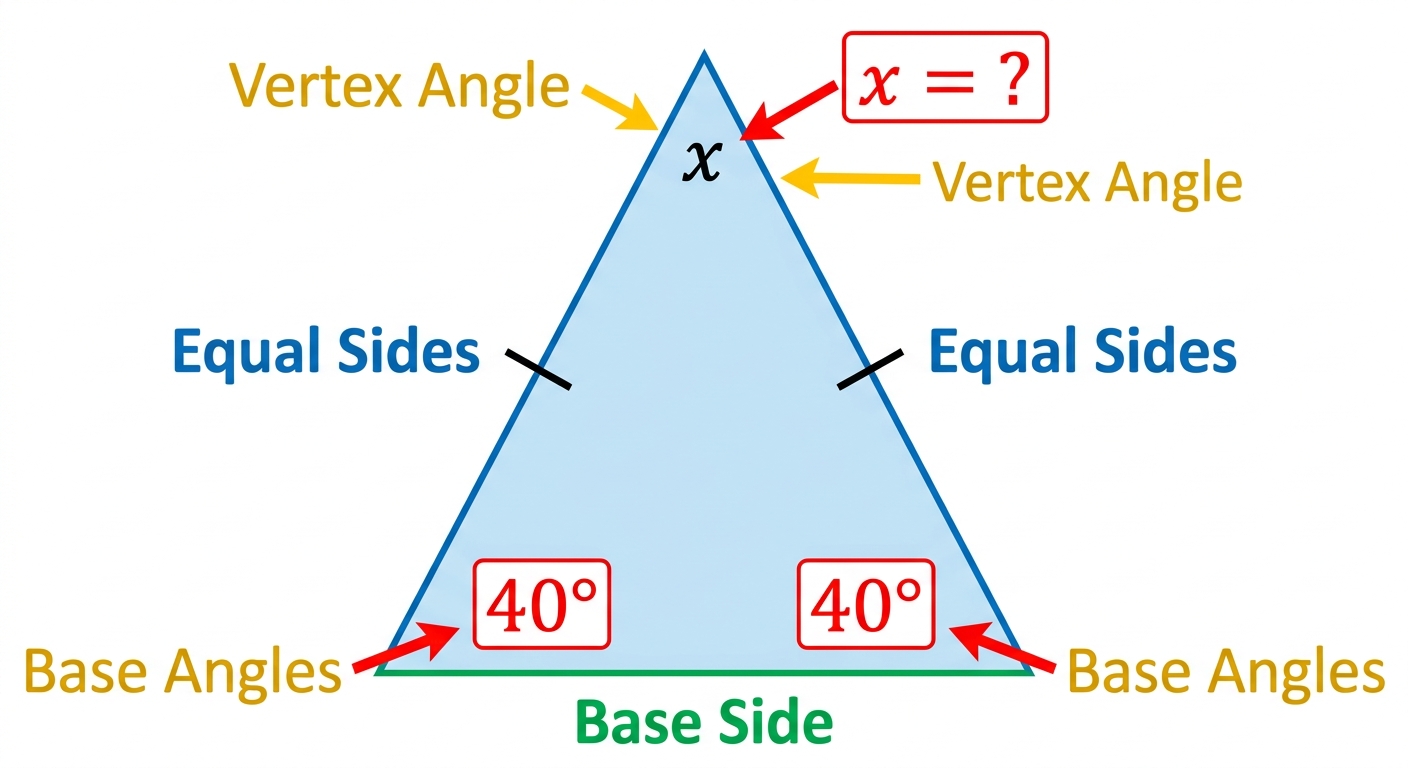
An isosceles triangle has two equal sides. One base angle measures .
Calculate the vertex angle of the triangle. [2]
Calculate the vertex angle of the triangle. [2]

Solutions
2QuestionProperties of Squares Rectangles Parallelograms and TrapeziumsAssessment Practice
5 marks~8 minCriterion C
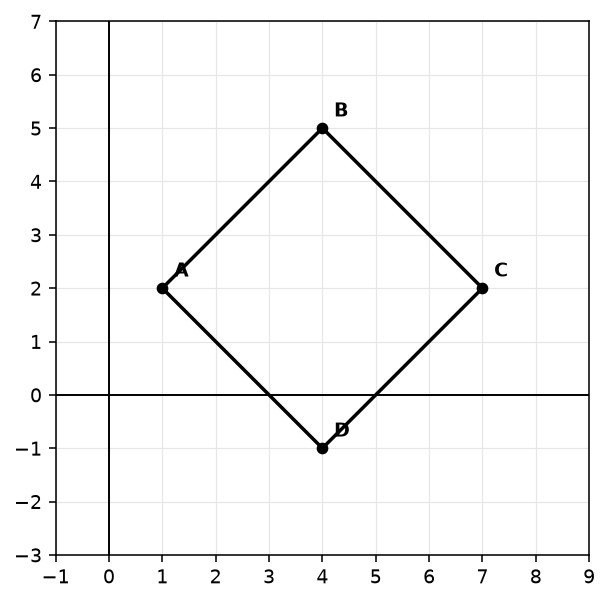
Quadrilateral has vertices , , , .
a
Calculate the slopes of all four sides , , , and . [2]
b
Explain how your slopes show that is a parallelogram. [2]
c
Justify whether is a rectangle. Use co-interior angles in your answer. [1]
Solutions
3QuestionClassifying Triangles by Sides and AnglesAssessment Practice
6 marks~9 minCriterion D
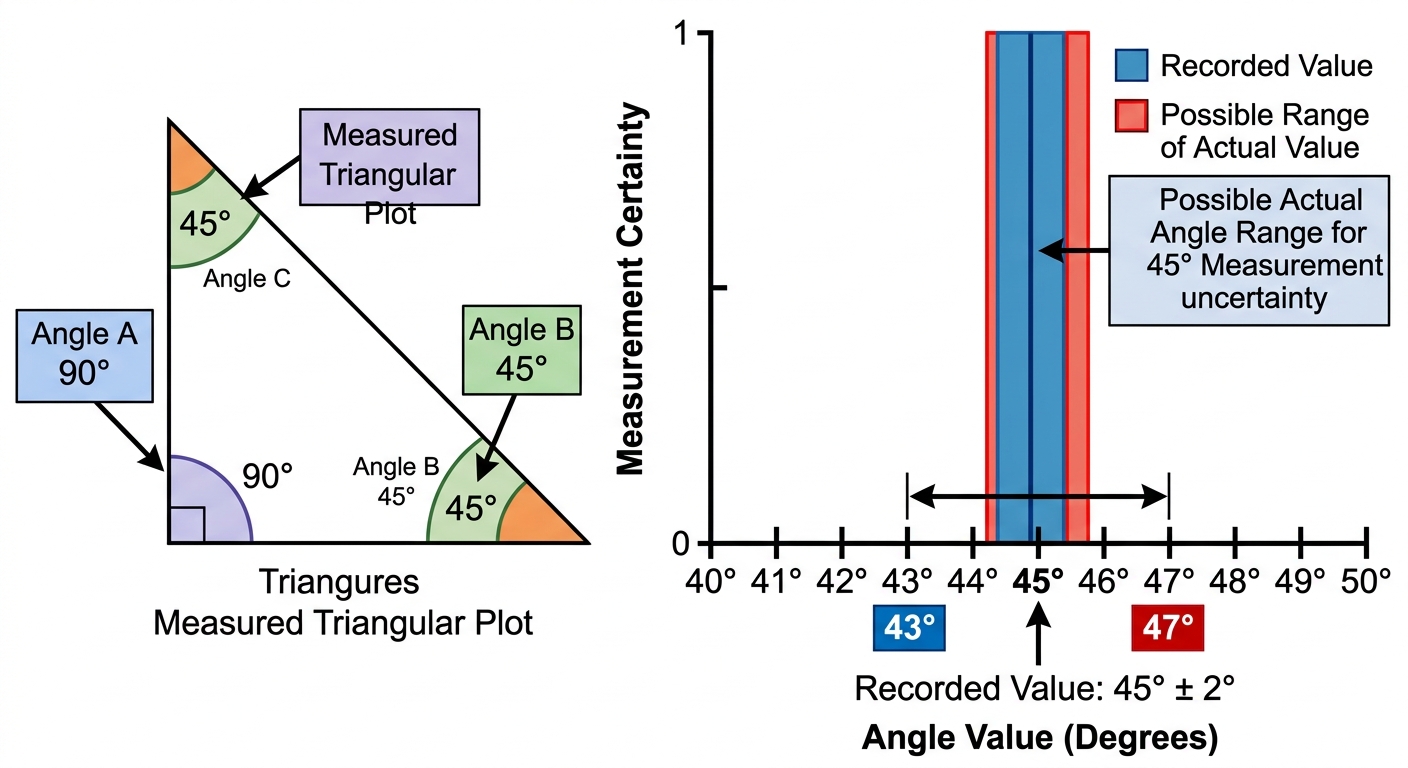
A surveyor measures a triangular plot of land and records angles of , , and . Her laser tool has a margin of error of per angle.
a
Describe the type of triangle formed by the angles , , and , classifying it by both angles and sides. [2]
b
Explain how a measurement error could produce a different triangle. Give one possible set of actual angles and classify that triangle by both angles and sides. [2]
c
Analyse the validity of the surveyor's claim that the plot is exactly right isosceles, given the measurement error. [2]
Solutions
4QuestionProperties of Isosceles Equilateral and Right TrianglesAssessment Practice
6 marks~9 minCriterion B
The table below shows the vertex angle and base angles of five isosceles triangles.
| Vertex angle (, degrees) | 20 | 40 | 60 | 80 | 100 |
|---|---|---|---|---|---|
| Base angle (, degrees) | 80 | 70 | 60 | 50 | 40 |
a
Calculate the sum of all three angles for each triangle in the table. [2]
b
Explain why the relationship between the vertex angle and base angle in any isosceles triangle can be written as . [2]
c
A student claims that an isosceles triangle with a vertex angle of has base angles of each, making it a special triangle where the base angle is exactly twice the vertex angle. Analyse whether this claim is correct and explain what is special about this triangle. [2]
Solutions
That's every free question here — 4 of 58.
+54 more questions, plus Mock Papers & Worksheets, are waiting in Premium.