You're viewing free preview questions — 6 questions previewing here — subscribe to unlock 61 more, plus the Full Question Bank, Mock Papers & Worksheets.Upgrade
Back

Arithmetic and geometric sequences — Free MYP3 Mathematics Practice Questions

Free questions

Open in full, with answers, mark scheme and examiner insights.

Question 1Criterion A + C · Band 1-4 · Easy · 3 marksrevisionprep.com

Calculating common ratios

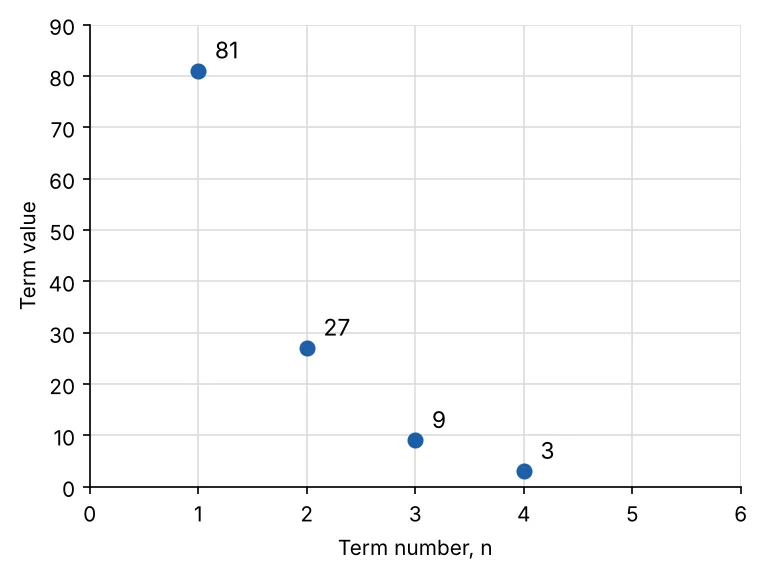
The graph shows the first four terms of a geometric sequence. The horizontal axis is the term number nn.
Question diagram
(a)
Use the graph to calculate the common ratio. [1]Criterion A (ii) · Level 1-2
(b)
Explain how the graph shows that the sequence is geometric. [1]Criterion C (ii) · Level 3-4
(c)
Calculate the 5th term and describe what happens to the terms as nn gets larger. [1]Criterion A (iii) · Level 3-4

revisionprep.com

Summary Answer

Not available for this question.

Model Answer

Not available for this question.

Marking Scheme

Not available for this question.

Examiner Insights

Not available for this question.

Question 2Criterion A + C · Band 1-4 · Easy · 3 marksrevisionprep.com

Comparing arithmetic and geometric sequences
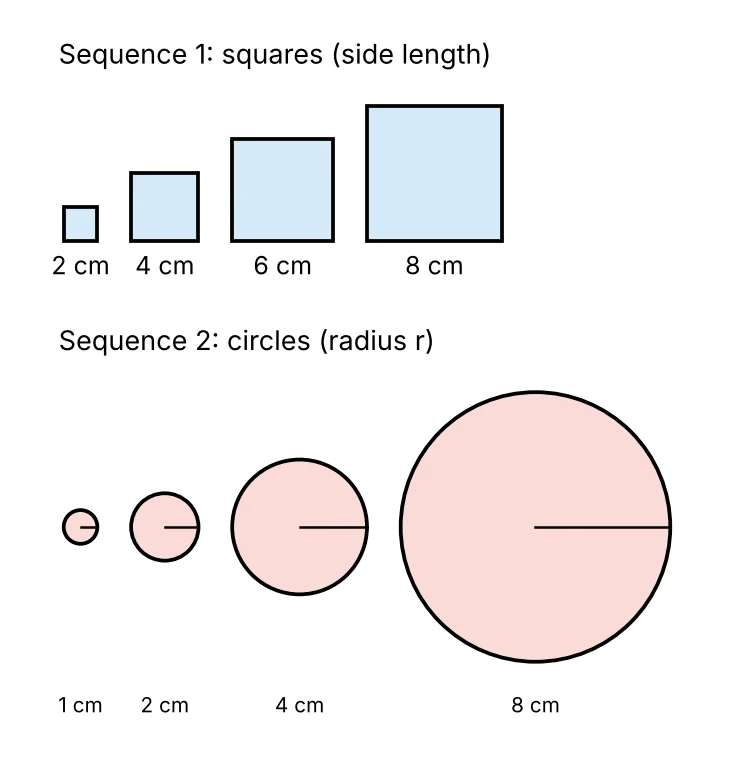
The diagram shows two sequences of shapes drawn to scale. Sequence 1 is made of squares and Sequence 2 is made of circles.
Question diagram
(a)
Calculate the common difference of the side lengths of the squares. [1]Criterion A (ii) · Level 1-2
(b)
Calculate the common ratio of the radii of the circles. [1]Criterion A (ii) · Level 1-2
(c)
Use the picture to explain which sequence adds the same amount each time and which multiplies by the same amount each time. [1]Criterion C (ii) · Level 3-4

revisionprep.com

Summary Answer

Not available for this question.

Model Answer

Not available for this question.

Marking Scheme

Not available for this question.

Examiner Insights

Not available for this question.

Question 3Criterion A + C · Band 3-6 · Medium · 5 marksrevisionprep.com

Arithmetic sequences and common differences
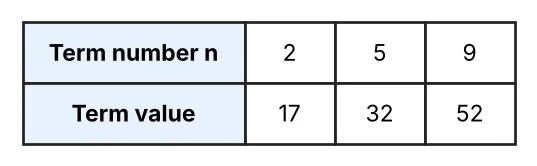
Some terms of an arithmetic sequence are shown in the table.
Question diagram
(a)
Show that the common difference between term 22 and term 55 is the same as between term 55 and term 99. [2]Criterion A (ii) · Level 3-4
(b)
Calculate the first term. [1]Criterion A (ii) · Level 3-4
(c)
A student says that the 12th term is 7070. Justify whether the student is correct. [2]Criterion C (iii) · Level 5-6

revisionprep.com

Summary Answer

Not available for this question.

Model Answer

Not available for this question.

Marking Scheme

Not available for this question.

Examiner Insights

Not available for this question.

Question 4Criterion B + C · Band 3-6 · Medium · 6 marksrevisionprep.com

Recognising geometric sequences

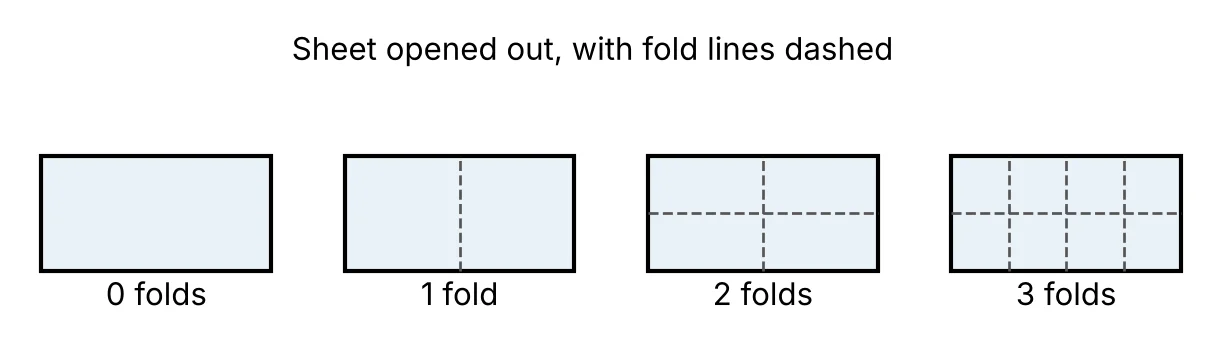
A sheet of paper is folded in half again and again. When the sheet is opened out, the fold lines make rectangles. The diagram shows the opened sheet after 00, 11, 22 and 33 folds. The numbers of rectangles are

Number of folds: 0, 1, 2, 30,\ 1,\ 2,\ 3
Number of rectangles: 1, 2, 4, 81,\ 2,\ 4,\ 8
Question diagram
(a)
Calculate the number of rectangles after 1010 folds. Show your working. [2]Criterion B (i) · Level 3-4
(b)
Write a formula for tnt_n, the number of rectangles after nn folds. Explain why your formula fits the sequence. [2]Criterion B (ii) · Level 5-6
(c)
A student says the number of rectangles first goes above 100100 after 66 folds. Analyse the values to decide whether the student is correct. [2]Criterion C (iii) · Level 5-6

revisionprep.com

Summary Answer

Not available for this question.

Model Answer

Not available for this question.

Marking Scheme

Not available for this question.

Examiner Insights

Not available for this question.

Question 5Criterion D · Band 3-8 · Challenge · 8 marksrevisionprep.com

Arithmetic sequences and common differences
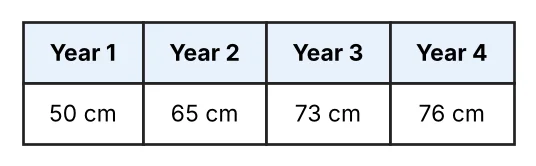
A gardener measures a young tree. In Year 1 it is 5050 cm tall. The gardener models the height by adding 1515 cm each year, which gives an arithmetic sequence. The measured heights are shown in the table.
Question diagram
(a)
Use the model to calculate the predicted height in Year 55. [2]Criterion D (iii) · Level 3-4
(b)
Calculate the difference in the measured height between each pair of years. Explain what these differences tell you about how well the model fits. [3]Criterion D (iv) · Level 5-6
(c)
Explain one limitation of using an arithmetic sequence to predict the height of a tree over many years. Use the measured heights to support your answer. [3]Criterion D (v) · Level 7-8

revisionprep.com

Summary Answer

Not available for this question.

Model Answer

Not available for this question.

Marking Scheme

Not available for this question.

Examiner Insights

Not available for this question.

Question 6Criterion C + A · Band 3-6 · Challenge · 8 marksrevisionprep.com

Recognising geometric sequences

A student looks at the sequence 7, 14, 28, 567,\ 14,\ 28,\ 56 and says: "It must be arithmetic because the terms go up every time."
(a)
Calculate the differences between terms next to each other. Explain what they tell you about whether the sequence is arithmetic. [2]Criterion A (ii) · Level 3-4
(b)
Calculate the ratios between terms next to each other. Justify whether the sequence is geometric. [2]Criterion C (iii) · Level 3-4
(c)
A new sequence starts at 55 and has the same common ratio. Write a formula for the nnth term. [2]Criterion A (ii) · Level 5-6
(d)
Use your formula to calculate the 4th term. Check your answer by multiplying by the ratio. [2]Criterion C (iv) · Level 5-6

revisionprep.com

Summary Answer

Not available for this question.

Model Answer

Not available for this question.

Marking Scheme

Not available for this question.

Examiner Insights

Not available for this question.

That's every free question here — 6 of 67.

+61 more questions, plus Mock Papers & Worksheets, are waiting in Premium.

Upgrade