You're viewing free preview questions — 6 questions previewing here — subscribe to unlock 60 more, plus the Full Question Bank, Mock Papers & Worksheets.Upgrade
Back

Number patterns and sequences — Free MYP3 Mathematics Practice Questions

Free questions

Open in full, with answers, mark scheme and examiner insights.

Question 1Criterion A · Band 3-4 · Easy · 4 marksrevisionprep.com

Identifying patterns in number series

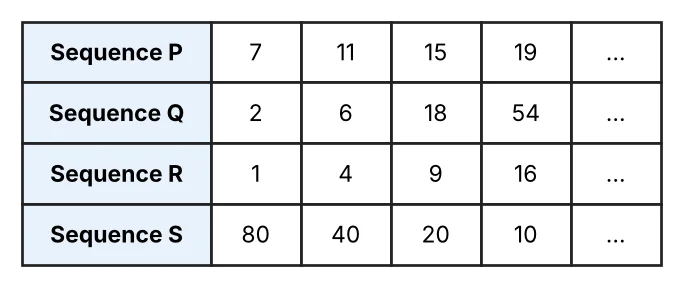
Four sequences are shown in the table.
Question diagram
(a)
Each sequence is arithmetic (add the same number each time), geometric (multiply by the same number each time) or neither. Classify each sequence. [2]Criterion A (i) · Level 3-4
(b)
Write down the next term of sequence R and the next term of sequence S. [2]Criterion A (ii) · Level 3-4

revisionprep.com

Summary Answer

Not available for this question.

Model Answer

Not available for this question.

Marking Scheme

Not available for this question.

Examiner Insights

Not available for this question.

Question 2Criterion A · Band 1-6 · Easy · 3 marksrevisionprep.com

Finding the next term in a sequence

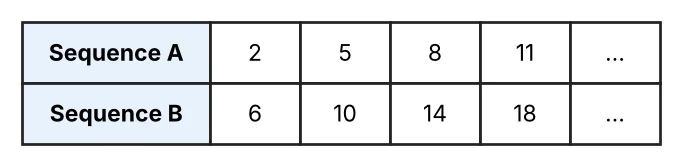
Two arithmetic sequences are shown in the table.
Question diagram
(a)
Write down the common difference of each sequence. [1]Criterion A (i) · Level 1-2
(b)
Calculate the 10th term of each sequence. [1]Criterion A (ii) · Level 3-4
(c)
Both sequences have 50 as a term. Find which sequence reaches 50 first by comparing the term numbers. [1]Criterion A (iii) · Level 5-6

revisionprep.com

Summary Answer

Not available for this question.

Model Answer

Not available for this question.

Marking Scheme

Not available for this question.

Examiner Insights

Not available for this question.

Question 3Criterion B · Band 3-6 · Medium · 4 marksrevisionprep.com

Identifying patterns in number series

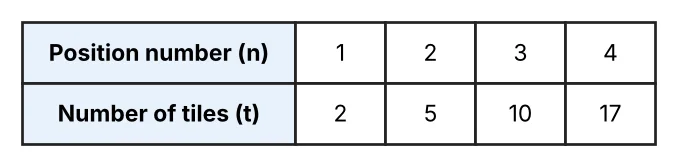
A tile pattern is described by this table.
Question diagram
(a)
Write down the difference between each pair of next-door values of tt. [1]Criterion B (i) · Level 3-4
(b)
Explain why this is not a linear pattern (not adding the same amount each time). [1]Criterion B (ii) · Level 3-4
(c)
The differences go up by the same amount each time. Use this to explain what kind of pattern it is, and show that n2+1n^2+1 fits all four terms. [2]Criterion B (iii) · Level 5-6

revisionprep.com

Summary Answer

Not available for this question.

Model Answer

Not available for this question.

Marking Scheme

Not available for this question.

Examiner Insights

Not available for this question.

Question 4Criterion C · Band 1-6 · Medium · 4 marksrevisionprep.com

Generating terms from a position-to-term rule

Sam and Mia each write a position-to-term rule for the same sequence. Sam writes 2(n+3)2(n+3). Mia writes 2n+62n+6.
(a)
Use Sam's rule to calculate the first four terms. [1]Criterion C (ii) · Level 1-2
(b)
Use Mia's rule to calculate the first four terms. [1]Criterion C (ii) · Level 1-2
(c)
Show algebraically that the two rules always give the same term. [2]Criterion C (iii) · Level 5-6

revisionprep.com

Summary Answer

Not available for this question.

Model Answer

Not available for this question.

Marking Scheme

Not available for this question.

Examiner Insights

Not available for this question.

Question 5Criterion A · Band 3-8 · Challenge · 5 marksrevisionprep.com

Creating patterns using rules

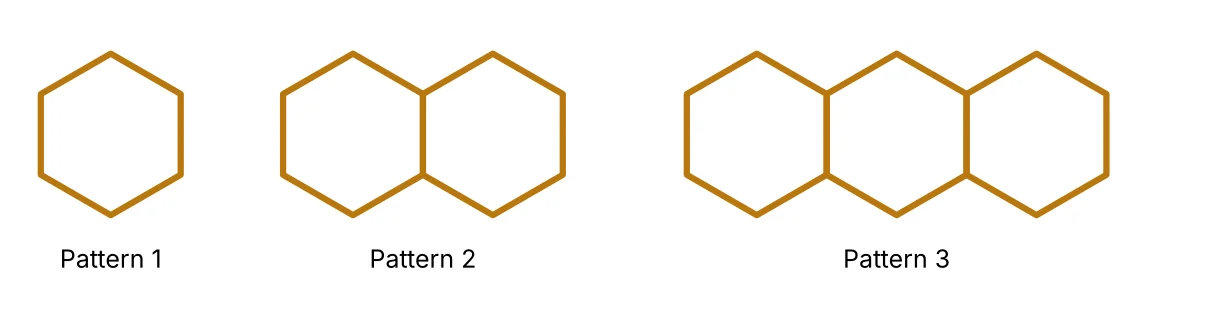
The diagram shows a pattern of hexagons made from matchsticks. Pattern 1 uses 6 matchsticks, Pattern 2 uses 11 matchsticks and Pattern 3 uses 16 matchsticks. Each new hexagon shares one side with the one before it.
Question diagram
(a)
Find the common difference and use it to write a formula for the number of matchsticks MM in Pattern nn. [2]Criterion A (i) · Level 5-6
(b)
Use your formula to find the number of matchsticks in Pattern 10. [1]Criterion A (ii) · Level 3-4
(c)
A student says they can use exactly 100 matchsticks to make a complete pattern. Justify whether this is correct. [2]Criterion A (iii) · Level 7-8

revisionprep.com

Summary Answer

Not available for this question.

Model Answer

Not available for this question.

Marking Scheme

Not available for this question.

Examiner Insights

Not available for this question.

Question 6Criterion D · Band 3-8 · Challenge · 8 marksrevisionprep.com

Describing patterns using words and symbols
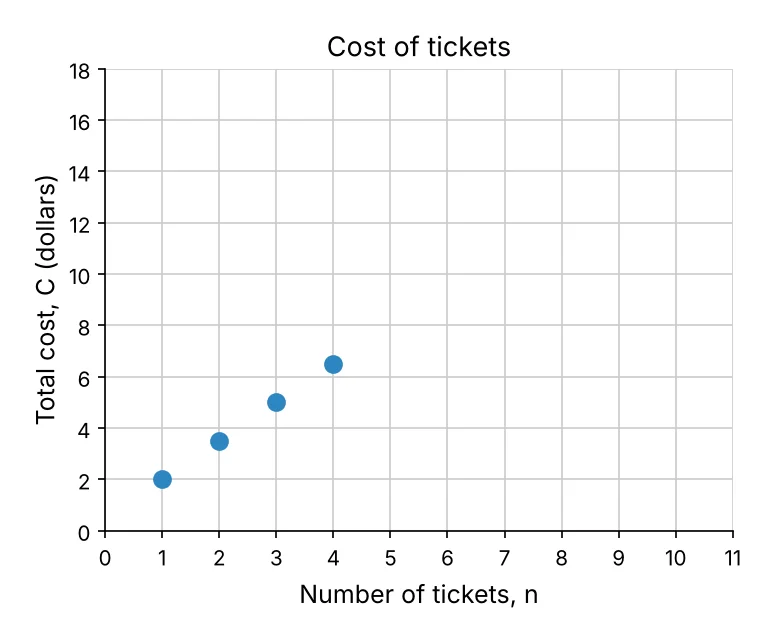
A school fundraiser sells tickets. The cost of 1 ticket is 2.00 dollars, 2 tickets cost 3.50 dollars, 3 tickets cost 5.00 dollars and 4 tickets cost 6.50 dollars. The graph shows these points.
Question diagram
(a)
Find a formula for the total cost CC dollars for nn tickets. Show your working. [2]Criterion D (ii) · Level 3-4
(b)
Use your formula to calculate the cost of 10 tickets. Show the substitution. [2]Criterion D (iii) · Level 3-4
(c)
A class of 30 students each wants one ticket. Explain one limit of the straight-line pricing for a big purchase like this, and suggest one change that would be more realistic. [4]Criterion D (v) · Level 7-8

revisionprep.com

Summary Answer

Not available for this question.

Model Answer

Not available for this question.

Marking Scheme

Not available for this question.

Examiner Insights

Not available for this question.

That's every free question here — 6 of 66.

+60 more questions, plus Mock Papers & Worksheets, are waiting in Premium.

Upgrade