You're viewing free preview questions — 6 questions previewing here — subscribe to unlock 48 more, plus the Full Question Bank, Mock Papers & Worksheets.Upgrade
Back

Pattern recognition in real life — Free MYP3 Mathematics Practice Questions

Free questions

Open in full, with answers, mark scheme and examiner insights.

Question 1Criterion A · Band 1-4 · Easy · 2 marksrevisionprep.com

Patterns in nature and architecture

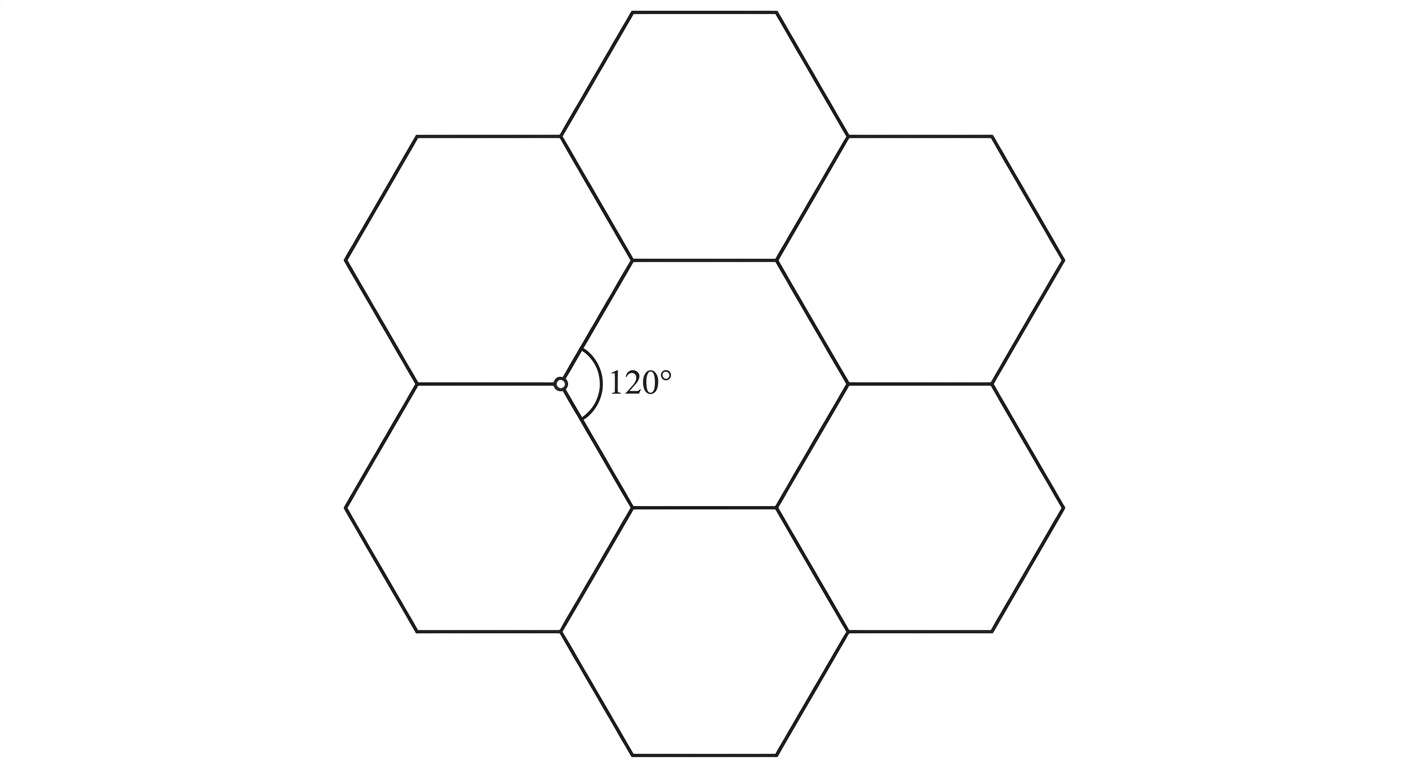
Bees build honeycombs from cells shaped like regular hexagons. In a regular hexagon all the sides are equal and all the angles are equal. The picture shows some cells.
Question diagram
(a)
State the number of sides of a regular hexagon. [1]Criterion A (i) · Level 1-2
(b)
Each angle of a regular hexagon is 120∘120^\circ. Explain why hexagon cells fit together with no gaps. [1]Criterion A (iii) · Level 3-4

revisionprep.com

Summary Answer

Not available for this question.

Model Answer

Not available for this question.

Marking Scheme

Not available for this question.

Examiner Insights

Not available for this question.

Question 2Criterion A · Band 1-2 · Easy · 2 marksrevisionprep.com

Cultural patterns in art and design

The diagram shows an eight-pointed star. Stars like this are often used in Islamic art.
Question diagram
(a)
Calculate the smallest angle that the star can turn about its centre so that it looks the same. [1]Criterion A (ii) · Level 1-2
(b)
State the order of rotational symmetry of the star. [1]Criterion A (i) · Level 1-2

revisionprep.com

Summary Answer

Not available for this question.

Model Answer

Not available for this question.

Marking Scheme

Not available for this question.

Examiner Insights

Not available for this question.

Question 3Criterion D · Band 1-4 · Medium · 2 marksrevisionprep.com

Patterns in calendar and time systems

A community centre plans an event every 44 years on 2929 February. The leap years are 20242024, 20282028, 20322032 and 20362036.
(a)
State the next leap year after 20362036. [1]Criterion D (iii) · Level 1-2
(b)
Explain one limitation of using the rule "every 44 years" to plan this event far into the future. [1]Criterion D (iv) · Level 3-4

revisionprep.com

Summary Answer

Not available for this question.

Model Answer

Not available for this question.

Marking Scheme

Not available for this question.

Examiner Insights

Not available for this question.

Question 4Criterion C + A · Band 3-6 · Medium · 6 marksrevisionprep.com

Analysing and explaining real-world patterns
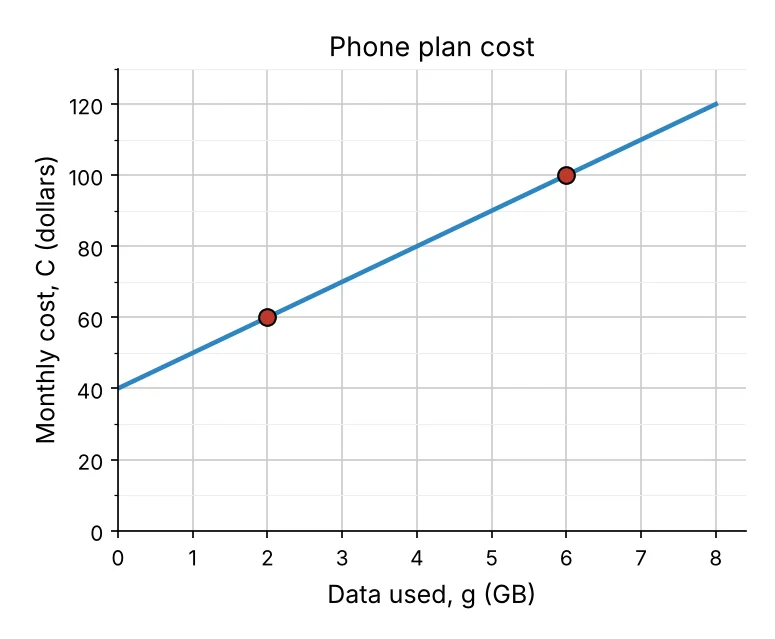
A phone plan has a fixed fee each month plus a cost for each GB of data used. The graph shows the total cost, CC dollars, for gg GB of data. The two marked points on the line are at (2,60)(2, 60) and (6,100)(6, 100).
Question diagram
(a)
Calculate how much the cost rises for each extra GB of data. [1]Criterion A (ii) · Level 3-4
(b)
Read the cost on the graph when g=0g=0. Explain what this value and the answer to part (a) each mean for this plan. [3]Criterion C (iii) · Level 5-6
(c)
A customer says: "Using 1010 GB costs less than twice as much as using 22 GB." Analyse whether the customer is correct. [2]Criterion C (iv) · Level 5-6

revisionprep.com

Summary Answer

Not available for this question.

Model Answer

Not available for this question.

Marking Scheme

Not available for this question.

Examiner Insights

Not available for this question.

Question 5Criterion B · Band 3-6 · Challenge · 6 marksrevisionprep.com

Patterns in nature and architecture

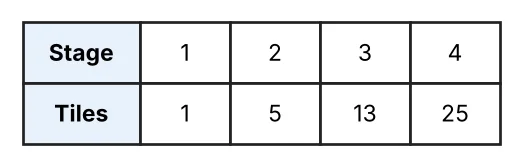
Mia builds a spiral from square tiles. The number of tiles at each stage is shown in the table.
Question diagram
(a)
Calculate the first differences and the second differences of the number of tiles. [2]Criterion B (i) · Level 3-4
(b)
Use the differences to predict the number of tiles at stage 55. Explain your method. [2]Criterion B (ii) · Level 5-6
(c)
Mia says the number of tiles at stage nn is 2n2−2n+12n^2-2n+1. Check her rule for stages 33 and 44, then use it to find the number of tiles at stage 1010. [2]Criterion B (iii) · Level 5-6

revisionprep.com

Summary Answer

Not available for this question.

Model Answer

Not available for this question.

Marking Scheme

Not available for this question.

Examiner Insights

Not available for this question.

Question 6Criterion B · Band 3-6 · Challenge · 6 marksrevisionprep.com

Patterns in music and rhythm

A musician claps a pattern of numbers:

1, 2, 1, 3, 1, 2, 1, 3, 1, 2, 1, 3, …1,\ 2,\ 1,\ 3,\ 1,\ 2,\ 1,\ 3,\ 1,\ 2,\ 1,\ 3,\ \dots
(a)
Describe the rule that makes this pattern. [2]Criterion B (ii) · Level 3-4
(b)
Find the value of the 2020th clap and the value of the 3131st clap. Show your working. [2]Criterion B (i) · Level 3-4
(c)
A second musician says: "Every clap in an odd-numbered position has the value 11." Use the pattern to decide whether this is correct. [2]Criterion B (iii) · Level 5-6

revisionprep.com

Summary Answer

Not available for this question.

Model Answer

Not available for this question.

Marking Scheme

Not available for this question.

Examiner Insights

Not available for this question.

That's every free question here — 6 of 54.

+48 more questions, plus Mock Papers & Worksheets, are waiting in Premium.

Upgrade