You're viewing free preview questions — 6 questions previewing here — subscribe to unlock 69 more, plus the Full Question Bank, Mock Papers & Worksheets.Upgrade
Back

Introduction to probability and probability scale — Free MYP3 Mathematics Practice Questions

Free questions

Open in full, with answers, mark scheme and examiner insights.

Question 1Criterion A · Band 1-2 · Easy · 2 marksrevisionprep.com

Understanding probability as a measure
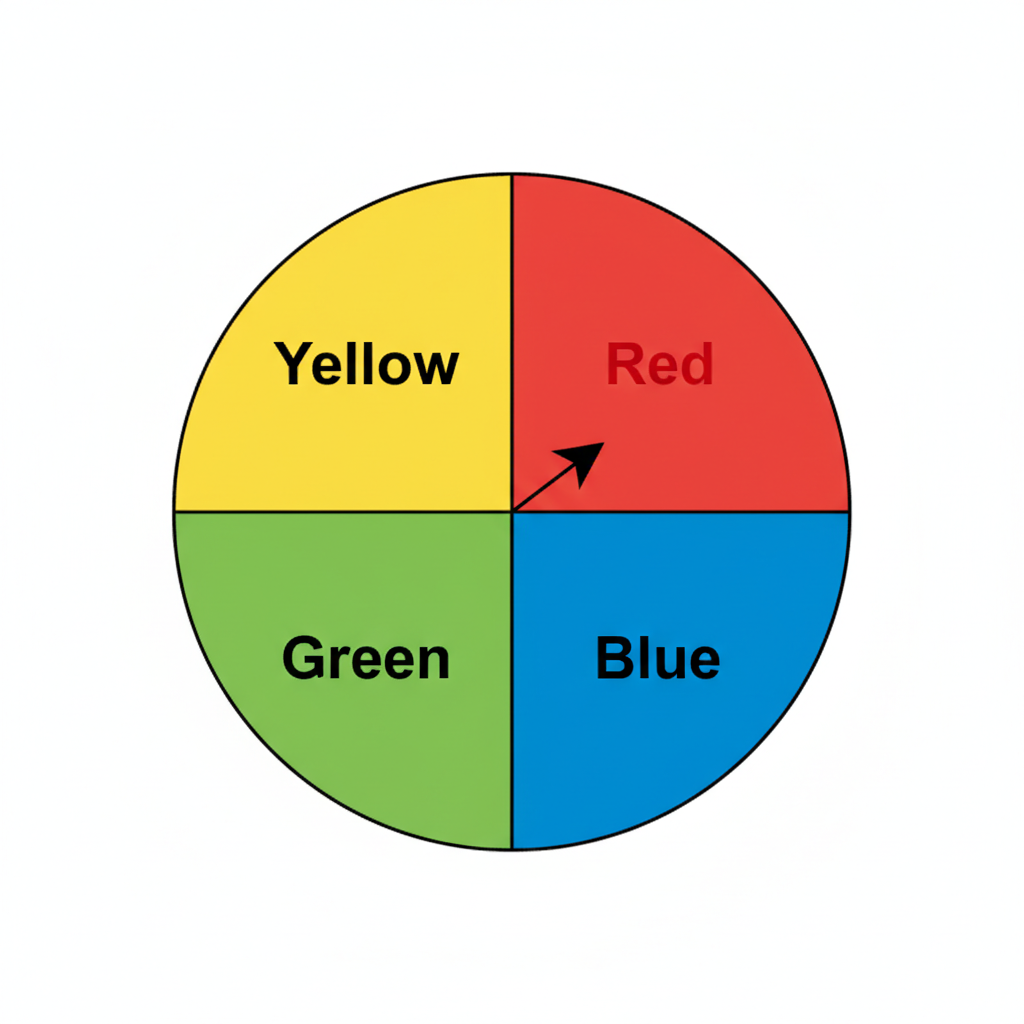
A spinner has 4 equal sectors: red, blue, green and yellow. It is spun once.
Question diagram
(a)
Calculate the probability of landing on blue. Give your answer as a fraction. [1]Criterion A (ii) · Level 1-2
(b)
Explain why the probability of landing on red is the same as the probability of landing on blue. [1]Criterion A (i) · Level 1-2

revisionprep.com

Summary Answer

Not available for this question.

Model Answer

Not available for this question.

Marking Scheme

Not available for this question.

Examiner Insights

Not available for this question.

Question 2Criterion A · Band 1-2 · Easy · 2 marksrevisionprep.com

Describing events as likely or unlikely
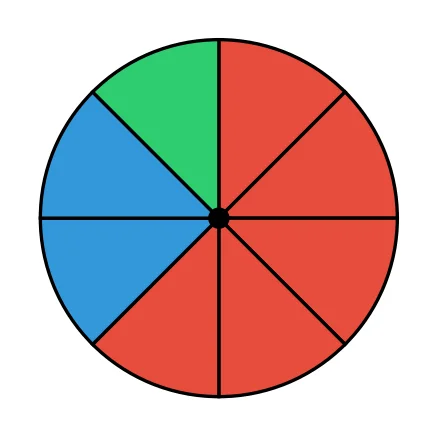
A spinner has 8 equal sections: 5 red, 2 blue and 1 green. It is spun once.
Question diagram
(a)
Calculate the probability of landing on red. [1]Criterion A (ii) · Level 1-2
(b)
Is landing on red likely or unlikely? Give a reason. [1]Criterion A (i) · Level 1-2

revisionprep.com

Summary Answer

Not available for this question.

Model Answer

Not available for this question.

Marking Scheme

Not available for this question.

Examiner Insights

Not available for this question.

Question 3Criterion D · Band 1-6 · Medium · 6 marksrevisionprep.com

Understanding probability as a measure

A game uses a bag of 10 tiles: 4 gold tiles and 6 silver tiles. Sam wins if a gold tile is taken. Tara wins if a silver tile is taken. One tile is taken without looking.
(a)
Calculate the probability that Sam wins. Give your answer in its simplest form. [1]Criterion D (iii) · Level 1-2
(b)
A game is fair if both players have the same chance of winning. Explain why this game is not fair. [2]Criterion D (v) · Level 3-4
(c)
Change one silver tile into a gold tile. Show that the game is now fair. [2]Criterion D (iii) · Level 3-4
(d)
Sam wants a game where he wins with probability 710\dfrac{7}{10} using the same 1010 tiles. State how many gold tiles he needs. [1]Criterion D (ii) · Level 5-6

revisionprep.com

Summary Answer

Not available for this question.

Model Answer

Not available for this question.

Marking Scheme

Not available for this question.

Examiner Insights

Not available for this question.

Question 4Criterion C + A · Band 1-6 · Medium · 6 marksrevisionprep.com

Identifying impossible and certain events

A fair die has faces 1, 2, 3, 4, 5 and 6. It is rolled once.

A: The die lands on 7.

B: The die lands on a number less than 7.

C: The die lands on an even number.
(a)
Say whether each event is impossible, certain or neither. [2]Criterion A (ii) · Level 1-2
(b)
Use the list of faces 1,2,3,4,5,61, 2, 3, 4, 5, 6 to explain your answers to part (a). [2]Criterion C (iii) · Level 3-4
(c)
Mia says: 'If I roll the die 100 times, I will definitely roll a 6.' Explain whether this is certain. [2]Criterion C (iii) · Level 5-6

revisionprep.com

Summary Answer

Not available for this question.

Model Answer

Not available for this question.

Marking Scheme

Not available for this question.

Examiner Insights

Not available for this question.

Question 5Criterion A + C · Band 3-6 · Challenge · 8 marksrevisionprep.com

Probability scale from 0 to 1

A spinner has four sectors, A, B, C and D. It is spun 40 times.

A: 16 times, B: 12 times, C: 8 times, D: 4 times
(a)
Calculate the relative frequency of each letter as a decimal. [2]Criterion A (ii) · Level 3-4
(b)
Use the relative frequencies to design a spinner. Calculate the angle of each sector, and show that your angles add up to a full turn. [3]Criterion A (iii) · Level 5-6
(c)
Chen says: 'C came up 8 times in 40 spins, so in 100 spins it will come up 16 times.' Explain his mistake and give a better prediction. [3]Criterion C (iii) · Level 5-6

revisionprep.com

Summary Answer

Not available for this question.

Model Answer

Not available for this question.

Marking Scheme

Not available for this question.

Examiner Insights

Not available for this question.

Question 6Criterion B · Band 3-8 · Challenge · 9 marksrevisionprep.com

The language of probability: certain, likely, unlikely, impossible
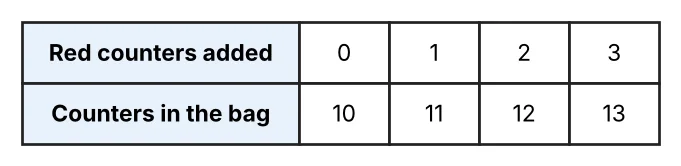
A bag has 2 red counters and 8 blue counters. Tom adds red counters to the bag one at a time. After each one he finds the probability of taking a red counter. The table shows how many counters are in the bag.
Question diagram
(a)
Write the probability of taking a red counter after Tom has added 1 red counter and after he has added 2. Give each answer in its simplest form. [2]Criterion B (i) · Level 3-4
(b)
The probabilities are 15\dfrac{1}{5}, 311\dfrac{3}{11}, 13\dfrac{1}{3} and 513\dfrac{5}{13}. Describe what happens to the probability of taking a red counter each time a red counter is added. [2]Criterion B (ii) · Level 3-4
(c)
Find how many red counters Tom must add so that the probability of red is exactly 12\dfrac{1}{2}. Show that your answer works. [2]Criterion B (iii) · Level 5-6
(d)
Explain why the probability of red can never reach 11, however many red counters Tom adds. [1]

(e) Tom adds rr red counters. Write a formula for the probability of taking a red counter in terms of rr. Use it to find how many red counters he must add for the probability to be 34\dfrac{3}{4}. [2]
Criterion B (iii) · Level 5-6

revisionprep.com

Summary Answer

Not available for this question.

Model Answer

Not available for this question.

Marking Scheme

Not available for this question.

Examiner Insights

Not available for this question.

That's every free question here — 6 of 75.

+69 more questions, plus Mock Papers & Worksheets, are waiting in Premium.

Upgrade