You're viewing free preview questions — 4 questions previewing here — subscribe to unlock 51 more, plus the Full Question Bank, Mock Papers & Worksheets.Upgrade
Listing Outcomes Sample Space Diagrams — Free MYP3 Mathematics Practice Questions

1QuestionCounting Outcomes for Combined EventsConcept Practice
2 marks~3 minCriterion A
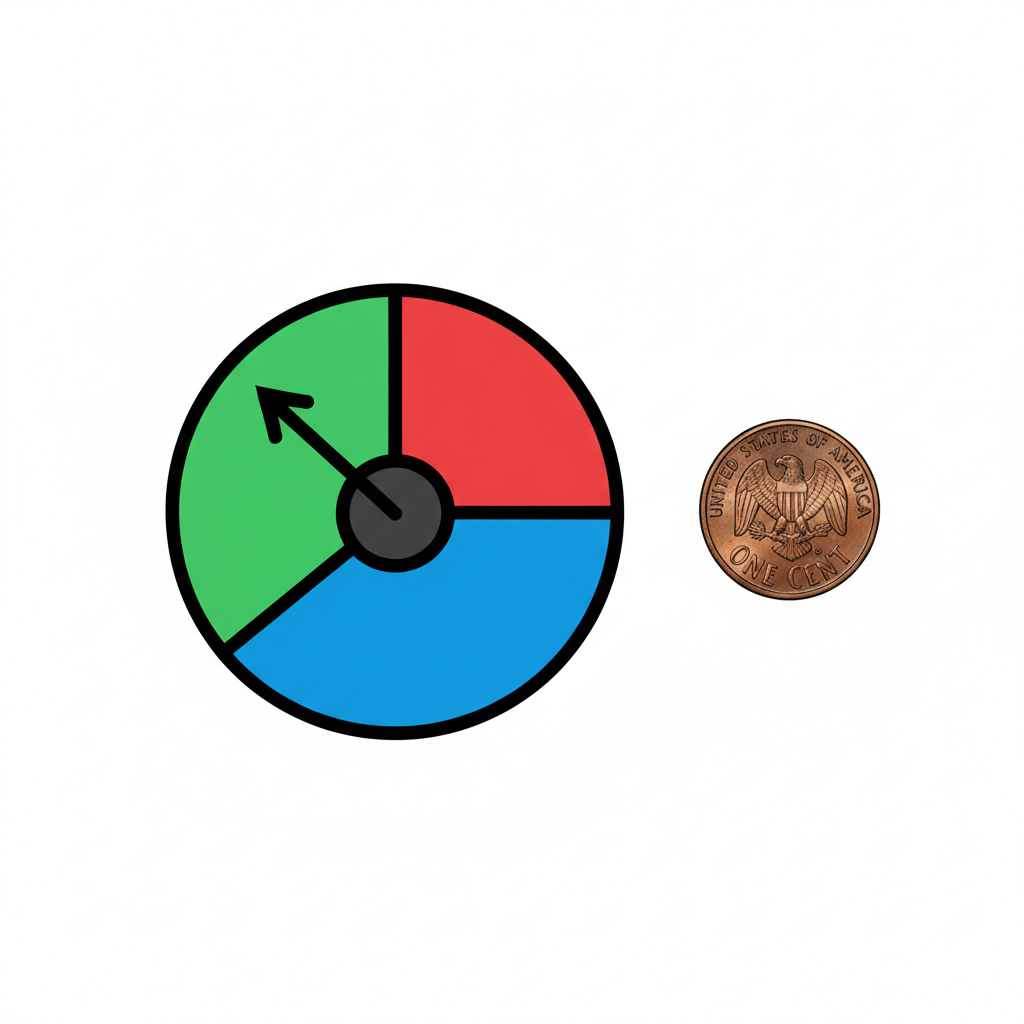
A spinner has three equal sections labelled red, blue, and green. A fair coin is tossed at the same time as the spinner is spun.
List all possible combined outcomes of this experiment. Write each outcome as an ordered pair in the format . [2]
List all possible combined outcomes of this experiment. Write each outcome as an ordered pair in the format . [2]

Solutions
2QuestionDrawing Sample Space DiagramsAssessment Practice
2 marks~3 minCriterion D
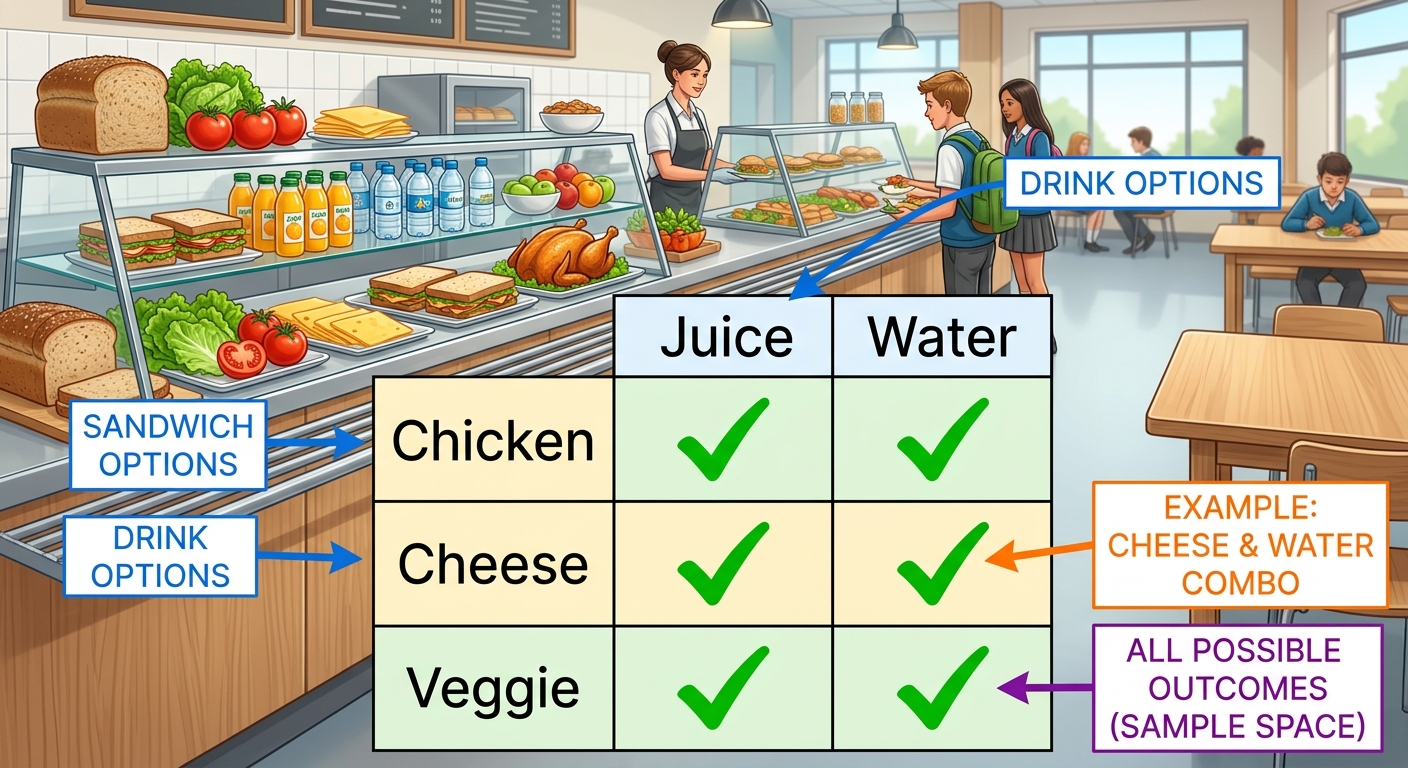
A school canteen offers three sandwiches (chicken, cheese, veggie) and two drinks (juice, water). A sample space diagram is drawn to show all possible lunch combinations.
Explain one real-world limitation of using a sample space diagram to represent the lunch combinations a student might actually choose. [2]
Explain one real-world limitation of using a sample space diagram to represent the lunch combinations a student might actually choose. [2]
Solutions
3QuestionCounting Outcomes for Combined EventsConcept Practice
5 marks~8 minCriterion B
A student investigates outcomes for two independent events.
Event X has 2, 3, or 4 choices. Event Y has 3, 4, or 5 choices. The combined outcomes for each matching pair are 6, 12, and 20 respectively.
Event X has 2, 3, or 4 choices. Event Y has 3, 4, or 5 choices. The combined outcomes for each matching pair are 6, 12, and 20 respectively.
a
Calculate the total outcomes for each pair as a product of the two numbers of choices. [1]
b
Explain how the pattern from part (a) leads to a general formula for the total number of outcomes when Event X has choices and Event Y has choices. [2]
c
A spinner has 4 equal sections and a die has 6 faces. Apply your formula to find the total number of outcomes when both are spun or rolled together. Justify whether this total is greater than, equal to, or less than 30. [2]
Solutions
4QuestionCounting Outcomes for Combined EventsAssessment Practice
6 marks~9 minCriterion C
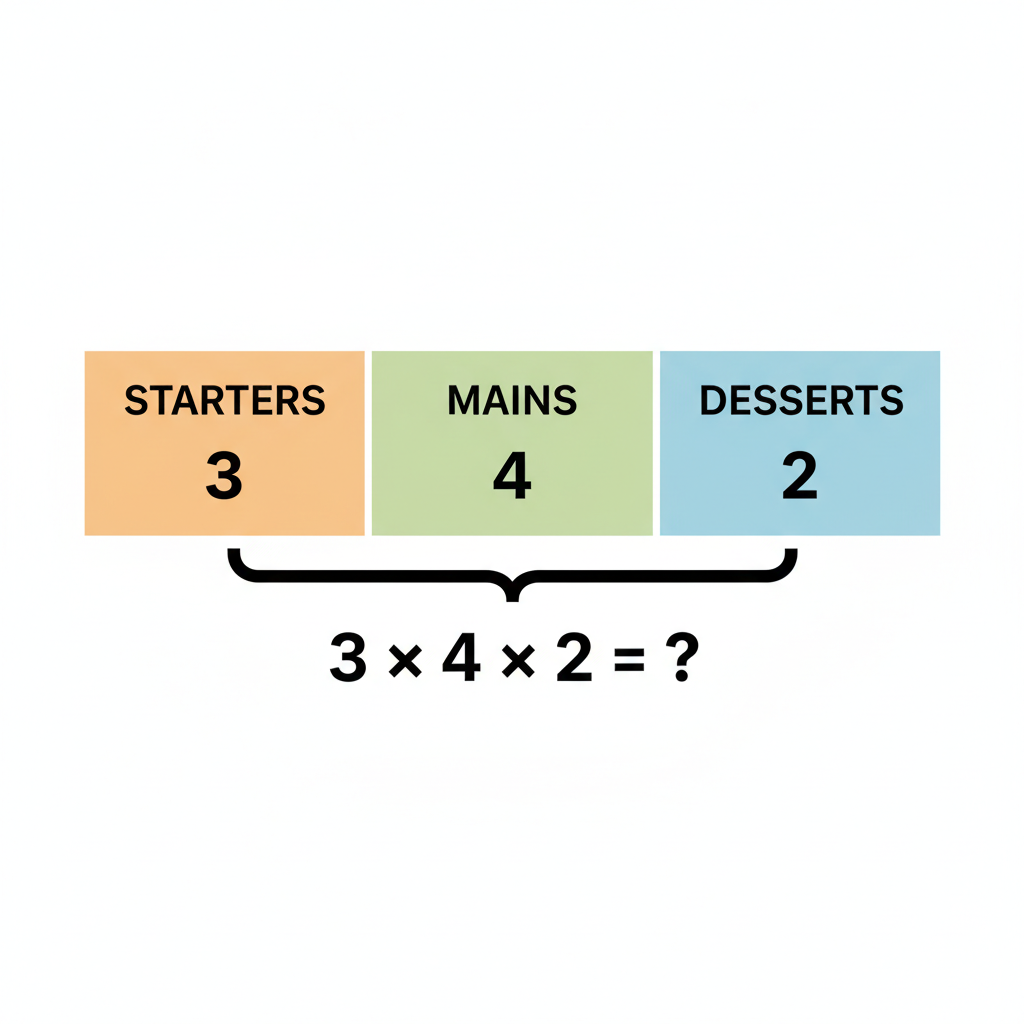
A restaurant offers 3 starters, 4 mains, and 2 desserts. A three-course meal consists of one choice from each course.
a
Calculate the total number of different three-course meals possible. [2]
b
The chef removes 2 starters and 1 main from the menu. Calculate the number of different three-course meals now available. [2]
c
A customer claims the multiplication principle always gives the correct number of meal combinations. Analyse this claim, using the results from parts (a) and (b) to support your reasoning. [2]
Solutions
That's every free question here — 4 of 55.
+51 more questions, plus Mock Papers & Worksheets, are waiting in Premium.