You're viewing free preview questions — 4 questions previewing here — subscribe to unlock 65 more, plus the Full Question Bank, Mock Papers & Worksheets.Upgrade
Single and Combined Events — Free MYP3 Mathematics Practice Questions

1QuestionCalculating Combined Probabilities BasicConcept Practice
2 marks~3 minCriterion A
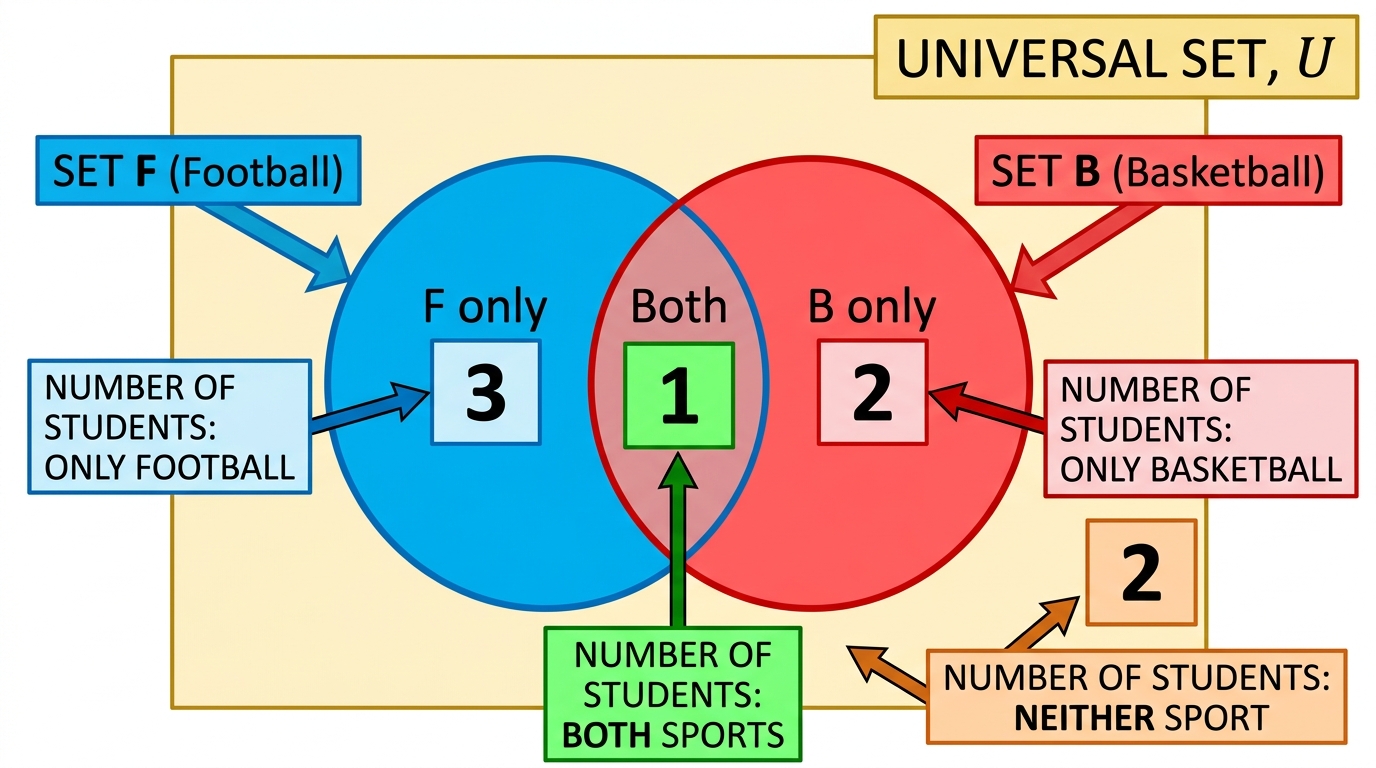
A class of 8 students was surveyed about the sports they play. The Venn diagram shows Set (football) and Set (basketball): 3 students play only football, 2 play only basketball, 1 plays both, and 2 play neither.
a
Calculate the probability that a randomly selected student plays both football and basketball. Express your answer as a fraction in its simplest form. [1]
b
A student is chosen at random. Given that the student plays at least one sport, calculate the probability that they play football. Express your answer as a fraction in its simplest form. [1]

Solutions
2QuestionCalculating Combined Probabilities BasicAssessment Practice
6 marks~9 minCriterion D
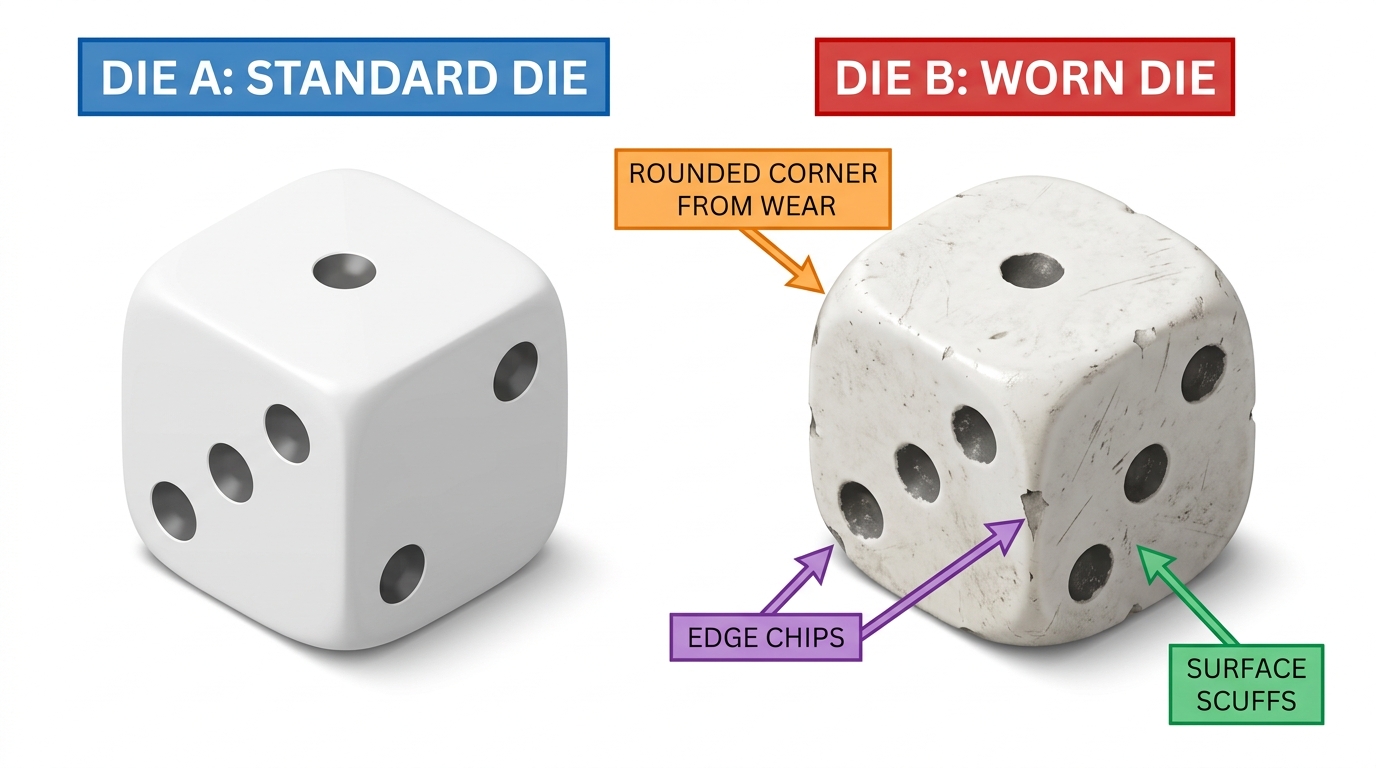
A board game designer claims the probability of rolling a 6 twice in a row on a fair die is . A player suspects their die may be unbalanced from manufacturing or use.
a
Calculate the theoretical probability of rolling two 6s in a row on a fair die. [2]
b
Explain how one manufacturing defect and one type of wear could each cause the actual probability to differ from . [2]
c
The designer tests the die by rolling it 360 times. The number 6 appears 75 times. Analyse whether this result supports or challenges the claim that the die is fair. [2]
Solutions
3QuestionProbability of a Single Event OccurringAssessment Practice
6 marks~9 minCriterion C
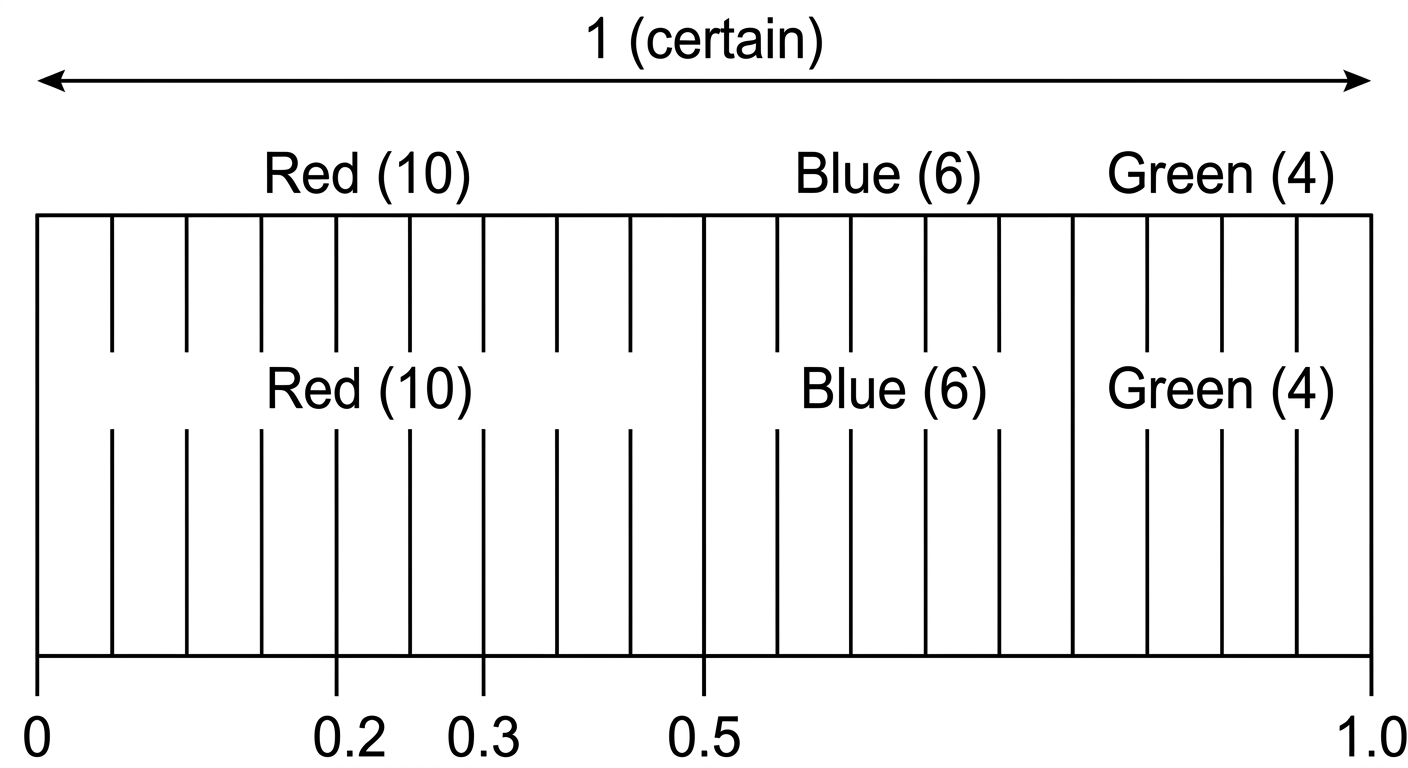
A bag contains 10 red, 6 blue, and 4 green marbles. A student claims: "Red is twice as likely as blue, and blue is 1.5 times as likely as green."
a
Calculate the probability of selecting each colour. Express each as a fraction in simplest form, a decimal, and a percentage. [2]
b
Explain how a bar model or probability scale showing all three probabilities supports or challenges the student's claim. [2]
c
Justify whether the student's claim is correct by testing each part mathematically. [2]
Solutions
4QuestionCalculating Combined Probabilities BasicAssessment Practice
5 marks~8 minCriterion B
A game uses two spinners. Spinner X has 3 equal sections labelled A, B, and C. Spinner Y has 2 equal sections labelled 1 and 2. Both spinners are spun at the same time, and all outcomes are equally likely.
a
List all possible outcomes when both spinners are spun together. [1]
b
Explain why the total number of outcomes can be found by multiplying the number of sections on each spinner, and write this as a rule using and . [2]
c
Spinner X is changed to one with 4 equal sections labelled A, B, C, and D. Spinner Y stays the same. Calculate the probability that the result is not (A, 1). [2]
Solutions
That's every free question here — 4 of 69.
+65 more questions, plus Mock Papers & Worksheets, are waiting in Premium.