You're viewing free preview questions — 6 questions previewing here — subscribe to unlock 77 more, plus the Full Question Bank, Mock Papers & Worksheets.Upgrade
Back

Levels of organisation — Free MYP3 Sciences Practice Questions

Free questions

Open in full, with answers, mark scheme and examiner insights.

Question 1Criterion B + C · Easy · 3 marksrevisionprep.com

Examples in humans and plants

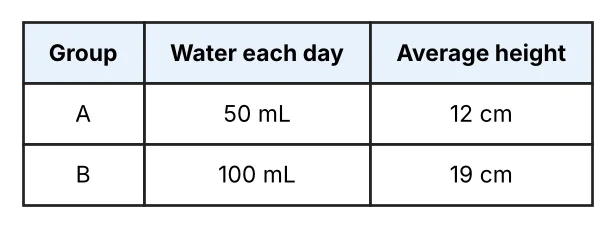
A student wants to know how the volume of water affects the height of bean plants. She plants ten bean seeds in pots of the same soil. Five plants get 50 mL of water each day and five get 100 mL. All the plants stand in the same place and get the same light. After two weeks she records the average height of each group. The values are shown in the table.
Question diagram
(a)
Identify the independent variable. [1]
(b)
Explain why the soil must be the same type in every pot. [1]
(c)
Interpret the results. State what conclusion she can draw, and one limit of the investigation. [1]

revisionprep.com

Summary Answer

Not available for this question.

Model Answer

Not available for this question.

Marking Scheme

Not available for this question.

Examiner Insights

Not available for this question.

Question 2Criterion A · Easy · 3 marksrevisionprep.com

Importance of structural organisation in biology
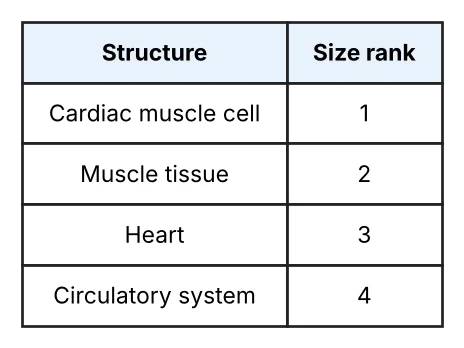
The table shows four structures in the human body. They are ranked by size, with 1 as the smallest.
Question diagram
(a)
Write the level of organisation of each of the four structures. [1]
(b)
Describe the pattern between the size rank and the level of organisation. [1]
(c)
A student says that removing the heart has no effect on the structures above it. Explain why this is wrong. [1]

revisionprep.com

Summary Answer

Not available for this question.

Model Answer

Not available for this question.

Marking Scheme

Not available for this question.

Examiner Insights

Not available for this question.

Question 3Criterion A · Medium · 4 marksrevisionprep.com

From cells to tissues, organs and systems
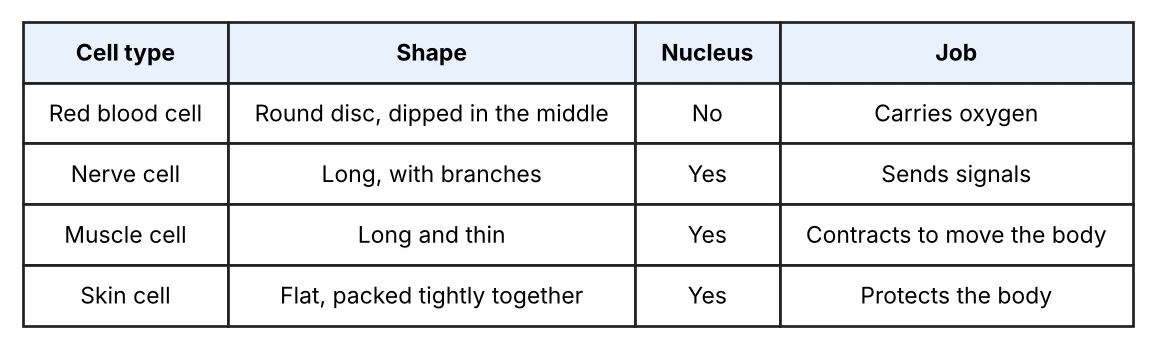
The table shows four types of human cell.
Question diagram
(a)
State one way the red blood cell is different from the other three cells. [1]
(b)
Explain how the shape of the nerve cell helps it to do its job. [1]
(c)
Choose the muscle cell or the skin cell. Use the table to explain how its shape helps it do its job. [2]

revisionprep.com

Summary Answer

Not available for this question.

Model Answer

Not available for this question.

Marking Scheme

Not available for this question.

Examiner Insights

Not available for this question.

Question 4Criterion A + C · Medium · 3 marksrevisionprep.com

Examples in humans and plants

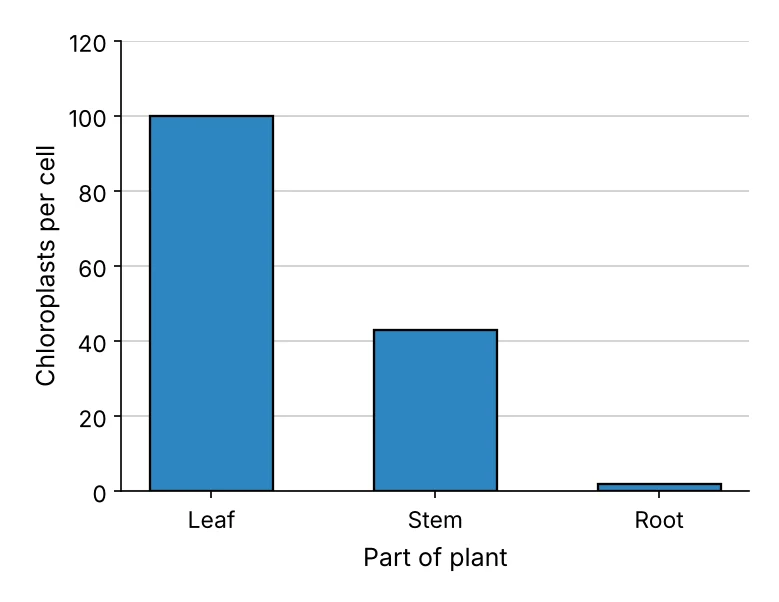
Chloroplasts are green parts of a plant cell. The bar chart shows the average number of chloroplasts per cell in three parts of a plant.
Question diagram
(a)
State what chloroplasts do in a plant cell. [1]
(b)
Explain why leaf cells have more chloroplasts than root cells. [1]
(c)
A student says that stem cells are partly able to photosynthesise. Use the graph to decide if the claim is supported. [1]

revisionprep.com

Summary Answer

Not available for this question.

Model Answer

Not available for this question.

Marking Scheme

Not available for this question.

Examiner Insights

Not available for this question.

Question 5Criterion D · Challenge · 8 marksrevisionprep.com

From cells to tissues, organs and systems

A hospital can grow a replacement organ from a patient's own stem cells. Stem cells are cells that can turn into many different types of cell. Each organ costs 500 000 dollars to make, and the hospital can treat at most 50 patients each year.
(a)
Describe one reason why it could be unfair if only patients who can pay get this treatment. [1]
(b)
Explain one ethical concern about growing human organs in a laboratory. [3]
(c)
A doctor says: Even if the cost fell, this technology might still not be used widely. Analyse one limit or risk, other than cost, that could stop it being used widely. [4]

revisionprep.com

Summary Answer

Not available for this question.

Model Answer

Not available for this question.

Marking Scheme

Not available for this question.

Examiner Insights

Not available for this question.

Question 6Criterion C + A · Challenge · 6 marksrevisionprep.com

Interdependence of levels

The data shows approximate values for three types of human cell.

- Muscle cell: mitochondria per cell 2000; energy released per second 8000 units
- Nerve cell: mitochondria per cell 500; energy released per second 2000 units
- Skin cell: mitochondria per cell 200; energy released per second 800 units
(a)
Calculate the energy released per second by one mitochondrion in each cell type. [2]
(b)
Use your results to explain why a muscle cell releases much more energy per second than a skin cell. [2]
(c)
Some mitochondria in a muscle cell stop working and only 1500 are left. Predict the energy released per second and describe the effect on a muscle. [2]

revisionprep.com

Summary Answer

Not available for this question.

Model Answer

Not available for this question.

Marking Scheme

Not available for this question.

Examiner Insights

Not available for this question.

That's every free question here — 6 of 83.

+77 more questions, plus Mock Papers & Worksheets, are waiting in Premium.

Upgrade