You're viewing free preview questions — 4 questions previewing here — subscribe to unlock 76 more, plus the Full Question Bank, Mock Papers & Worksheets.Upgrade
Unicellular vs Multicellular Organisms — Free MYP3 Sciences Practice Questions

1QuestionAdvantages and Limitations of UnicellularityConcept Practice
2 marks~3 minCriterion A
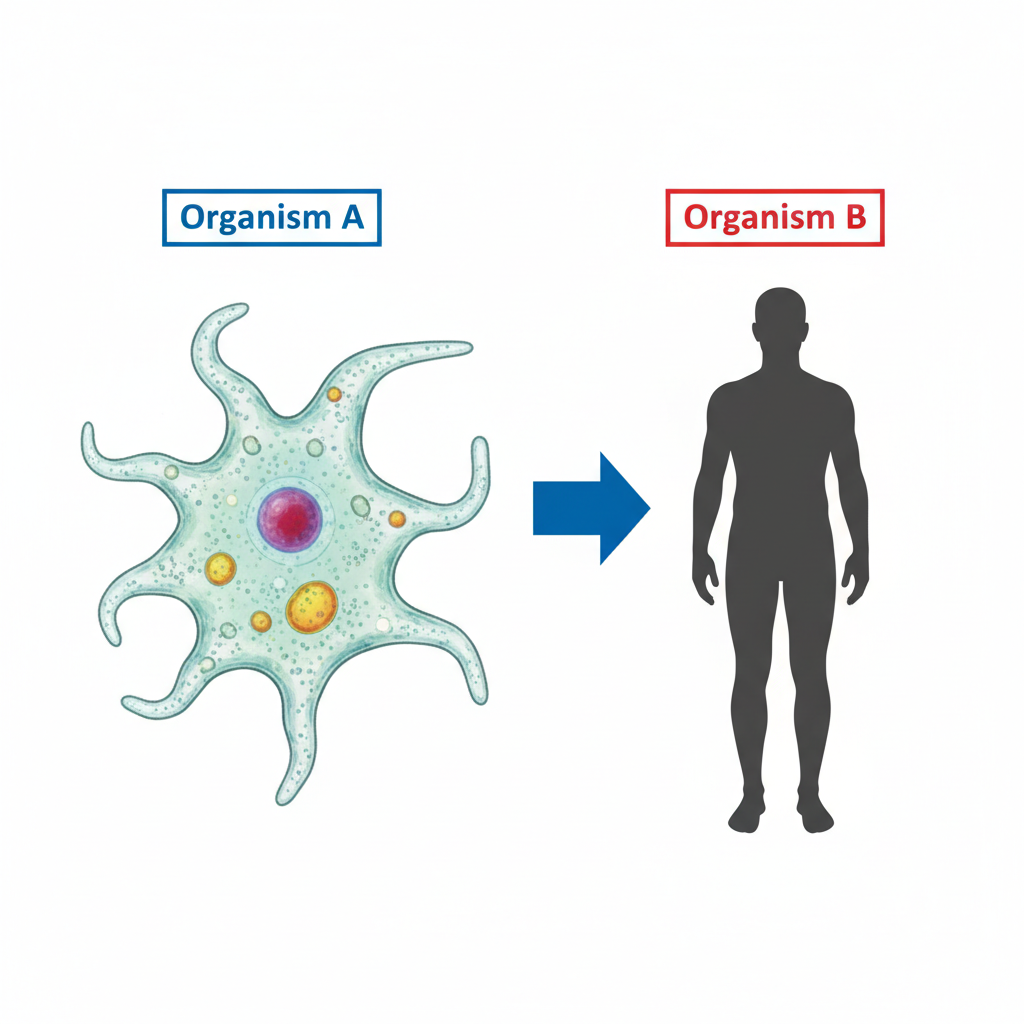
The diagram shows an amoeba and a human.
a
Identify which organism is unicellular. [1]
b
State the number of cells that make up a unicellular organism. [1]

Solutions
2QuestionAdvantages and Limitations of UnicellularityAssessment Practice
5 marks~8 minCriterion D
A school swimming pool contains a rapidly multiplying unicellular alga. The population doubles every hour. Starting with 100 cells, an exponential model predicts the population will cover the entire pool surface in 48 hours.
a
Calculate the number of algal cells present after 3 hours. Show all working. [2]
b
Explain why the algal population is unlikely to keep doubling every hour throughout the full 48 hours. [1]
c
The table below shows two pools with different conditions.
Pool A — nutrient-rich, no filtration, warm temperature
Pool B — low nutrients, active filtration, cooler temperature
Analyse which pool is more likely to reach full surface coverage by the algae, and justify your answer using the data provided. [2]
Pool A — nutrient-rich, no filtration, warm temperature
Pool B — low nutrients, active filtration, cooler temperature
Analyse which pool is more likely to reach full surface coverage by the algae, and justify your answer using the data provided. [2]

Solutions
3QuestionExamples of Bacteria Amoeba and ParameciumAssessment Practice
6 marks~9 minCriterion C
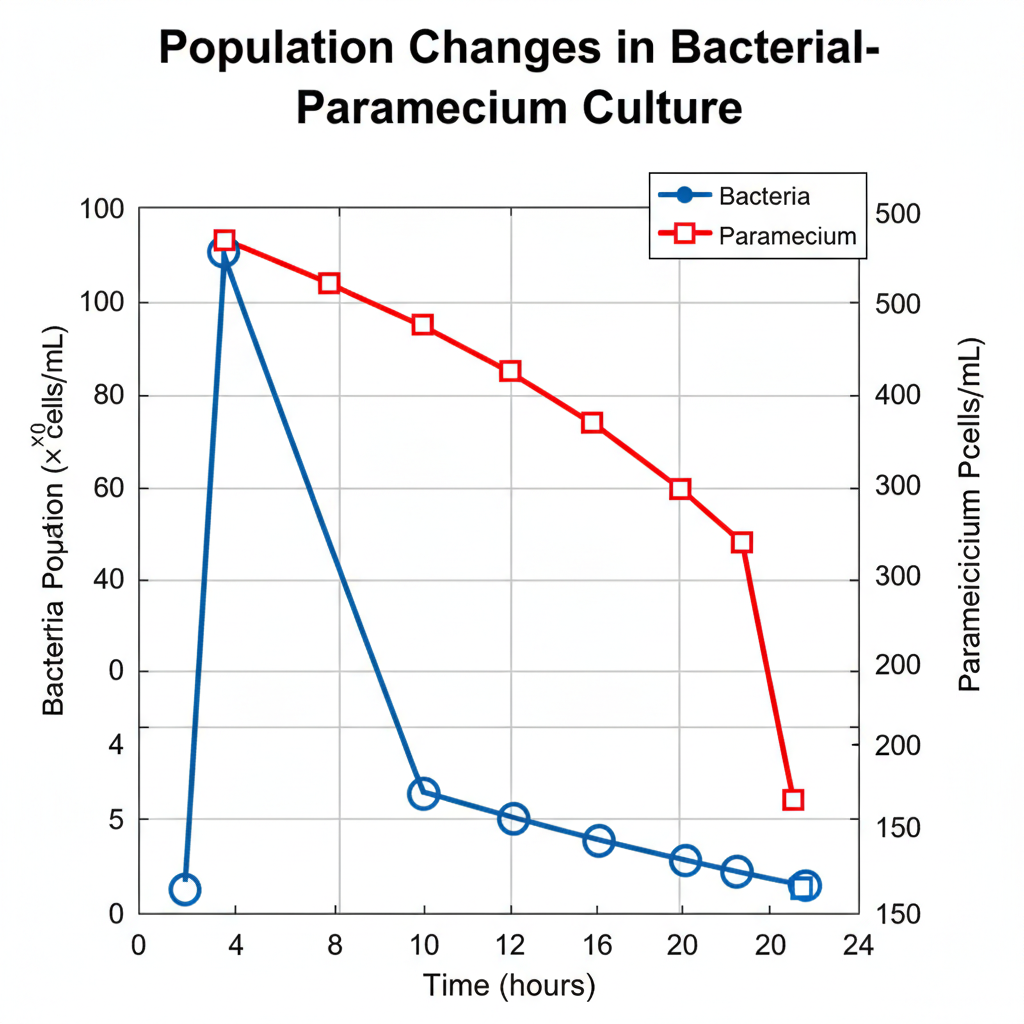
A scientist grows bacteria and Paramecium together in a culture for 24 hours. Bacteria reproduce by binary fission. Paramecium feed on bacteria. The graph shows how both populations change over this period. Bacteria reach a peak at hour 12, then decline. The Paramecium population rises steadily from hour 6 onward.
a
Describe the trend in the bacteria population from hour 0 to hour 12, and from hour 12 to hour 24. [2]
b
Explain why the Paramecium population begins to rise after hour 6, using evidence from the graph. [2]
c
At hour 12, an antibiotic is added that rapidly reduces the bacteria population to near zero. Analyse how this would affect the Paramecium population over the following 12 hours, and justify your reasoning. [2]
Solutions
4QuestionAdvantages and Limitations of UnicellularityAssessment Practice
6 marks~9 minCriterion B
A scientist measured how long a blue dye takes to diffuse from the surface to the centre of three organisms.
Organism: Amoeba / Flatworm / Hypothetical giant amoeba
Diameter (mm): 2 / 5 / 10
Diffusion time (s): 4 / 25 / ?
Organism: Amoeba / Flatworm / Hypothetical giant amoeba
Diameter (mm): 2 / 5 / 10
Diffusion time (s): 4 / 25 / ?
a
Describe the relationship between organism diameter and diffusion time shown in the data. [1]
b
Calculate the predicted diffusion time for the hypothetical giant amoeba. Show your working. [2]
c
Explain why a unicellular organism cannot survive if it grows too large, using the concept of surface area to volume ratio in your answer. [3]

Solutions
That's every free question here — 4 of 80.
+76 more questions, plus Mock Papers & Worksheets, are waiting in Premium.