You're viewing free preview questions — 4 questions previewing here — subscribe to unlock 75 more, plus the Full Question Bank, Mock Papers & Worksheets.Upgrade
Seasons and the Earth Tilt — Free MYP3 Sciences Practice Questions

1QuestionClimatic Differences Due to Earth MovementConcept Practice
2 marks~3 minCriterion A
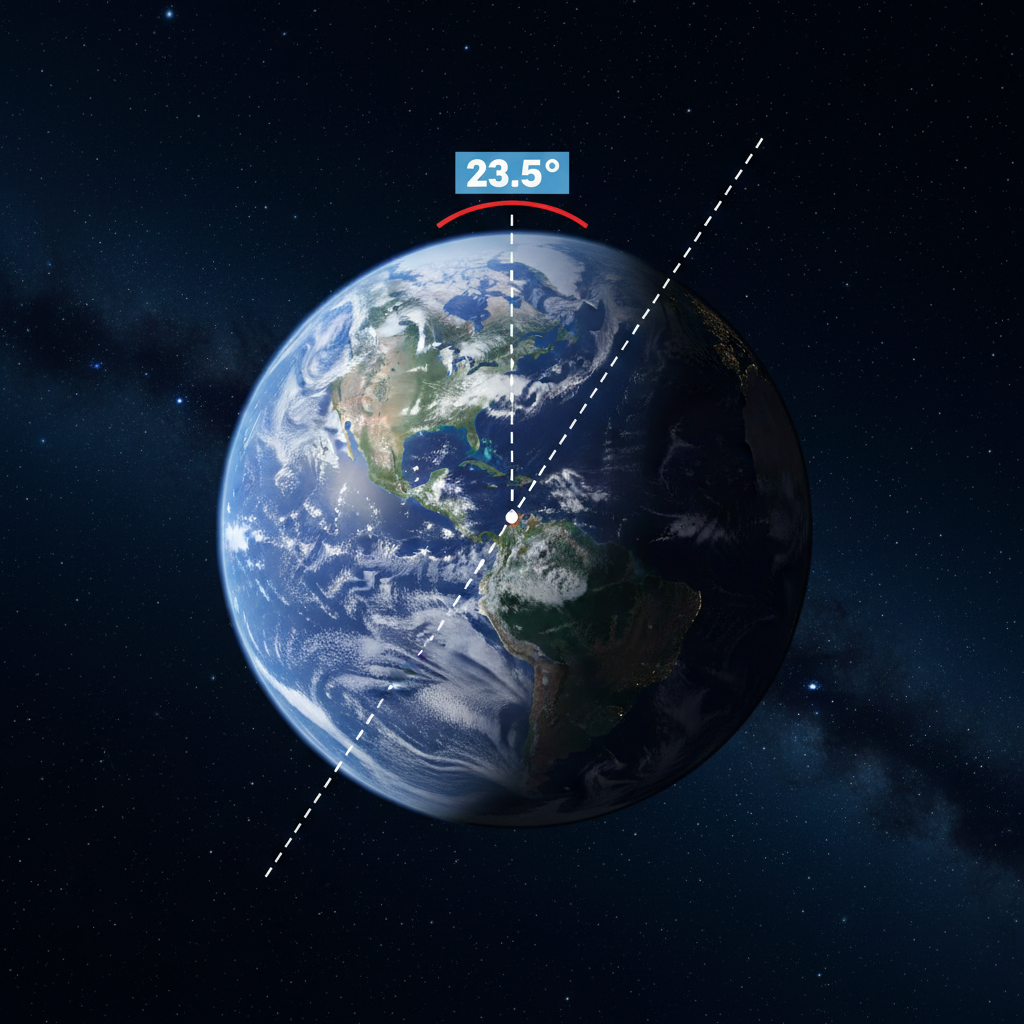
The diagram shows Earth with its axis of rotation drawn as a straight line through the North and South Poles. The angle between this axis and the vertical is marked as .
a
State the name of this angle. [1]
b
Explain why this angle causes some parts of Earth to receive more solar energy than others during the year. [1]

Solutions
2QuestionClimatic Differences Due to Earth MovementAssessment Practice
4 marks~6 minCriterion D
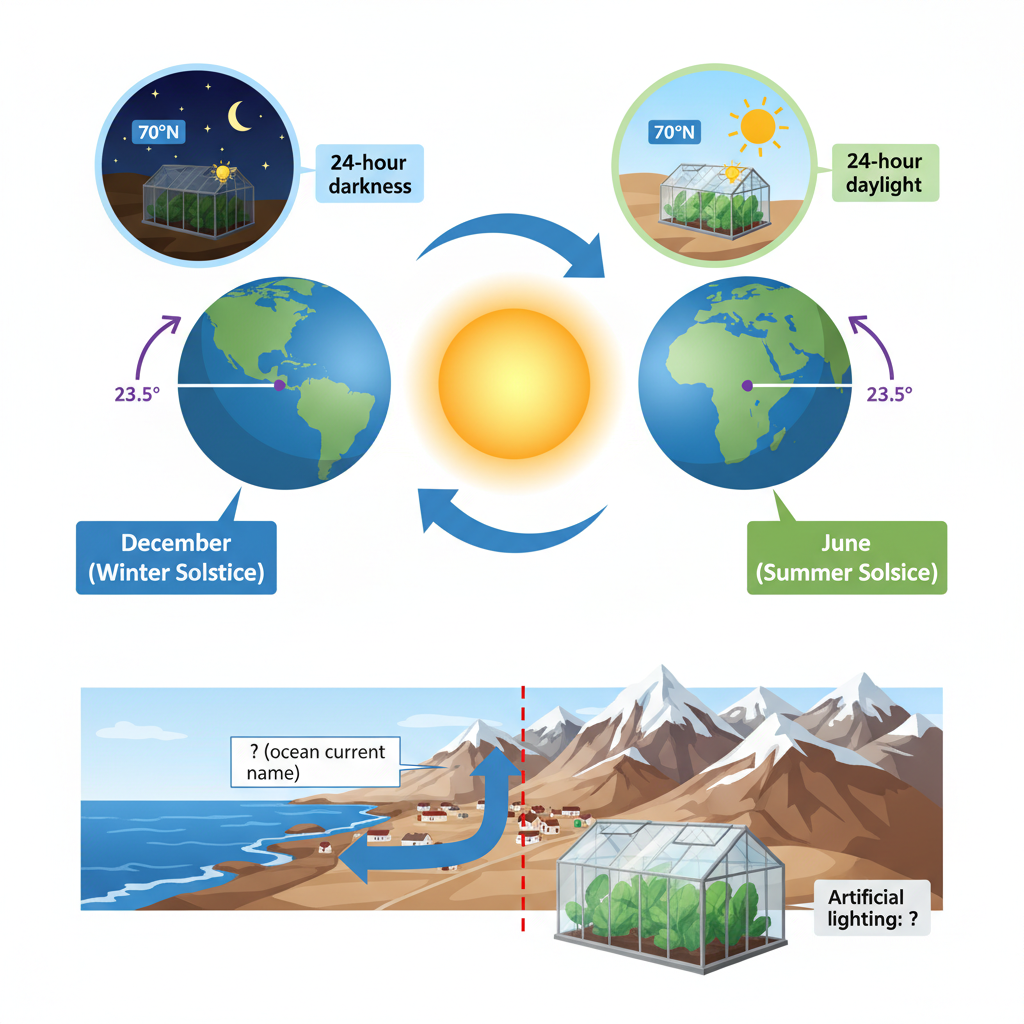
A Norwegian town at 70°N experiences 24-hour darkness in December and 24-hour daylight in June because of Earth's axial tilt. Farmers plan to use greenhouses with artificial lighting in winter and rely on continuous natural daylight in summer to grow crops year-round.
a
Describe one benefit of 24-hour summer daylight for crop growth at 70°N. [1]
b
Explain one limitation of using artificial lighting to replace sunlight during winter. [2]
c
The Gulf Stream, a warm ocean current, flows past northern Norway. Analyse how this current affects the reliability of using axial tilt alone to predict growing seasons in this region. [1]
Solutions
3QuestionClimatic Differences Due to Earth MovementConcept Practice
2 marks~3 minCriterion B
A student investigates how latitude affects seasonal temperature variation. Average monthly temperatures are recorded over one year at three locations: the equator (), , and the Arctic Circle (). The same thermometer is used on the same day each month.
a
Identify the independent variable in this investigation. [1]
b
Identify one controlled variable and explain why keeping it constant makes this a fair test. [1]
Solutions
4QuestionClimatic Differences Due to Earth MovementAssessment Practice
4 marks~6 minCriterion C
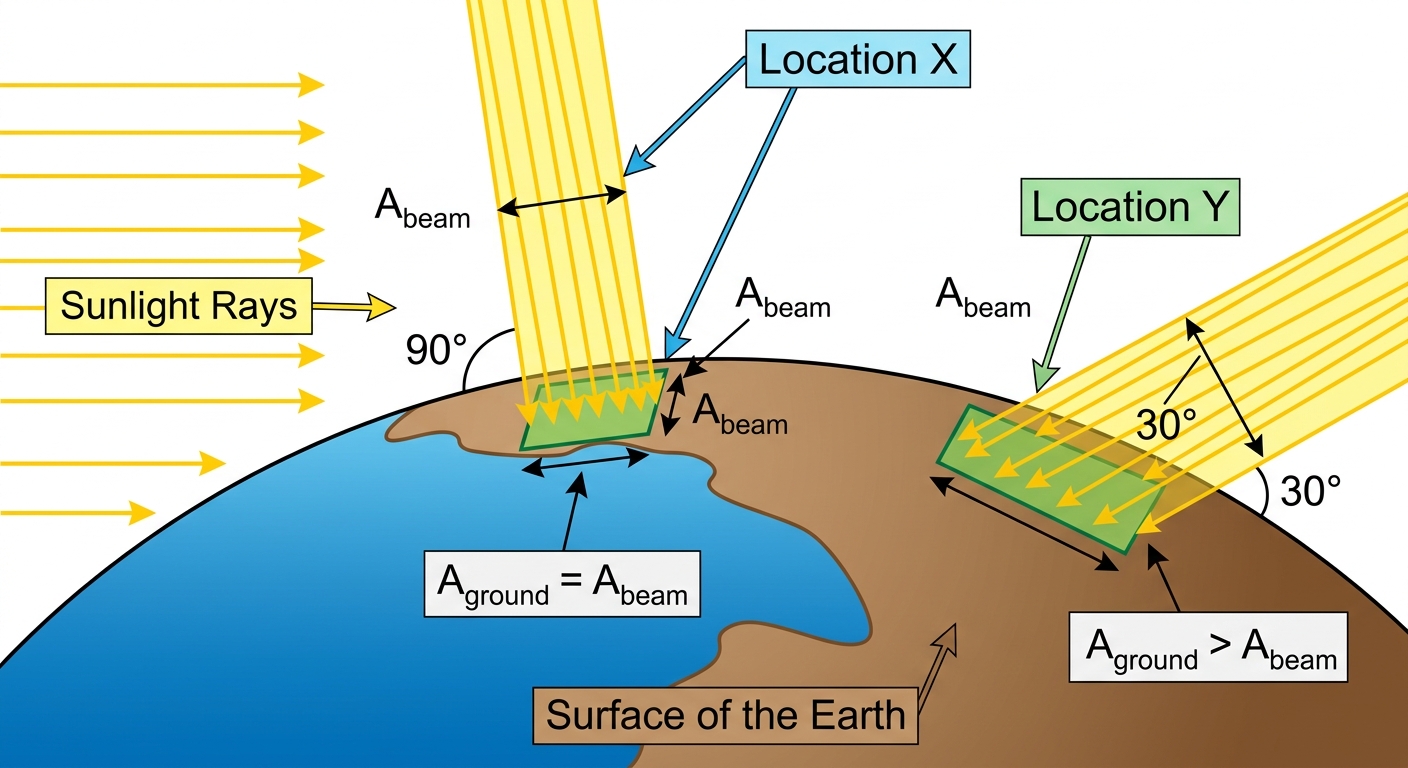
The diagram shows sunlight striking Earth's surface at Location X () and Location Y () during the same time of year.
a
State which location receives more heat energy per square metre. [1]
b
Explain how the angle of insolation at Location X causes energy to be more concentrated than at Location Y. [2]
c
A student claims that Location Y could receive equal heating if sunlight shone for twice as long each day. Analyse whether this claim is scientifically valid, using your understanding of angle of insolation. [1]
Solutions
That's every free question here — 4 of 79.
+75 more questions, plus Mock Papers & Worksheets, are waiting in Premium.