You're viewing free preview questions — 6 questions previewing here — subscribe to unlock 60 more, plus the Full Question Bank, Mock Papers & Worksheets.Upgrade
Back

The Solar System and beyond — Free MYP3 Sciences Practice Questions

Free questions

Open in full, with answers, mark scheme and examiner insights.

Question 1Criterion A · Easy · 3 marksrevisionprep.com

Planets, moons and other celestial bodies
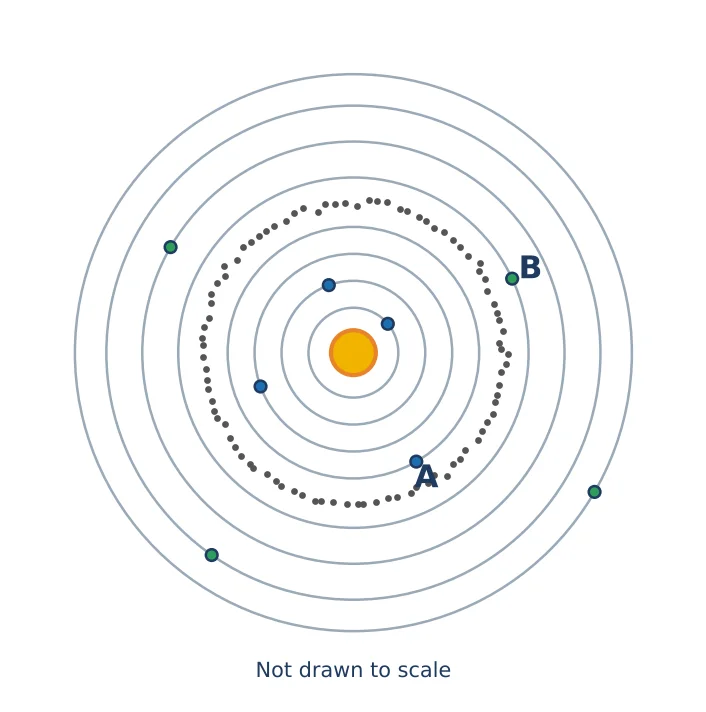
The diagram shows the Sun and the eight planets in their orbits (not drawn to scale). Planet A is the fourth planet from the Sun. Planet B is the fifth planet from the Sun.
Question diagram
(a)
State whether planet A is an inner planet or an outer planet. [1]
(b)
Explain why planet B is classed as an outer planet. [1]
(c)
Describe one difference in composition between the inner planets and the outer planets. [1]

revisionprep.com

Summary Answer

Not available for this question.

Model Answer

Not available for this question.

Marking Scheme

Not available for this question.

Examiner Insights

Not available for this question.

Question 2Criterion A · Easy · 2 marksrevisionprep.com

Structure and order of the Solar System
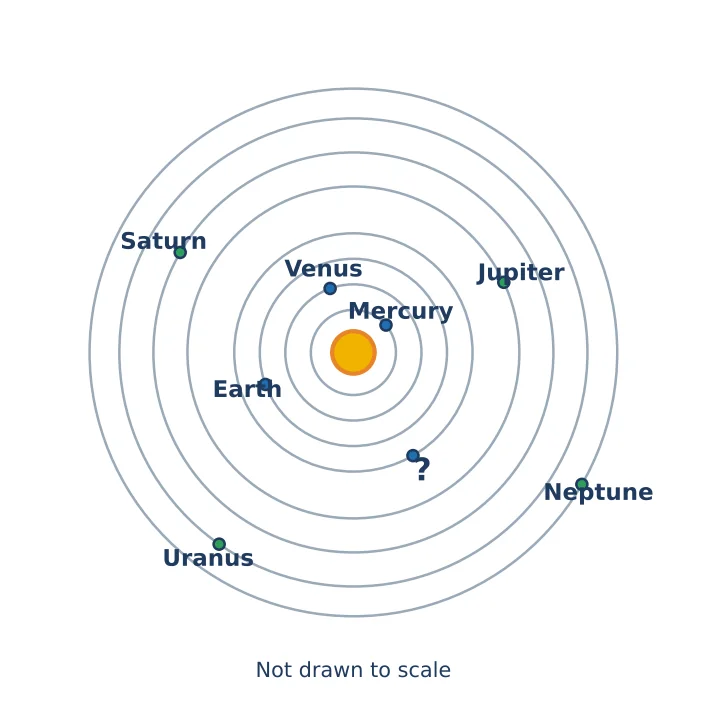
The diagram shows the eight planets in their orbits around the Sun (not drawn to scale). One planet has no name label. It is marked with a question mark.
Question diagram
(a)
Identify the planet marked with a question mark. [1]
(b)
Explain why this planet takes longer than Earth to complete one orbit. [1]

revisionprep.com

Summary Answer

Not available for this question.

Model Answer

Not available for this question.

Marking Scheme

Not available for this question.

Examiner Insights

Not available for this question.

Question 3Criterion B + C · Medium · 6 marksrevisionprep.com

Movements of planets around the Sun

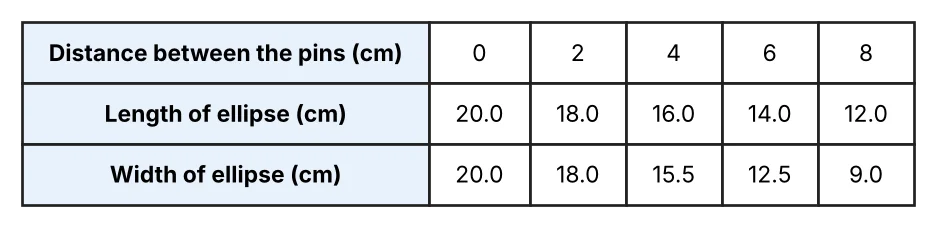
A student draws ellipses as a model of planetary orbits. She loops a string 20 cm long round two pins in a card, pulls the string tight with a pencil and draws round both pins. She changes the distance between the pins. She measures the length and the width of each ellipse. The data is shown in the table.
Question diagram
(a)
Identify the independent variable and the dependent variable. [2]
(b)
Calculate width ÷ length for pin distances of 4 cm and 8 cm. [2]
(c)
Describe what the pattern in width ÷ length shows about the shape of the ellipse as the pins move apart. [1]
(d)
Suggest one way to make the results more reliable. [1]

revisionprep.com

Summary Answer

Not available for this question.

Model Answer

Not available for this question.

Marking Scheme

Not available for this question.

Examiner Insights

Not available for this question.

Question 4Criterion D + A · Medium · 4 marksrevisionprep.com

Historical models of the Solar System

In 1610 Galileo used a telescope to see four moons moving around Jupiter, and he saw that Venus has phases like our Moon. These observations supported the Sun-centred model. The Church, however, supported the Earth-centred model. In 1633 Galileo was put on trial and made to say that he was wrong.
(a)
Explain how the moons of Jupiter were evidence against the claim that everything orbits Earth. [2]
(b)
Explain why Galileo's observations were hard for some people to accept. [1]
(c)
Discuss whether it was right for the Church to put Galileo on trial. Give one reason on each side. [1]

revisionprep.com

Summary Answer

Not available for this question.

Model Answer

Not available for this question.

Marking Scheme

Not available for this question.

Examiner Insights

Not available for this question.

Question 5Criterion C + A · Challenge · 5 marksrevisionprep.com

Planets, moons and other celestial bodies

The data shows the average surface temperature of four planets and some facts about their atmospheres.

- Planet: Mercury, Venus, Earth, Mars
- Distance from the Sun (AU): 0.39, 0.72, 1.00, 1.52
- Average surface temperature (°C): 167, 464, 15, -65
- Atmosphere: almost none, very thick and mostly carbon dioxide, thin (nitrogen and oxygen), very thin and mostly carbon dioxide
(a)
State which planet is the hottest. [1]
(b)
A student predicts: 'The closer a planet is to the Sun, the hotter it is.' Use the data to explain why the prediction is wrong. [2]
(c)
Explain why Venus is hotter than Mercury. [2]

revisionprep.com

Summary Answer

Not available for this question.

Model Answer

Not available for this question.

Marking Scheme

Not available for this question.

Examiner Insights

Not available for this question.

Question 6Criterion A + C · Challenge · 6 marksrevisionprep.com

Asteroids, comets and meteoroids

Comet Halley orbits the Sun once about every 76 years. Its speed changes during the orbit.

- Speed at closest approach to the Sun (km/s): 54.6
- Speed at its farthest point from the Sun (km/s): 0.91

The asteroid Ceres has a nearly circular orbit and an average speed of 17.9 km/s.
(a)
Describe how the make-up of a comet makes it look different from an asteroid when both are near the Sun. [2]
(b)
Explain why Halley's speed is much greater at its closest approach to the Sun than at its farthest point. [2]
(c)
A student says: 'A comet moves at the same speed throughout its orbit.' Evaluate this claim using the data. [2]

revisionprep.com

Summary Answer

Not available for this question.

Model Answer

Not available for this question.

Marking Scheme

Not available for this question.

Examiner Insights

Not available for this question.

That's every free question here — 6 of 66.

+60 more questions, plus Mock Papers & Worksheets, are waiting in Premium.

Upgrade