You're viewing free preview questions — 6 questions previewing here — subscribe to unlock 54 more, plus the Full Question Bank, Mock Papers & Worksheets.Upgrade
Back

Balanced forces, resultant force and force diagrams — Free MYP3 Sciences Practice Questions

Free questions

Open in full, with answers, mark scheme and examiner insights.

Question 1Criterion A · Easy · 2 marksrevisionprep.com

Definition and effects of balanced forces
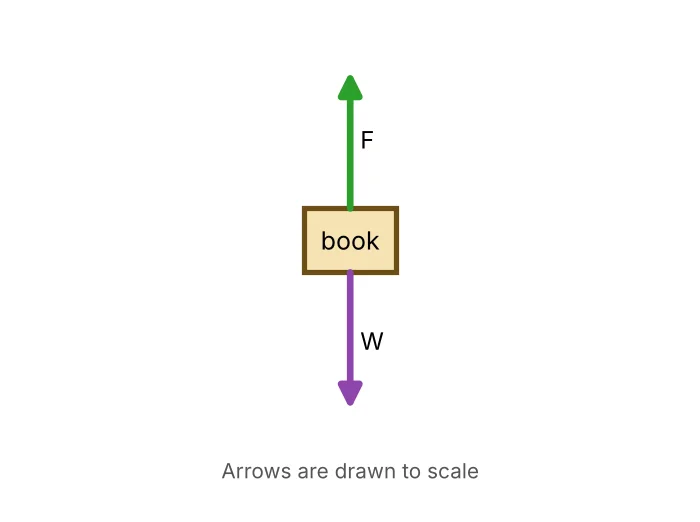
A book rests on a table. The diagram shows the two forces acting on the book. The arrows are drawn to scale.
Question diagram
(a)
Name the force labelled F. [1]
(b)
Explain how F and W together keep the book at rest. [1]

revisionprep.com

Summary Answer

Not available for this question.

Model Answer

Not available for this question.

Marking Scheme

Not available for this question.

Examiner Insights

Not available for this question.

Question 2Criterion A · Easy · 2 marksrevisionprep.com

Definition and effects of unbalanced forces
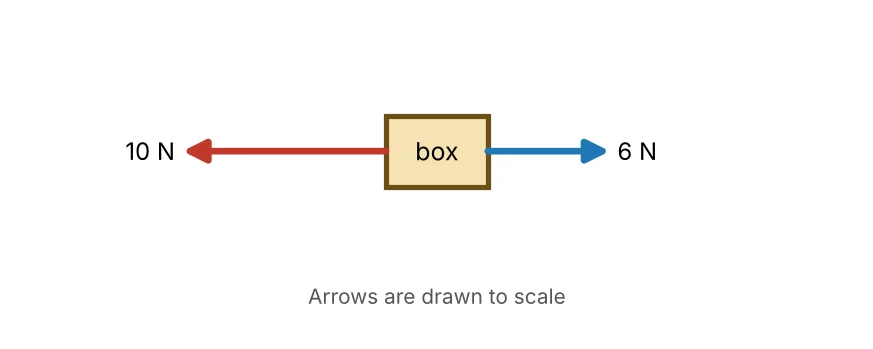
A box is acted on by two horizontal forces, as shown. The arrows are drawn to scale.
Question diagram
(a)
Calculate the net force on the box. [1]
(b)
State the direction of the net force and explain why it acts in that direction. [1]

revisionprep.com

Summary Answer

Not available for this question.

Model Answer

Not available for this question.

Marking Scheme

Not available for this question.

Examiner Insights

Not available for this question.

Question 3Criterion B + C · Medium · 6 marksrevisionprep.com

Definition and effects of unbalanced forces
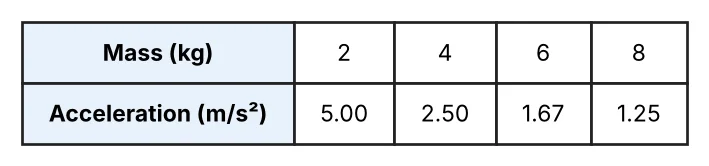
A student pulls trolleys of different masses with the same 10 N net force and measures the acceleration each time. The data is shown in the table.
Question diagram
(a)
Identify the independent variable, the dependent variable and one control variable. [2]
(b)
Describe the relationship between mass and acceleration shown by the data. [2]
(c)
Predict the acceleration of a 10 kg trolley pulled by the same 10 N force. Explain how this fits the pattern. [2]

revisionprep.com

Summary Answer

Not available for this question.

Model Answer

Not available for this question.

Marking Scheme

Not available for this question.

Examiner Insights

Not available for this question.

Question 4Criterion A · Medium · 3 marksrevisionprep.com

Equilibrium and motion analysis

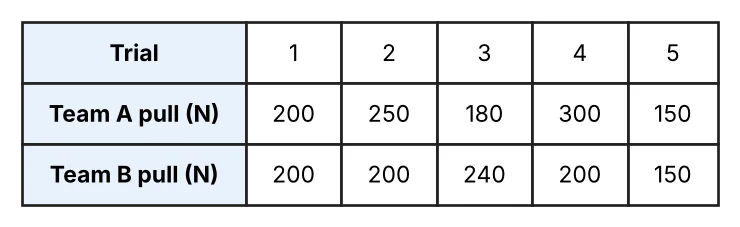
In a tug-of-war, Team A pulls the rope to the right and Team B pulls it to the left. Take right as positive. The rope starts at rest. The table shows five trials.
Question diagram
(a)
Calculate the net force on the rope in each trial. [1]
(b)
State which trials show equilibrium. Explain how the net force shows this. [1]
(c)
Compare trials 2, 3 and 4. State which trial has the largest acceleration and the direction of the rope's motion in trial 3. [1]

revisionprep.com

Summary Answer

Not available for this question.

Model Answer

Not available for this question.

Marking Scheme

Not available for this question.

Examiner Insights

Not available for this question.

Question 5Criterion C + A · Challenge · 5 marksrevisionprep.com

Definition and effects of balanced forces
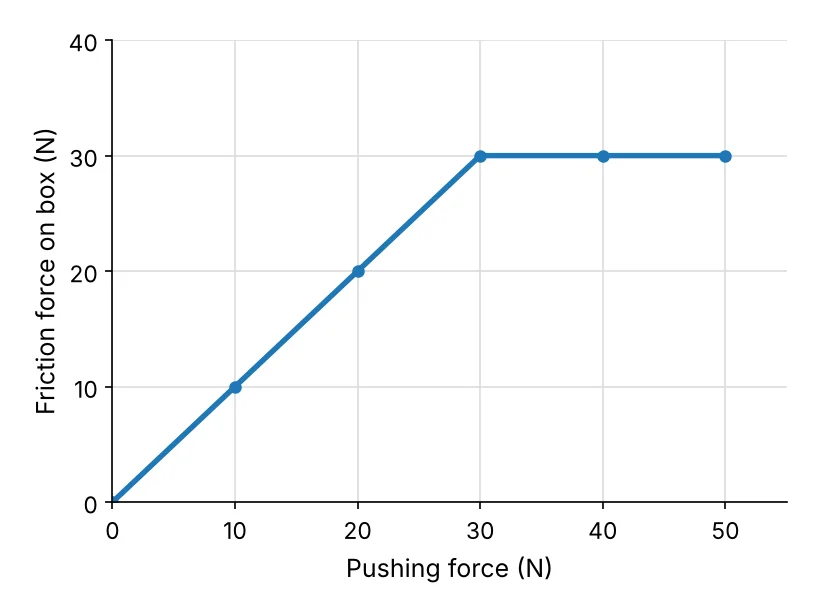
A student pushes a 10 kg box on a rough floor with a force that she slowly increases. She measures the friction force with a force sensor. The graph shows her results. The box does not move until the friction force stops increasing.
Question diagram
(a)
Use the graph to find the friction force when the pushing force is 20 N. [1]
(b)
Explain why the box does not move when the pushing force is 10 N, 20 N or 30 N. [1]
(c)
Calculate the net force on the box when the pushing force is 50 N. [1]
(d)
A student says: 'Friction is always equal to the push.' Evaluate this claim using the graph. [2]

revisionprep.com

Summary Answer

Not available for this question.

Model Answer

Not available for this question.

Marking Scheme

Not available for this question.

Examiner Insights

Not available for this question.

Question 6Criterion D + A · Challenge · 8 marksrevisionprep.com

Predicting motion with force diagrams

A lift (elevator) and its passengers have a total mass of 800 kg. The lift hangs from a steel cable. Use g = 10 N/kg.
(a)
Calculate the weight of the lift and its passengers. [1]
(b)
The lift speeds up as it goes upwards. The tension in the cable is 9000 N. Calculate the acceleration. [2]
(c)
The lift now moves upwards at a constant speed. State the tension in the cable. [1]
(d)
The cable breaks. Describe the forces on the lift and its motion immediately after. [1]

(e) Lifts are built with a cable that can take about three times the tension that is normally needed. Evaluate this safety decision. Give one advantage and one disadvantage. [3]

revisionprep.com

Summary Answer

Not available for this question.

Model Answer

Not available for this question.

Marking Scheme

Not available for this question.

Examiner Insights

Not available for this question.

That's every free question here — 6 of 60.

+54 more questions, plus Mock Papers & Worksheets, are waiting in Premium.

Upgrade