You're viewing free preview questions — 6 questions previewing here — subscribe to unlock 62 more, plus the Full Question Bank, Mock Papers & Worksheets.Upgrade
Back

Colour and the electromagnetic spectrum — Free MYP3 Sciences Practice Questions

Free questions

Open in full, with answers, mark scheme and examiner insights.

Question 1Criterion A · Easy · 2 marksrevisionprep.com

Primary and secondary colours of light
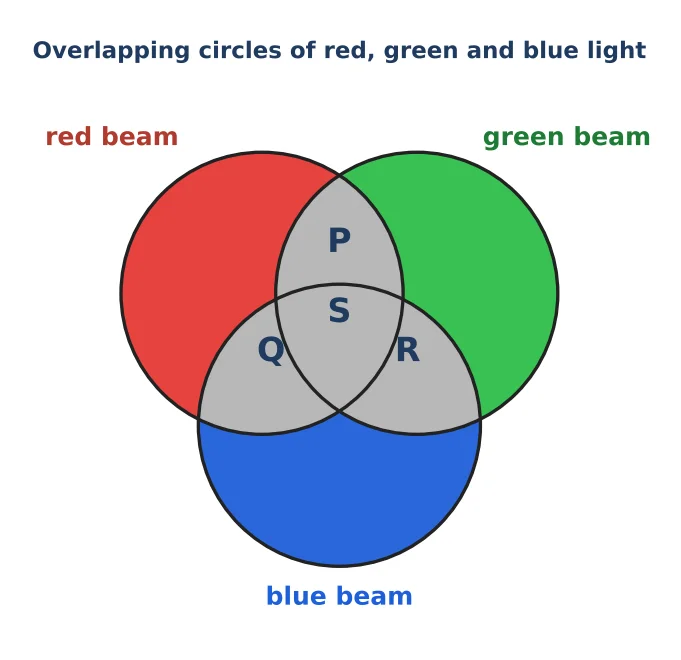
The diagram shows circles of red, green and blue light overlapping on a screen. The places where the circles overlap are labelled P, Q, R and S. P is the place where only the red and green circles overlap.
Question diagram
(a)
State the colour of the light at P. [1]
(b)
Explain how this colour is made. [1]

revisionprep.com

Summary Answer

Not available for this question.

Model Answer

Not available for this question.

Marking Scheme

Not available for this question.

Examiner Insights

Not available for this question.

Question 2Criterion A · Easy · 3 marksrevisionprep.com

Overview of the electromagnetic spectrum
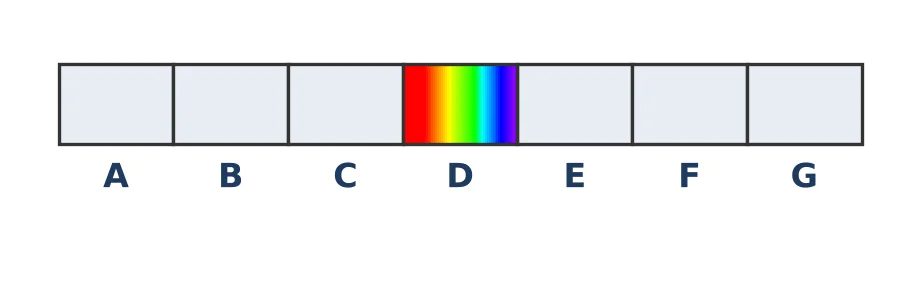
The diagram shows the seven regions of the electromagnetic spectrum in a row. Region A has the longest wavelength and region G has the shortest wavelength. D is visible light.
Question diagram
(a)
Name the type of wave at C. [1]
(b)
Name the type of wave at E. [1]
(c)
State which letter shows the waves with the highest frequency. [1]

revisionprep.com

Summary Answer

Not available for this question.

Model Answer

Not available for this question.

Marking Scheme

Not available for this question.

Examiner Insights

Not available for this question.

Question 3Criterion D · Medium · 5 marksrevisionprep.com

White light and the visible spectrum

Ultraviolet (UV) radiation is invisible to humans and can damage the eyes. Two pairs of sunglasses have equally dark lenses. Pair A is labelled 'blocks UV'. Pair B has no UV label and does not block UV.
(a)
Explain why wearing pair B can be more harmful to the eyes than wearing no sunglasses. [2]
(b)
Suggest one way a buyer can check that sunglasses block UV. [1]
(c)
Explain one benefit and one limit of relying only on the label. [2]

revisionprep.com

Summary Answer

Not available for this question.

Model Answer

Not available for this question.

Marking Scheme

Not available for this question.

Examiner Insights

Not available for this question.

Question 4Criterion C + A · Medium · 6 marksrevisionprep.com

Uses of different EM waves (introductory)
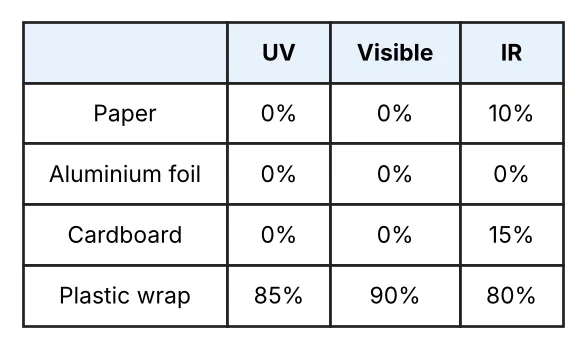
A student tests how well four materials let ultraviolet (UV), visible light and infrared (IR) pass through. The table shows the percentage that passes through. These are example data.
Question diagram
(a)
State which material blocks the most infrared radiation. [1]
(b)
Explain why plastic wrap lets a high percentage of all three types through while aluminium foil lets none through. [2]
(c)
A museum wants to protect a photograph from UV, visible and infrared. Use the data to justify which material gives the best protection, and give one limit of your choice. [3]

revisionprep.com

Summary Answer

Not available for this question.

Model Answer

Not available for this question.

Marking Scheme

Not available for this question.

Examiner Insights

Not available for this question.

Question 5Criterion B · Challenge · 6 marksrevisionprep.com

White light and the visible spectrum

A student thinks that a green leaf looks green because it reflects green light. She wants to find out how well sheets of red, green, blue and white paper reflect red, green and blue light. She has a torch, red, green and blue filters, a light sensor, a ruler and the four sheets of paper.
(a)
Write a hypothesis that the student could test. [1]
(b)
State the independent variable and the dependent variable. [2]
(c)
Suggest two variables the student should keep the same to make it a fair test. [2]
(d)
Describe one way the student can make her results more reliable. [1]

revisionprep.com

Summary Answer

Not available for this question.

Model Answer

Not available for this question.

Marking Scheme

Not available for this question.

Examiner Insights

Not available for this question.

Question 6Criterion A + C · Challenge · 6 marksrevisionprep.com

Dispersion of light through a prism

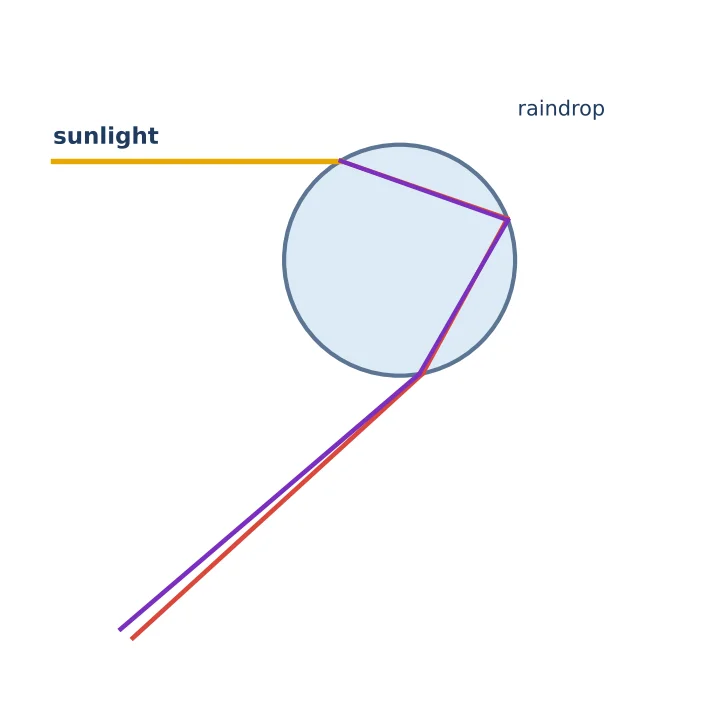
Sunlight enters a spherical raindrop. The light is refracted as it enters, reflects once from the back of the drop, and is refracted again as it leaves. The diagram shows the path of red light and violet light.
Question diagram
(a)
Explain why sunlight is split into different colours in a raindrop. [2]
(b)
Violet light leaves the drop at an angle of about 40° to the sunlight direction and red leaves at about 42°. Explain why the red band is on the outside of a rainbow and violet on the inside. [2]
(c)
A student says: 'One raindrop makes the whole rainbow.' Evaluate this claim. [2]

revisionprep.com

Summary Answer

Not available for this question.

Model Answer

Not available for this question.

Marking Scheme

Not available for this question.

Examiner Insights

Not available for this question.

That's every free question here — 6 of 68.

+62 more questions, plus Mock Papers & Worksheets, are waiting in Premium.

Upgrade