You're viewing free preview questions — 4 questions previewing here — subscribe to unlock 68 more, plus the Full Question Bank, Mock Papers & Worksheets.Upgrade
Properties of Waves — Free MYP3 Sciences Practice Questions

1QuestionDefinition of a Wave and Wave TypesConcept Practice
2 marks~3 minCriterion A
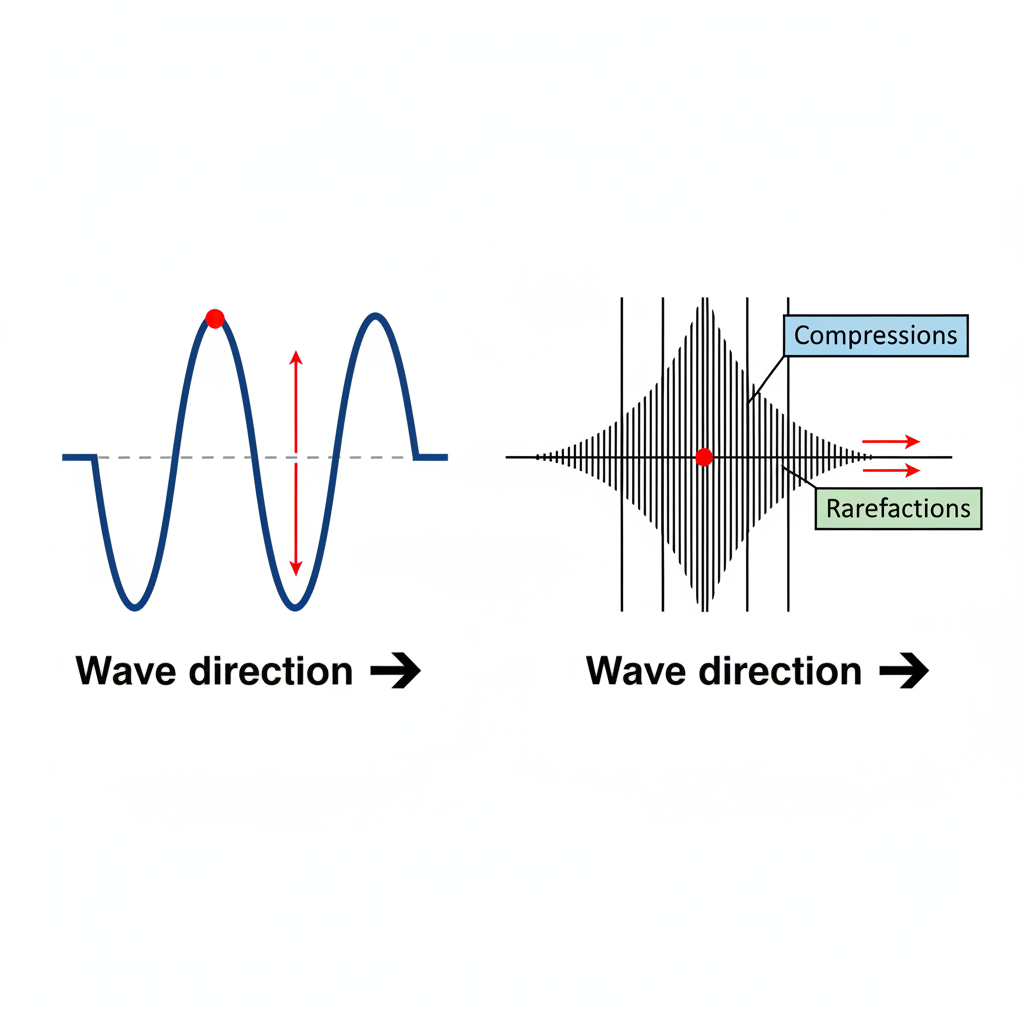
The diagram shows two waves, labelled Wave A and Wave B.
Wave A displays a repeating up-and-down pattern. Wave B displays alternating regions of compressed and spread-out particles along a horizontal line.
Wave A displays a repeating up-and-down pattern. Wave B displays alternating regions of compressed and spread-out particles along a horizontal line.
a
Identify which wave is transverse and which is longitudinal. [1]
b
Explain how the direction of particle vibration differs between the two wave types. [1]

Solutions
2QuestionDefinition of a Wave and Wave TypesAssessment Practice
2 marks~3 minCriterion D
When a pebble is dropped into a still pond, ripples spread outward in circles. The water molecules move up and down but do not travel outward with the ripples.
a
Describe what these ripples demonstrate about how waves transfer energy. [1]
b
Explain one limitation of using this pond model to understand the behaviour of ocean waves. [1]

Solutions
3QuestionMeasuring and Calculating Wave SpeedAssessment Practice
5 marks~8 minCriterion C
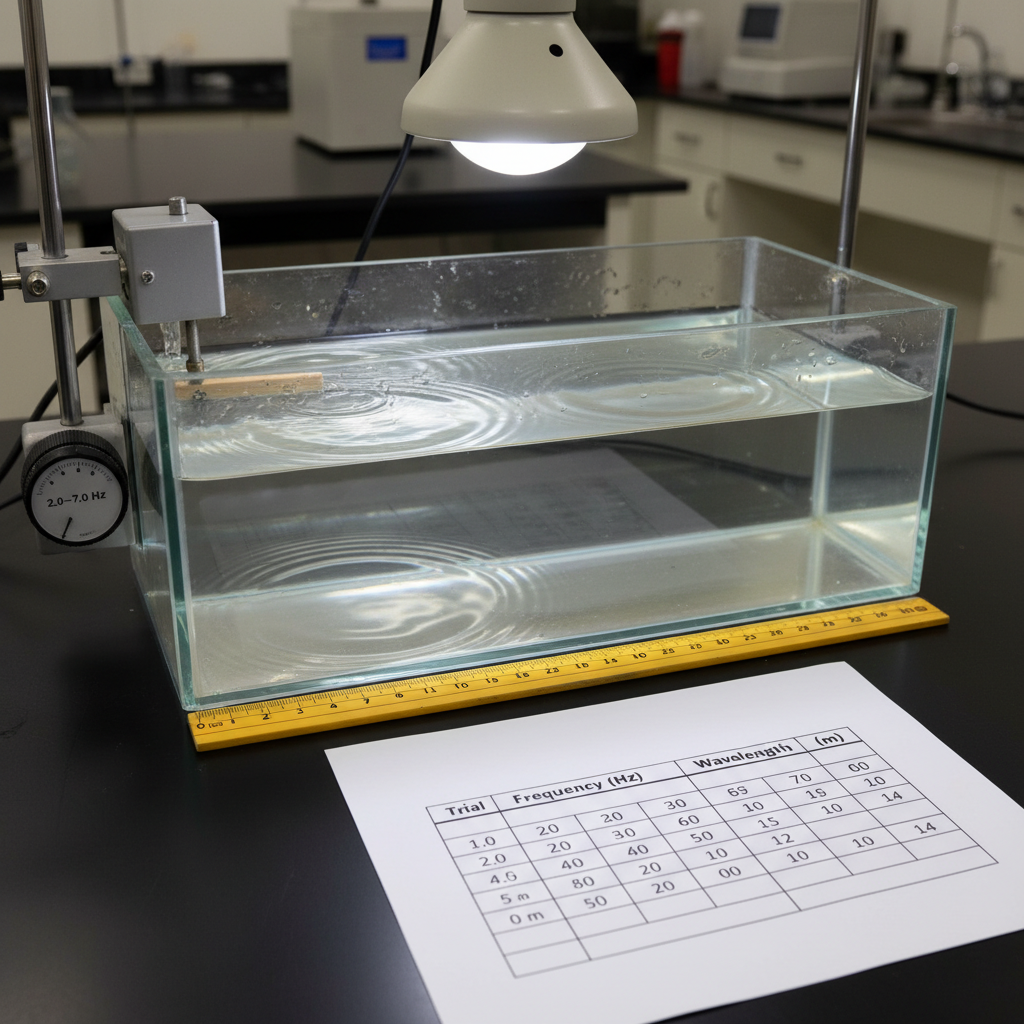
A student investigates wave speed in a ripple tank by changing the frequency of a wave generator and measuring the corresponding wavelength. The results are recorded below.
Wave speed is given by .
| Trial | 1 | 2 | 3 | 4 | 5 | 6 |
|---|---|---|---|---|---|---|
| Frequency (Hz) | 2.0 | 3.0 | 4.0 | 5.0 | 6.0 | 7.0 |
| Wavelength (m) | 0.30 | 0.20 | 0.15 | 0.12 | 0.10 | 0.14 |
Wave speed is given by .
a
Calculate the wave speed for trials 1 and 6. [2]
b
Explain why the data from trials 1–5 supports the claim that wave speed in the ripple tank is constant regardless of frequency. [2]
c
Analyse the result from trial 6 and suggest one reason why it differs from the other trials. [1]
Solutions
4QuestionKey Terms Wavelength Frequency Amplitude SpeedAssessment Practice
3 marks~5 minCriterion B
Four waves travel at the same speed. Their properties are shown below.
| Wave | A | B | C | D |
|---|---|---|---|---|
| Wavelength (m) | 2 | 4 | 6 | 8 |
| Frequency (Hz) | 150 | 75 | 50 | 37.5 |
a
State the wave equation that links wave speed , wavelength , and frequency . [1]
b
Using the data, describe what happens to frequency as wavelength increases. [1]
c
The speed of all four waves is the same. Analyse the data to explain why wavelength and frequency change in the way you described in (b). [1]
Solutions
That's every free question here — 4 of 72.
+68 more questions, plus Mock Papers & Worksheets, are waiting in Premium.