You're viewing free preview questions — 5 questions previewing here — subscribe to unlock 86 more, plus the Full Question Bank, Mock Papers & Worksheets.Upgrade
Ecosystems and Trophic Levels — Free MYP4 Biology Practice Questions

1QuestionProducers, Consumers, and DecomposersConcept Practice
2 marks~3 minCriterion A
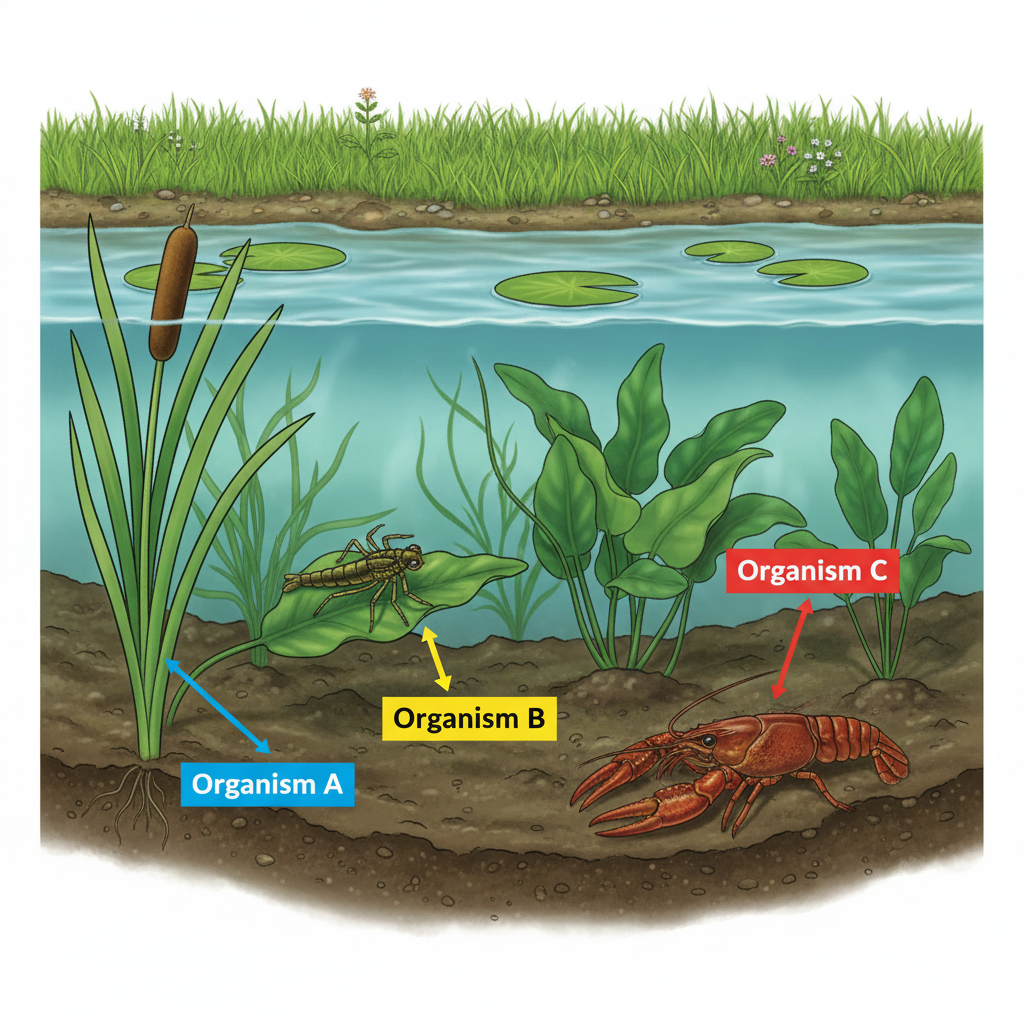
A pond ecosystem contains three organisms: Organism A (a cattail plant), Organism B (a dragonfly nymph), and Organism C (a crayfish). Crayfish feed on decaying plant and animal material on the pond floor, while dragonfly nymphs are active predators of small invertebrates.
a
Identify the producer in this pond ecosystem. [1]
b
The crayfish is sometimes called a "scavenger" rather than a decomposer. Explain why the crayfish can still be classified as a decomposer in this ecosystem. [1]

Solutions
2QuestionBiomass Pyramids and Energy PyramidsAssessment Practice
2 marks~3 minCriterion C
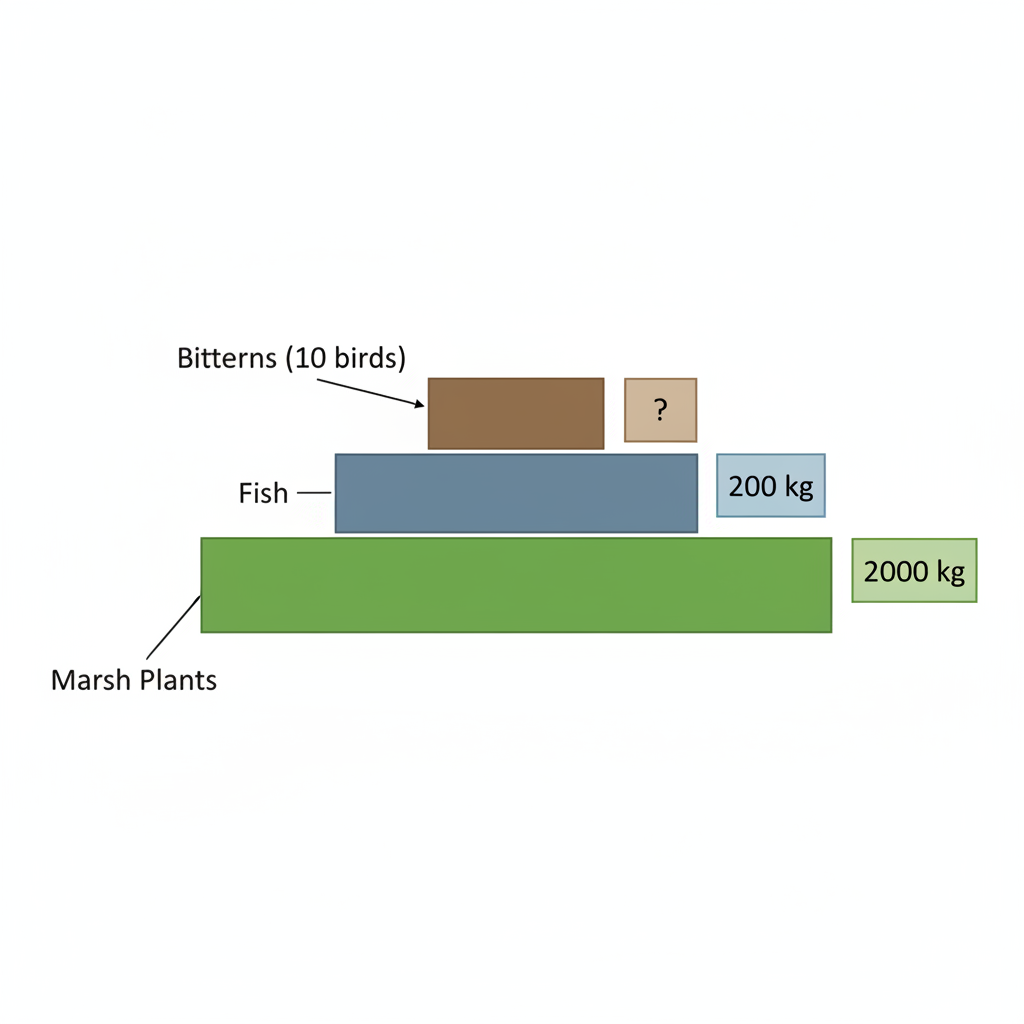
A conservation team is restoring a wetland to support 10 bitterns (apex predators). Each bittern requires approximately 200 kg of fish per year; each kilogram of fish biomass requires approximately 10 kg of marsh plants to produce.
a
Calculate the minimum mass of marsh plants needed annually to sustain the 10 bitterns. Show your working. [1]
b
The team uses a simple energy pyramid to plan the required marsh plant area. Discuss one limitation of this model that could cause the team to underestimate or overestimate the area of marsh plants actually needed. [1]
Solutions
3QuestionLimiting Factors and Ecosystem StabilityAssessment Practice
4 marks~6 minCriterion A
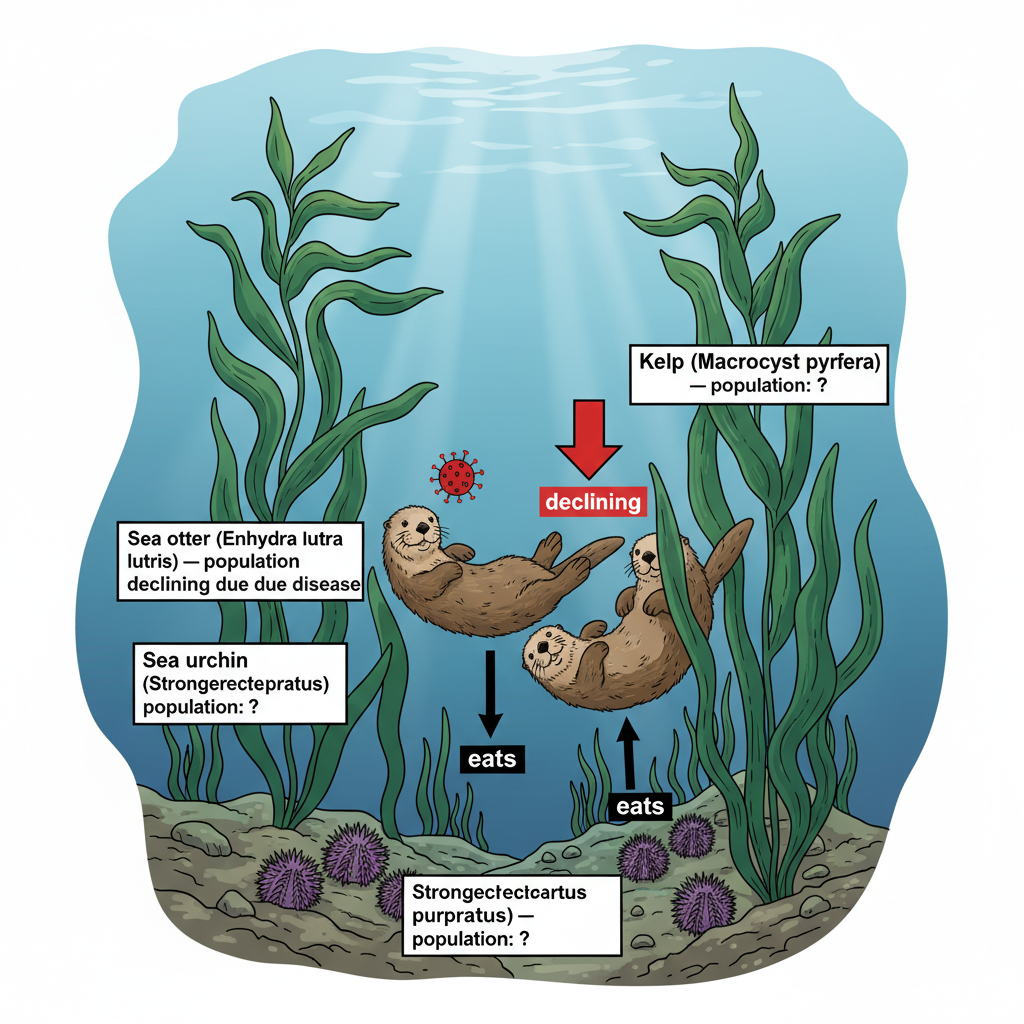
A kelp forest ecosystem contains three organisms linked in a food chain: kelp → sea urchins → sea otters. Sea otters prey on sea urchins; sea urchins graze on kelp. A disease reduces the sea otter population by approximately 70% over two years. Kelp coverage subsequently falls to less than 10% of its original extent.
a
Deduce the sequence of population changes in sea urchins and kelp following the decline in sea otters. [2]
b
Explain how sea otters function as a biotic limiting factor for the sea urchin population, and predict what the near-disappearance of kelp reveals about the upper limit of sea urchin population growth. [2]
Solutions
4QuestionDefinition and Components of an EcosystemAssessment Practice
5 marks~8 minCriterion D
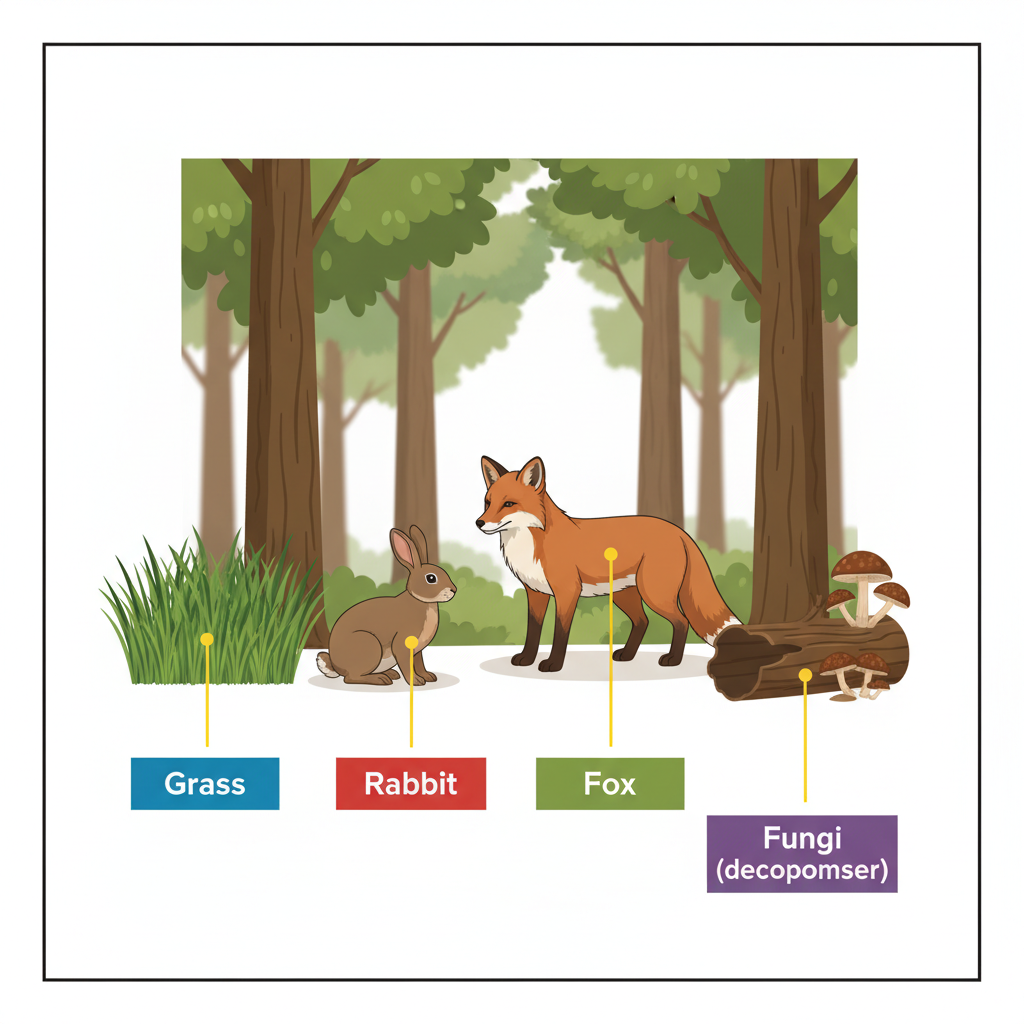
The diagram below shows a simple forest ecosystem with four labelled organisms: grass, rabbit, fox, and decomposer fungi.
a
Identify the producer in this ecosystem. [1]
b
The rabbit feeds on grass, and the fox feeds on the rabbit. Deduce the trophic level occupied by the fox, and explain how energy is lost between each trophic level. [2]
c
A disease eliminates the fox population entirely. Analyse how this change would affect the populations of both rabbits and grass over time, referring to the balance of the ecosystem. [2]
Solutions
5QuestionDefinition and Components of an EcosystemAssessment Practice
11 marks~17 minCriterion D
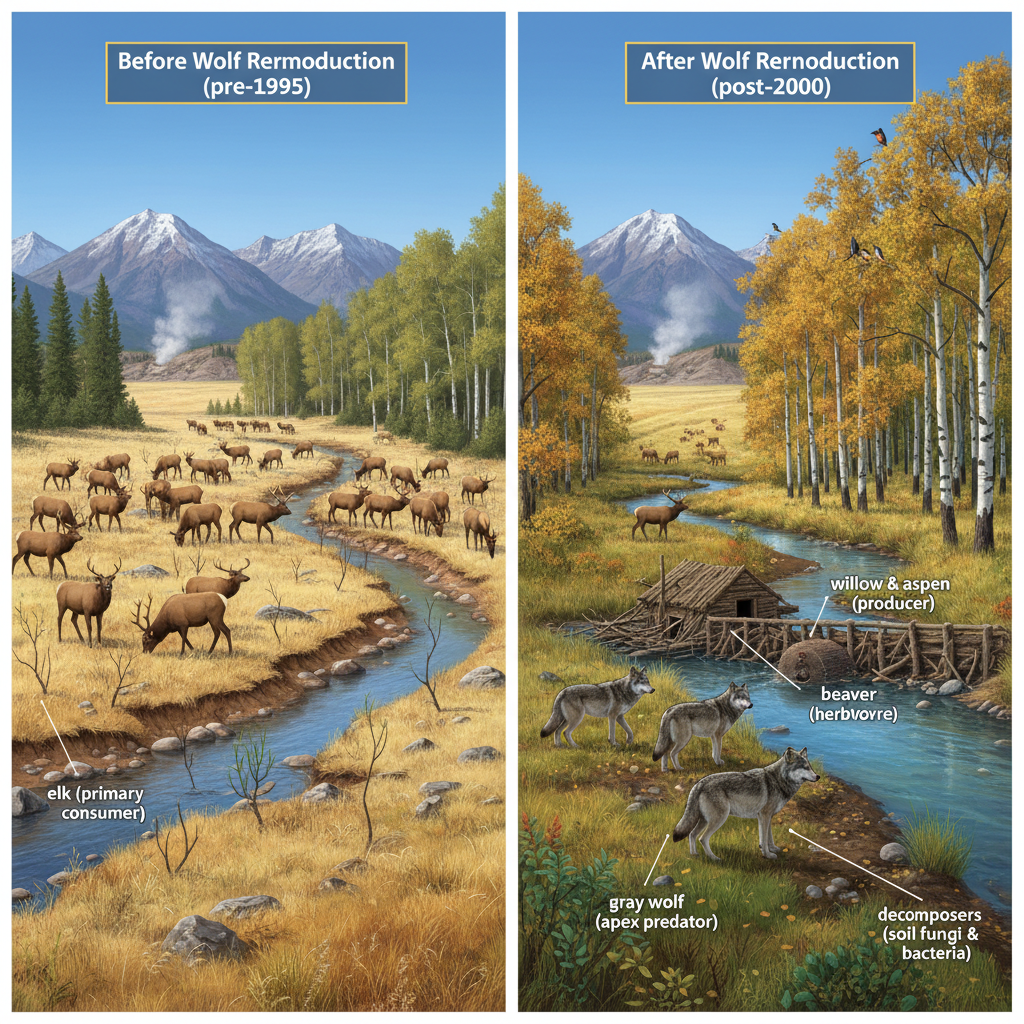
In 1995, gray wolves were reintroduced to Yellowstone National Park after a 70-year absence. Wolves preyed on elk, which had overgrazed streamside vegetation. Elk populations declined and their behaviour changed, allowing willow and aspen to recover along streams. This triggered a cascade of changes: beaver populations increased, songbird habitat improved, and soil erosion decreased. The reintroduction generated significant ecotourism revenue for local communities but caused conflict with ranchers whose livestock were occasionally killed by wolves.
a
Identify the trophic level of wolves in this ecosystem and explain how their reintroduction affected producers and primary consumers. Use evidence from the stimulus. [3]
b
Apply the concept of a trophic cascade to explain how wolf reintroduction led to increased beaver populations and reduced soil erosion. [4]
c
Evaluate whether the ecological benefits of wolf reintroduction justify the socioeconomic costs, considering the perspectives of at least two stakeholder groups. [4]
Solutions
That's every free question here — 5 of 91.
+86 more questions, plus Mock Papers & Worksheets, are waiting in Premium.