You're viewing free preview questions — 4 questions previewing here — subscribe to unlock 79 more, plus the Full Question Bank, Mock Papers & Worksheets.Upgrade
Isotopes and Relative Atomic Mass — Free MYP4 Chemistry Practice Questions

1QuestionDefinition and Examples of IsotopesConcept Practice
2 marks~3 minCriterion A
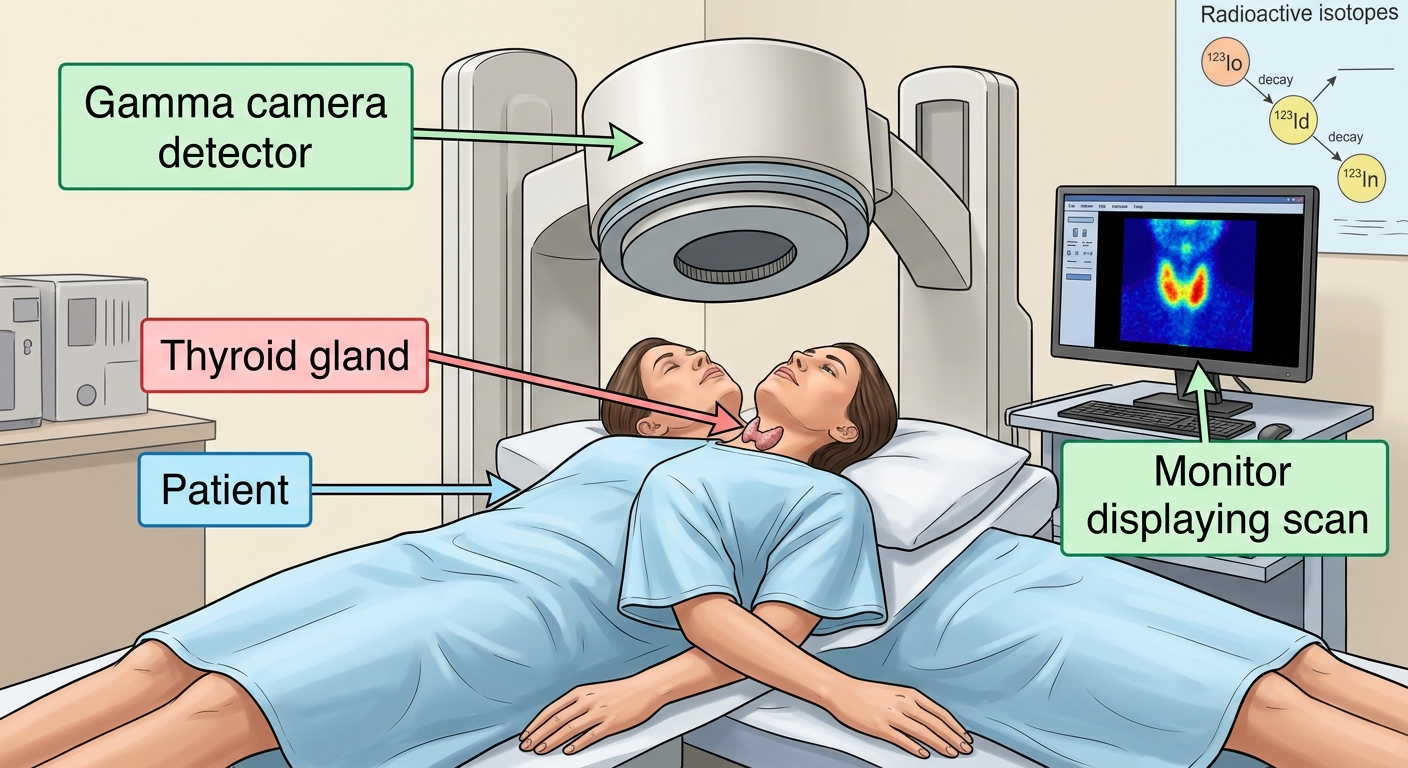
Iodine-123 (I) is a radioactive isotope used in hospitals to image a patient's thyroid gland. A small quantity is administered to the patient, and its gamma emissions are detected to produce a diagnostic image.
a
Outline what makes I an isotope of iodine. [1]
b
A patient undergoing this procedure expresses concern about radiation exposure. Discuss one limitation of using I for thyroid imaging that is directly related to this concern. [1]

Solutions
2QuestionDefinition and Examples of IsotopesAssessment Practice
5 marks~8 minCriterion C
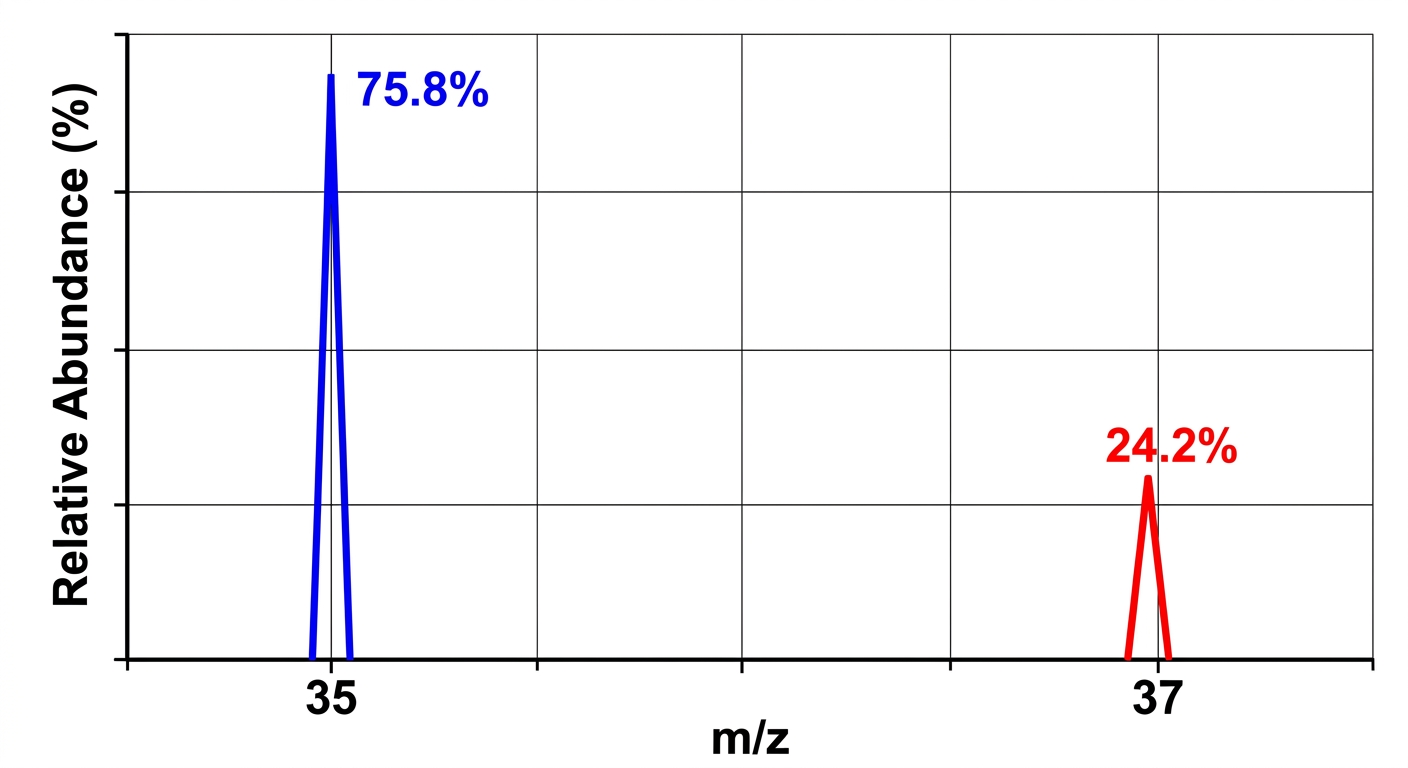
Mass spectrometry of a chlorine sample produces two peaks:
, relative abundance
, relative abundance
A separate experiment determines the average atomic mass of chlorine to be .
The weighted-average formula for atomic mass is:
where , are isotope masses and , are their percentage abundances.
, relative abundance
, relative abundance
A separate experiment determines the average atomic mass of chlorine to be .
The weighted-average formula for atomic mass is:
where , are isotope masses and , are their percentage abundances.
a
Calculate the average atomic mass of chlorine predicted by the two-isotope data. [2]
b
Deduce whether the experimentally determined value of is consistent with chlorine existing as only two stable isotopes. Justify your reasoning using your answer to part (a) and the concept of experimental error. [3]
Solutions
3QuestionCalculating Relative Atomic Mass RAMAssessment Practice
6 marks~9 minCriterion D
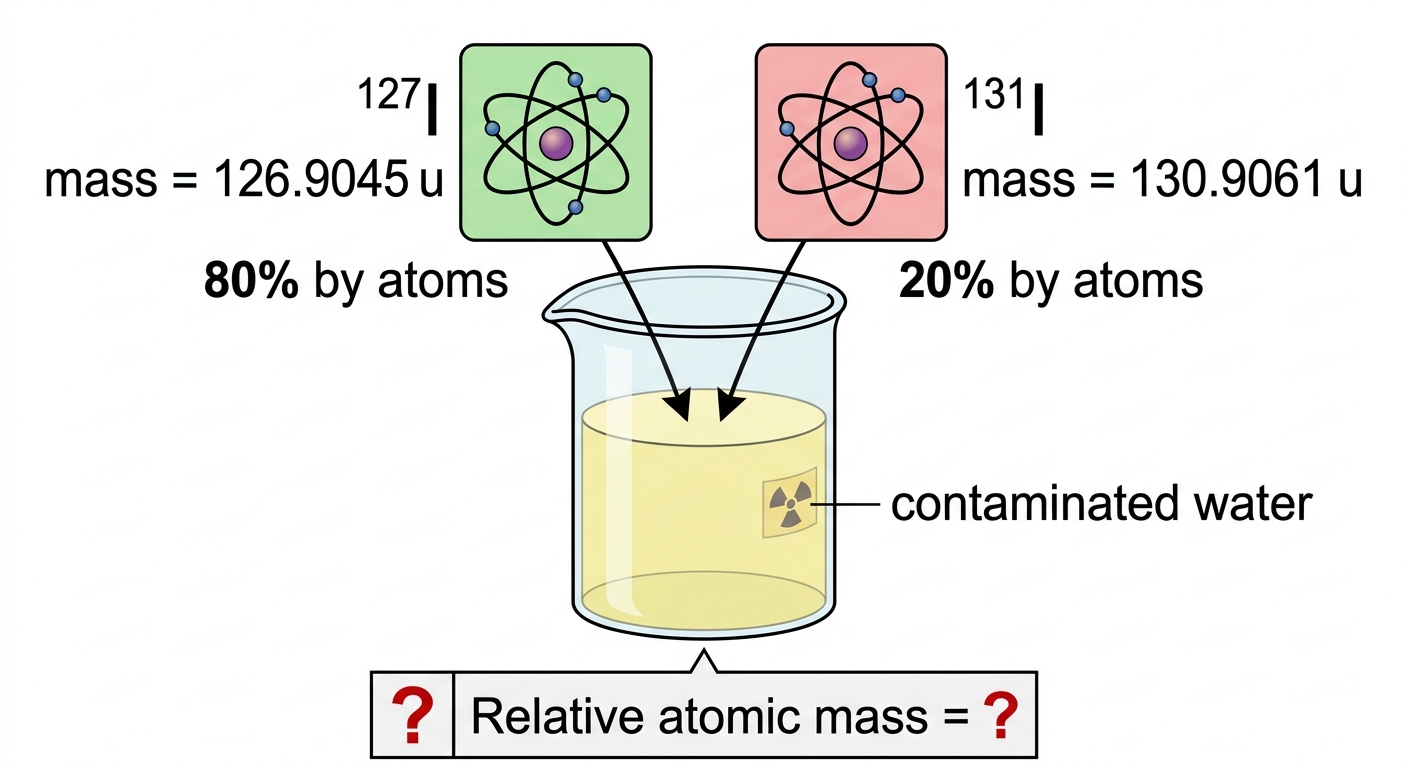
A nuclear accident releases iodine-131 into a local water supply. Natural iodine consists entirely of iodine-127 (mass = 126.9045 u). A contaminated water sample contains 80% iodine-127 and 20% iodine-131 (mass = 130.9061 u) by number of atoms.
a
Calculate the relative atomic mass (RAM) of iodine in the contaminated sample. [2]
b
Deduce whether the altered RAM alone is sufficient to confirm the presence of iodine-131 contamination. Justify your reasoning with reference to the standard RAM of iodine. [2]
c
Evaluate the limitations of using RAM as a monitoring tool for iodine-131 contamination, with reference to the health risks posed by iodine-131 accumulation in the thyroid gland. [2]
Solutions
4QuestionStability of Isotopes and Radioactivity IntroAssessment Practice
4 marks~6 minCriterion B
The stability of an isotope depends on its neutron-to-proton ratio (). Data for five isotopes are given below.
| Isotope | H-1 | H-2 | He-4 | C-14 | U-238 |
|---|---|---|---|---|---|
| Protons | 1 | 1 | 2 | 6 | 92 |
| Neutrons | 0 | 1 | 2 | 8 | 146 |
| ratio | 0.00 | 1.00 | 1.00 | 1.33 | 1.59 |
| Stability | stable | stable | stable | radioactive | radioactive |
a
Describe the relationship between the ratio and isotope stability, referring to specific values in the data above. [2]
b
Deduce whether oxygen-16 (8 protons, 8 neutrons) and oxygen-18 (8 protons, 10 neutrons) are stable or radioactive. Justify each prediction using the pattern from part (a). [2]
Solutions
That's every free question here — 4 of 83.
+79 more questions, plus Mock Papers & Worksheets, are waiting in Premium.