You're viewing free preview questions — 4 questions previewing here — subscribe to unlock 76 more, plus the Full Question Bank, Mock Papers & Worksheets.Upgrade
Periodic Table Groups and Periods — Free MYP4 Chemistry Practice Questions

1QuestionMetals Non-Metals and MetalloidsConcept Practice
2 marks~3 minCriterion B
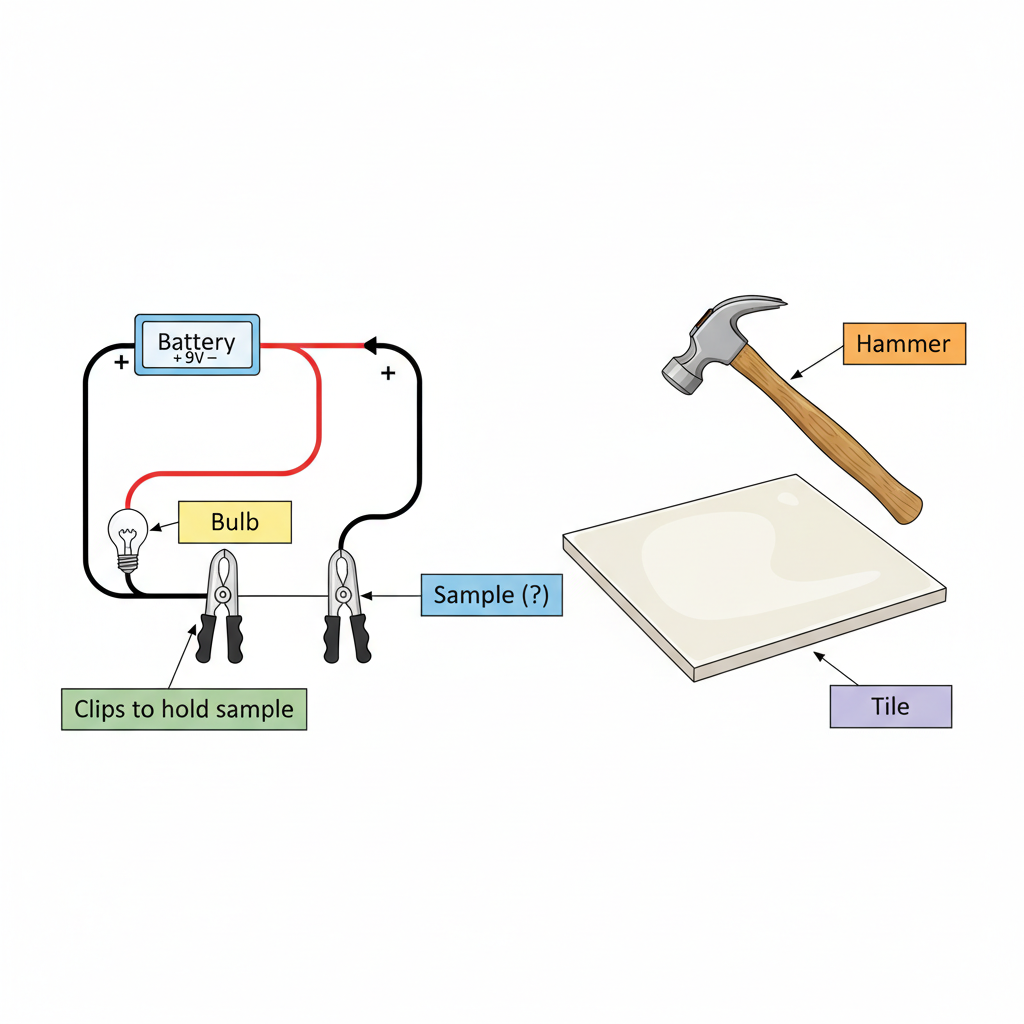
Outline the steps of an experiment to test whether a given sample is a metal, non-metal, or metalloid. The apparatus diagram shows a circuit with a battery, a bulb, and two wires ending in clips to hold the sample, plus a hammer and a tile.

Solutions
2QuestionGroup 17 Halogens and Group 18 Noble GasesAssessment Practice
4 marks~6 minCriterion C
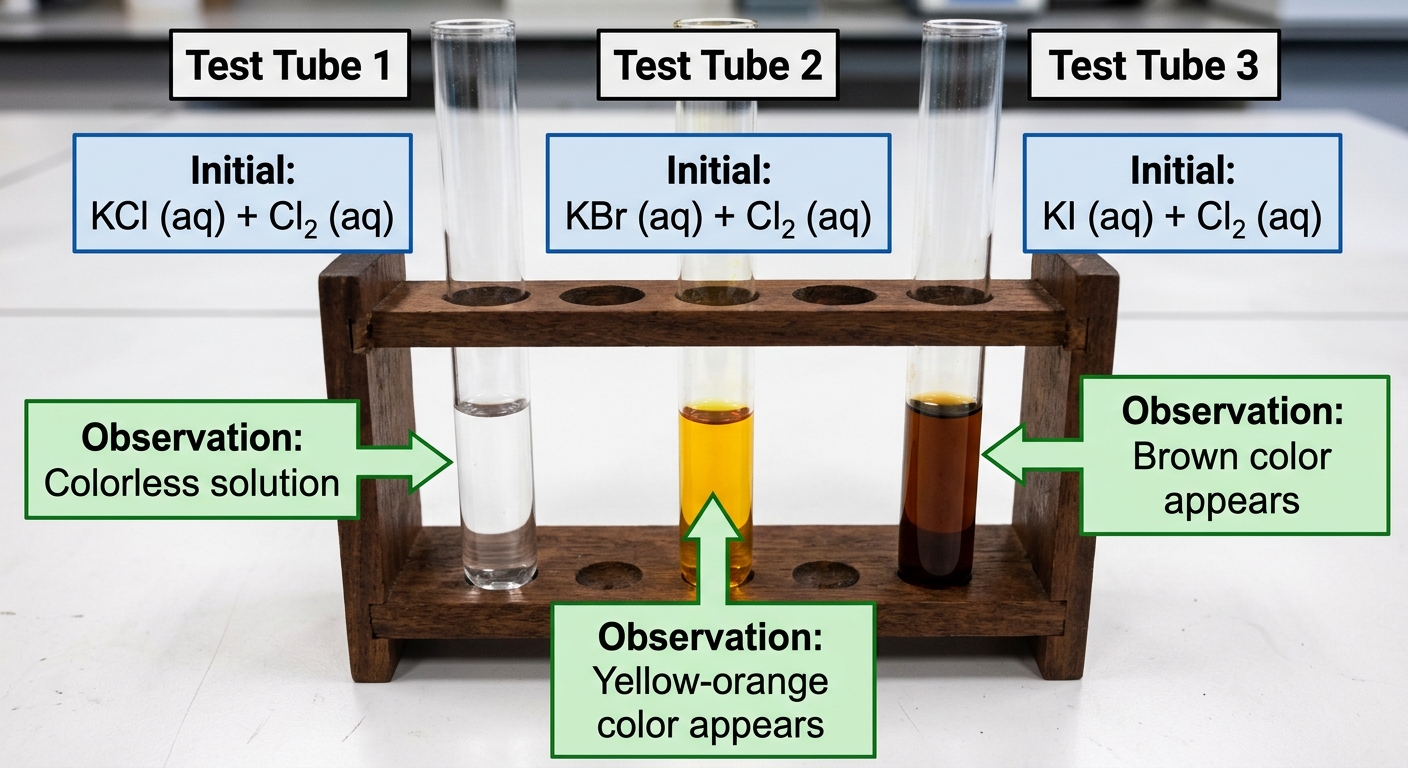
Three test tubes each contain a colourless solution. Chlorine water () is added to each.
| Test tube 1: potassium chloride () | no colour change |
|---|---|
| Test tube 2: potassium bromide () | yellow-orange colour appears |
| Test tube 3: potassium iodide () | brown colour appears |
a
State the reactivity trend of the halogens down Group 17. [1]
b
Explain why chlorine displaces bromine from and iodine from , but produces no change in . [2]
c
The displacement of iodine from produces a more intense colour than the displacement of bromine from . A student claims this means iodine is more reactive than bromine. Evaluate this claim. [1]
Solutions
3QuestionIdentifying Groups Periods and Atomic NumberAssessment Practice
8 marks~12 minCriterion D
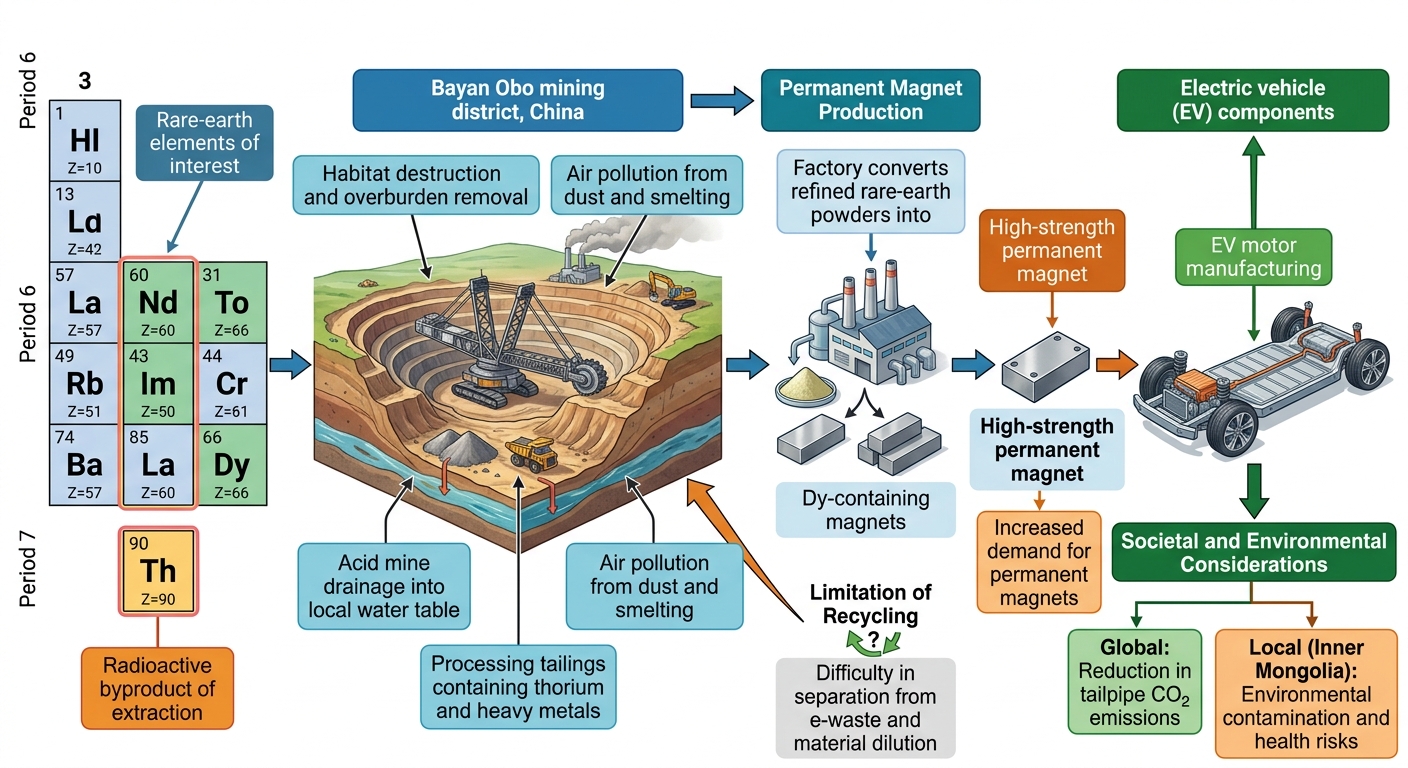
Neodymium (, ), dysprosium (, ), and lanthanum (, ) are rare-earth elements used in high-strength permanent magnets for electric vehicle (EV) motors. All three are in Period 6, Group 3 of the periodic table. They are mined predominantly at Bayan Obo, Inner Mongolia, China. Extraction releases thorium (, , Period 7, Group 3) as a mildly radioactive byproduct and requires removal of large amounts of overburden, causing habitat destruction.
a
Explain why , , and are chemically similar and tend to occur together in the same ore deposits, using their positions in the periodic table. [2]
b
Identify and explain one societal benefit of extracting these rare-earth elements for EV magnets. [2]
c
Analyse one environmental trade-off associated with the extraction of these elements, using evidence from the context above. [2]
d
Discuss why recycling rare-earth elements from end-of-life EV magnets cannot, on its own, resolve the trade-offs identified in part (c). [2]
Solutions
4QuestionIdentifying Groups Periods and Atomic NumberAssessment Practice
8 marks~12 minCriterion A
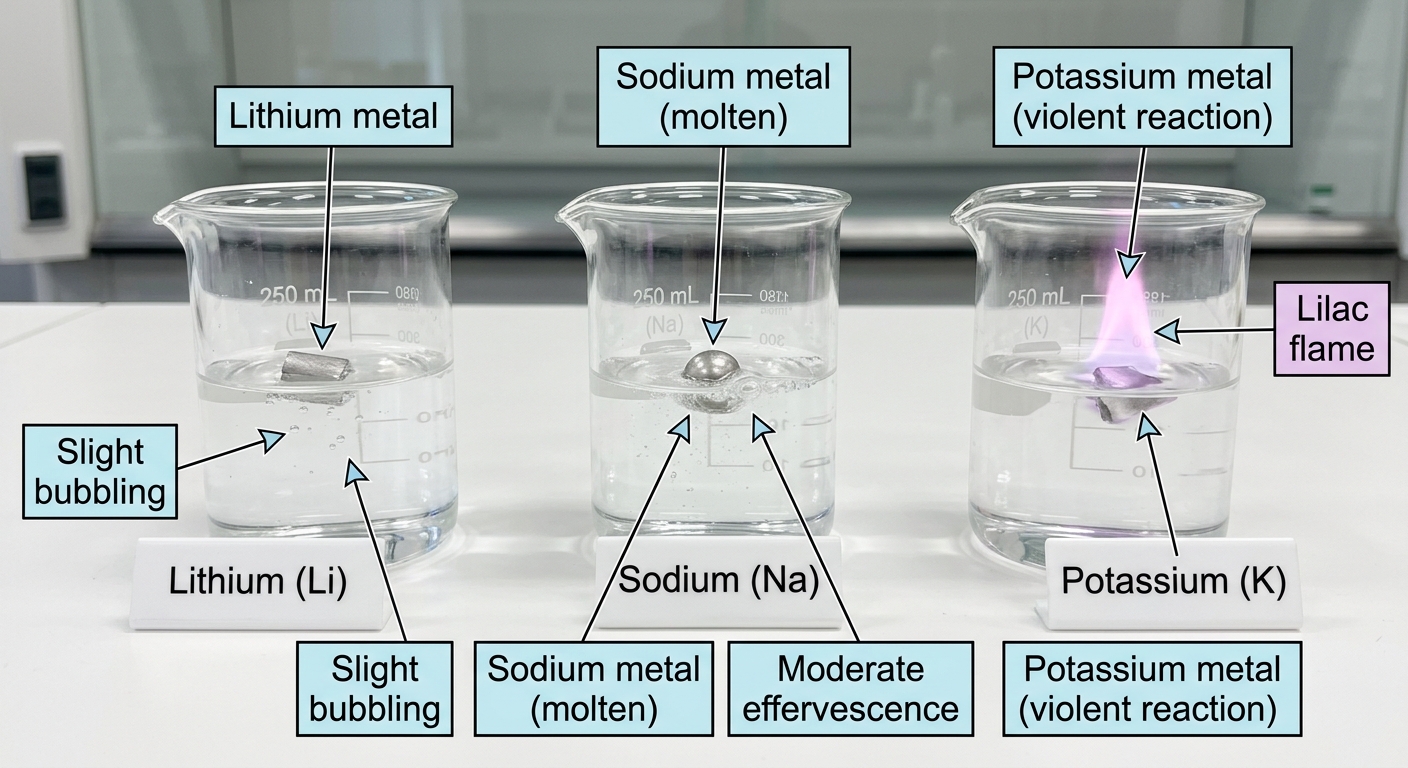
When Group 1 metals react with water at room temperature, the following observations are recorded:
Lithium: fizzes gently, moves slowly on the water surface.
Sodium: fizzes vigorously, moves rapidly, melts into a ball.
Potassium: reacts violently, ignites with a lilac flame, moves extremely fast.
Lithium: fizzes gently, moves slowly on the water surface.
Sodium: fizzes vigorously, moves rapidly, melts into a ball.
Potassium: reacts violently, ignites with a lilac flame, moves extremely fast.
a
Identify the trend in reactivity down Group 1 and use the observations above to support your answer. [2]
b
Rubidium (Rb) is a Group 1 element below potassium. Deduce the products of its reaction with water and write a balanced chemical equation, including state symbols. [2]
c
Justify the predicted reactivity of rubidium relative to potassium by explaining how atomic radius, electron shielding, and ionisation energy change down Group 1, and linking these changes to the ease of losing the valence electron. [4]
Solutions
That's every free question here — 4 of 80.
+76 more questions, plus Mock Papers & Worksheets, are waiting in Premium.