You're viewing free preview questions — 4 questions previewing here — subscribe to unlock 68 more, plus the Full Question Bank, Mock Papers & Worksheets.Upgrade
Periodic Trends and Element Properties — Free MYP4 Chemistry Practice Questions

1QuestionPredicting Properties of Unknown ElementsAssessment Practice
3 marks~5 minCriterion C
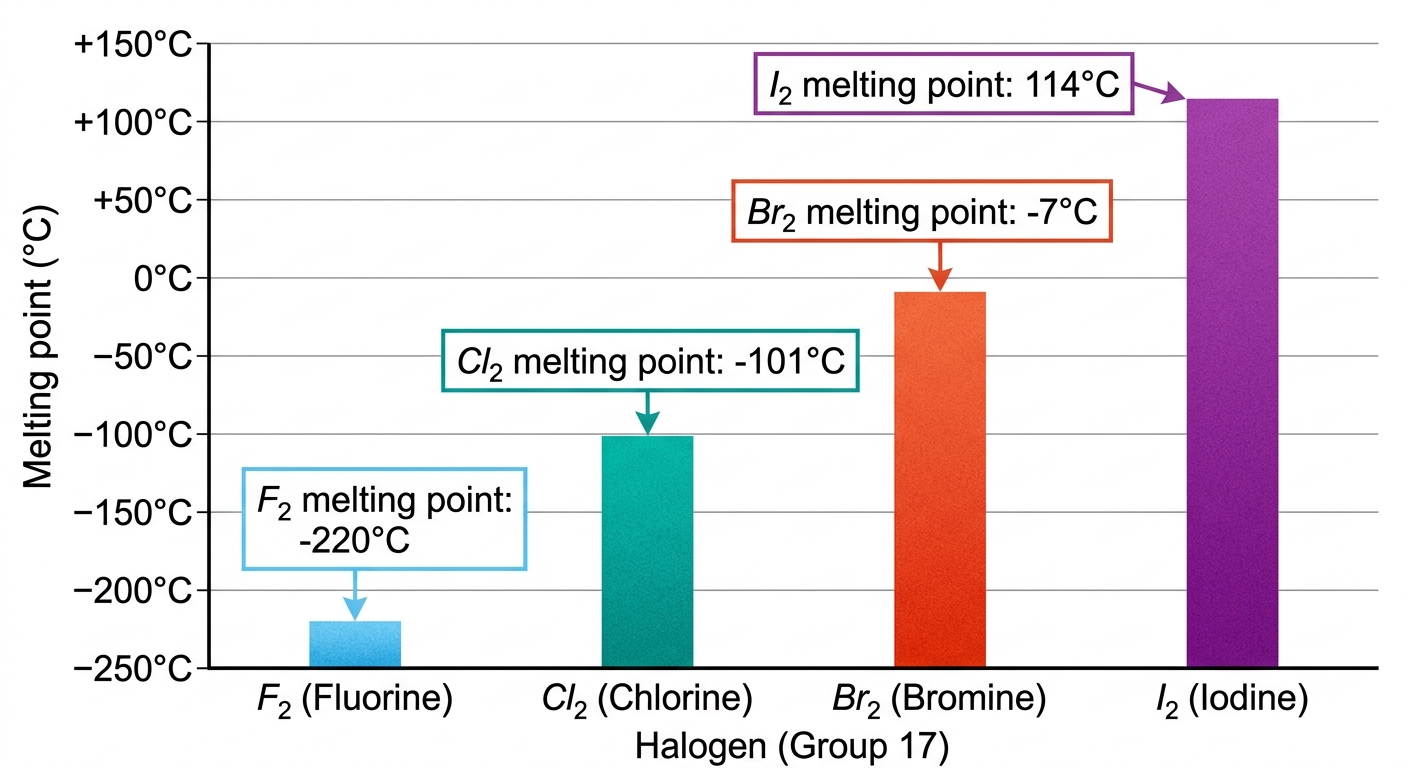
The melting points of the Group 17 halogens are given below.
:
:
:
:
:
:
:
:
a
Describe the trend in melting points down Group 17 from to . [1]
b
Explain why this trend occurs, referring to intermolecular forces and molecular properties. [1]
c
Astatine () lies below iodine in Group 17. Evaluate whether the trend established in (a) and (b) is sufficient to predict a reliable melting point for , and state your predicted value with justification. [1]

Solutions
2QuestionPredicting Properties of Unknown ElementsAssessment Practice
5 marks~8 minCriterion B
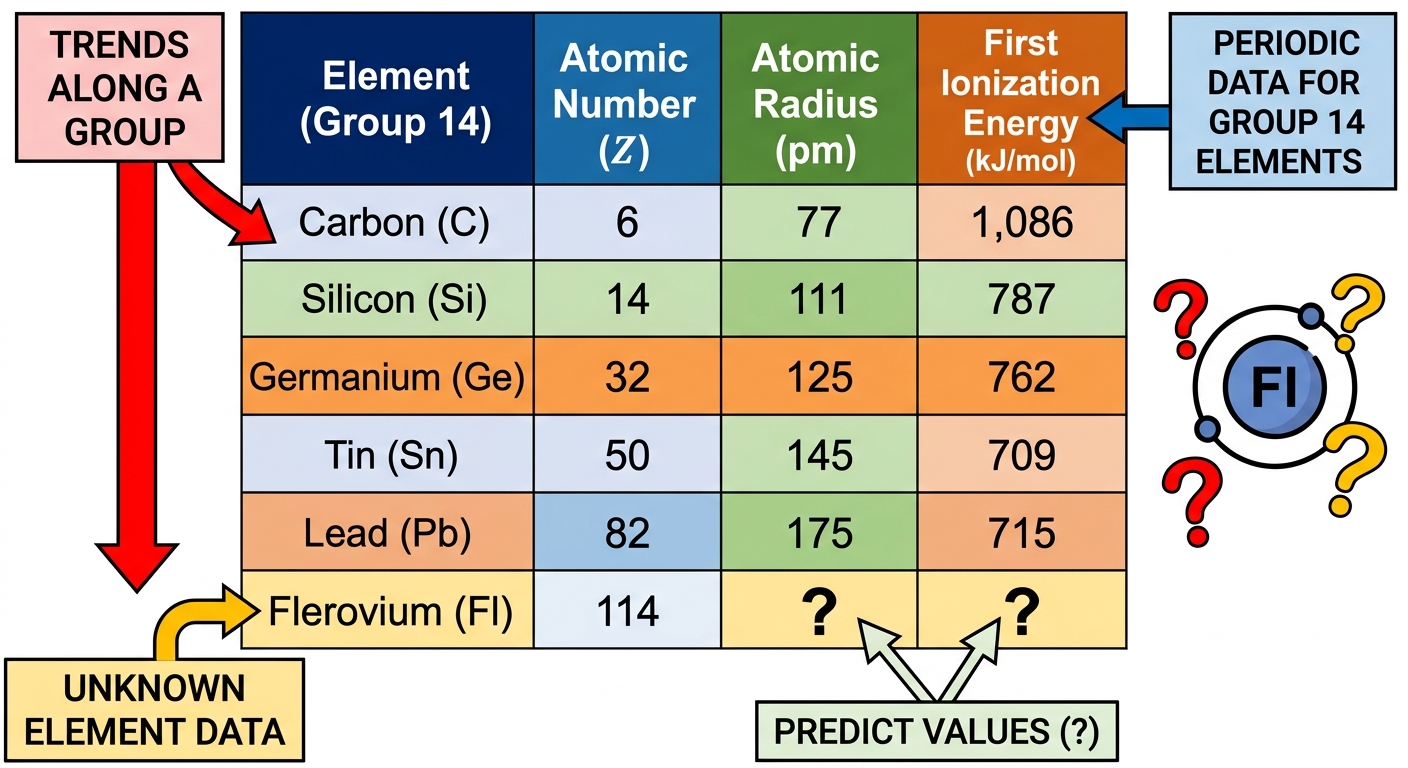
The table below shows atomic radius and first ionisation energy for Group 14 elements.
Flerovium (Fl, element 114) is a synthetic Group 14 element positioned below lead.
| Element | C | Si | Ge | Sn | Pb | Fl |
|---|---|---|---|---|---|---|
| Atomic radius (pm) | 77 | 111 | 125 | 145 | 175 | ? |
| First ionisation energy (kJ/mol) | 1086 | 787 | 762 | 709 | 715 | ? |
Flerovium (Fl, element 114) is a synthetic Group 14 element positioned below lead.
a
Explain the trend in atomic radius from C to Pb, and deduce the atomic radius of Fl. [2]
b
Explain the trend in first ionisation energy from C to Pb, and deduce the first ionisation energy of Fl. [2]
c
Construct a balanced chemical equation, with state symbols, for the reaction of Fl with oxygen. Justify the oxidation state you have assigned to Fl, referring to trends in Group 14. [1]
Solutions
3QuestionTrends in Atomic Radius Ionization EnergyAssessment Practice
6 marks~9 minCriterion D
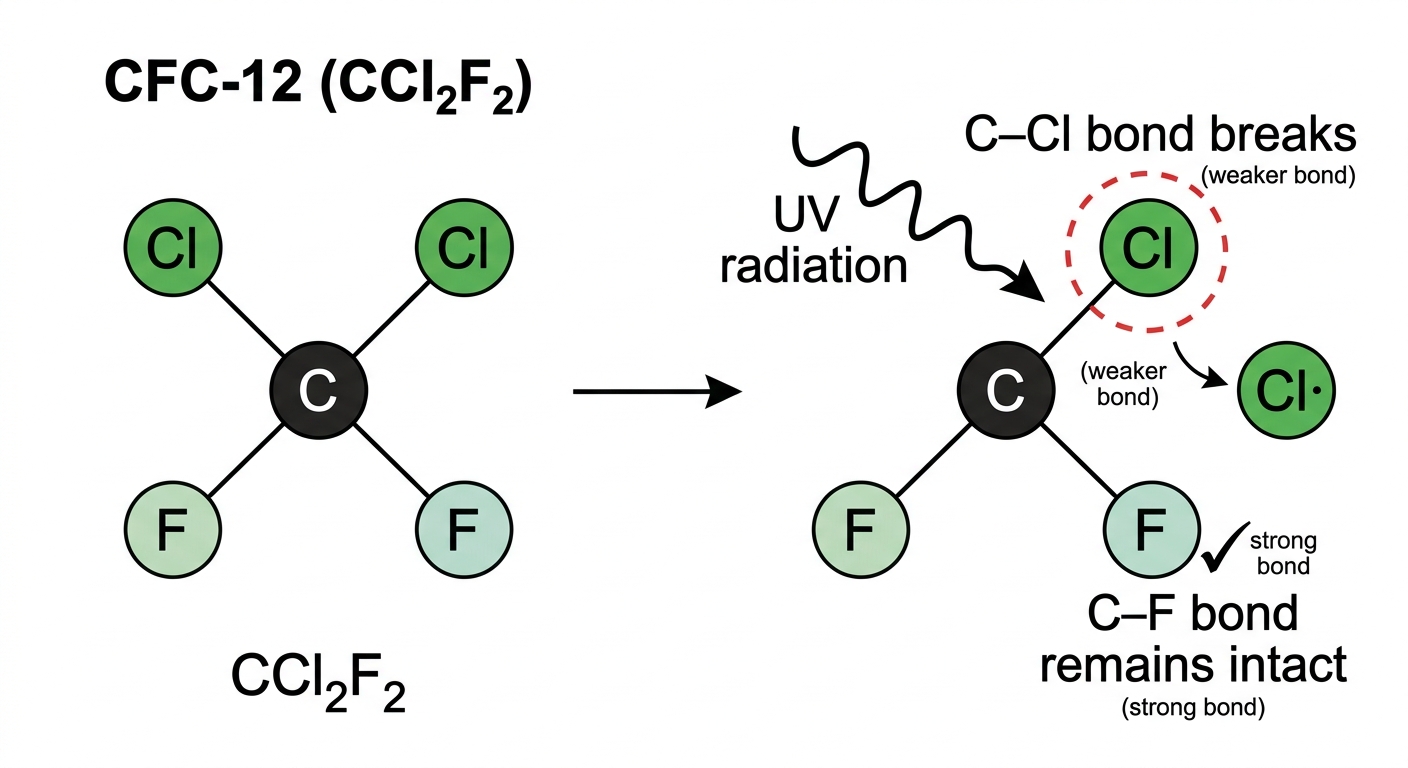
Dichlorodifluoromethane (), known as CFC-12, was widely used in refrigerators and aerosol sprays. When released into the atmosphere, it rises to the stratosphere where ultraviolet (UV) radiation breaks chemical bonds, releasing halogen atoms that can destroy ozone () molecules.
First ionization energies of the halogens in CFC-12:
F:
Cl:
First ionization energies of the halogens in CFC-12:
F:
Cl:
a
Using the ionization energy data, explain why the C–F bond in CFC-12 is more resistant to UV breakdown than the C–Cl bond. [2]
b
Explain how the difference in bond stability between C–F and C–Cl bonds affects the ability of CFC-12 to deplete the ozone layer. [2]
c
Evaluate the reliability of using ionization energy alone to predict which halogen-containing compounds pose the greatest risk to the ozone layer. [2]
Solutions
4QuestionTrends in Atomic Radius Ionization EnergyAssessment Practice
6 marks~9 minCriterion A
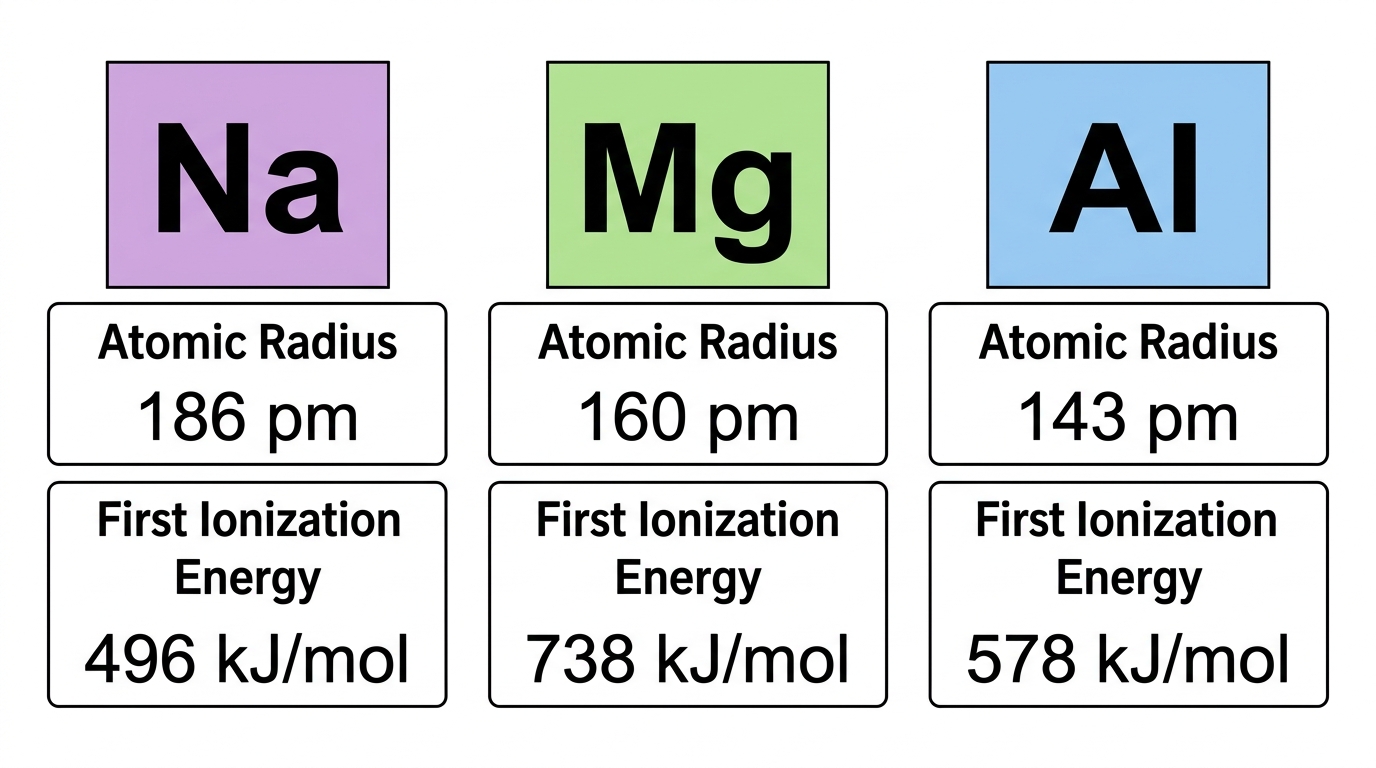
The table below shows atomic radius and first ionisation energy for three consecutive Period 3 elements.
Atomic radius (pm): : 186, : 160, : 143
First ionisation energy (kJ mol): : 496, : 738, : 578
Atomic radius (pm): : 186, : 160, : 143
First ionisation energy (kJ mol): : 496, : 738, : 578
a
Describe the trend in atomic radius from to , quoting the data. [2]
b
Explain, using nuclear charge and electron shielding, why atomic radius decreases across this period. [2]
c
Analyse the first ionisation energy data, accounting for both the general trend from to and the anomaly at . [2]
Solutions
That's every free question here — 4 of 72.
+68 more questions, plus Mock Papers & Worksheets, are waiting in Premium.