You're viewing free preview questions — 6 questions previewing here — subscribe to unlock 78 more, plus the Full Question Bank, Mock Papers & Worksheets.Upgrade
Back

Balancing Equations and Conservation of Mass — Free MYP4 Chemistry Practice Questions

Free questions

Open in full, with answers, mark scheme and examiner insights.

Question 1Criterion A · Band 1-4 · Easy · 4 marksrevisionprep.com

Balancing Simple Chemical Equations

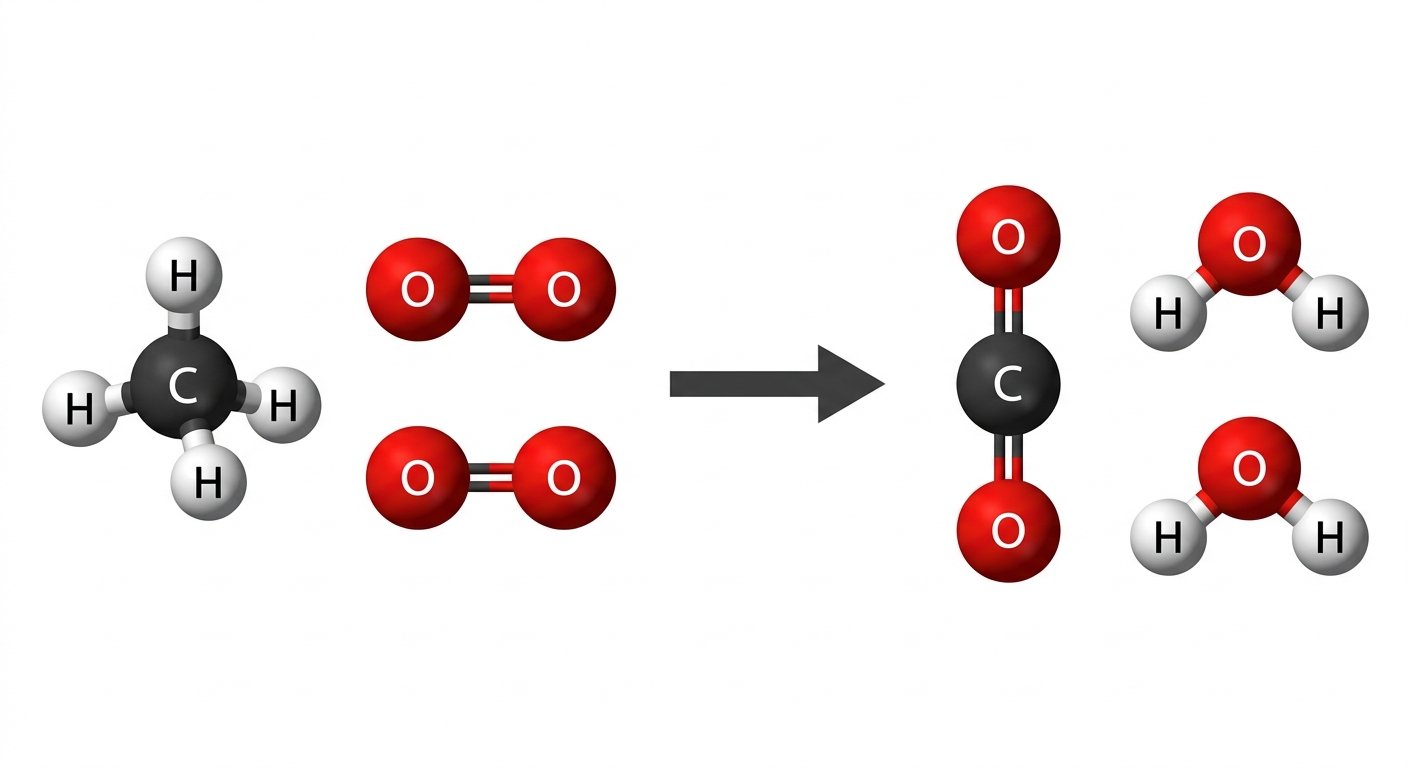
The diagram shows the molecules taking part in the combustion of methane. Carbon atoms are black, oxygen atoms red and hydrogen atoms white.
Question diagram
(a)
Write the formula of each substance shown in the diagram. [1]Criterion A (ii) · Level 1-2
(b)
Write the balanced symbol equation, with state symbols, for this reaction taking place at 120 °C. [2]Criterion A (ii) · Level 3-4
(c)
Explain how the diagram shows that mass is conserved. [1]Criterion A (i) · Level 3-4

revisionprep.com

Summary Answer

Not available for this question.

Model Answer

Not available for this question.

Marking Scheme

Not available for this question.

Examiner Insights

Not available for this question.

Question 2Criterion A · Band 1-4 · Easy · 7 marksrevisionprep.com

Predicting Products Using Balanced Equations

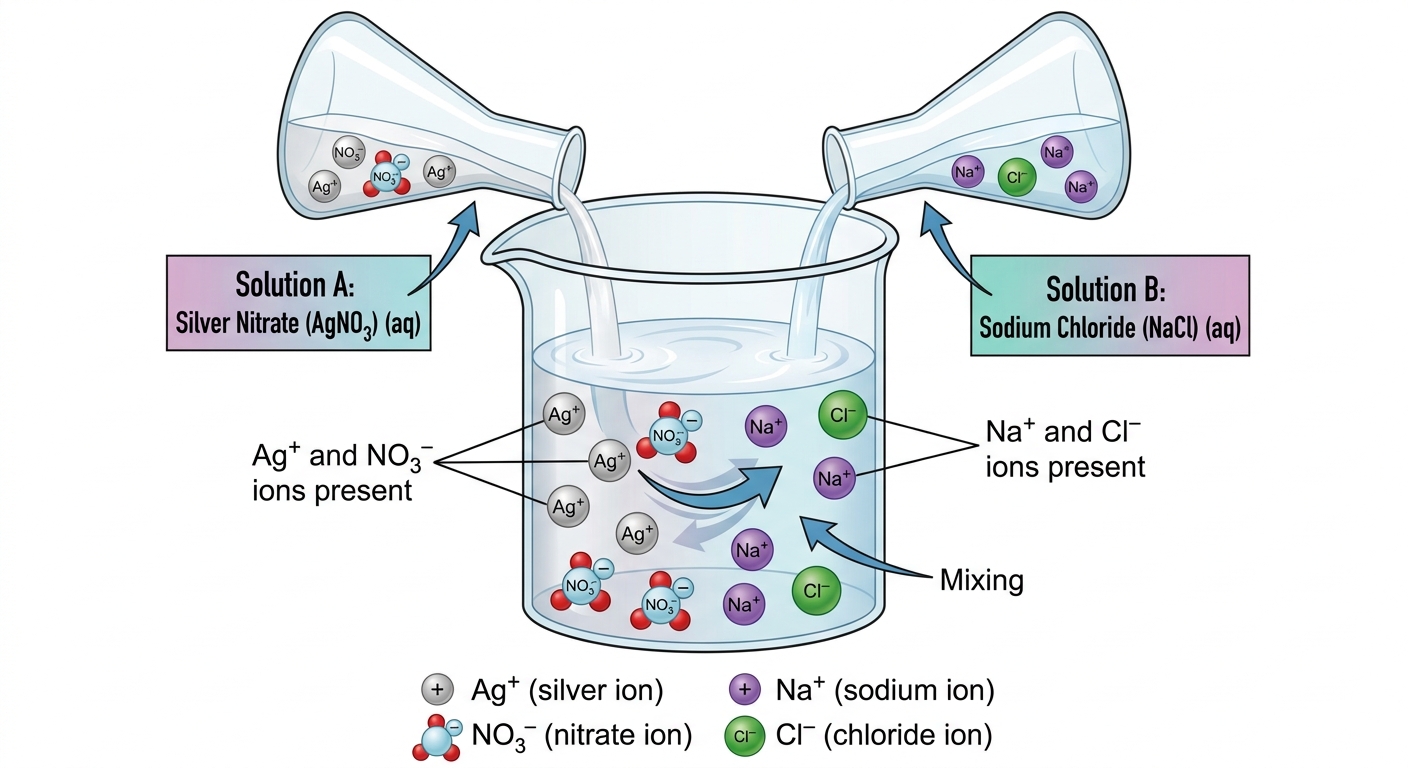
The diagram shows silver nitrate solution and sodium chloride solution being mixed, and the ions present in each. Silver chloride is insoluble; sodium nitrate is soluble.

Relative formula masses: AgNO3\mathrm{AgNO_{3}} = 170, AgCl = 143.5.
Question diagram
(a)
Predict the formula of the precipitate. [1]Criterion A (ii) · Level 1-2
(b)
Write the balanced equation, with state symbols, for the reaction. [2]Criterion A (ii) · Level 3-4
(c)
Identify the spectator ions, and write the ionic equation for the reaction. [2]Criterion A (iii) · Level 3-4
(d)
Calculate the mass of precipitate formed from 1.70 g of silver nitrate with excess sodium chloride. [2]Criterion A (ii) · Level 3-4

revisionprep.com

Summary Answer

Not available for this question.

Model Answer

Not available for this question.

Marking Scheme

Not available for this question.

Examiner Insights

Not available for this question.

Question 3Criterion C + A · Band 3-6 · Medium · 8 marksrevisionprep.com

Law of Conservation of Mass

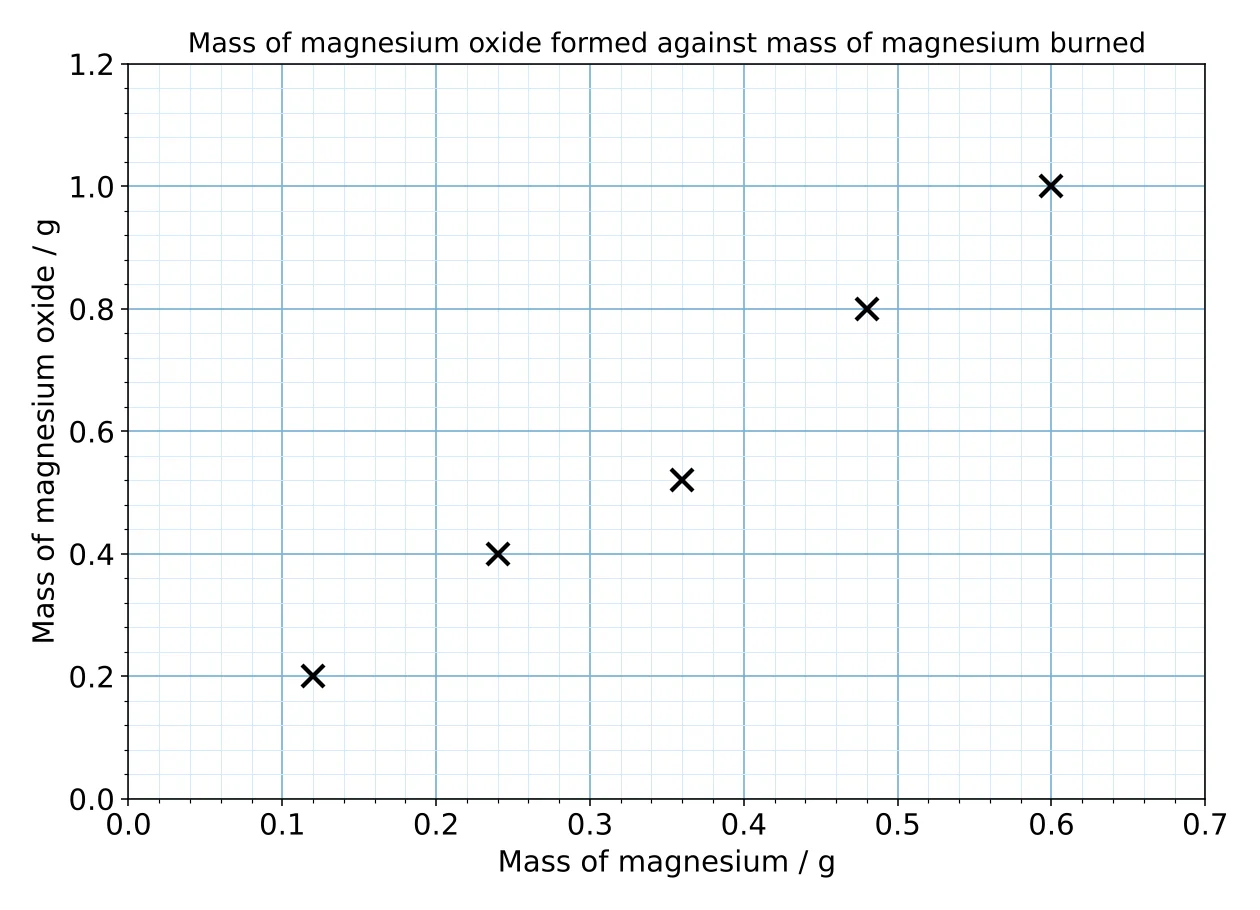
A class burns different masses of magnesium in crucibles and weighs the magnesium oxide formed. Their results are plotted on the graph.
Question diagram
(a)
Identify the anomalous point and suggest one reason for it. [2]Criterion C (ii) · Level 5-6
(b)
Determine the gradient of the line of best fit, ignoring the anomalous point. [2]Criterion C (i) · Level 5-6
(c)
State what the gradient tells you about the masses of magnesium and magnesium oxide. [1]Criterion C (ii) · Level 5-6
(d)
Use the gradient to calculate the mass of oxygen that combines with 0.90 g of magnesium. [2]

(e) Explain why the line of best fit passes through the origin. [1]
Criterion C (ii) · Level 5-6

revisionprep.com

Summary Answer

Not available for this question.

Model Answer

Not available for this question.

Marking Scheme

Not available for this question.

Examiner Insights

Not available for this question.

Question 4Criterion A + C · Band 3-6 · Medium · 8 marksrevisionprep.com

Mass Changes in Closed and Open Systems

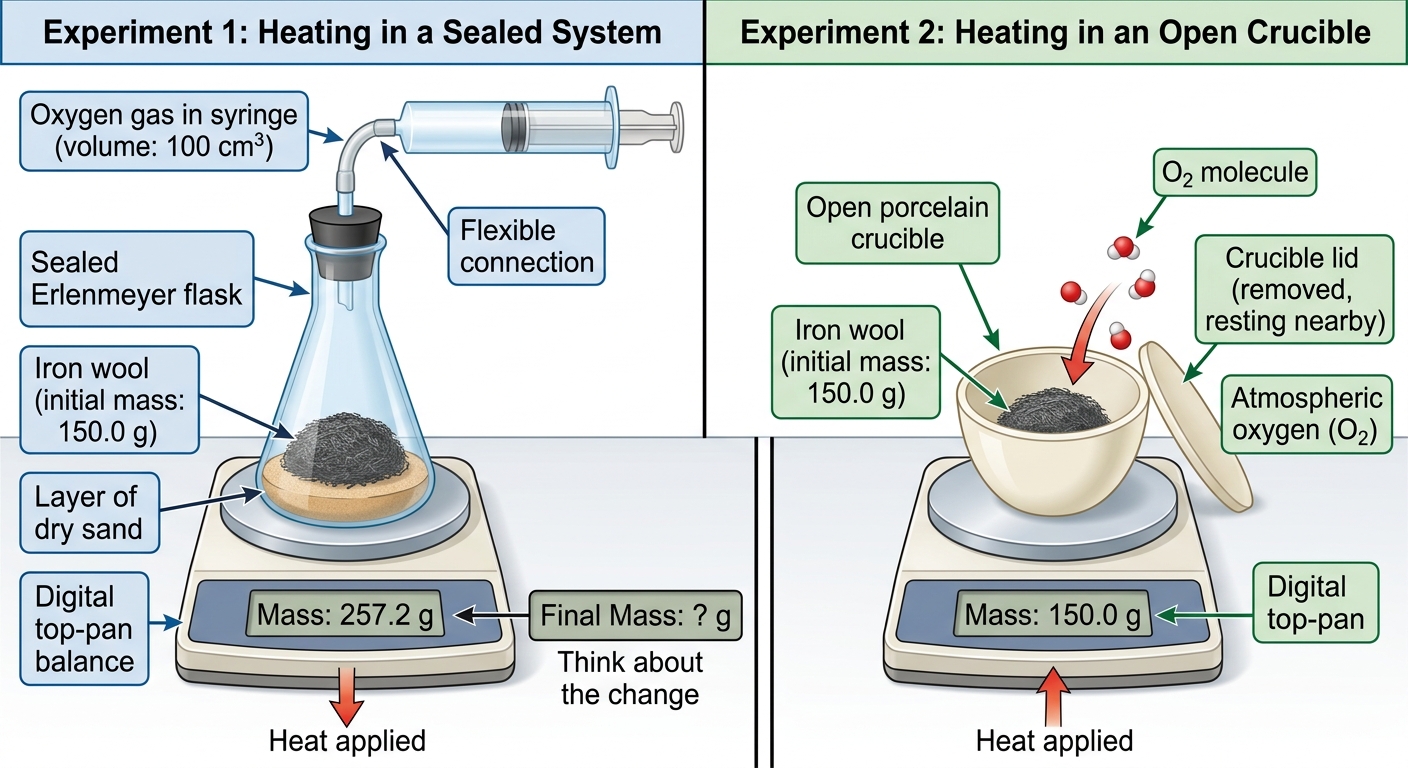
The diagram shows two experiments with 150.0 g of iron wool. In Experiment 1 the iron wool is heated in a sealed flask connected to a syringe of oxygen. In Experiment 2 it is heated in an open crucible; the balance was set to zero with the empty crucible on it.

Fe+O2→Fe2O3\mathrm{Fe + O_{2} \rightarrow Fe_{2}O_{3}}

Relative atomic masses: Fe = 56, O = 16.
Question diagram
(a)
Balance the equation. [1]Criterion A (ii) · Level 3-4
(b)
Predict the final balance reading in Experiment 1, and give a reason. [2]Criterion A (ii) · Level 3-4
(c)
Suggest why the syringe plunger moves inwards during Experiment 1. [1]Criterion C (ii) · Level 5-6
(d)
In Experiment 2 the final reading is 157.2 g. Calculate the mass of oxygen that combined with the iron and the mass of iron that reacted. [3]

(e) Suggest why only part of the iron wool reacted in Experiment 2. [1]
Criterion C (i) · Level 5-6

revisionprep.com

Summary Answer

Not available for this question.

Model Answer

Not available for this question.

Marking Scheme

Not available for this question.

Examiner Insights

Not available for this question.

Question 5Criterion D + A · Band 3-8 · Challenge · 9 marksrevisionprep.com

Law of Conservation of Mass

The diagram shows a plant that makes 1000 tonnes of ammonia each day. Nitrogen comes from the air, and hydrogen is made from natural gas in the steam reformer.

N2(g)+3H2(g)→2NH3(g)\mathrm{N_{2}(g) + 3H_{2}(g) \rightarrow 2NH_{3}(g)}

Relative atomic masses: N = 14, H = 1.
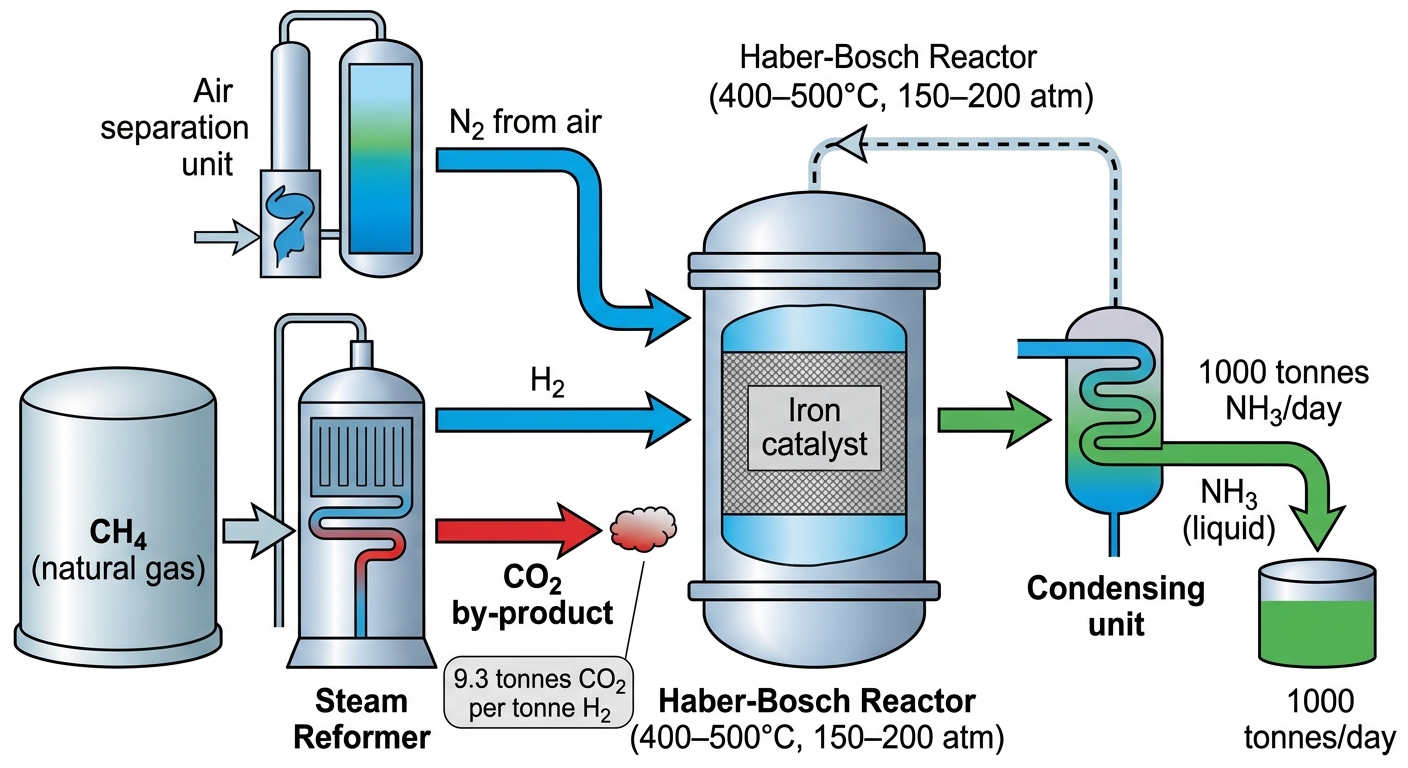
Question diagram
(a)
Calculate the masses of nitrogen and hydrogen needed each day, assuming they are all converted into ammonia. [3]Criterion A (ii) · Level 5-6
(b)
Use the information in the diagram to calculate the mass of carbon dioxide released each day by hydrogen production. [1]Criterion D (i) · Level 3-4
(c)
Explain why the mass of ammonia produced equals the total mass of nitrogen and hydrogen used. [1]Criterion A (i) · Level 3-4
(d)
Ammonia from plants like this is used to make fertilisers that grow about half of the world's food. Discuss the benefits and drawbacks of the process, and suggest one way the carbon dioxide released could be reduced. [4]Criterion D (i), D (ii) · Level 7-8

revisionprep.com

Summary Answer

Not available for this question.

Model Answer

Not available for this question.

Marking Scheme

Not available for this question.

Examiner Insights

Not available for this question.

Question 6Criterion B + A · Band 3-8 · Challenge · 10 marksrevisionprep.com

Balancing Complex Reactions with Polyatomic Ions

Kofi plans to investigate how the mass of precipitate depends on the volume of sodium hydroxide solution added to 25 cm³ of copper(II) sulfate solution. A blue precipitate of copper(II) hydroxide forms.

CuSO4(aq)+NaOH(aq)→Cu(OH)2(s)+Na2SO4(aq)\mathrm{CuSO_{4}(aq) + NaOH(aq) \rightarrow Cu(OH)_{2}(s) + Na_{2}SO_{4}(aq)}
(a)
Balance the equation. [1]Criterion A (ii) · Level 3-4
(b)
Formulate a hypothesis for Kofi's investigation and explain it using the balanced equation. [3]Criterion B (ii) · Level 7-8
(c)
Identify the independent variable, the dependent variable and two control variables. [2]Criterion B (iii) · Level 5-6
(d)
Describe how Kofi should obtain an accurate mass of dry precipitate for each volume, and how many volumes he should test. [4]Criterion B (iii), B (iv) · Level 5-6

revisionprep.com

Summary Answer

Not available for this question.

Model Answer

Not available for this question.

Marking Scheme

Not available for this question.

Examiner Insights

Not available for this question.

That's every free question here — 6 of 84.

+78 more questions, plus Mock Papers & Worksheets, are waiting in Premium.

Upgrade