You're viewing free preview questions — 6 questions previewing here — subscribe to unlock 61 more, plus the Full Question Bank, Mock Papers & Worksheets.Upgrade
Back

Chemical Formulas and Equations — Free MYP4 Chemistry Practice Questions

Free questions

Open in full, with answers, mark scheme and examiner insights.

Question 1Criterion A · Band 3-4 · Easy · 7 marksrevisionprep.com

Writing Chemical Formulas of Compounds

The diagram shows the electron arrangements of a sodium atom (11 protons) and a chlorine atom (17 protons), and the ions formed when one electron is transferred.
(a)
State the charge on each ion formed and explain, using the diagram, why each ion has this charge. [3]Criterion A (i) · Level 3-4
(b)
Explain why the formula of sodium chloride is NaCl\mathrm{NaCl} and not NaCl2\mathrm{NaCl_{2}}. [2]Criterion A (i) · Level 3-4
(c)
Oxygen atoms gain two electrons to form oxide ions. Deduce the formula of sodium oxide and justify your answer using ionic charges. [2]Criterion A (ii) · Level 3-4

revisionprep.com

Summary Answer

Not available for this question.

Model Answer

Not available for this question.

Marking Scheme

Not available for this question.

Examiner Insights

Not available for this question.

Question 2Criterion A · Band 1-4 · Easy · 4 marksrevisionprep.com

Word Equations and Symbol Equations

A coil of copper wire is placed in colourless silver nitrate solution. After an hour, grey crystals of silver have grown on the wire and the solution has turned blue because copper(II) nitrate has formed. Silver ions are Ag+\mathrm{Ag^{+}}, copper(II) ions are Cu2+\mathrm{Cu^{2+}} and nitrate ions are NO3−\mathrm{NO_{3}^{-}}.
(a)
Write down the word equation for this reaction. [1]Criterion A (i) · Level 1-2
(b)
Deduce the balanced symbol equation, including state symbols. [2]Criterion A (ii) · Level 3-4
(c)
State one observation which shows that a new substance has formed. [1]Criterion A (i) · Level 1-2

revisionprep.com

Summary Answer

Not available for this question.

Model Answer

Not available for this question.

Marking Scheme

Not available for this question.

Examiner Insights

Not available for this question.

Question 3Criterion B · Band 3-6 · Medium · 9 marksrevisionprep.com

Word Equations and Symbol Equations

Bath bombs fizz in water because sodium hydrogencarbonate reacts with citric acid:

sodium hydrogencarbonate + citric acid → sodium citrate + water + carbon dioxide

A student says: "When a bath bomb fizzes, mass is lost, so mass is not conserved in this reaction." You are asked to plan an investigation to test this claim.
(a)
Explain the problem that the investigation needs to test. [2]Criterion B (i) · Level 3-4
(b)
Formulate a testable hypothesis for an open beaker and for a sealed container, and explain it using the word equation. [2]Criterion B (ii) · Level 5-6
(c)
Explain how you would manipulate the independent variable, measure the dependent variable and control two other variables. [3]Criterion B (iii) · Level 5-6
(d)
Outline how you would collect sufficient data, and state one safety precaution. [2]Criterion B (iii), B (iv) · Level 5-6

revisionprep.com

Summary Answer

Not available for this question.

Model Answer

Not available for this question.

Marking Scheme

Not available for this question.

Examiner Insights

Not available for this question.

Question 4Criterion A · Band 3-6 · Medium · 4 marksrevisionprep.com

State Symbols in Chemical Reactions

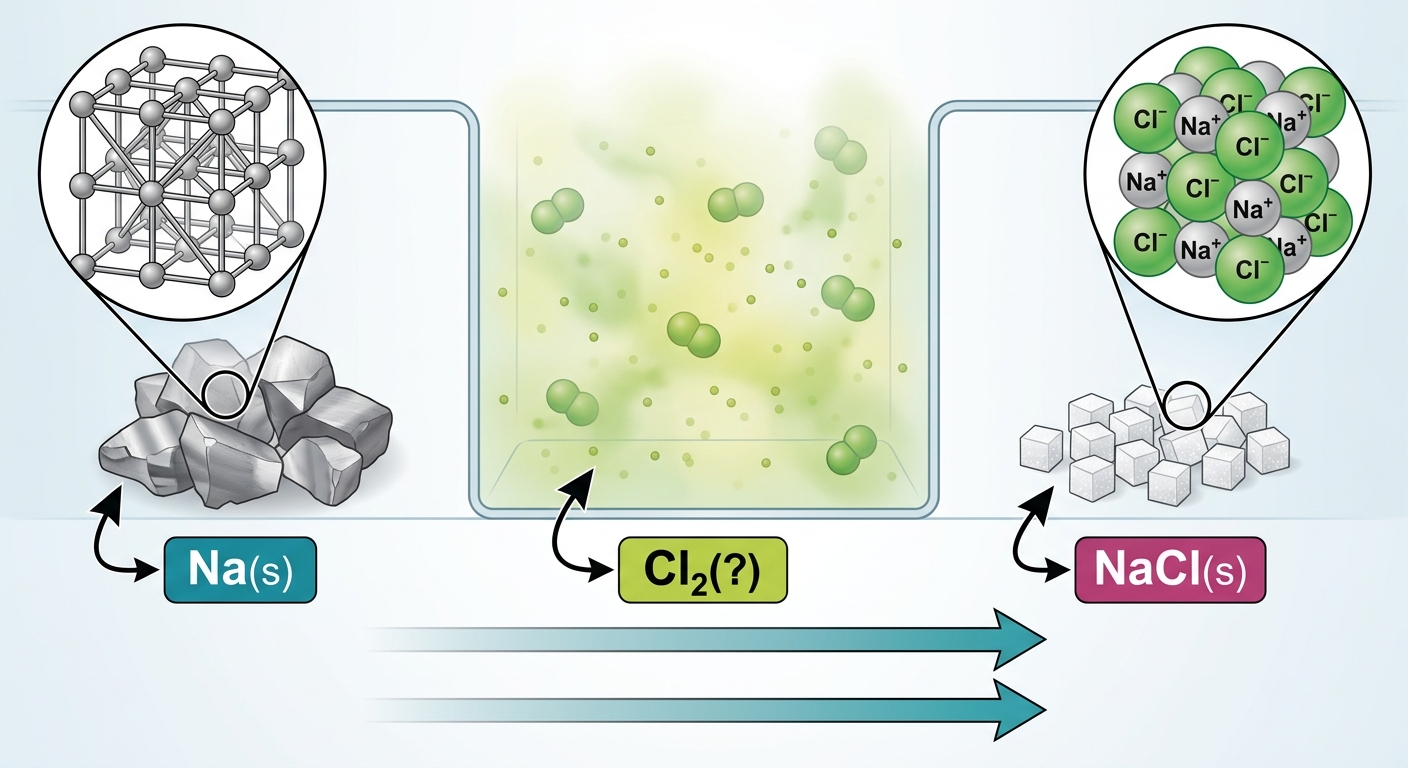
The diagram shows solid sodium reacting with chlorine at room temperature to form sodium chloride. The state symbol for chlorine is missing.
Question diagram
(a)
Deduce the balanced symbol equation, including state symbols, for this reaction. [2]Criterion A (ii) · Level 3-4
(b)
Explain why chlorine is a gas but sodium chloride is a solid at room temperature. [2]Criterion A (i) · Level 5-6

revisionprep.com

Summary Answer

Not available for this question.

Model Answer

Not available for this question.

Marking Scheme

Not available for this question.

Examiner Insights

Not available for this question.

Question 5Criterion C + D · Band 1-8 · Challenge · 9 marksrevisionprep.com

Writing Chemical Formulas of Compounds

Ammonium nitrate, NH4NO3\mathrm{NH_{4}NO_{3}}, and urea, CO(NH2)2\mathrm{CO(NH_{2})_{2}}, are both nitrogen fertilisers. Nitrate from fertilised fields can wash into lakes and cause eutrophication.

Relative atomic masses: H = 1, C = 12, N = 14, O = 16.
(a)
State the number of nitrogen atoms in one formula unit of each fertiliser. [1]Criterion C (ii) · Level 1-2
(b)
Calculate the relative formula mass, Mr\mathrm{M_r}, of each fertiliser. [2]Criterion C (i) · Level 3-4
(c)
Calculate the percentage by mass of nitrogen in each fertiliser. [2]Criterion C (i) · Level 5-6
(d)
A farming co-operative must transport its fertiliser 400 km by truck. Evaluate which fertiliser it should choose, using your answers to (c) and at least one environmental consideration. [4]Criterion D (ii) · Level 7-8

revisionprep.com

Summary Answer

Not available for this question.

Model Answer

Not available for this question.

Marking Scheme

Not available for this question.

Examiner Insights

Not available for this question.

Question 6Criterion D + A · Band 1-8 · Challenge · 10 marksrevisionprep.com

Identifying Reactants and Products

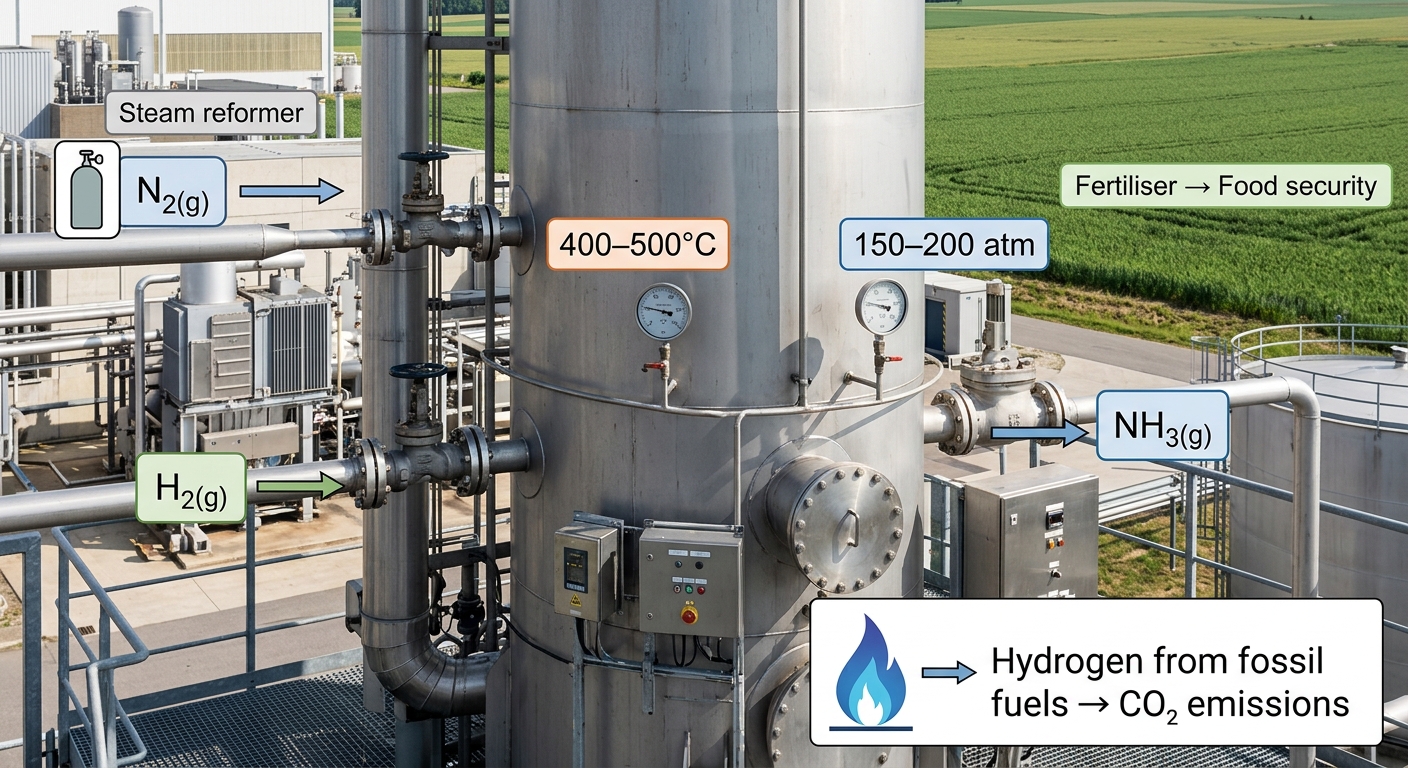
The photograph shows a plant that makes ammonia for fertilisers:

N2(g)+3H2(g)⇌2NH3(g)\mathrm{N_{2}(g)} + \mathrm{3H_{2}(g)} \rightleftharpoons \mathrm{2NH_{3}(g)}

The hydrogen is made from methane and steam in a reformer:

CH4+H2O→CO2+H2\mathrm{CH_{4}} + \mathrm{H_{2}O} \rightarrow \mathrm{CO_{2}} + \mathrm{H_{2}} (unbalanced)
Question diagram
(a)
Identify the reactants and the product of the ammonia reaction, using the labels in the photograph. [1]Criterion A (i) · Level 1-2
(b)
State what the symbol ⇌\rightleftharpoons shows about this reaction. [1]Criterion A (i) · Level 3-4
(c)
Deduce the balanced symbol equation for the reformer reaction. [2]Criterion A (ii) · Level 5-6
(d)
Use the two equations to deduce how many molecules of CO2\mathrm{CO_{2}} are produced for every 2 molecules of NH3\mathrm{NH_{3}} made. [2]

(e) "Green ammonia" uses hydrogen made by electrolysis of water powered by wind or solar electricity. Discuss whether countries should switch to green ammonia. Refer to at least two perspectives. [4]
Criterion D (i) · Level 5-6

revisionprep.com

Summary Answer

Not available for this question.

Model Answer

Not available for this question.

Marking Scheme

Not available for this question.

Examiner Insights

Not available for this question.

That's every free question here — 6 of 67.

+61 more questions, plus Mock Papers & Worksheets, are waiting in Premium.

Upgrade