You're viewing free preview questions — 6 questions previewing here — subscribe to unlock 88 more, plus the Full Question Bank, Mock Papers & Worksheets.Upgrade
Back

Reactivity series and displacement — Free MYP4 Chemistry Practice Questions

Free questions

Open in full, with answers, mark scheme and examiner insights.

Question 1Criterion A · Band 1-4 · Easy · 4 marksrevisionprep.com

Predicting Products Based on Reactivity
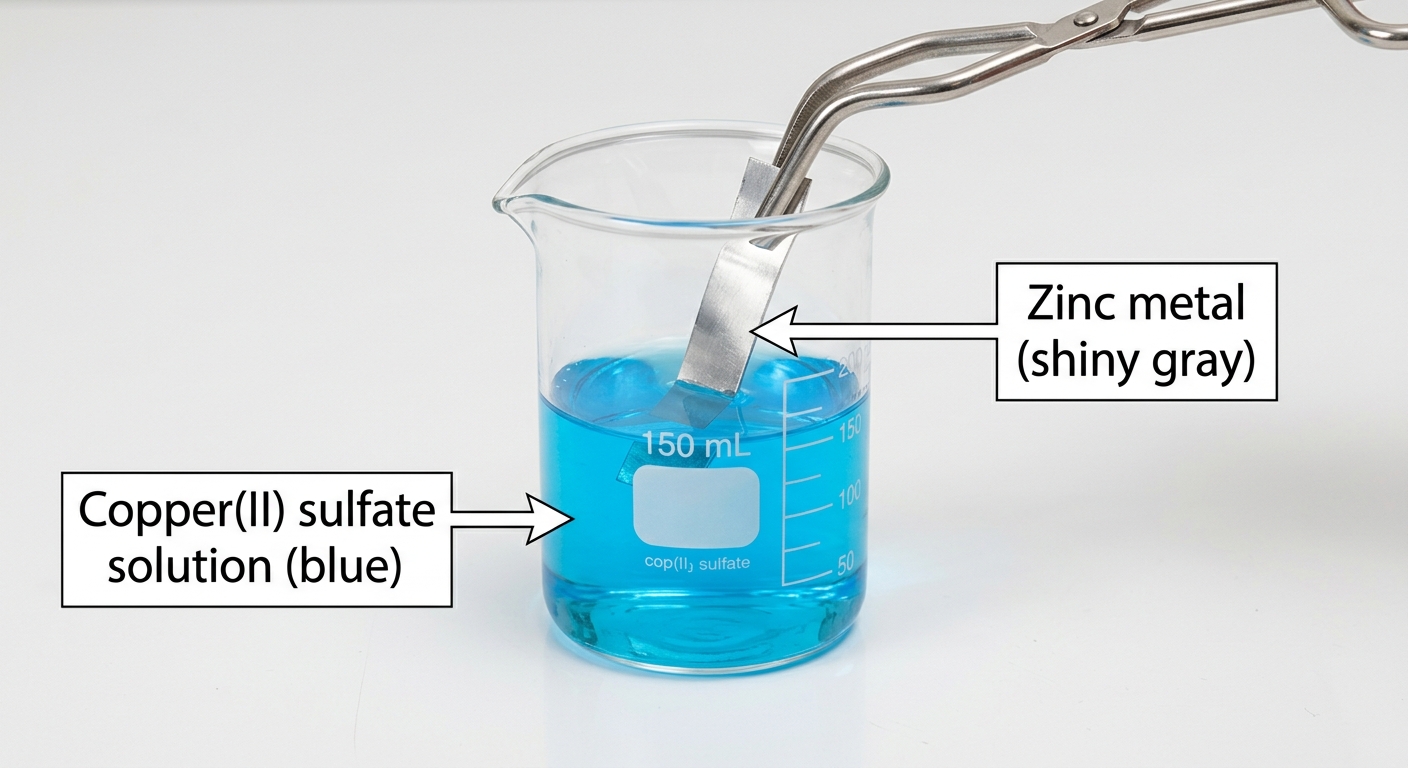
A student places a strip of zinc metal into a solution of copper(II) sulfate. Within minutes, a reddish-brown solid coats the zinc surface and the blue colour of the solution fades.
Question diagram
(a)
State the name of this reaction type. [1]Criterion A (i) · Level 1-2
(b)
Deduce which metal is more reactive, and write the balanced ionic equation for the reaction. [1]Criterion A (ii) · Level 3-4
(c)
Explain why the reddish-brown solid forms and why the blue colour fades, using the reactivity series and electron transfer. [2]Criterion A (i) · Level 3-4

revisionprep.com

Summary Answer

Not available for this question.

Model Answer

Not available for this question.

Marking Scheme

Not available for this question.

Examiner Insights

Not available for this question.

Question 2Criterion A · Band 1-4 · Easy · 4 marksrevisionprep.com

Applications of Reactivity in Industry and Everyday Life
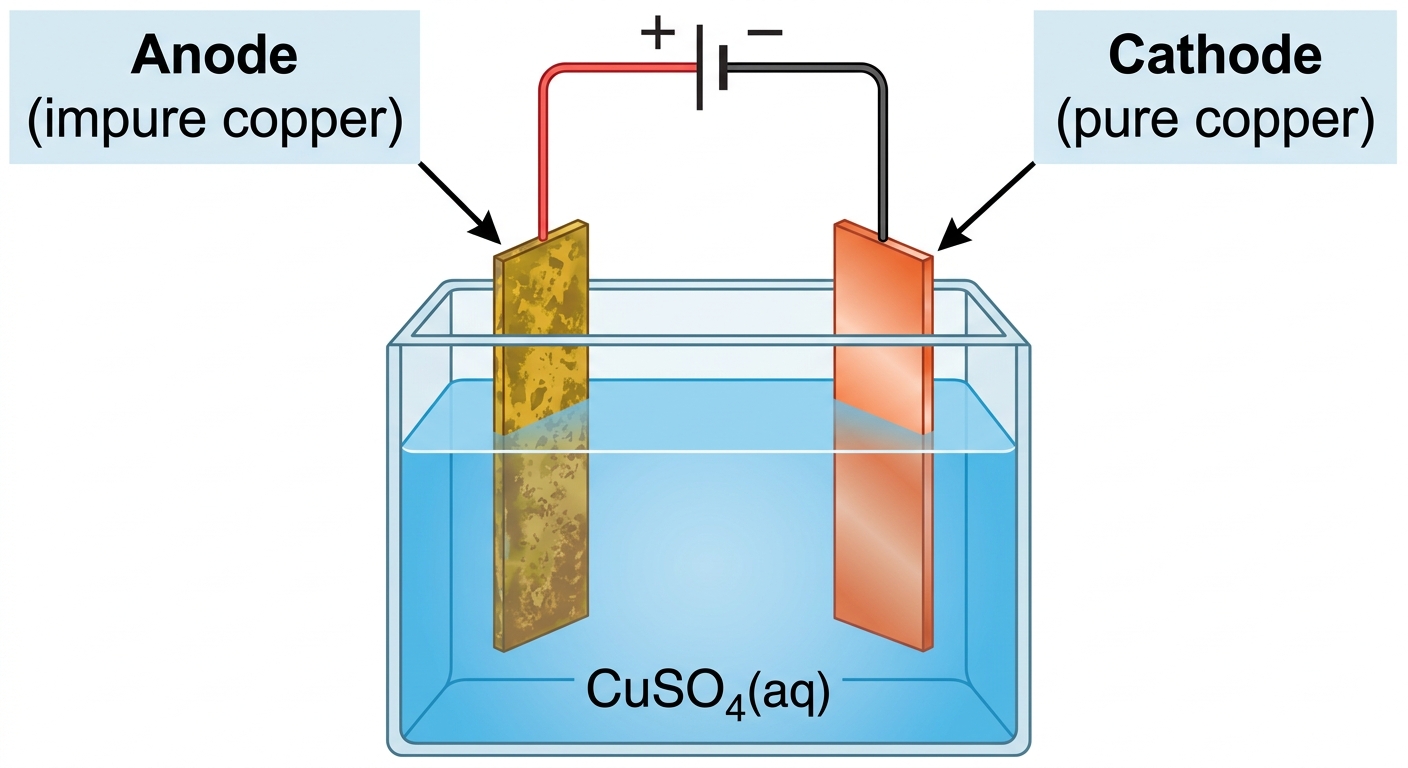
The diagram shows a cell used to purify copper. The anode is impure copper, the cathode is pure copper and the electrolyte is copper(II) sulfate solution. Impurities collect as a sludge below the anode.
Question diagram
(a)
Identify the substance deposited on the cathode. [1]Criterion A (i) · Level 1-2
(b)
Write the half-equation for the reaction at the anode. [1]Criterion A (ii) · Level 3-4
(c)
Explain why the copper deposited on the cathode is purer than the anode. [2]Criterion A (i) · Level 3-4

revisionprep.com

Summary Answer

Not available for this question.

Model Answer

Not available for this question.

Marking Scheme

Not available for this question.

Examiner Insights

Not available for this question.

Question 3Criterion C + A · Band 3-6 · Medium · 10 marksrevisionprep.com

Reactivity of metals with water, acid and oxygen

Amara added 0.0050 mol of each of magnesium, zinc and iron powder, in turn, to 50 cm³ of 1.0 mol dm⁻³ hydrochloric acid (an excess). She measured the volume of hydrogen with a gas syringe. Her results are shown in the graph.

At room temperature and pressure, 1 mol of any gas occupies 24.0 dm³.
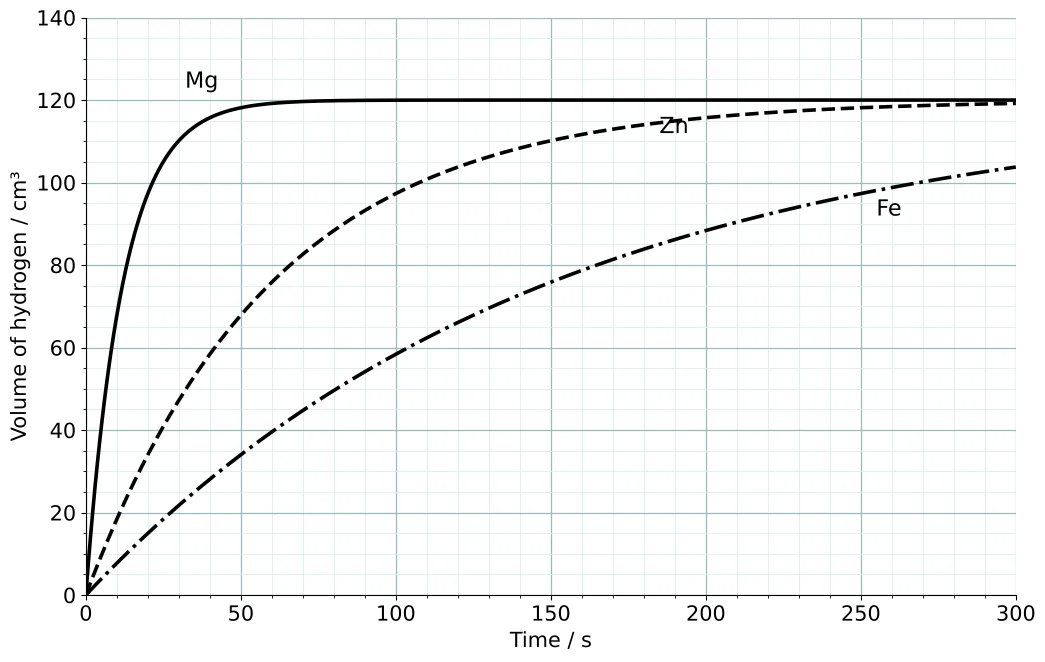
Question diagram
(a)
Use the graph to state the volume of hydrogen produced by zinc in the first 60 s. [1]Criterion C (ii) · Level 3-4
(b)
Calculate the mean rate of hydrogen production for magnesium over the first 20 s. Give the unit. [2]Criterion C (ii) · Level 3-4
(c)
Show that 0.0050 mol of metal produces 120 cm³ of hydrogen. Use M + 2HCl → MCl₂ + H₂. [2]Criterion A (ii) · Level 5-6
(d)
Predict the final volume of hydrogen from iron if the reaction were left to finish, and explain your answer. [1]

(e) Use the gradients of the graphs to deduce the order of reactivity of the three metals, and explain how the graph supports it. [2]

(f) Identify one variable, other than those stated, that Amara must control, and explain why. [2]
Criterion C (ii) · Level 5-6

revisionprep.com

Summary Answer

Not available for this question.

Model Answer

Not available for this question.

Marking Scheme

Not available for this question.

Examiner Insights

Not available for this question.

Question 4Criterion D + A · Band 3-6 · Medium · 6 marksrevisionprep.com

Displacement Reactions Using Metals

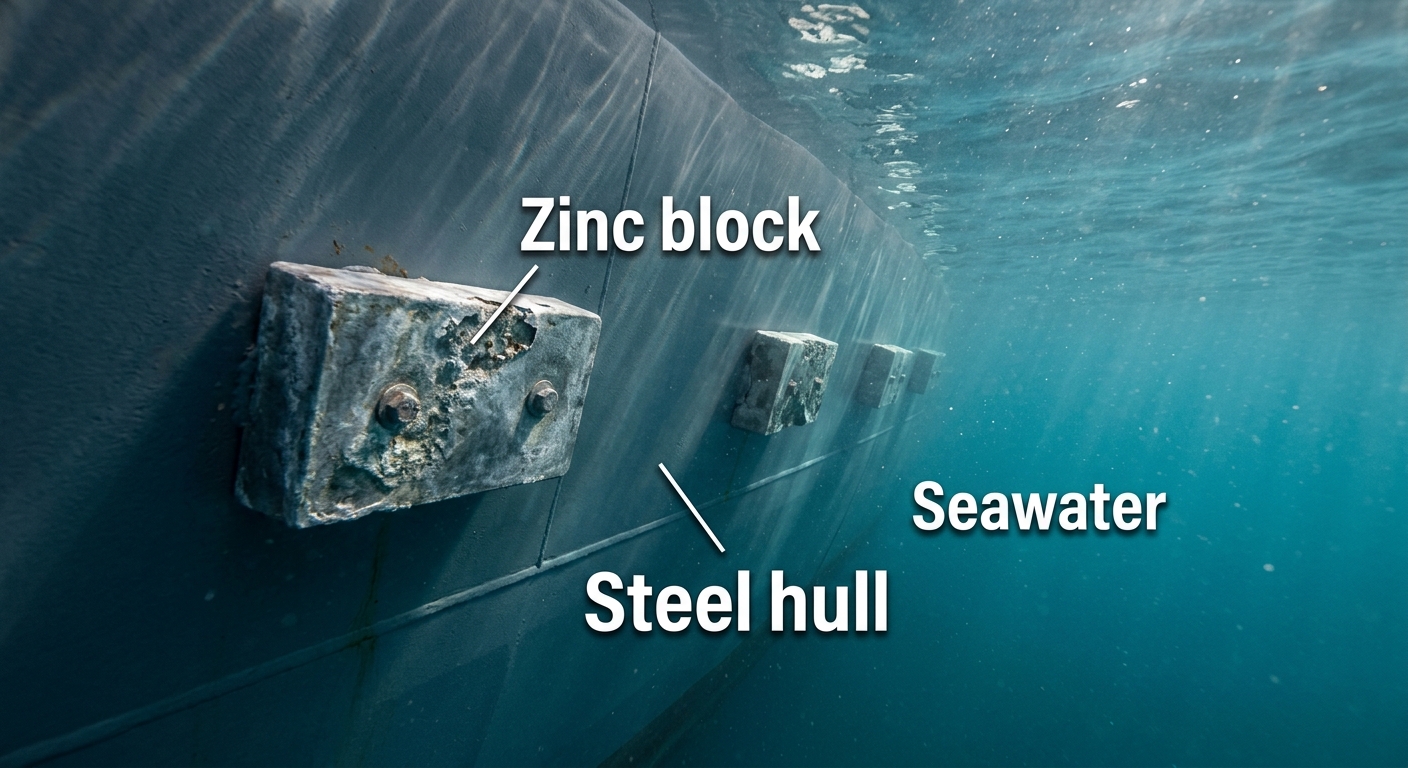
The photograph shows a zinc block bolted to the steel hull of a ship. A new block has a mass of 6.5 kg and loses about 1.3 kg each year. Blocks must be replaced before less than 25% of the original mass remains.
Question diagram
(a)
Explain why zinc blocks protect the steel hull. [1]Criterion A (i) · Level 3-4
(b)
Calculate how long, in years, a block can be left before it reaches 25% of its original mass. [2]Criterion D (i) · Level 5-6
(c)
The ship's owner can replace blocks every 3 years or every 4 years. Justify which interval should be chosen. [1]Criterion D (i) · Level 5-6
(d)
Discuss one implication of fitting zinc blocks for the marine environment around a busy harbour. [2]Criterion D (ii) · Level 5-6

revisionprep.com

Summary Answer

Not available for this question.

Model Answer

Not available for this question.

Marking Scheme

Not available for this question.

Examiner Insights

Not available for this question.

Question 5Criterion B · Band 3-8 · Challenge · 9 marksrevisionprep.com

Corrosion and Methods of prevention

Ravi wants to compare how well four methods protect iron nails from rusting: painting, coating in oil, galvanising (a zinc coating) and wrapping a strip of magnesium around the nail. He will leave the nails in 3% salt water for one week.
(a)
State a focused research question for this investigation. [1]Criterion B (i) · Level 3-4
(b)
Formulate a hypothesis about which methods will protect best, and explain it using scientific reasoning. [2]Criterion B (ii) · Level 5-6
(c)
Explain how Ravi can measure the amount of rusting so that the results can be compared quantitatively. [2]Criterion B (iii) · Level 5-6
(d)
Identify two variables that must be controlled and explain how. [2]

(e) Explain why an untreated nail should also be set up. [1]

(f) Suggest how Ravi could change the method to test which methods still protect the iron when the coating is damaged. [1]
Criterion B (iii) · Level 5-6

revisionprep.com

Summary Answer

Not available for this question.

Model Answer

Not available for this question.

Marking Scheme

Not available for this question.

Examiner Insights

Not available for this question.

Question 6Criterion A + C · Band 3-8 · Challenge · 8 marksrevisionprep.com

The Reactivity Series of Metals

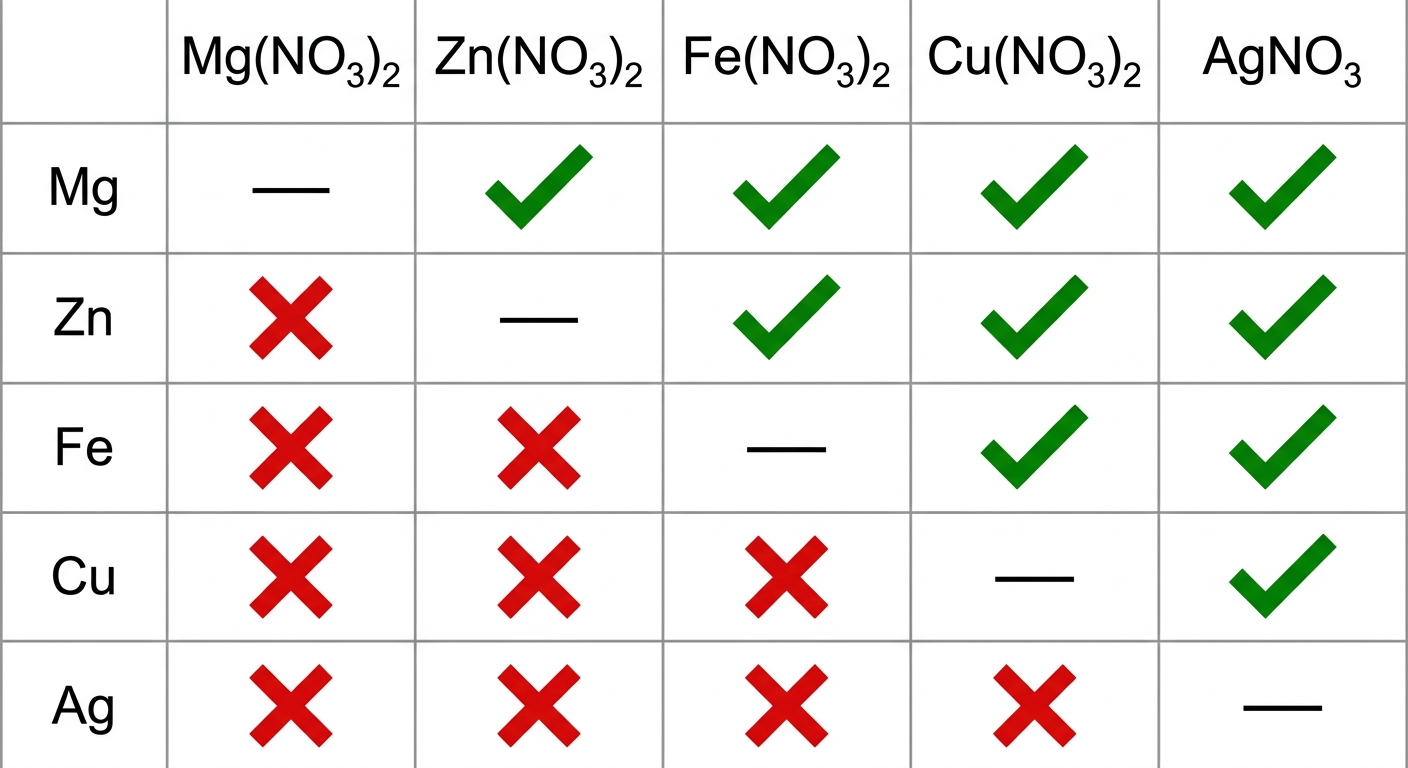
A student investigates displacement reactions by placing five metals into aqueous nitrate solutions of the same metals. The results are shown in the table: a tick means the metal displaced the other metal from solution, a cross means no reaction, and a dash means the metal was not tested in its own solution.

Metal added | Mg(NO₃)₂ | Zn(NO₃)₂ | Fe(NO₃)₂ | Cu(NO₃)₂ | AgNO₃
Mg:✓ ✓ ✓ ✓
Zn✗✓ ✓ ✓
Fe✗ ✗✓ ✓
Cu✗ ✗ ✗✓

Ag: ✗ ✗ ✗ ✗ |
Question diagram
(a)
Deduce the order of decreasing reactivity of the five metals and explain the pattern in the data that allows this order to be determined. [2]Criterion C (ii) · Level 3-4
(b)
Deduce whether a reaction occurs when zinc is placed into iron(II) nitrate solution, Fe(NO₃)₂(aq). Write the balanced chemical equation with state symbols if a reaction occurs, or state "no reaction." [2]Criterion A (ii) · Level 3-4
(c)
A student claims: "Any metal will displace any other metal from its nitrate solution, provided enough time is given." Evaluate this claim by referring to the reactivity order from (a) and explaining the electron transfer process that determines whether displacement occurs. [4]Criterion A (i) · Level 7-8

revisionprep.com

Summary Answer

Not available for this question.

Model Answer

Not available for this question.

Marking Scheme

Not available for this question.

Examiner Insights

Not available for this question.

That's every free question here — 6 of 94.

+88 more questions, plus Mock Papers & Worksheets, are waiting in Premium.

Upgrade