You're viewing free preview questions — 4 questions previewing here — subscribe to unlock 148 more, plus the Full Question Bank, Mock Papers & Worksheets.Upgrade
Reactivity Series and Reaction Predictions — Free MYP4 Chemistry Practice Questions

1QuestionThe Reactivity Series of MetalsConcept Practice
2 marks~3 minCriterion A
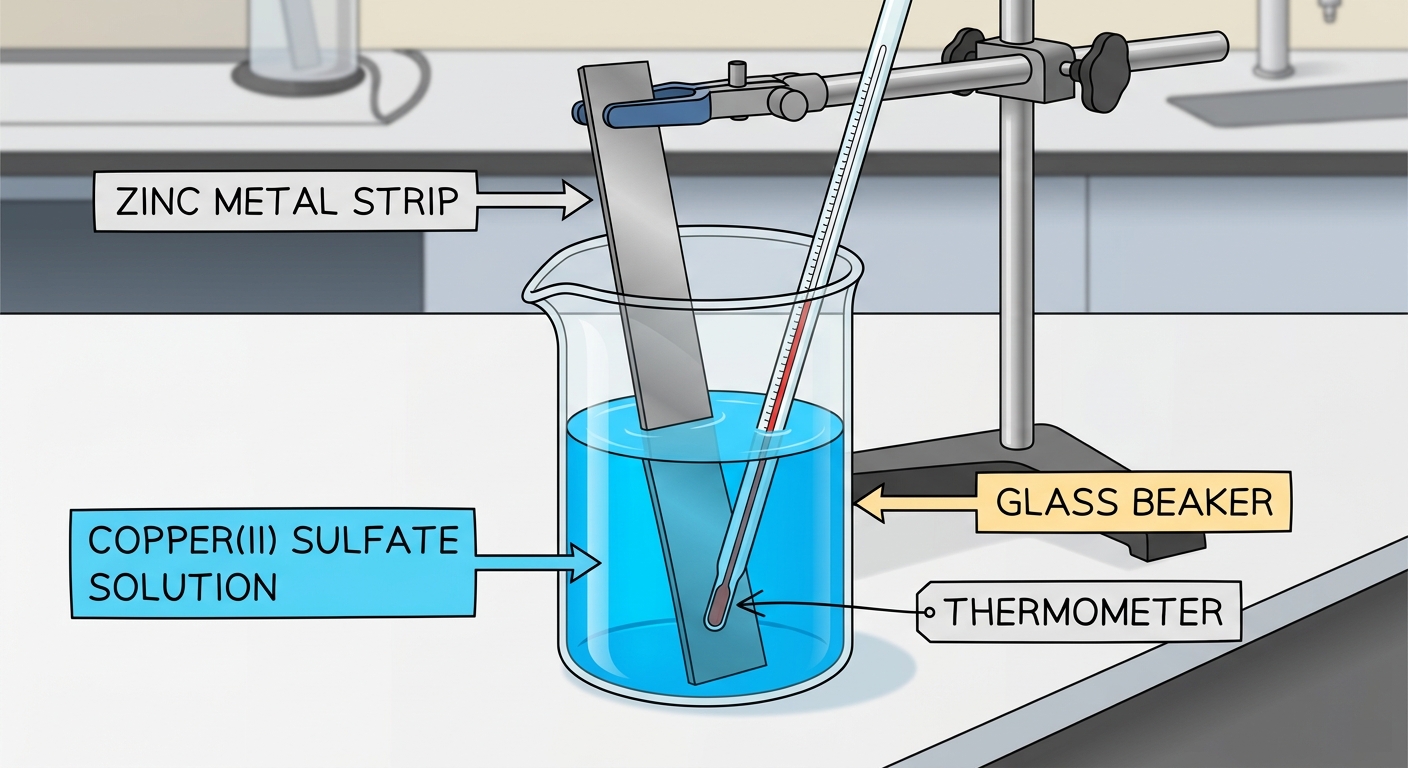
A piece of zinc metal is placed in a beaker containing copper(II) sulfate solution. Over time, a reddish-brown solid forms on the zinc surface and the solution changes colour.
a
Deduce the identity of the reddish-brown solid, and write the balanced chemical equation for this reaction. [1]
b
Explain, using the reactivity series, why zinc displaces copper from solution but copper would not displace zinc if the metals were swapped. [1]

Solutions
2QuestionCorrosion and Methods of preventionAssessment Practice
3 marks~5 minCriterion D
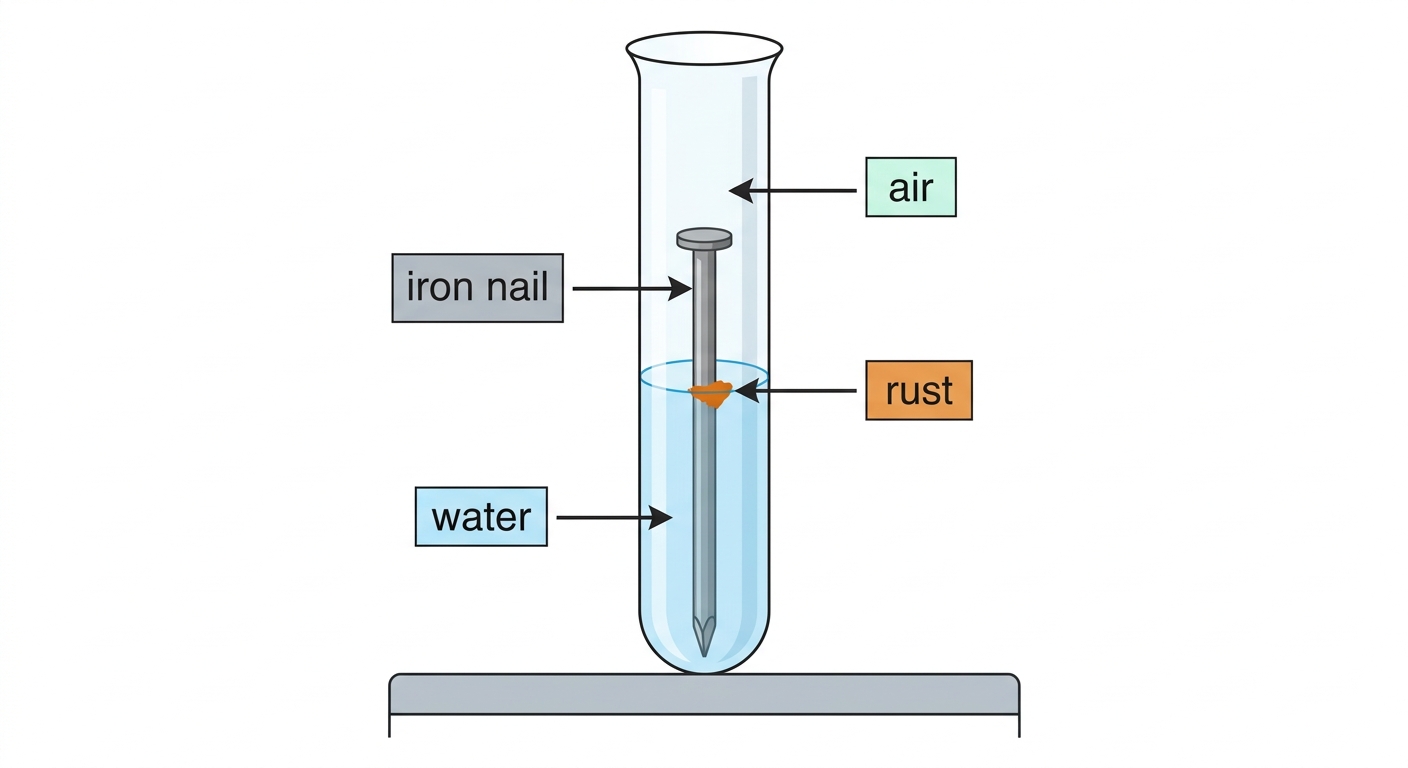
An iron nail is partially submerged in water inside a test tube open to the air. Rust forms most heavily at the waterline — the boundary between the liquid water and the air above it.
a
Identify the two reactants required for iron to rust. [1]
b
Explain why rust forms most heavily at the waterline rather than on the fully submerged section of the nail. [1]
c
A student proposes coating the nail in a thin layer of zinc to prevent rusting. Evaluate whether this method would protect the nail even if the zinc coating is scratched and the iron beneath is exposed. [1]
Solutions
3QuestionRedox ReactionsAssessment Practice
6 marks~9 minCriterion B
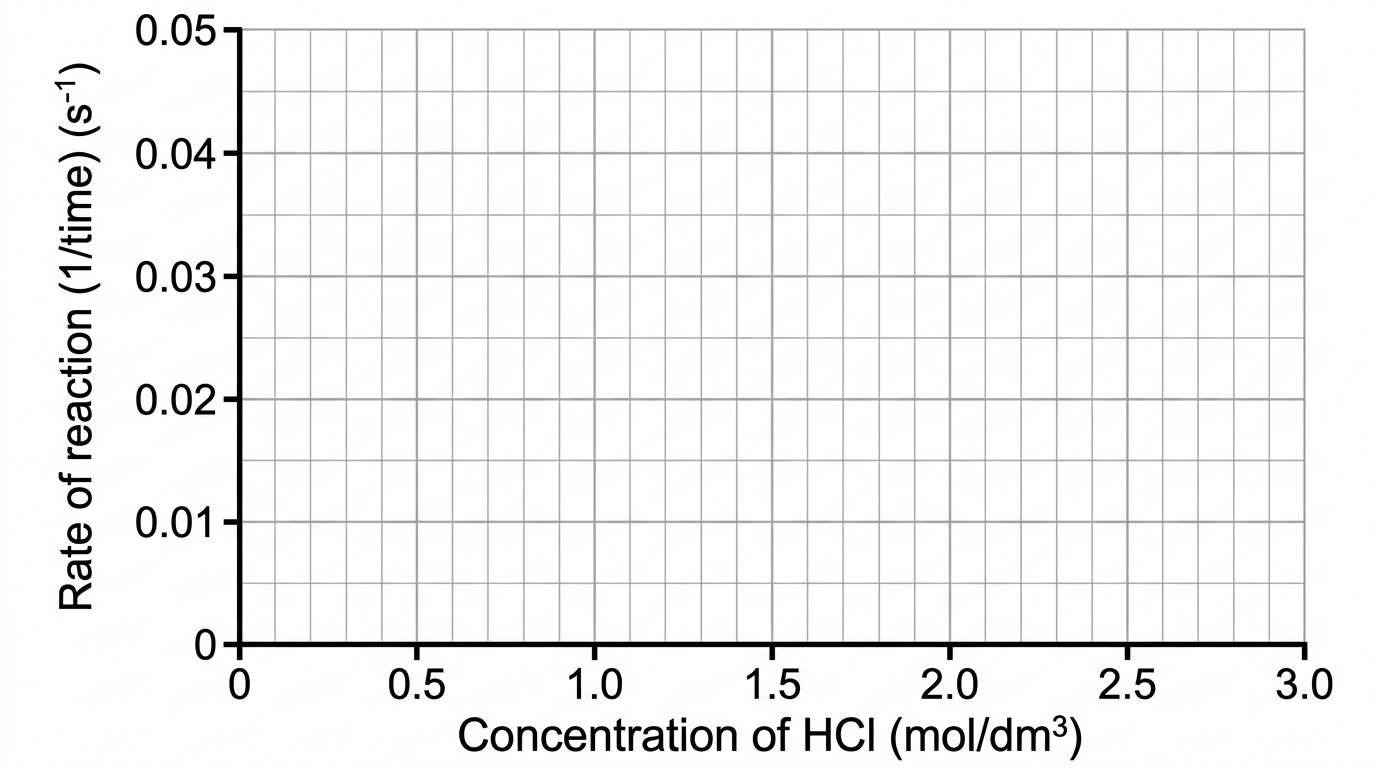
A student investigates how the concentration of hydrochloric acid (HCl) affects its reaction rate with magnesium ribbon at . The time for the ribbon to completely dissolve is recorded.
The reaction is:
| Concentration of HCl () | 0.5 | 1.0 | 1.5 | 2.0 | 2.5 |
|---|---|---|---|---|---|
| Time (s) | 120 | 60 | 40 | 30 | 24 |
The reaction is:
a
Construct a graph of rate of reaction (), where rate , against concentration of HCl (). Describe the shape of the graph. [2]
b
Interpret the graph to deduce the mathematical relationship between concentration of HCl and rate of reaction, using specific values from the data to support your answer. [2]
c
A student claims that at , the reaction time will be 20 s. Evaluate this prediction, identifying one assumption the student must make and one experimental factor that could cause the actual result to differ. [2]
Solutions
4QuestionThe Reactivity Series of MetalsAssessment Practice
8 marks~12 minCriterion C
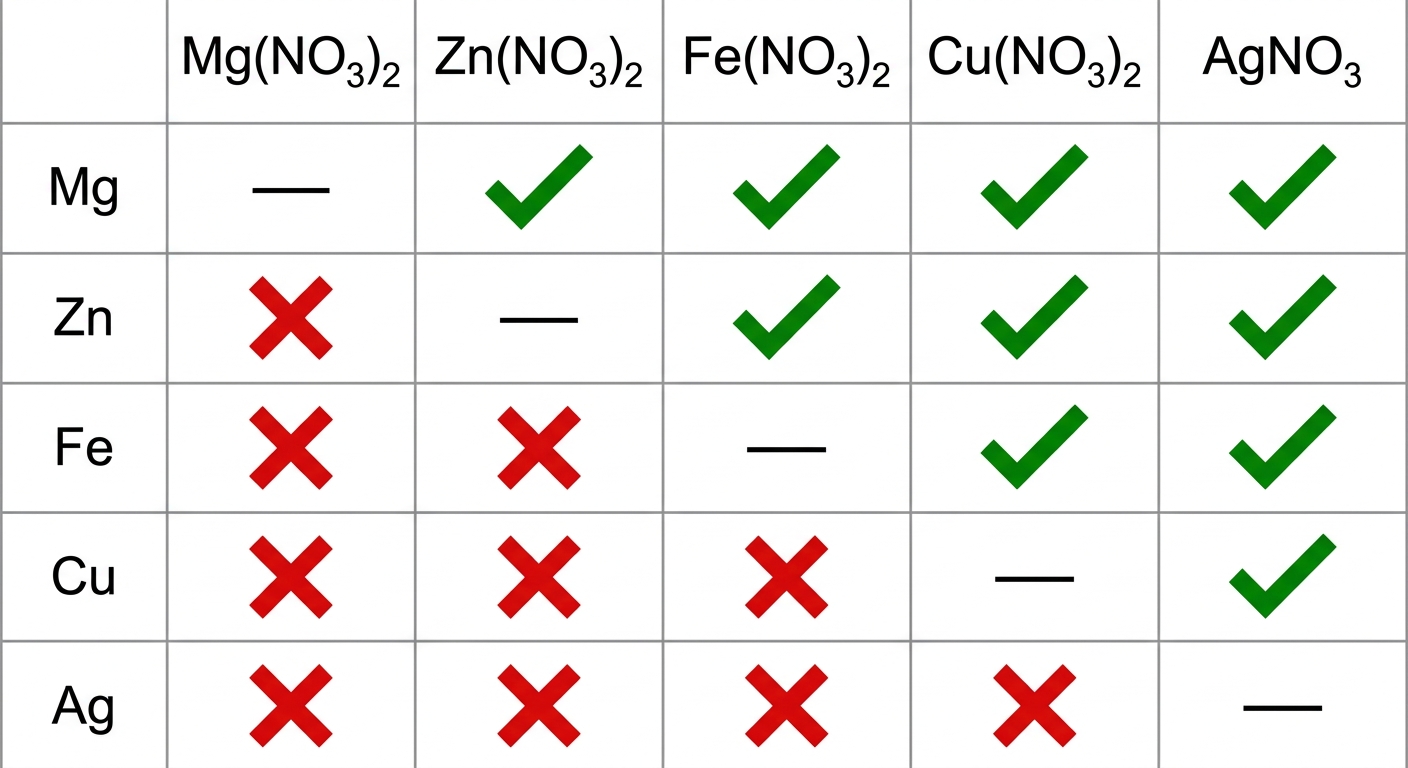
A student investigates displacement reactions by placing five metals into aqueous nitrate solutions of the same metals. A tick (✓) indicates the metal displaced the other from solution; a cross (✗) indicates no reaction; a dash (—) indicates the metal was not tested against its own solution.
Metal added — — — — —
Ag: ✗ ✗ ✗ ✗ —
Metal added — — — — —
| Mg: | ✓ ✓ ✓ ✓ |
|---|---|
| Zn: ✗ | ✓ ✓ ✓ |
| Fe: ✗ ✗ | ✓ ✓ |
| Cu: ✗ ✗ ✗ | ✓ |
Ag: ✗ ✗ ✗ ✗ —
a
Deduce the order of decreasing reactivity of the five metals and explain the pattern in the data that allows this order to be determined. [2]
b
Deduce whether a reaction occurs when zinc is placed into iron(II) nitrate solution, . Write the balanced chemical equation with state symbols if a reaction occurs, or state "no reaction." [2]
c
A student claims: "Any metal will displace any other metal from its nitrate solution, provided enough time is given." Evaluate this claim by referring to the reactivity order from (a) and explaining the electron transfer process that determines whether displacement occurs. [4]
Solutions
That's every free question here — 4 of 152.
+148 more questions, plus Mock Papers & Worksheets, are waiting in Premium.