You're viewing free preview questions — 4 questions previewing here — subscribe to unlock 77 more, plus the Full Question Bank, Mock Papers & Worksheets.Upgrade
Types of Reactions — Free MYP4 Chemistry Practice Questions

1QuestionSingle and Double Displacement ReactionsConcept Practice
4 marks~6 minCriterion A
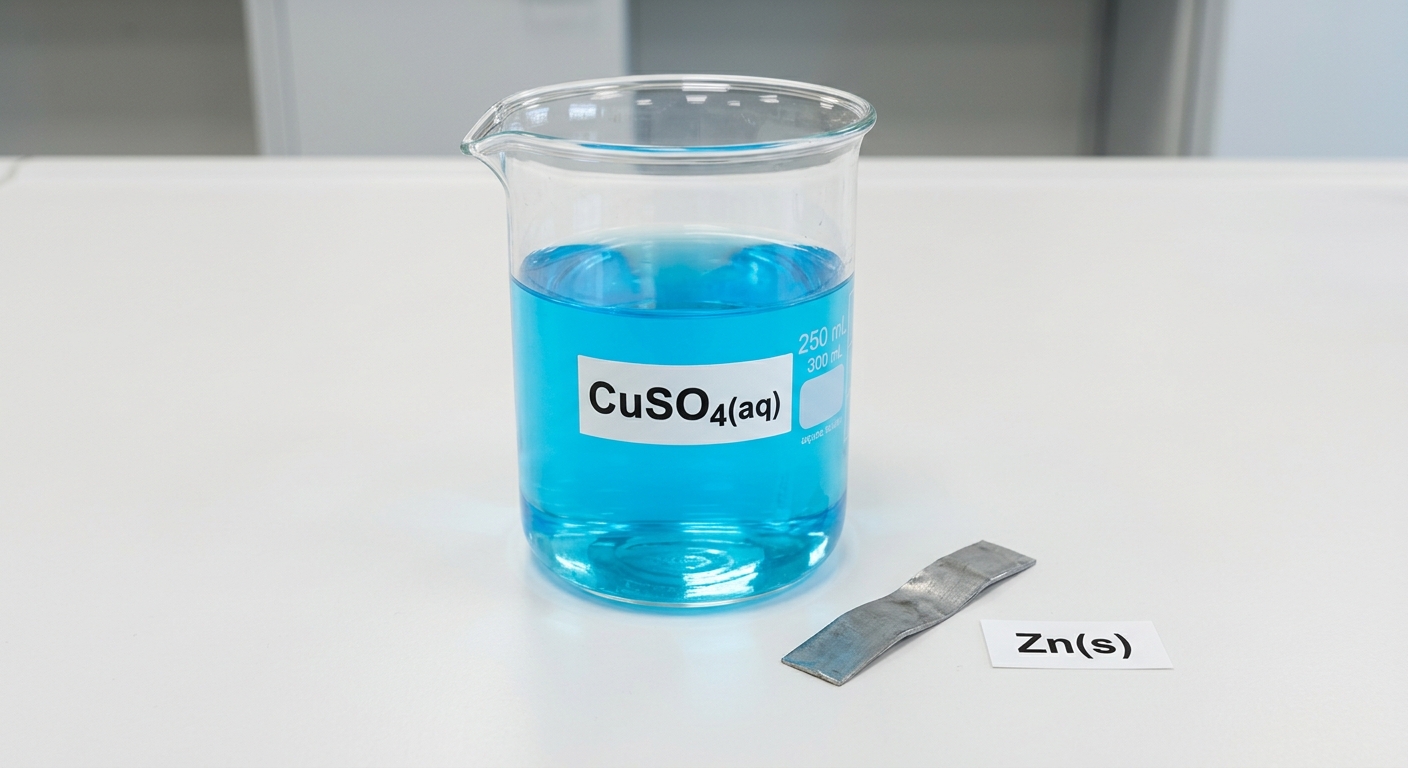
In an industrial metal recovery process, zinc pellets are added to a copper(II) sulfate solution. A reaction occurs spontaneously at room temperature.
a
Construct the balanced chemical equation for this reaction, including state symbols. [2]
b
Deduce two observable changes that occur as the reaction proceeds, linking each observation to a specific chemical change taking place. [2]

Solutions
2QuestionObserving Chemical Change Color Gas Temperature PrecipitateAssessment Practice
6 marks~9 minCriterion B
A student investigates how the concentration of sodium carbonate (NaCO) solution affects the mass of calcium carbonate (CaCO) precipitate formed with excess calcium chloride (CaCl) solution. The reaction is:
The volume of NaCO is fixed at 50.0 mL; CaCl is 50.0 mL at 0.50 M throughout.
Concentration of NaCO (M): 0.10, 0.20, 0.30, 0.40, 0.50
Mass of CaCO precipitate (g): 0.50, 1.00, 1.50, 2.00, 2.50
The volume of NaCO is fixed at 50.0 mL; CaCl is 50.0 mL at 0.50 M throughout.
Concentration of NaCO (M): 0.10, 0.20, 0.30, 0.40, 0.50
Mass of CaCO precipitate (g): 0.50, 1.00, 1.50, 2.00, 2.50
a
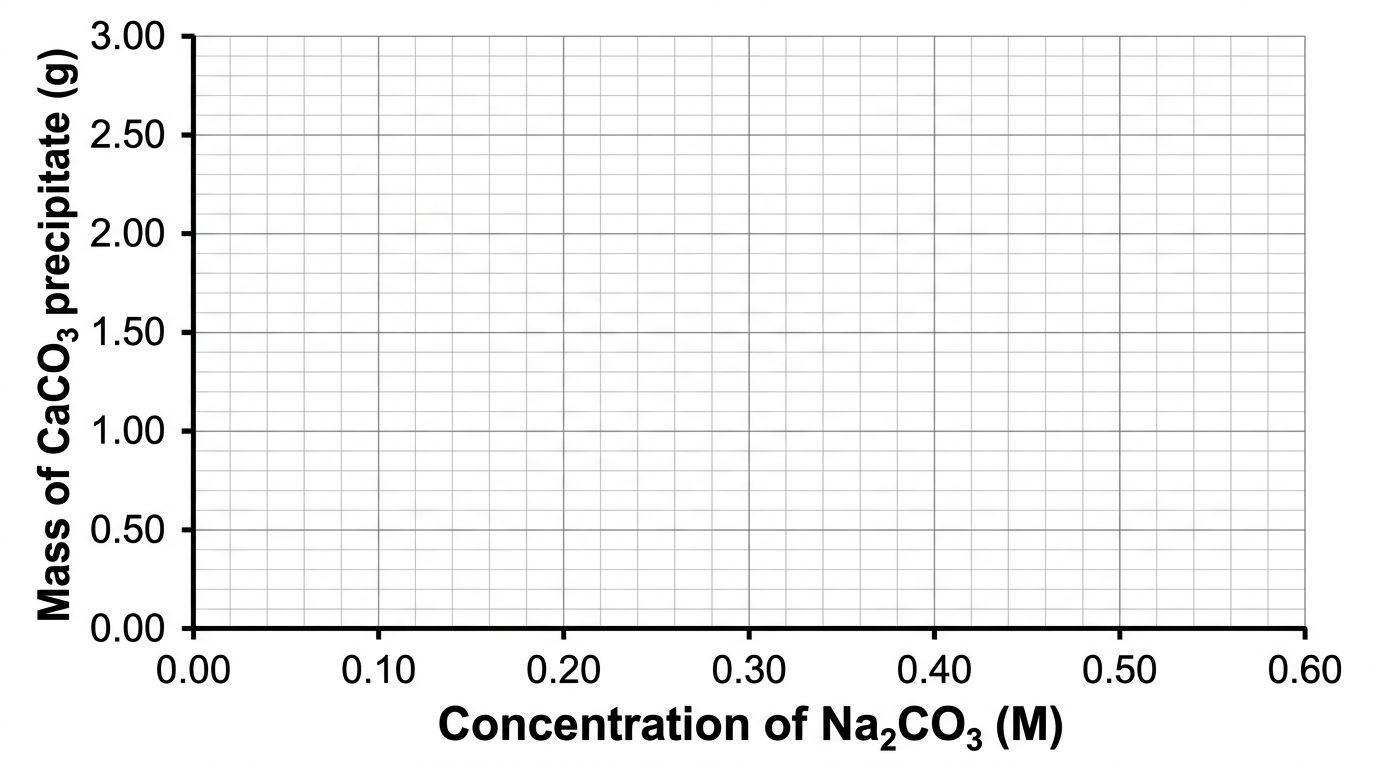
Construct a graph of mass of CaCO precipitate (y-axis) against concentration of NaCO (x-axis) and interpret the pattern shown. [2]
b
Deduce the mathematical relationship between concentration of NaCO and mass of CaCO precipitate, showing your working. [2]
c
The student claims the relationship established in (b) can reliably predict the mass of precipitate at any NaCO concentration between 0.10 M and 0.50 M. Evaluate this claim for a concentration of 0.35 M, identifying one assumption that could limit the reliability of the prediction. [2]
Solutions
3QuestionObserving Chemical Change Color Gas Temperature PrecipitateAssessment Practice
7 marks~11 minCriterion C
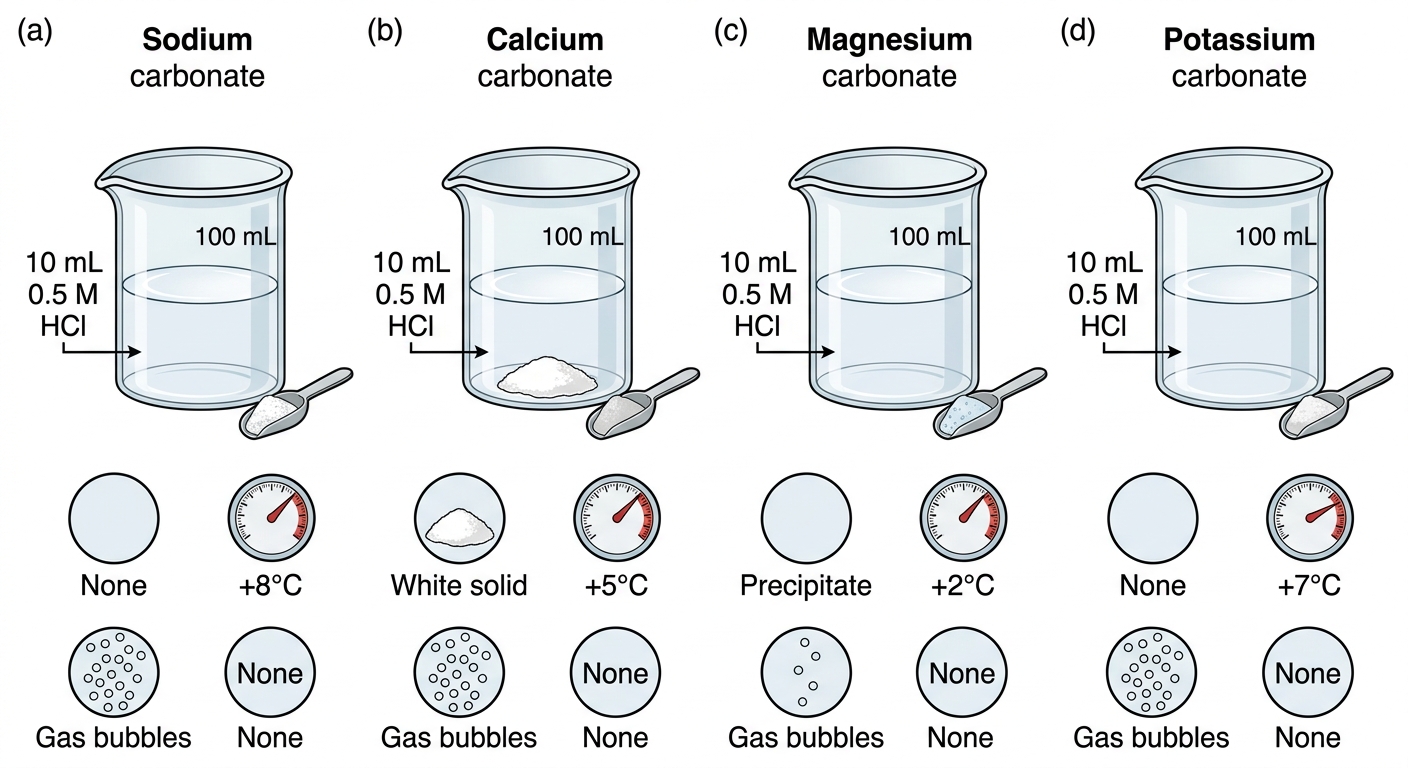
In an investigation, 10 mL of 0.5 M hydrochloric acid was added to separate samples of four metal carbonates at 25°C. Observations are recorded below.
Reaction 1 — Sodium carbonate: no colour change; many gas bubbles; temperature change +8°C; no precipitate
Reaction 2 — Calcium carbonate: no colour change; many gas bubbles; temperature change +5°C; white precipitate
Reaction 3 — Magnesium carbonate: no colour change; few gas bubbles; temperature change +2°C; no precipitate
Reaction 4 — Potassium carbonate: no colour change; many gas bubbles; temperature change +7°C; no precipitate
Reaction 1 — Sodium carbonate: no colour change; many gas bubbles; temperature change +8°C; no precipitate
Reaction 2 — Calcium carbonate: no colour change; many gas bubbles; temperature change +5°C; white precipitate
Reaction 3 — Magnesium carbonate: no colour change; few gas bubbles; temperature change +2°C; no precipitate
Reaction 4 — Potassium carbonate: no colour change; many gas bubbles; temperature change +7°C; no precipitate
a
Identify which reaction shows an anomalous result. Justify your answer by referring to specific data from the table. [3]
b
Deduce one chemical and one physical factor that could explain the reduced reactivity observed in that reaction. [4]
Solutions
4QuestionPrecipitation and Gas Formation ReactionsAssessment Practice
8 marks~12 minCriterion D
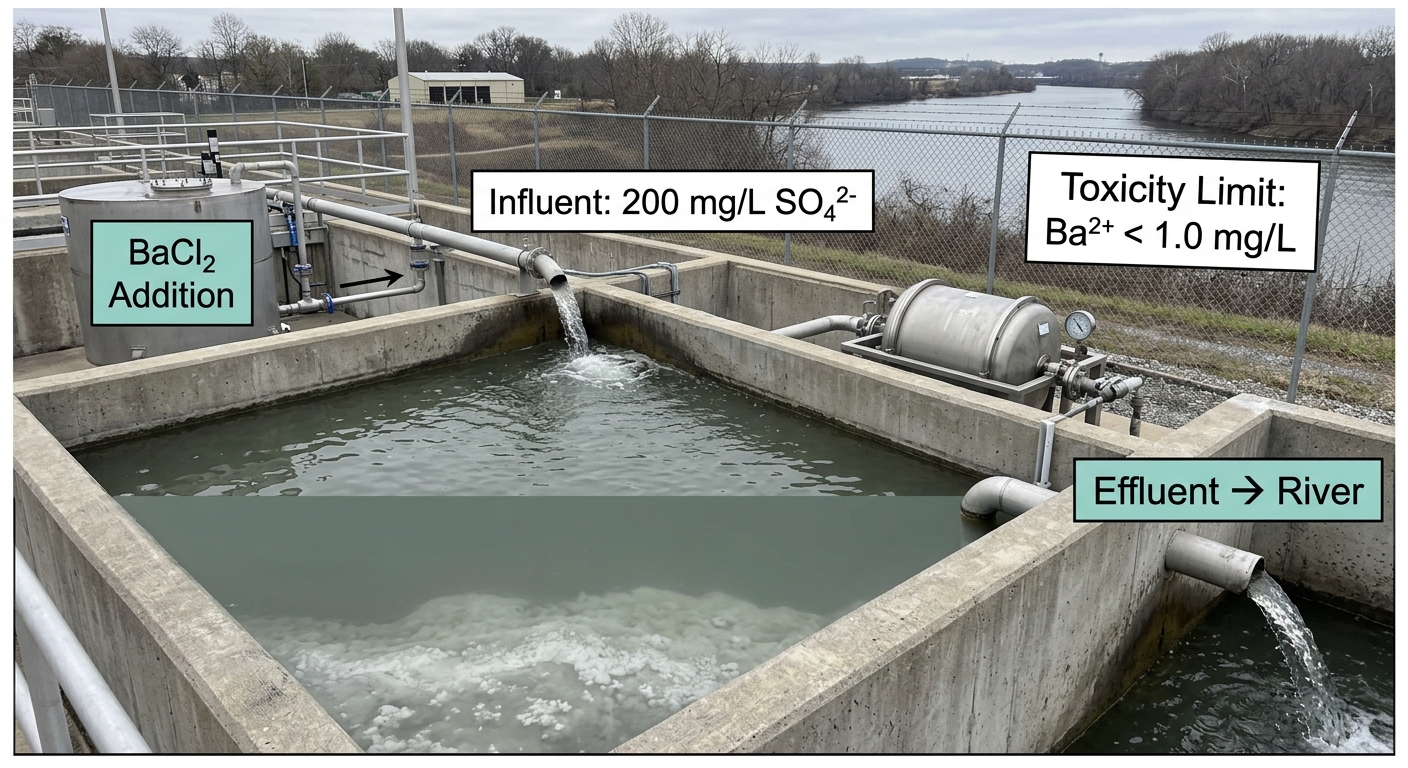
A municipal wastewater facility receives industrial wastewater containing 200 mg/L of sulfate ions (). Barium chloride () is added to precipitate sulfate as barium sulfate (), which is then removed by filtration:
Barium ions () are toxic to aquatic life above 1.0 mg/L. .
Molar masses (g/mol): Ba = 137.3, Cl = 35.5, S = 32.1, O = 16.0.
Barium ions () are toxic to aquatic life above 1.0 mg/L. .
Molar masses (g/mol): Ba = 137.3, Cl = 35.5, S = 32.1, O = 16.0.
a
Calculate the minimum mass of (in grams) needed to completely precipitate the sulfate ions from 1000 L of wastewater. [2]
b
Deduce the concentration of (in mg/L) remaining in the treated water after filtration, and state whether it exceeds the toxicity threshold. [2]
c
Evaluate the environmental trade-offs of using barium chloride precipitation for sulfate removal. In your answer: identify one environmental benefit of removing sulfate; identify one environmental risk introduced by barium chloride; and discuss two limitations of applying the calculation from part (b) to predict real-world treatment outcomes. [4]
Solutions
That's every free question here — 4 of 81.
+77 more questions, plus Mock Papers & Worksheets, are waiting in Premium.