You're viewing free preview questions — 4 questions previewing here — subscribe to unlock 72 more, plus the Full Question Bank, Mock Papers & Worksheets.Upgrade
Diffusion and Brownian Motion — Free MYP4 Chemistry Practice Questions

1QuestionExamples of diffusion (perfume spreading, gas exchange)Concept Practice
3 marks~5 minCriterion B
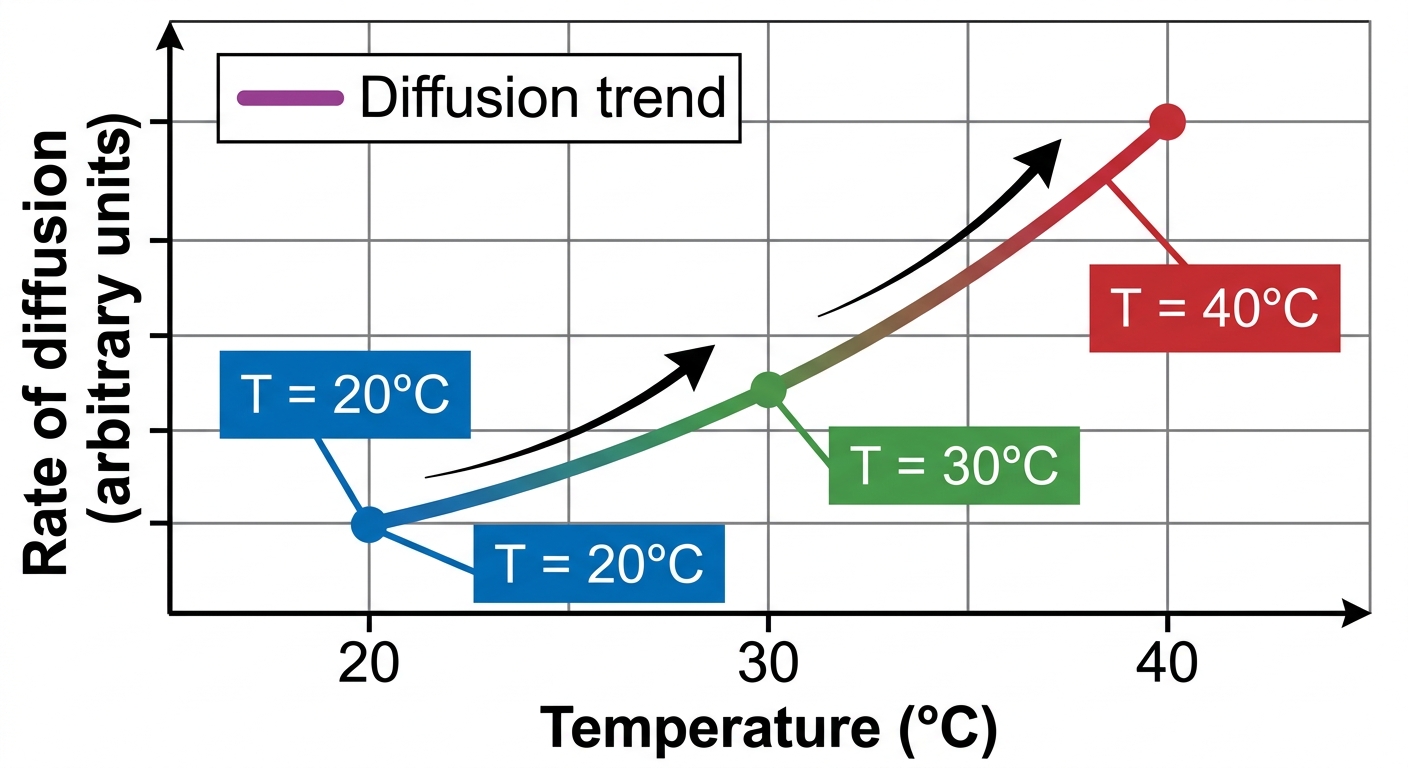
An open perfume bottle is placed in a room. The rate at which the perfume vapour spreads is measured at three temperatures.
| Temperature (°C) | 20 | 30 | 40 |
|---|---|---|---|
| Rate of diffusion (arbitrary units) | 2.0 | 3.5 | 5.5 |
a
Identify the trend shown by the data. [1]
b
Using particle theory, explain why increasing temperature affects the speed of perfume molecules. [1]
c
Analyse why faster-moving perfume molecules produce a higher rate of diffusion through air. [1]

Solutions
2QuestionFactors affecting diffusion rate (temperature, particle size)Assessment Practice
4 marks~6 minCriterion C
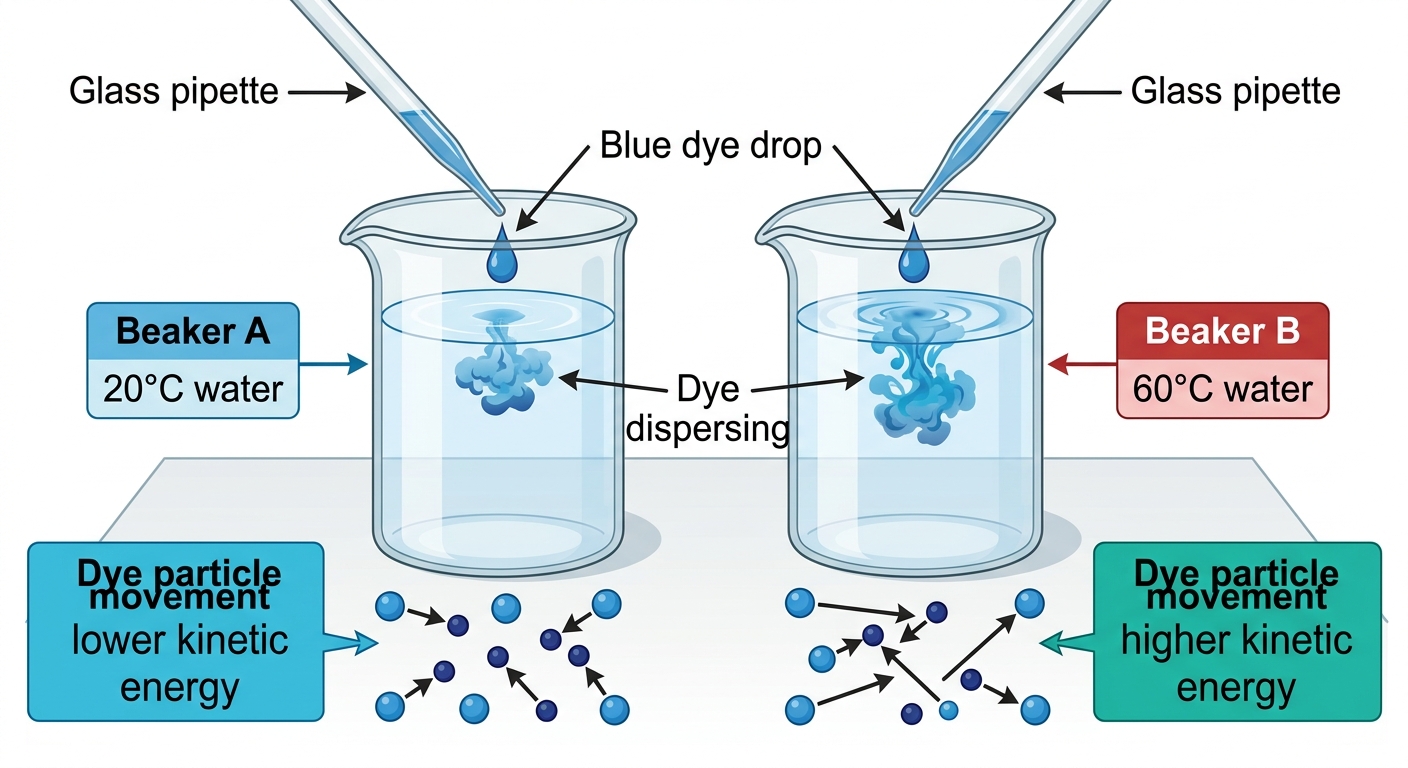
Two identical beakers of water are placed on a bench. Beaker A is at ; Beaker B is at . One drop of blue dye is added to each beaker simultaneously.
a
State which beaker shows faster diffusion of the dye. [1]
b
Explain how temperature affects the kinetic energy of particles and, as a result, the rate of diffusion. [2]
c
A student claims that doubling the temperature (from to ) will exactly double the diffusion rate. Evaluate this claim. [1]
Solutions
3QuestionExamples of diffusion (perfume spreading, gas exchange)Concept Practice
4 marks~6 minCriterion A
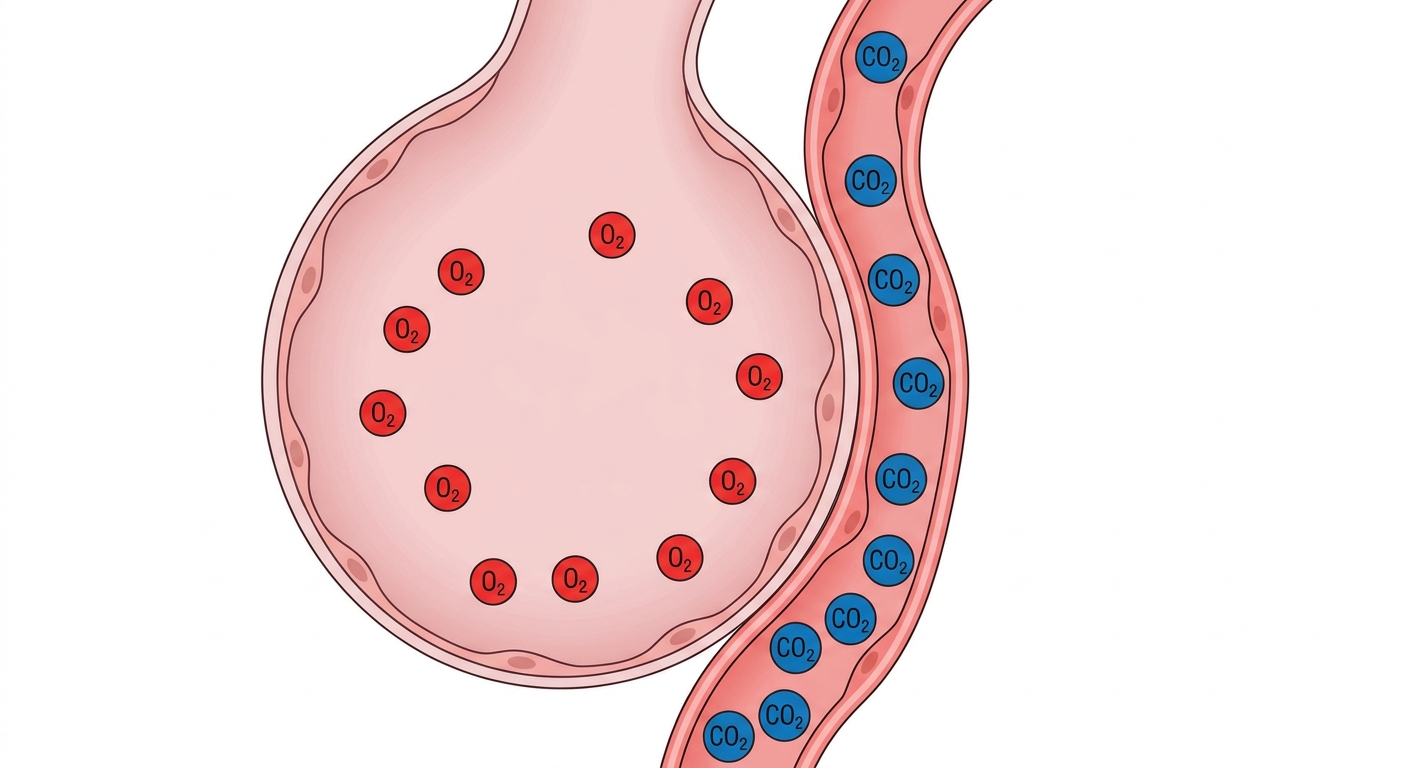
The diagram shows an alveolus in contact with a surrounding capillary. The alveolus contains a high concentration of molecules; the capillary blood contains a high concentration of molecules and a low concentration of molecules.
a
State the direction of net movement of molecules. [1]
b
Deduce the direction of net movement of molecules, and identify the driving force responsible. [1]
c
Explain, using particle theory, why moves from the alveolus into the blood rather than in the opposite direction. [2]
Solutions
4QuestionFactors affecting diffusion rate (temperature, particle size)Assessment Practice
6 marks~9 minCriterion D
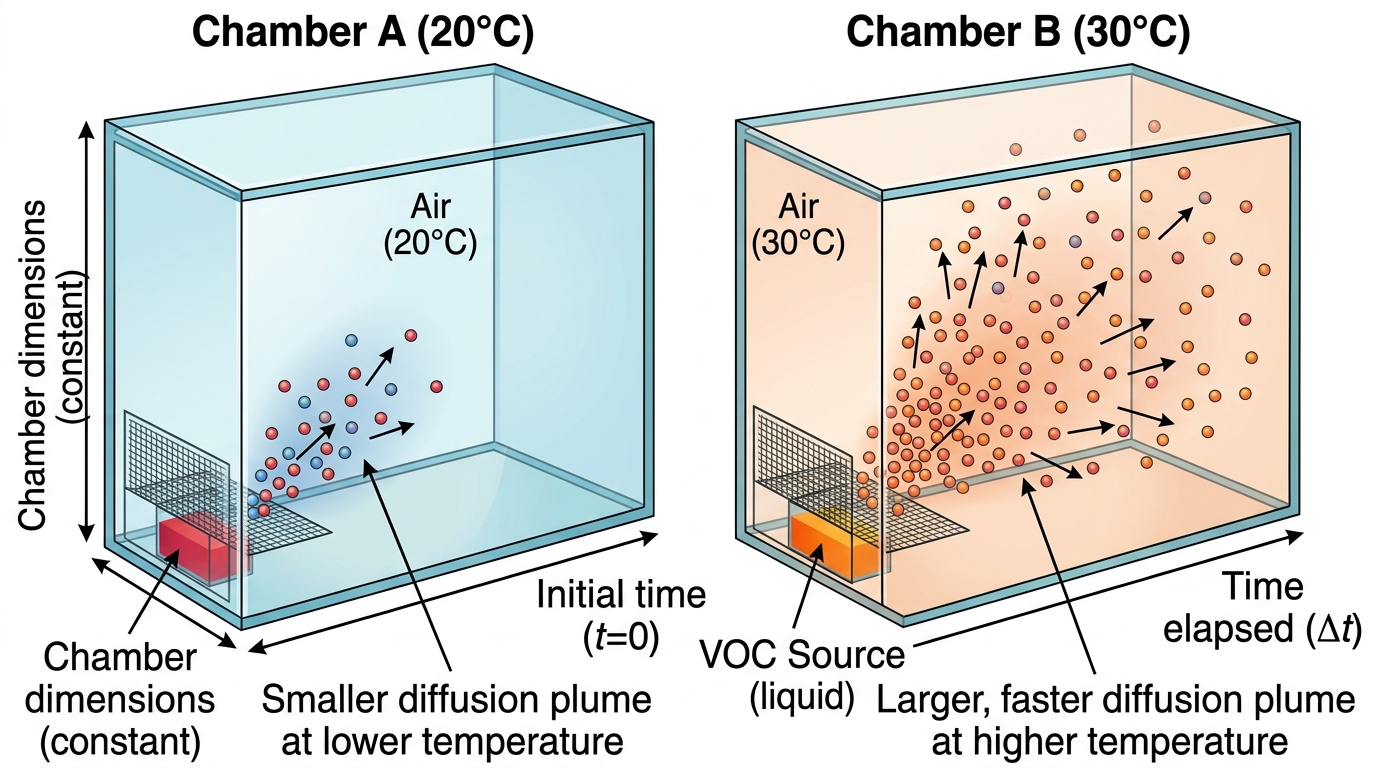
A chemical spill of volatile organic compounds (VOCs) occurs near a residential area. On a hot summer day (), VOCs diffuse rapidly into the air; on a cold winter day (), the same spill diffuses much more slowly.
a
Describe how the increase in temperature from to affects the kinetic energy of VOC molecules. [1]
b
Explain why the rate of diffusion of VOCs is greater at than at . [2]
c
Analyse the health implications for nearby residents on the hot day compared with the cold day, considering both the rate at which hazardous concentrations build up and the time available for protective action. [3]
Solutions
That's every free question here — 4 of 76.
+72 more questions, plus Mock Papers & Worksheets, are waiting in Premium.