You're viewing free preview questions — 4 questions previewing here — subscribe to unlock 82 more, plus the Full Question Bank, Mock Papers & Worksheets.Upgrade
Physical Vs. Chemical Changes — Free MYP4 Chemistry Practice Questions

1QuestionReversible vs irreversible changesConcept Practice
2 marks~3 minCriterion A
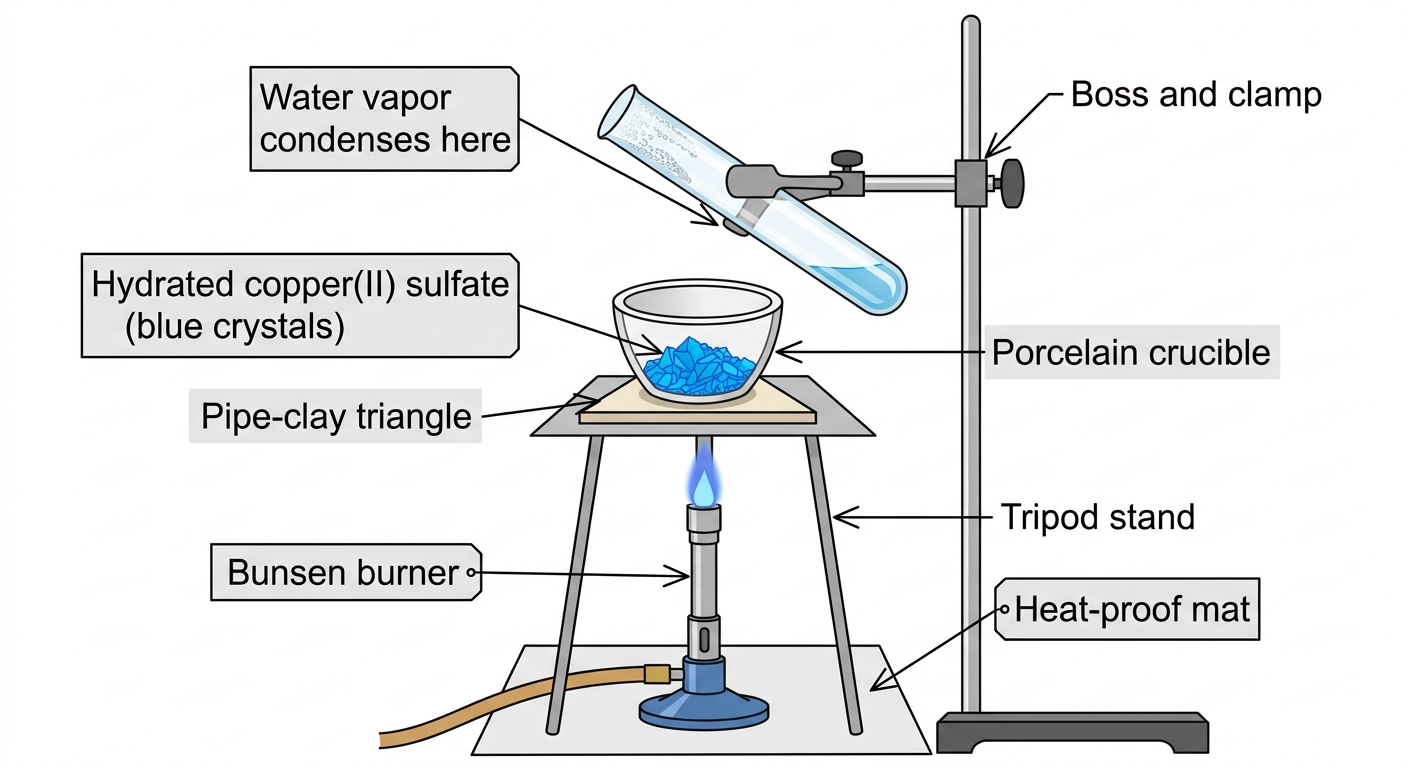
When hydrated copper(II) sulfate is heated, it loses water of crystallisation to form anhydrous copper(II) sulfate. This is a reversible reaction: adding water to the anhydrous solid reforms the hydrated salt.
a
State the colour change observed when hydrated copper(II) sulfate is heated, and identify what type of change this represents. [1]
b
Construct the balanced chemical equation, with state symbols, for the forward reaction only. [1]

Solutions
2QuestionReversible vs irreversible changesAssessment Practice
3 marks~5 minCriterion C
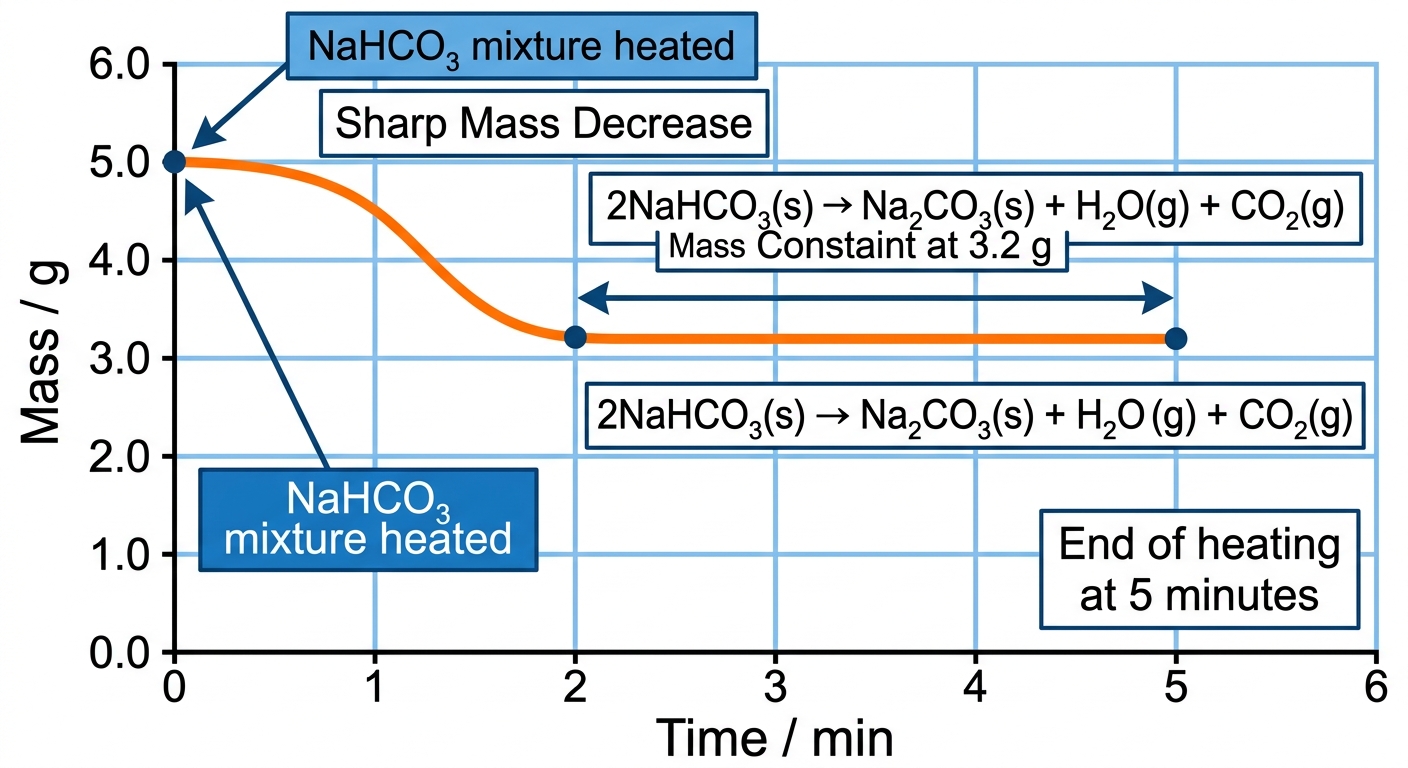
When sodium hydrogen carbonate is heated, it decomposes according to:
The graph below shows how the mass of a solid mixture containing changes as it is heated.
Graph: mass (g) on the y-axis; time (minutes) on the x-axis. Mass starts at 5.0 g, decreases sharply to approximately 3.2 g between 0 and 2 minutes, then remains constant at 3.2 g from 2 to 5 minutes.
The graph below shows how the mass of a solid mixture containing changes as it is heated.
Graph: mass (g) on the y-axis; time (minutes) on the x-axis. Mass starts at 5.0 g, decreases sharply to approximately 3.2 g between 0 and 2 minutes, then remains constant at 3.2 g from 2 to 5 minutes.
a
Describe the trend shown in the graph. [1]
b
Identify whether this change is reversible or irreversible, and state one piece of evidence from the graph that supports your answer. [1]
c
Analyse why the mass loss alone is insufficient to conclude that a chemical change has occurred, and explain what additional evidence from the reaction equation confirms this conclusion. [1]
Solutions
3QuestionReversible vs irreversible changesAssessment Practice
8 marks~12 minCriterion D
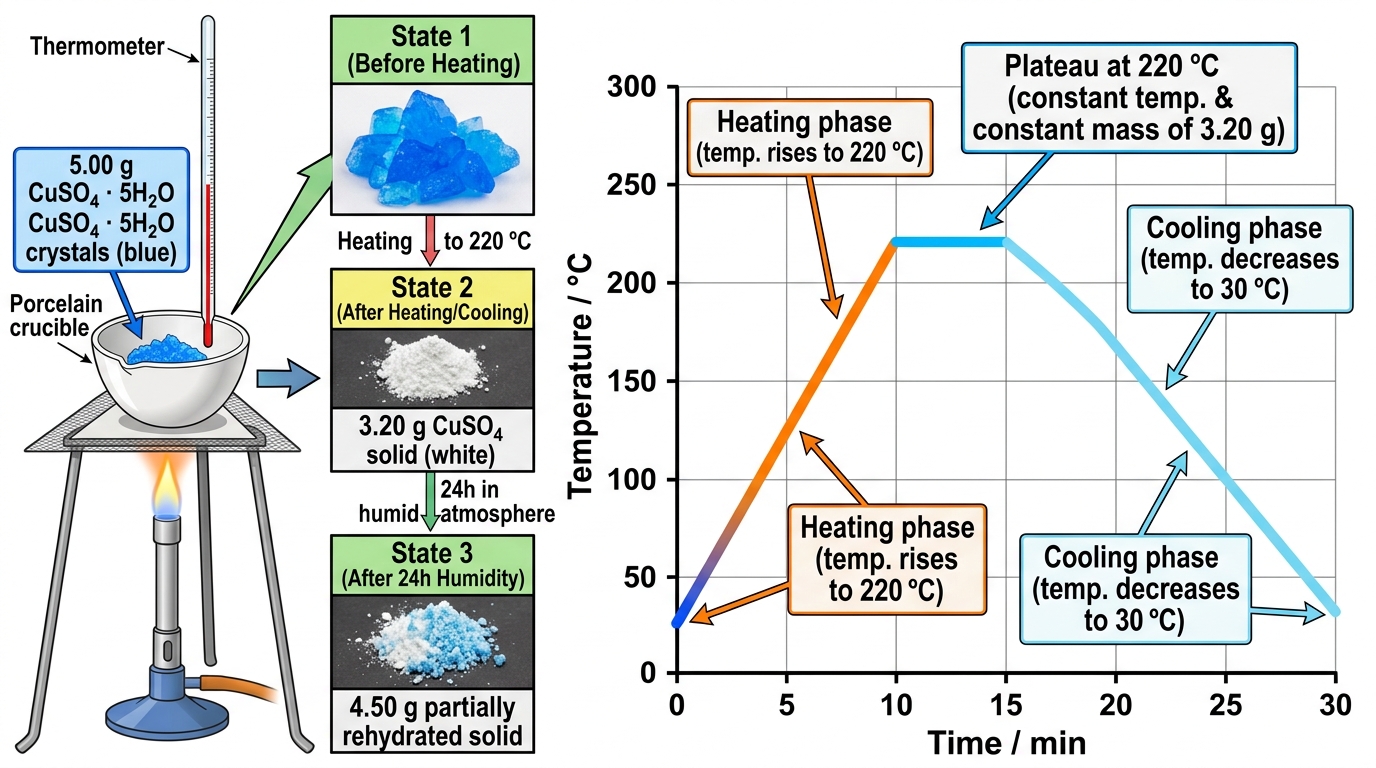
A student heats 5.00 g of blue copper(II) sulfate pentahydrate () crystals in a crucible. The temperature rises steadily from 25 °C to 220 °C over 10 minutes, then holds at 220 °C for 5 minutes; the final mass is 3.20 g. The white solid is then left in a humid atmosphere for 24 hours, after which the mass is 4.50 g.
a
Write a balanced chemical equation, including state symbols, for the dehydration of . [2]
b
Deduce the theoretical mass of water that should be lost during complete dehydration and compare it with the experimental mass loss. [2]
c
Analyse whether the overall change is chemically reversible. In your answer, refer to evidence for the formation of a new substance, the different conditions required for each reaction direction, and what the partial mass regain indicates about reversibility. [4]
Solutions
4QuestionReversible vs irreversible changesAssessment Practice
3 marks~5 minCriterion B
The table below shows the solubility of four salts in water at 20°C and 80°C.
Salt — Solubility at 20°C (g / 100 g water) — Solubility at 80°C (g / 100 g water)
Salt — Solubility at 20°C (g / 100 g water) — Solubility at 80°C (g / 100 g water)
| 36 | 39 | |
| 32 | 169 | |
| 0.16 | 0.09 | |
| 19.5 | 43.7 |
a
State the general trend in solubility with increasing temperature for most solids in this data. [1]
b
Identify the salt that does not follow this trend and describe how its solubility changes between 20°C and 80°C. [1]
c
Explain whether dissolving in water is a reversible or irreversible change, and justify your answer using evidence from the data. [1]
Solutions
That's every free question here — 4 of 86.
+82 more questions, plus Mock Papers & Worksheets, are waiting in Premium.