You're viewing free preview questions — 4 questions previewing here — subscribe to unlock 78 more, plus the Full Question Bank, Mock Papers & Worksheets.Upgrade
Chormatography and its applications — Free MYP4 Chemistry Practice Questions

1QuestionBasic principle of chromatography (mobile vs stationary phase)Concept Practice
2 marks~3 minCriterion A
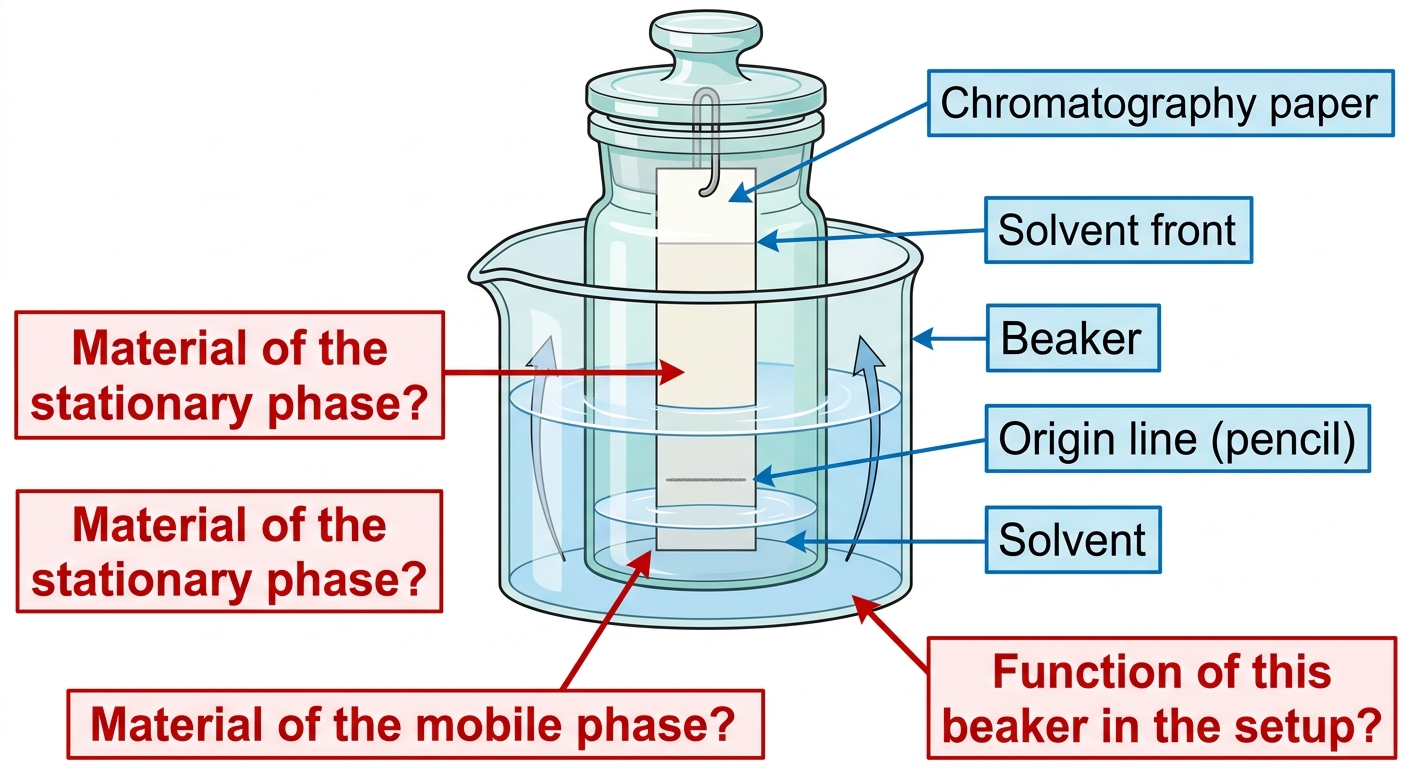
A student sets up a paper chromatography experiment to separate the dyes in a food colouring. The chromatography paper is clipped vertically inside a sealed glass beaker containing a small volume of ethanol as the solvent. The paper's lower edge dips into the ethanol, but the food colouring spot remains above the liquid surface.
a
Identify the mobile phase and the stationary phase in this setup. [1]
b
The student seals the beaker before starting the experiment. Explain why a sealed environment is important for obtaining reliable chromatography results. [1]

Solutions
2QuestionBasic principle of chromatography (mobile vs stationary phase)Assessment Practice
5 marks~8 minCriterion C
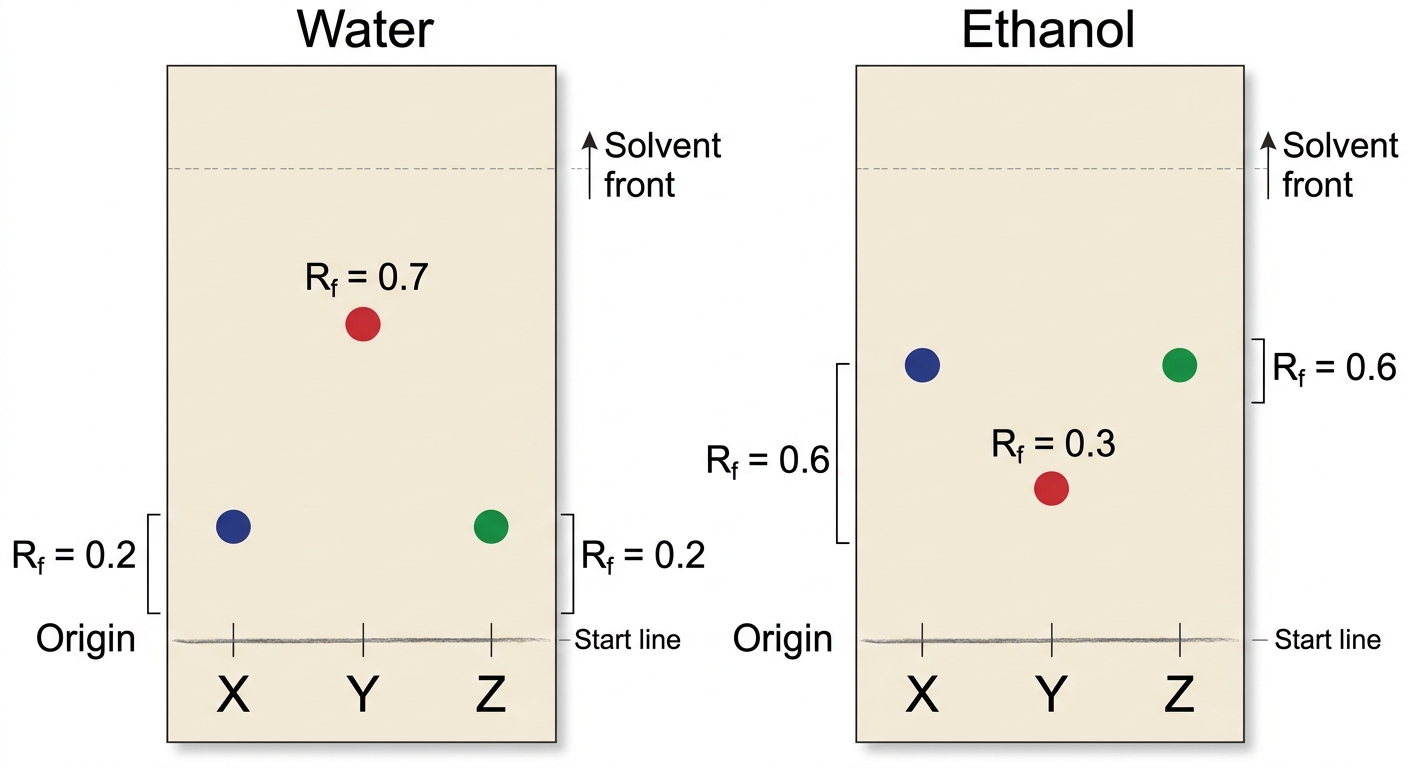
A student separates three ink samples (X, Y, Z) by paper chromatography using water and then ethanol as separate mobile phases. The stationary phase is identical in both runs.
Water as mobile phase — values: X = 0.2, Y = 0.7, Z = 0.2
Ethanol as mobile phase — values: X = 0.6, Y = 0.3, Z = 0.6
The student hypothesises: "All three inks contain the same dye."
Water as mobile phase — values: X = 0.2, Y = 0.7, Z = 0.2
Ethanol as mobile phase — values: X = 0.6, Y = 0.3, Z = 0.6
The student hypothesises: "All three inks contain the same dye."
a
State the principle that explains why different compounds travel different distances in chromatography. [1]
b
Deduce, using both sets of data, which inks could contain the same dye and which could not. [2]
c
Evaluate the student's hypothesis, referring to the role of both mobile phases in supporting your conclusion. [2]
Solutions
3QuestionInterpreting chromatograms (Rf values – basic idea)Assessment Practice
6 marks~9 minCriterion D
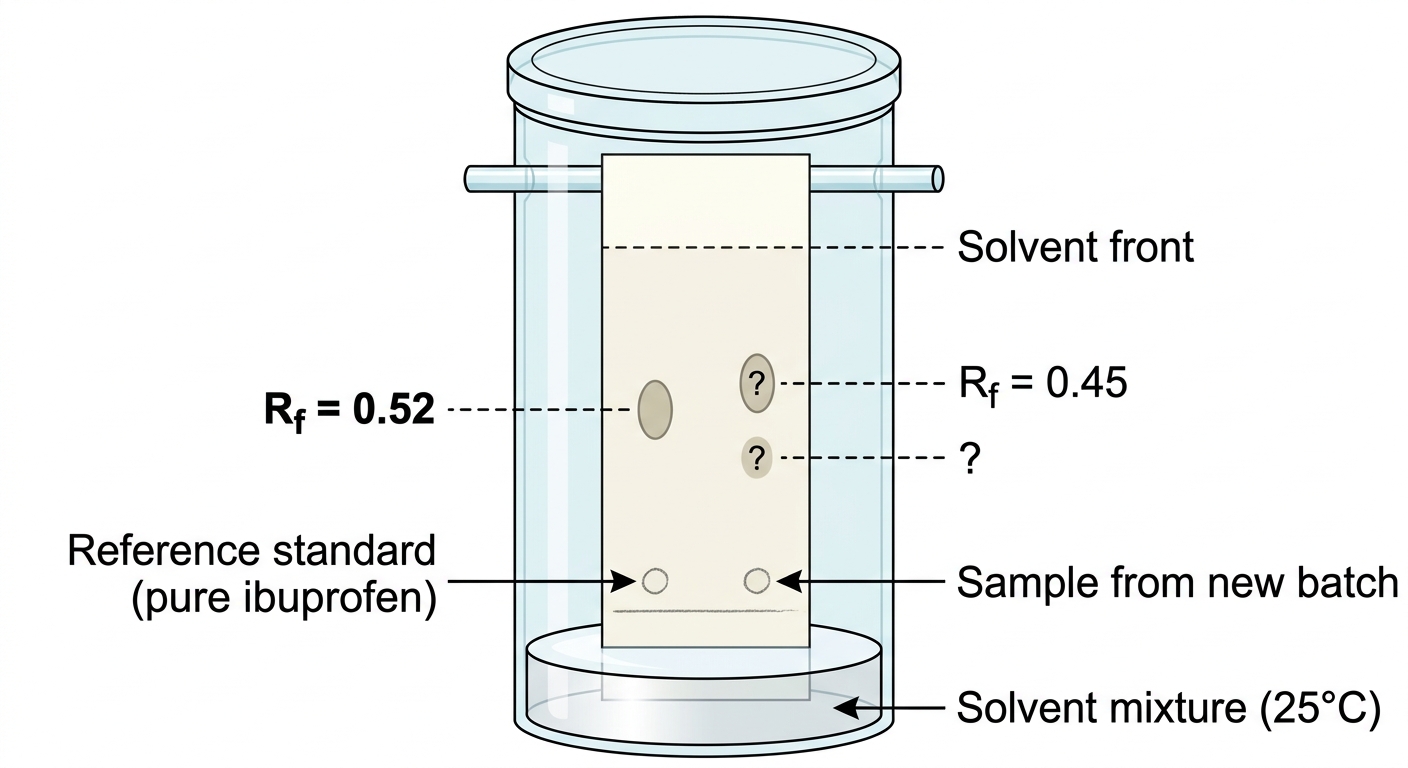
A pharmaceutical company uses paper chromatography to assess the purity of a batch of ibuprofen. A reference standard of pure ibuprofen gives an value of under standard conditions. A technician tests a sample from the new batch and records an value of for the spot believed to be ibuprofen. The technician relies solely on this value to confirm the compound's identity and approve the batch for patient use.
a
Explain why the difference between and may indicate the presence of an impurity in the batch. [2]
b
Discuss the risks to patient safety if the compound at is incorrectly approved as pure ibuprofen. [2]
c
Evaluate the reliability of using values alone to confirm the identity of a compound in a pharmaceutical purity test. [2]
Solutions
4QuestionApplications (forensics, food testing, drug analysis)Assessment Practice
6 marks~9 minCriterion B
A forensic scientist examines five ink samples from a forged document using paper chromatography in two solvents: water (polar) and ethanol (less polar).
Spots in water: A = 1, B = 2, C = 1, D = 3, E = 2
values in water: A = 0.45; B = 0.30 and 0.60; C = 0.70; D = 0.25, 0.50, and 0.55; E = 0.20 and 0.35
Spots in ethanol: A = 1, B = 1, C = 1, D = 2, E = 1
values in ethanol: A = 0.72; B = 0.55; C = 0.80; D = 0.40 and 0.62; E = 0.68
Spots in water: A = 1, B = 2, C = 1, D = 3, E = 2
values in water: A = 0.45; B = 0.30 and 0.60; C = 0.70; D = 0.25, 0.50, and 0.55; E = 0.20 and 0.35
Spots in ethanol: A = 1, B = 1, C = 1, D = 2, E = 1
values in ethanol: A = 0.72; B = 0.55; C = 0.80; D = 0.40 and 0.62; E = 0.68
a
Deduce which ink samples are pure substances and which are mixtures, using evidence from both solvents. [2]
b
Analyse the data for ink sample B across both solvents and generalise a rule linking solvent polarity to the effectiveness of chromatographic separation. [2]
c
Evaluate whether hexane (a non-polar solvent) would be suitable for identifying the individual components of ink sample D. Use your rule from part (b) and the data for sample D to support your judgement. [2]
Solutions
That's every free question here — 4 of 82.
+78 more questions, plus Mock Papers & Worksheets, are waiting in Premium.