You're viewing free preview questions — 4 questions previewing here — subscribe to unlock 82 more, plus the Full Question Bank, Mock Papers & Worksheets.Upgrade
Filtration, Evaporation and Crystallization — Free MYP4 Chemistry Practice Questions

1QuestionFiltration process (separating insoluble solids)Concept Practice
2 marks~3 minCriterion A
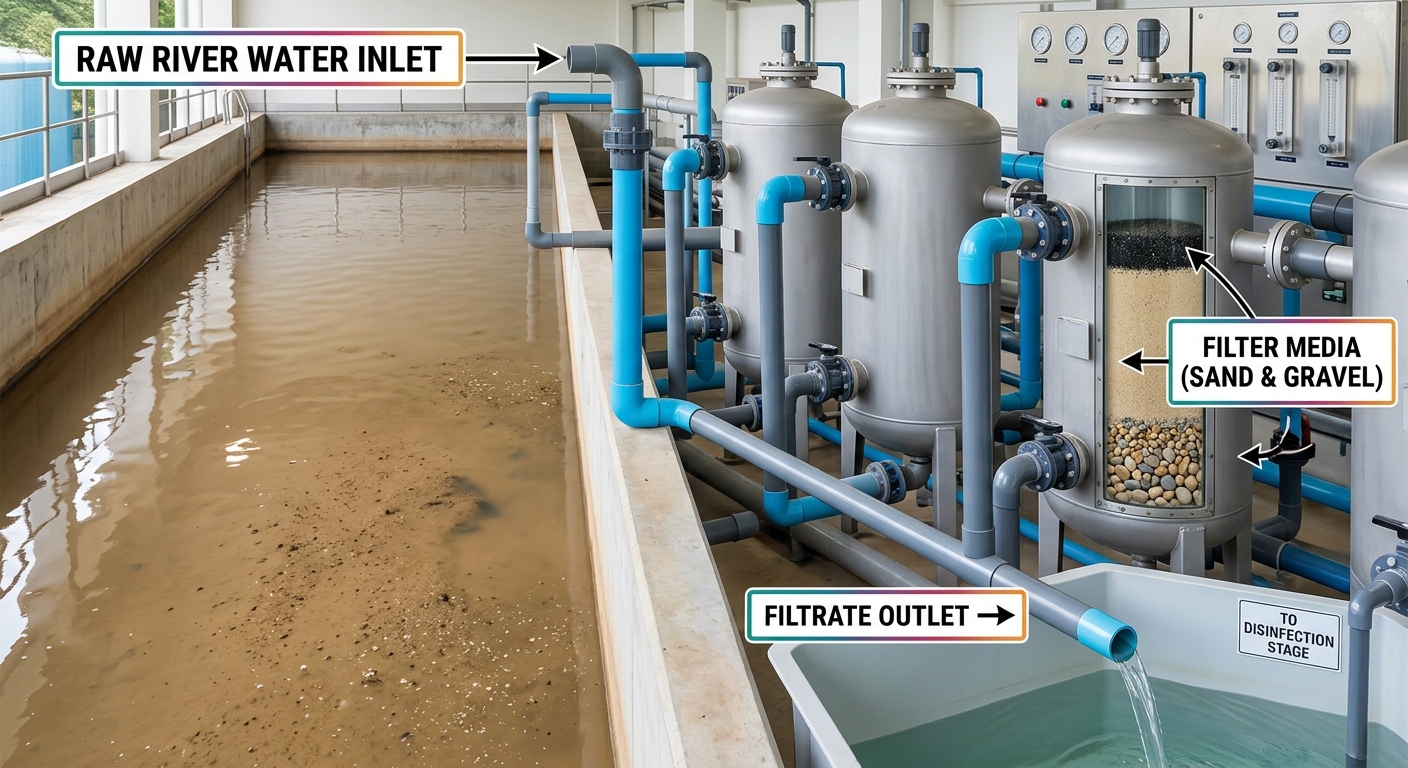
A municipal water treatment plant filters river water through layers of sand and gravel to remove suspended solids such as silt and clay before disinfection.
a
State the physical principle that allows filtration to separate suspended solids from river water. [1]
b
Explain one reason why filtration alone is insufficient to make river water safe for drinking. [1]

Solutions
2QuestionFiltration process (separating insoluble solids)Assessment Practice
5 marks~8 minCriterion C
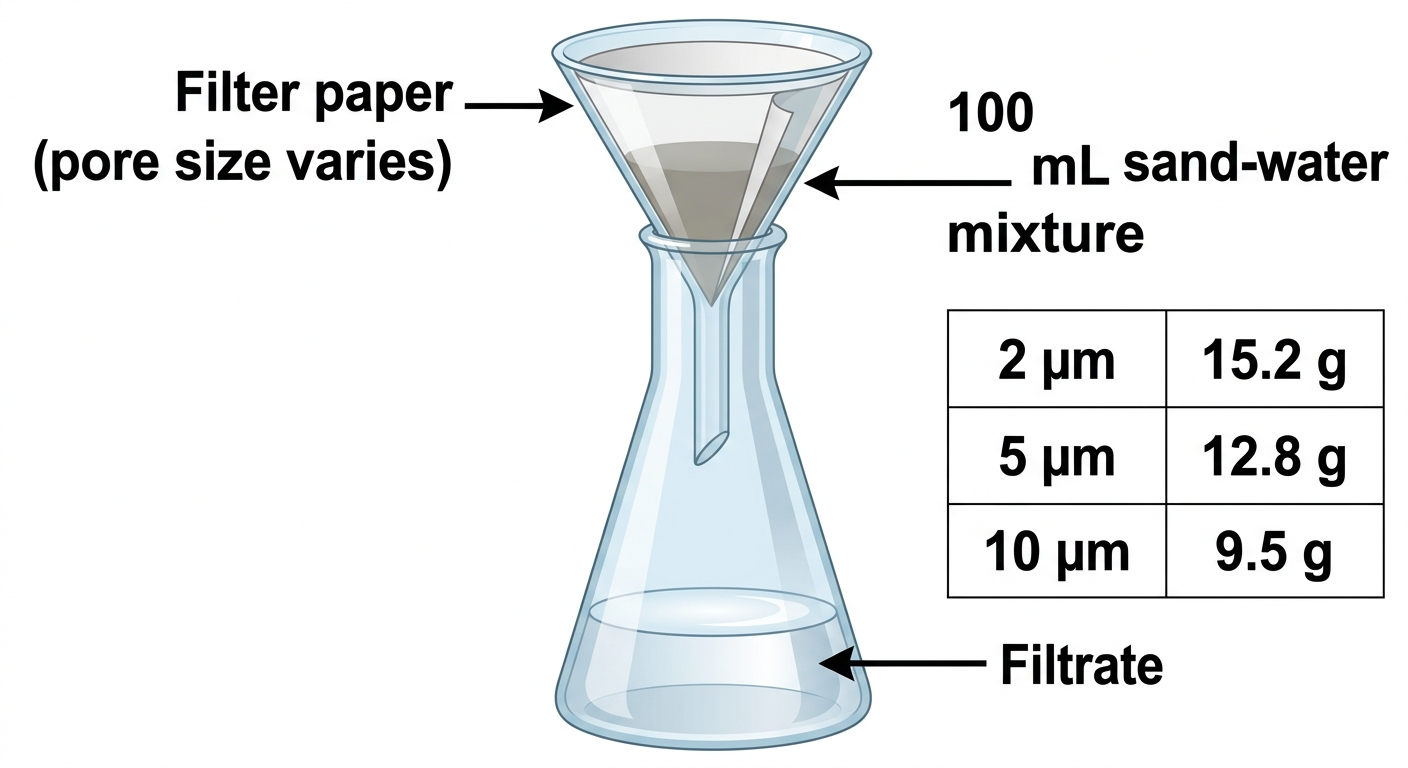
A student investigates how filter paper pore size affects the mass of sand residue collected during filtration. In each trial, 100 mL of a sand–water mixture is filtered for exactly 2 minutes.
The student expects mass of residue to increase as pore size decreases.
| Pore size (m) | 2 | 5 | 10 |
|---|---|---|---|
| Mass of residue (g) | 15.2 | 12.8 | 9.5 |
The student expects mass of residue to increase as pore size decreases.
a
Identify the anomalous data point and suggest one experimental cause. [2]
b
Describe the relationship between pore size and mass of residue collected, and explain the particle-level reason for this trend. [2]
c
Evaluate whether the 2 m filter paper would be the most suitable choice for routine laboratory filtration of sand–water mixtures. [1]
Solutions
3QuestionChoosing appropriate method based on mixture typeAssessment Practice
6 marks~9 minCriterion D
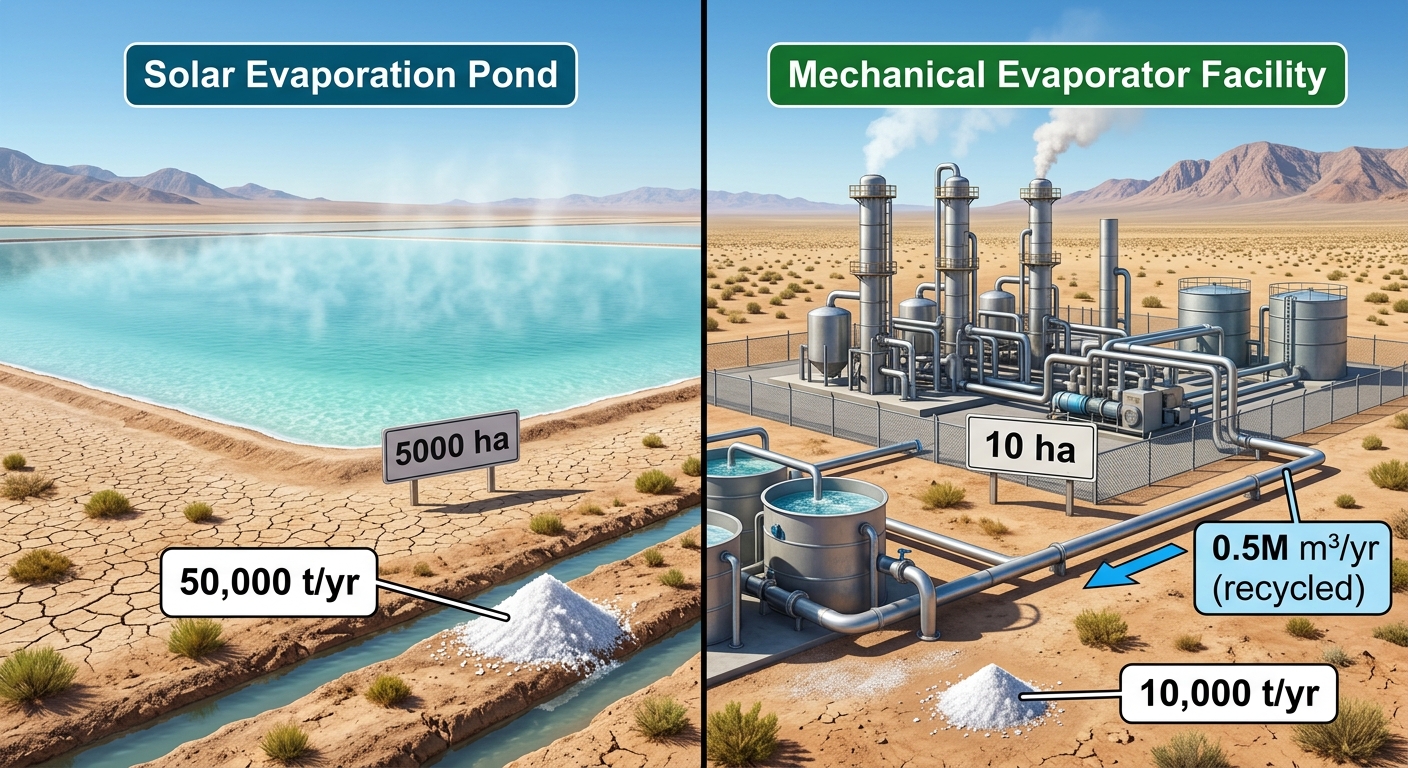
A mining company is evaluating two methods for extracting lithium from brine in a desert region where freshwater is scarce and the local population depends on groundwater for drinking and farming.
Method A (solar evaporation): 5000 hectares of land; 2 million of water lost annually; carbon footprint of 10 kg per kg of lithium; 50 000 tonnes of salt waste per year.
Method B (forced evaporation and crystallization): 10 hectares of land; 0.5 million of water annually (most recycled); carbon footprint of 200 kg per kg of lithium; 10 000 tonnes of salt waste per year, requiring chemical treatment.
Method A (solar evaporation): 5000 hectares of land; 2 million of water lost annually; carbon footprint of 10 kg per kg of lithium; 50 000 tonnes of salt waste per year.
Method B (forced evaporation and crystallization): 10 hectares of land; 0.5 million of water annually (most recycled); carbon footprint of 200 kg per kg of lithium; 10 000 tonnes of salt waste per year, requiring chemical treatment.
a
Identify one environmental advantage and one environmental disadvantage of each method. [2]
b
Evaluate the societal impacts of each method on the local community, considering water security, health risks, and economic opportunities. [2]
c
Evaluate the trade-offs between the two methods and reflect on the limitations of concluding that one method is universally better without considering local conditions. [2]
Solutions
4QuestionCrystallization for obtaining pure solidsAssessment Practice
3 marks~5 minCriterion B
A student purifies copper(II) sulfate by crystallization, varying the cooling rate of a saturated solution. The results are shown below.
In each trial, 50.0 g of crude copper(II) sulfate was used.
| Cooling rate (°C/min) | 1 | 5 | 15 | 30 |
|---|---|---|---|---|
| Mass of purified crystals (g) | 42.5 | 38.0 | 30.5 | 22.0 |
| Percentage yield (%) | 85.0 | 76.0 | 61.0 | 44.0 |
In each trial, 50.0 g of crude copper(II) sulfate was used.
a
Describe the trend in percentage yield as cooling rate increases. [1]
b
Explain why slower cooling produces larger crystals. [1]
c
Explain why slower cooling produces purer crystals, and evaluate whether maximising crystal purity always means maximising percentage yield. [1]
Solutions
That's every free question here — 4 of 86.
+82 more questions, plus Mock Papers & Worksheets, are waiting in Premium.