You're viewing free preview questions — 4 questions previewing here — subscribe to unlock 70 more, plus the Full Question Bank, Mock Papers & Worksheets.Upgrade
Solubility and factors affecting it — Free MYP4 Chemistry Practice Questions

1QuestionInterpreting solubility curves (basic graph reading)Concept Practice
2 marks~3 minCriterion A
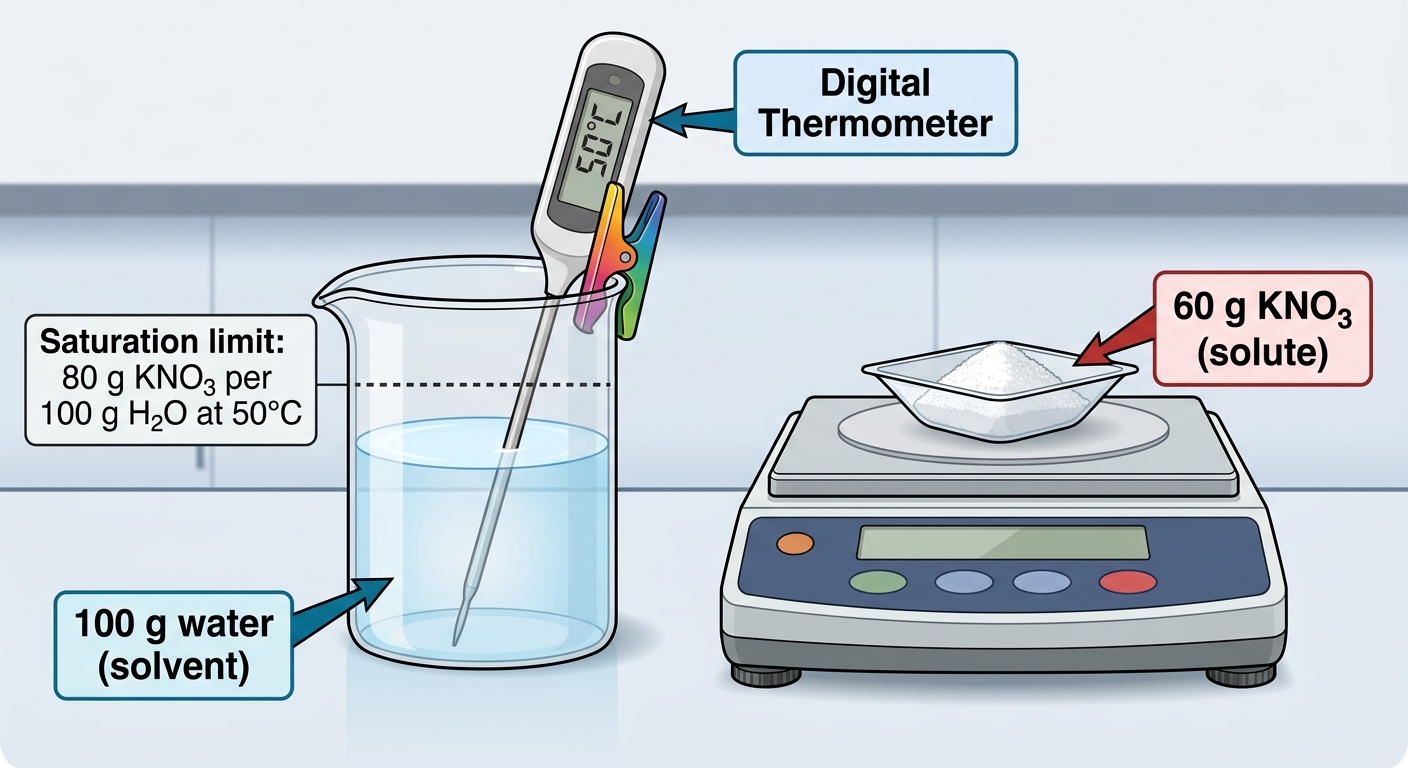
The solubility of at 50°C is 80 g per 100 g of water.
A student adds 60 g of (the solute) to 100 g of water (the solvent) at 50°C.
Using the terms solute, solvent, saturated, unsaturated, and solution, explain what happens when the is added to the water. [2]
A student adds 60 g of (the solute) to 100 g of water (the solvent) at 50°C.
Using the terms solute, solvent, saturated, unsaturated, and solution, explain what happens when the is added to the water. [2]

Solutions
2QuestionInterpreting solubility curves (basic graph reading)Assessment Practice
2 marks~3 minCriterion B
The solubility of potassium nitrate () at selected temperatures is given below.
The solubility at 40°C is not recorded.
| Temperature (°C) | 10 | 20 | 30 | 50 | 60 |
|---|---|---|---|---|---|
| Solubility (g per 100 g water) | 21 | 32 | 46 | 85 | 110 |
The solubility at 40°C is not recorded.
a
Calculate the solubility of at 40°C by interpolating between the data points at 30°C and 50°C. [1]
b
The data show that solubility does not increase by equal amounts for each 10°C rise. Deduce what this non-linear pattern suggests about the relationship between temperature and solubility of . [1]
Solutions
3QuestionSaturated, unsaturated, and supersaturated solutionsAssessment Practice
2 marks~3 minCriterion D
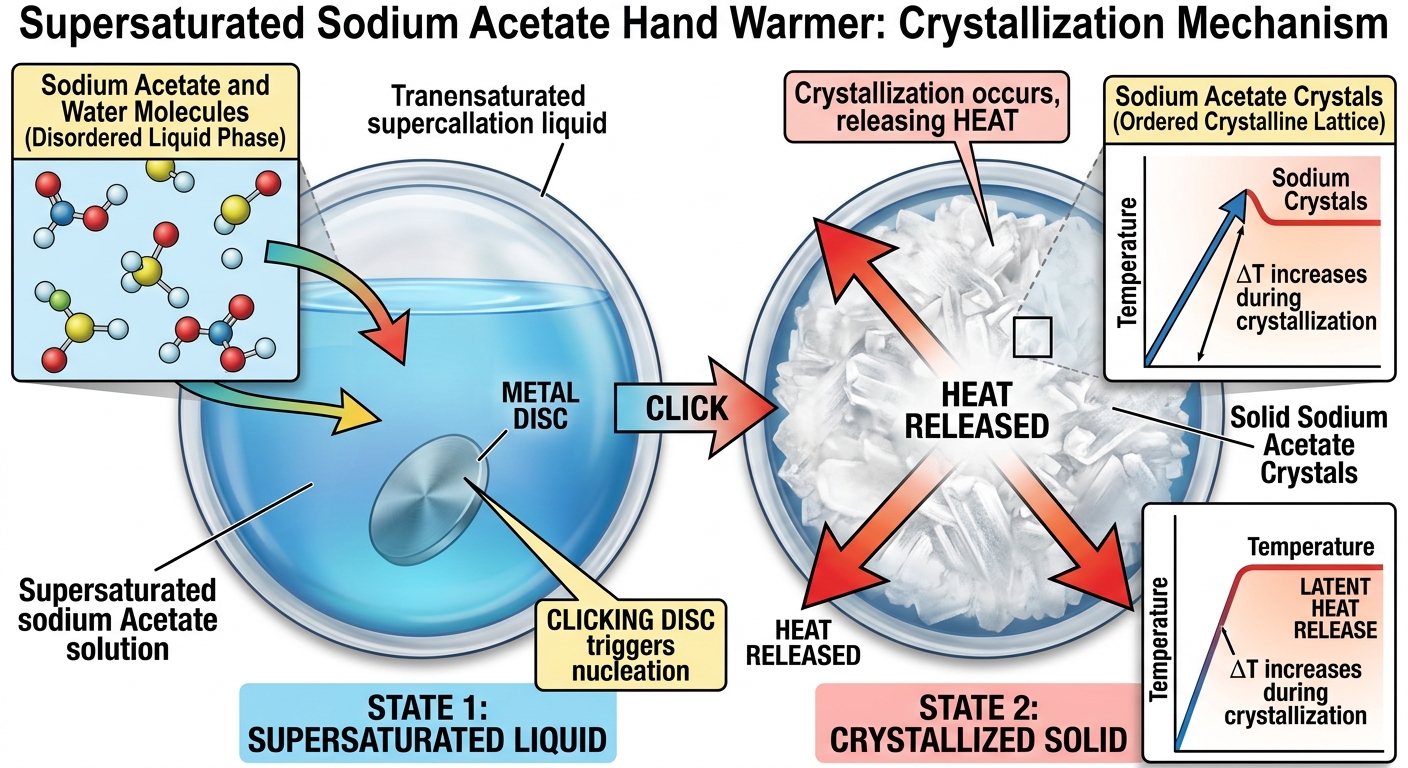
A reusable hand warmer contains a supersaturated solution of sodium acetate (). Clicking a metal disc inside the pack triggers rapid crystallization, releasing heat that warms the user's hands. The warmer can be reset by placing it in boiling water until all crystals dissolve.
a
Explain why the crystallization of the supersaturated sodium acetate solution releases heat energy. [1]
b
Evaluate one limitation of this hand warmer as a practical heat source for emergency situations. [1]
Solutions
4QuestionInterpreting solubility curves (basic graph reading)Assessment Practice
6 marks~9 minCriterion C
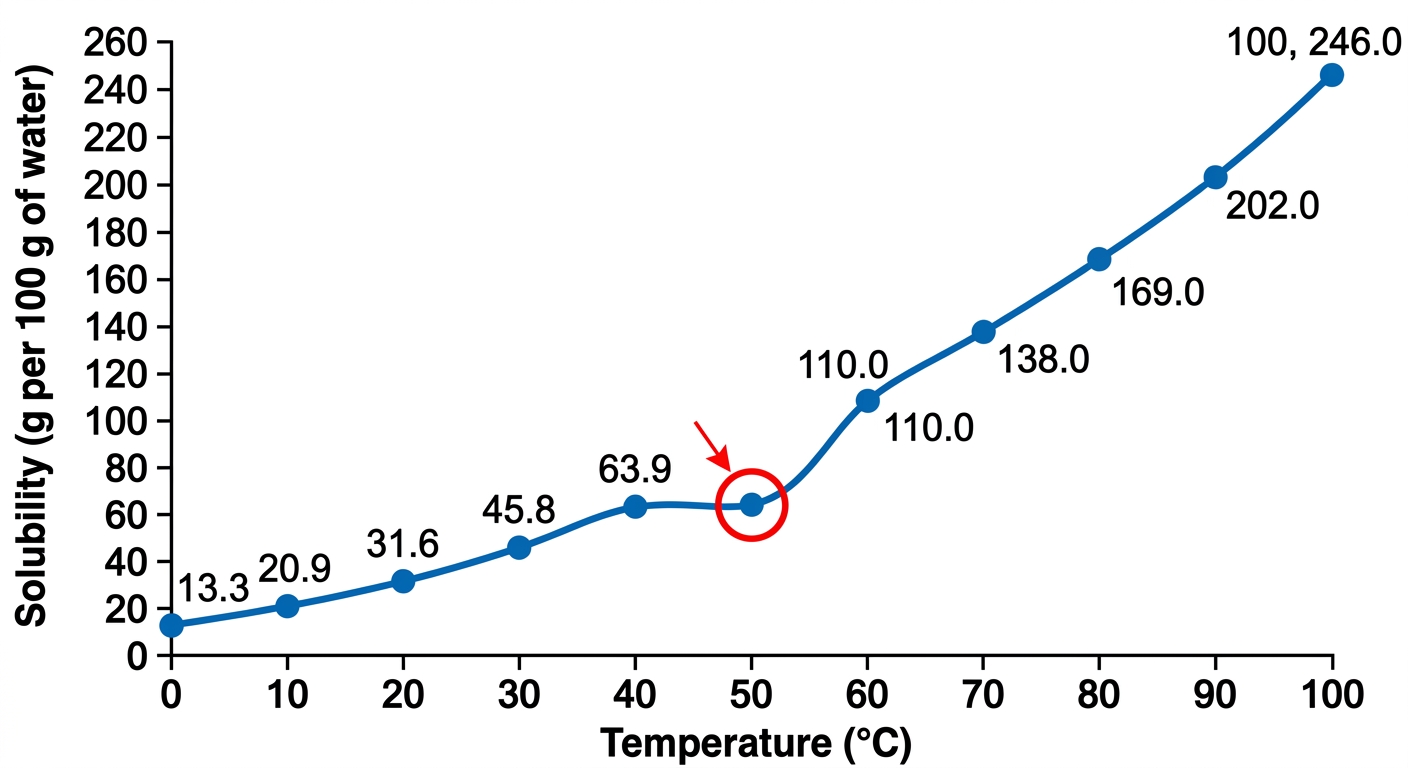
The solubility of potassium nitrate () in water was measured at regular temperature intervals. Results are shown below.
Temperature (°C): 0, 10, 20, 30, 40, 50, 60, 70, 80, 90, 100
Solubility (g per 100 g water): 13.3, 20.9, 31.6, 45.8, 63.9, 63.9, 110.0, 138.0, 169.0, 202.0, 246.0
Temperature (°C): 0, 10, 20, 30, 40, 50, 60, 70, 80, 90, 100
Solubility (g per 100 g water): 13.3, 20.9, 31.6, 45.8, 63.9, 63.9, 110.0, 138.0, 169.0, 202.0, 246.0
a
Identify the anomalous data point in the table and deduce the solubility value that would be expected at 50°C based on the trend between 40°C and 60°C. [2]
b
Explain one experimental error that could have produced this anomaly, describing how it would affect the measured solubility. [2]
c
A student claims that the solubility of at 45°C is approximately 75 g per 100 g water. Evaluate this claim using the corrected data trend, showing your reasoning clearly. [2]
Solutions
That's every free question here — 4 of 74.
+70 more questions, plus Mock Papers & Worksheets, are waiting in Premium.