You're viewing free preview questions — 6 questions previewing here — subscribe to unlock 62 more, plus the Full Question Bank, Mock Papers & Worksheets.Upgrade
Back

Energy profiles and bond energies — Free MYP4 Chemistry Practice Questions

Free questions

Open in full, with answers, mark scheme and examiner insights.

Question 1Criterion A + C · Band 1-4 · Easy · 6 marksrevisionprep.com

Energy profile diagrams (reactants → products)

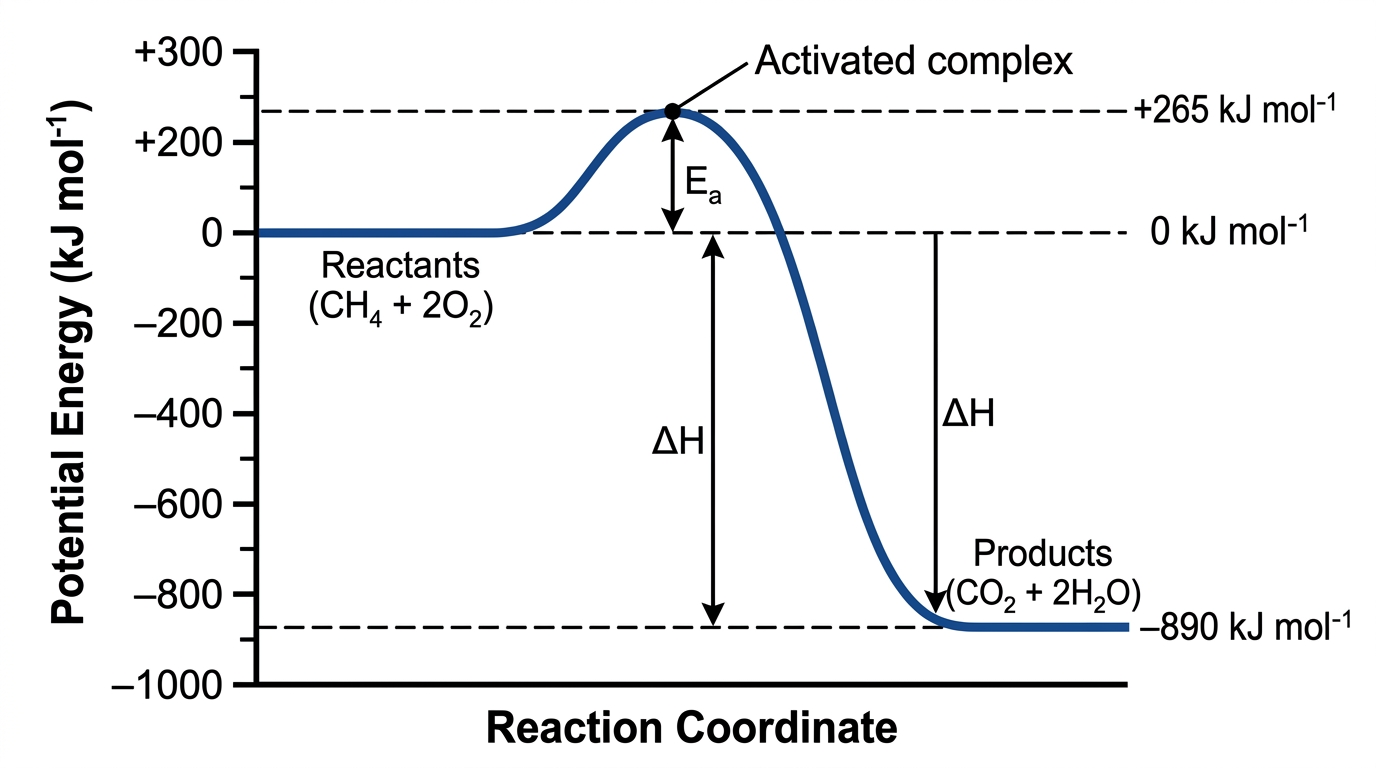
The diagram shows the energy profile for the complete combustion of methane, the main gas in natural gas.

CH4(g)+2O2(g)→CO2(g)+2H2O(l)\mathrm{CH_{4}(g) + 2O_{2}(g) \rightarrow CO_{2}(g) + 2H_{2}O(l)}

The mass of one mole of methane is 16 g.
Question diagram
(a)
State the activation energy and the overall energy change, ΔH\Delta H, shown on the diagram. [2]Criterion C (ii) · Level 1-2
(b)
Explain why natural gas from a cooker can leak into a kitchen without reacting, but burns as soon as a spark is made. [2]Criterion A (ii) · Level 3-4
(c)
Calculate the energy released when 8.0 g of methane burns completely. [2]Criterion A (ii) · Level 3-4

revisionprep.com

Summary Answer

Not available for this question.

Model Answer

Not available for this question.

Marking Scheme

Not available for this question.

Examiner Insights

Not available for this question.

Question 2Criterion A + C · Band 1-4 · Easy · 3 marksrevisionprep.com

Relationship between bond energy and reaction type

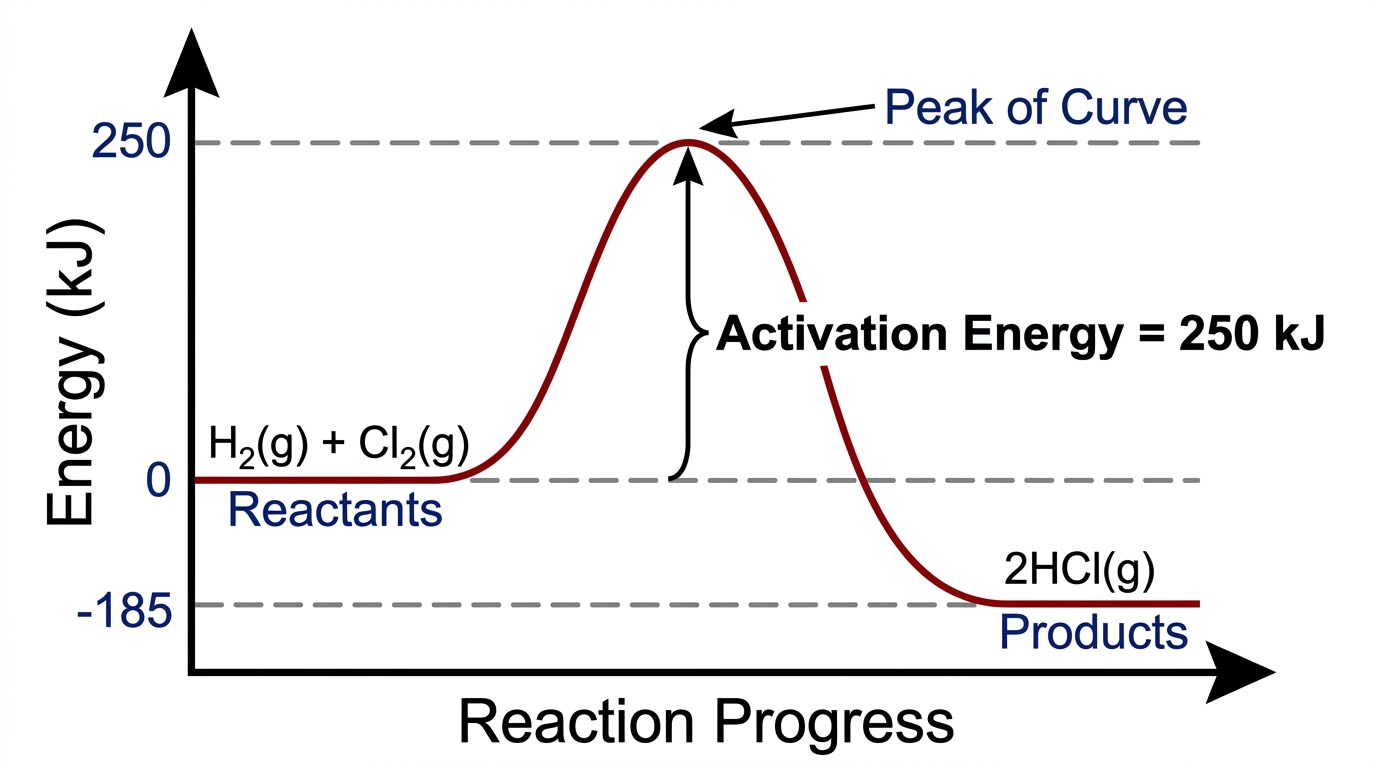
The diagram shows the energy profile for the reaction between hydrogen and chlorine.

H2(g)+Cl2(g)→2HCl(g)\mathrm{H_{2}(g) + Cl_{2}(g) \rightarrow 2HCl(g)}

Bond energies in kJ mol⁻¹: H-H 436; Cl-Cl 243; H-Cl 432
Question diagram
(a)
State the activation energy and ΔH\Delta H shown on the diagram. [1]Criterion C (ii) · Level 1-2
(b)
Use the bond energies to show that ΔH\Delta H is −185 kJ mol⁻¹. [2]Criterion A (ii) · Level 3-4

revisionprep.com

Summary Answer

Not available for this question.

Model Answer

Not available for this question.

Marking Scheme

Not available for this question.

Examiner Insights

Not available for this question.

Question 3Criterion A + C · Band 1-6 · Medium · 7 marksrevisionprep.com

Energy profile diagrams (reactants → products)

The table shows the activation energy for the decomposition of hydrogen peroxide with no catalyst and with two different catalysts.

2H2O2(aq)→2H2O(l)+O2(g)\mathrm{2H_{2}O_{2}(aq) \rightarrow 2H_{2}O(l) + O_{2}(g)}
(a)
Describe the effect of the catalysts on the activation energy. [1]Criterion C (ii) · Level 1-2
(b)
Sketch, on one set of axes, energy profiles for the reaction with no catalyst and with manganese(IV) oxide. Label both activation energies and ΔH\Delta H. [3]Criterion A (ii) · Level 5-6
(c)
Explain, using collision theory, why the reaction is fastest with manganese(IV) oxide. [2]Criterion A (ii) · Level 5-6
(d)
State how the value of ΔH\Delta H with iron(III) oxide compares with the value with no catalyst. [1]Criterion A (ii) · Level 3-4

revisionprep.com

Summary Answer

Not available for this question.

Model Answer

Not available for this question.

Marking Scheme

Not available for this question.

Examiner Insights

Not available for this question.

Question 4Criterion C + A · Band 3-6 · Medium · 7 marksrevisionprep.com

Bond breaking (endothermic) vs bond making (exothermic)

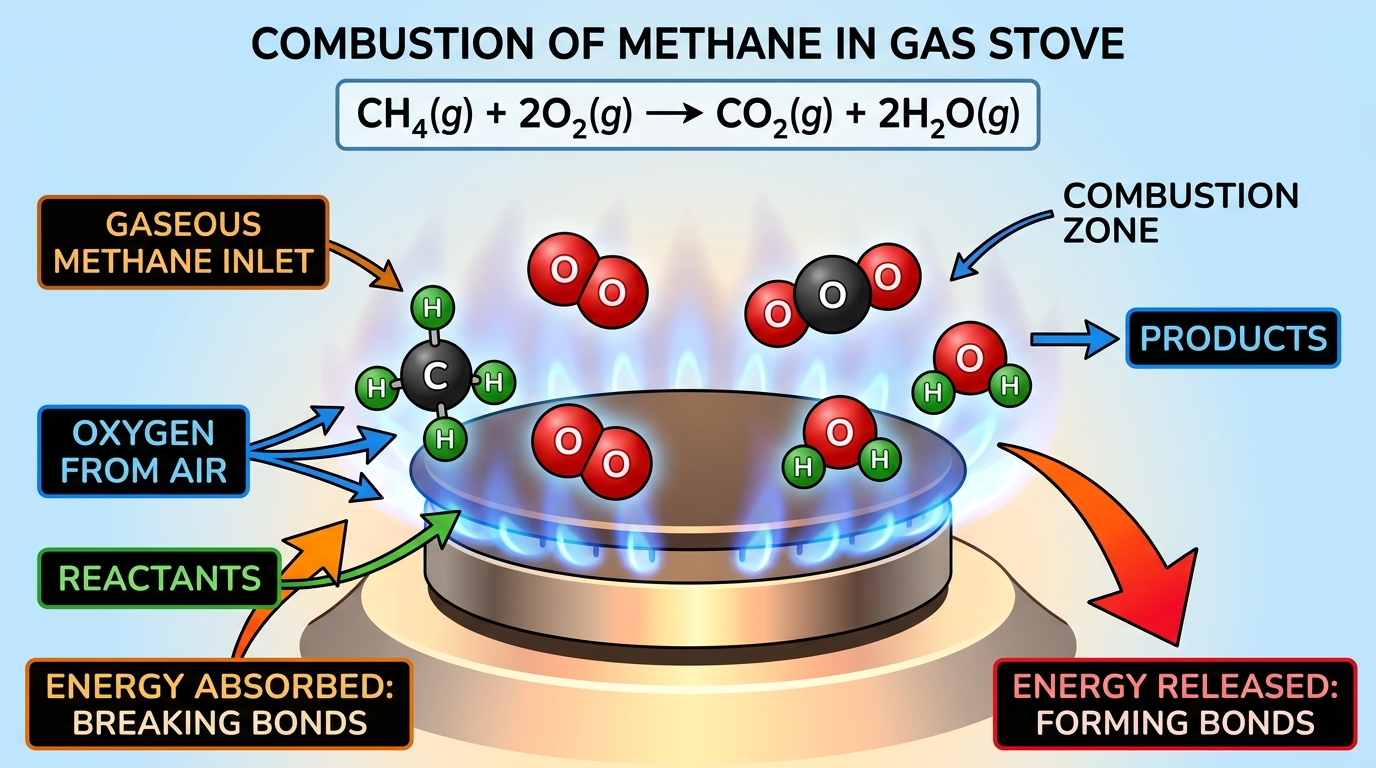
The diagram shows methane burning on a gas stove. Energy is absorbed as bonds break and released as bonds form.

CH4(g)+2O2(g)→CO2(g)+2H2O(g)\mathrm{CH_{4}(g) + 2O_{2}(g) \rightarrow CO_{2}(g) + 2H_{2}O(g)}

Bond energies in kJ mol⁻¹: C-H 413; O=O 498; C=O 805; O-H 464
Question diagram
(a)
Calculate the energy absorbed when all the bonds in the reactants are broken. [2]Criterion C (i) · Level 3-4
(b)
Calculate the energy released when all the bonds in the products are made. [2]Criterion C (i) · Level 3-4
(c)
Calculate ΔH\Delta H for the reaction. [1]Criterion C (i) · Level 3-4
(d)
A data book gives ΔH\Delta H = −890 kJ mol⁻¹ for burning methane. Suggest two reasons why this differs from your answer to (c). [2]Criterion A (iii) · Level 5-6

revisionprep.com

Summary Answer

Not available for this question.

Model Answer

Not available for this question.

Marking Scheme

Not available for this question.

Examiner Insights

Not available for this question.

Question 5Criterion D + A · Band 1-8 · Challenge · 9 marksrevisionprep.com

Activation energy and overall energy change (ΔH – qualitative)
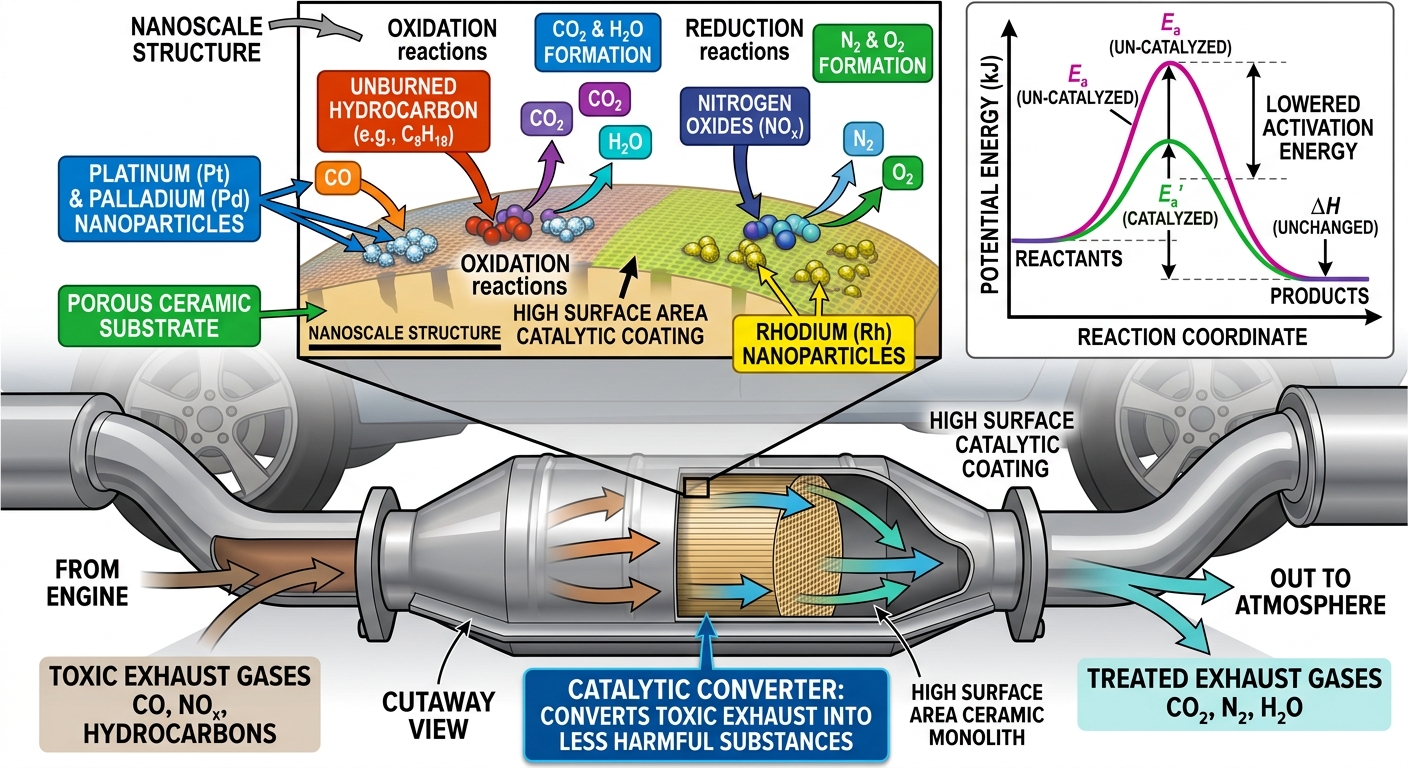
The diagram shows how a catalytic converter treats car exhaust. Platinum, palladium and rhodium on a ceramic honeycomb act as catalysts. Two of the reactions are:

2CO(g)+O2(g)→2CO2(g)\mathrm{2CO(g) + O_{2}(g) \rightarrow 2CO_{2}(g)}
2NO(g)→N2(g)+O2(g)\mathrm{2NO(g) \rightarrow N_{2}(g) + O_{2}(g)}
Question diagram
(a)
Name the toxic gases that enter the converter and the gases that leave it, using the diagram. [2]Criterion A (i) · Level 1-2
(b)
Explain, using the energy profile in the diagram, how the catalysts allow these reactions to happen as the gases pass through. [2]Criterion A (ii) · Level 5-6
(c)
Suggest why the catalyst is spread as a thin coating over a honeycomb rather than used as solid lumps. [1]Criterion D (i) · Level 5-6
(d)
Discuss whether catalytic converters are a good solution to the problem of pollution from cars. [4]Criterion D (ii) · Level 7-8

revisionprep.com

Summary Answer

Not available for this question.

Model Answer

Not available for this question.

Marking Scheme

Not available for this question.

Examiner Insights

Not available for this question.

Question 6Criterion B · Band 5-8 · Challenge · 10 marksrevisionprep.com

Interpreting energy diagrams (peaks, energy levels)

Ines wants to find which metal oxide is the most effective catalyst for the decomposition of hydrogen peroxide. She will test manganese(IV) oxide, copper(II) oxide, iron(III) oxide and zinc oxide.

2H2O2(aq)→2H2O(l)+O2(g)\mathrm{2H_{2}O_{2}(aq) \rightarrow 2H_{2}O(l) + O_{2}(g)}

She can use a conical flask, a bung with a delivery tube, a 100 cm³ gas syringe, a stopclock, a balance and measuring cylinders.
(a)
Formulate a hypothesis linking the rate of oxygen production to the activation energy with each catalyst. [2]Criterion B (ii) · Level 5-6
(b)
Identify the independent variable, the dependent variable and two control variables. [2]Criterion B (iii) · Level 5-6
(c)
Describe a method that would give sufficient, relevant data. [4]Criterion B (iv) · Level 7-8
(d)
Explain how she could show that the best catalyst is not used up in the reaction. [2]Criterion B (iv) · Level 5-6

revisionprep.com

Summary Answer

Not available for this question.

Model Answer

Not available for this question.

Marking Scheme

Not available for this question.

Examiner Insights

Not available for this question.

That's every free question here — 6 of 68.

+62 more questions, plus Mock Papers & Worksheets, are waiting in Premium.

Upgrade