You're viewing free preview questions — 4 questions previewing here — subscribe to unlock 61 more, plus the Full Question Bank, Mock Papers & Worksheets.Upgrade
Endothermic and Exothermic reactons — Free MYP4 Chemistry Practice Questions

1QuestionTemperature changes during reactionsConcept Practice
3 marks~5 minCriterion A
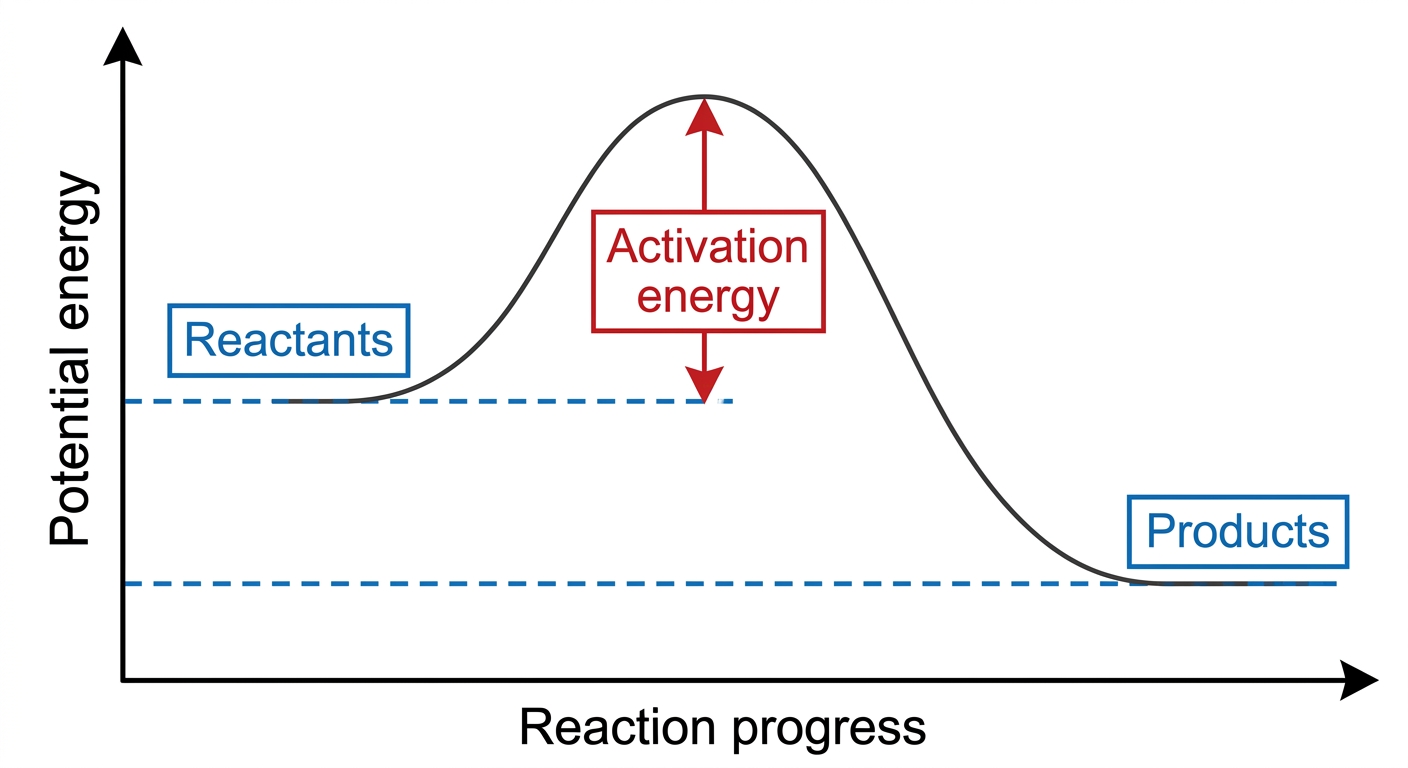
The energy profile diagram below shows the energy changes during a chemical reaction.
a
Deduce whether this reaction is endothermic or exothermic. [1]
b
Explain, in terms of bond breaking and bond forming, why this reaction has the overall energy change shown in the diagram. [2]

Solutions
2QuestionIdentifying reaction type from descriptions or dataAssessment Practice
3 marks~5 minCriterion C
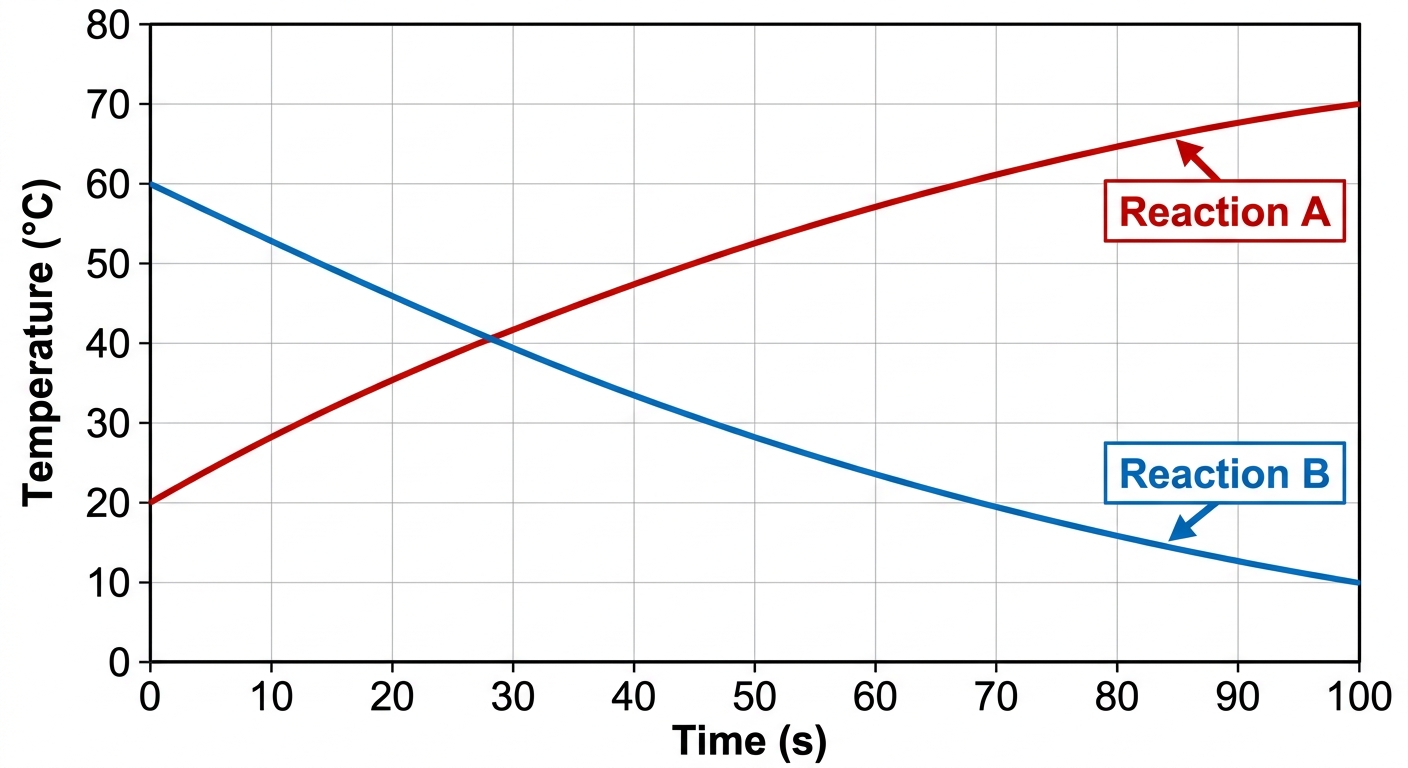
A student dissolves two different salts separately in water inside insulated cups and records the temperature of the solution every 30 seconds.
The graph shows the results.
Reaction A: temperature rises steadily from 20 °C to 34 °C over 3 minutes.
Reaction B: temperature falls steadily from 20 °C to 11 °C over 3 minutes.
The graph shows the results.
Reaction A: temperature rises steadily from 20 °C to 34 °C over 3 minutes.
Reaction B: temperature falls steadily from 20 °C to 11 °C over 3 minutes.
a
Identify the reaction type (endothermic or exothermic) for each reaction. [1]
b
Explain the temperature change observed in Reaction A in terms of energy transfer between the reaction and its surroundings. [1]
c
The student claims that Reaction B "destroys energy" because the surroundings lose heat. Evaluate this claim. [1]
Solutions
3QuestionTemperature changes during reactionsAssessment Practice
5 marks~8 minCriterion B
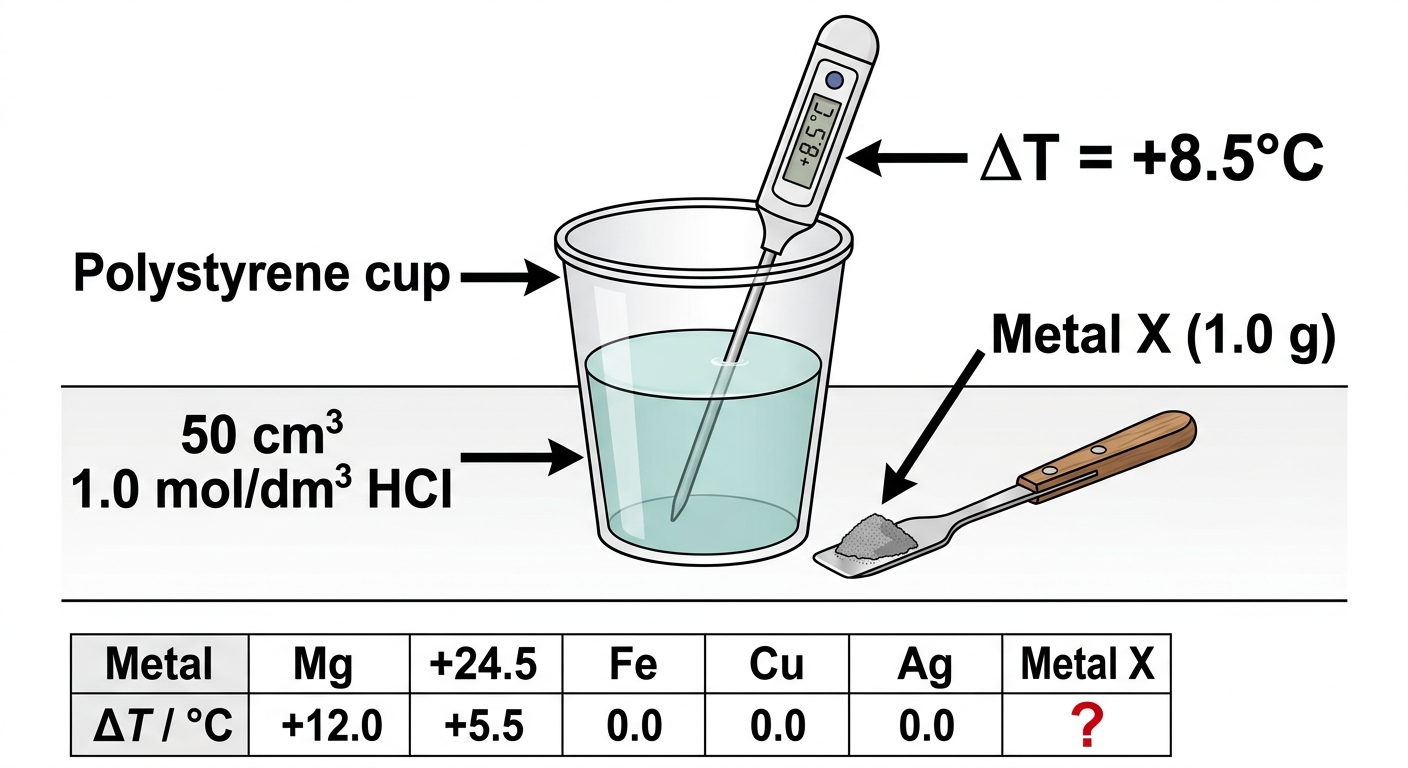
A student adds 1.0 g samples of five metals to 50 cm³ of 1.0 mol/dm³ hydrochloric acid in a polystyrene cup, recording the maximum temperature change () for each:
An unknown metal X, tested under identical conditions, gives °C.
| Metal | magnesium | zinc | iron | copper | silver |
|---|---|---|---|---|---|
| (°C) | +24.5 | +12.0 | +5.5 | 0.0 | 0.0 |
An unknown metal X, tested under identical conditions, gives °C.
a
State the type of energy change occurring when a reactive metal is added to hydrochloric acid, and write the general word equation for the reaction. [1]
b
Explain how the data above show a relationship between a metal's reactivity and its observed , referring to at least three metals in your answer. [2]
c
Deduce the identity of metal X. Justify your answer using both the data and the reactivity series. [2]
Solutions
4QuestionIdentifying reaction type from descriptions or dataAssessment Practice
6 marks~9 minCriterion D
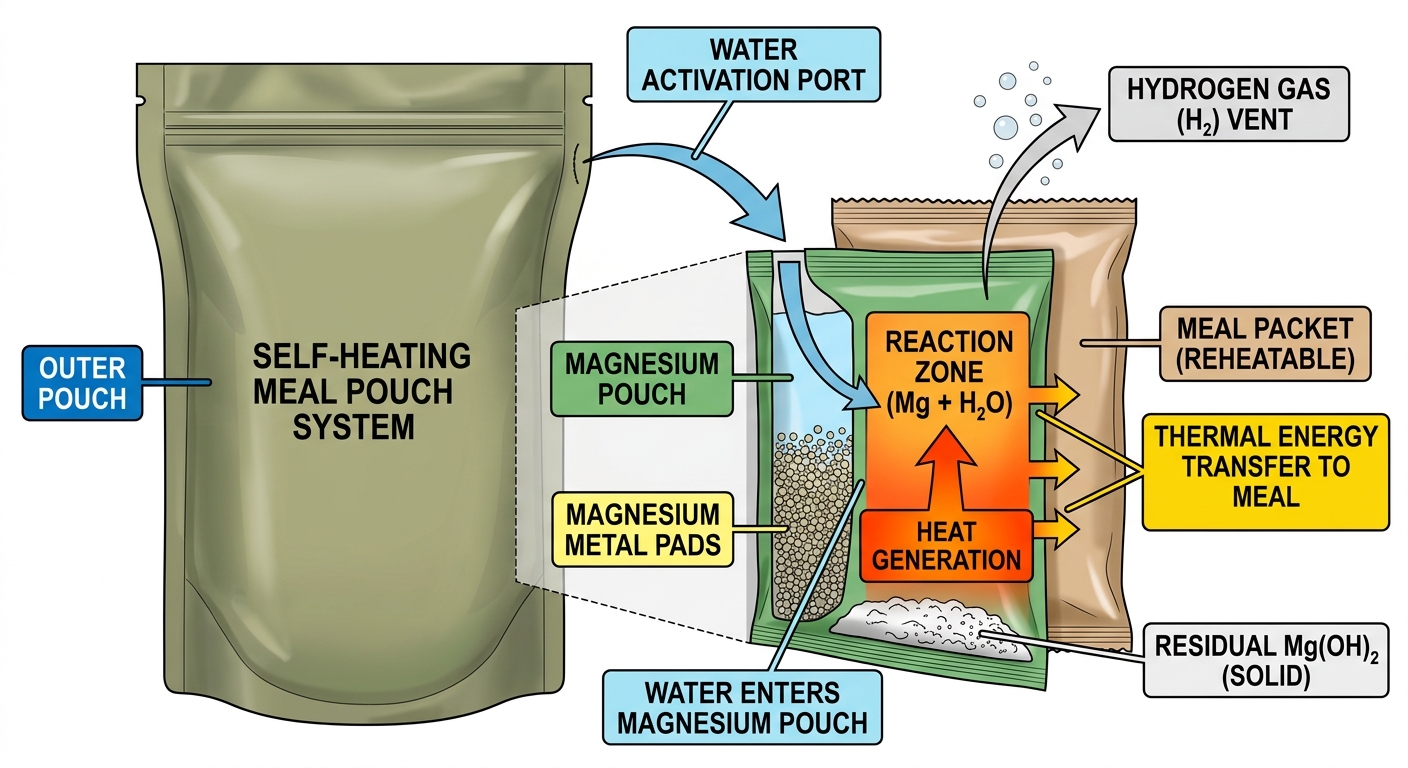
Self-heating meal pouches, used by hikers and military personnel, contain a compartment of magnesium metal. When water is added, the following reaction occurs:
The reaction releases sufficient heat to warm a meal without any external flame or electricity. Magnesium hydroxide accumulates as a solid residue, and hydrogen gas is released into the surroundings.
The reaction releases sufficient heat to warm a meal without any external flame or electricity. Magnesium hydroxide accumulates as a solid residue, and hydrogen gas is released into the surroundings.
a
Deduce whether this reaction is endothermic or exothermic. Justify your answer using evidence from the information above. [1]
b
Explain one societal benefit of this technology for people in remote or emergency situations. [2]
c
Evaluate one environmental limitation of this technology, considering the reaction products and their disposal, and discuss how this limitation affects the overall effectiveness of the technology. [3]
Solutions
That's every free question here — 4 of 65.
+61 more questions, plus Mock Papers & Worksheets, are waiting in Premium.