You're viewing free preview questions — 4 questions previewing here — subscribe to unlock 80 more, plus the Full Question Bank, Mock Papers & Worksheets.Upgrade
Factors affecting rate - temperature, concentration, surface, area and catalysts — Free MYP4 Chemistry Practice Questions

1QuestionSurface area and its role in solid reactionsConcept Practice
3 marks~5 minCriterion A
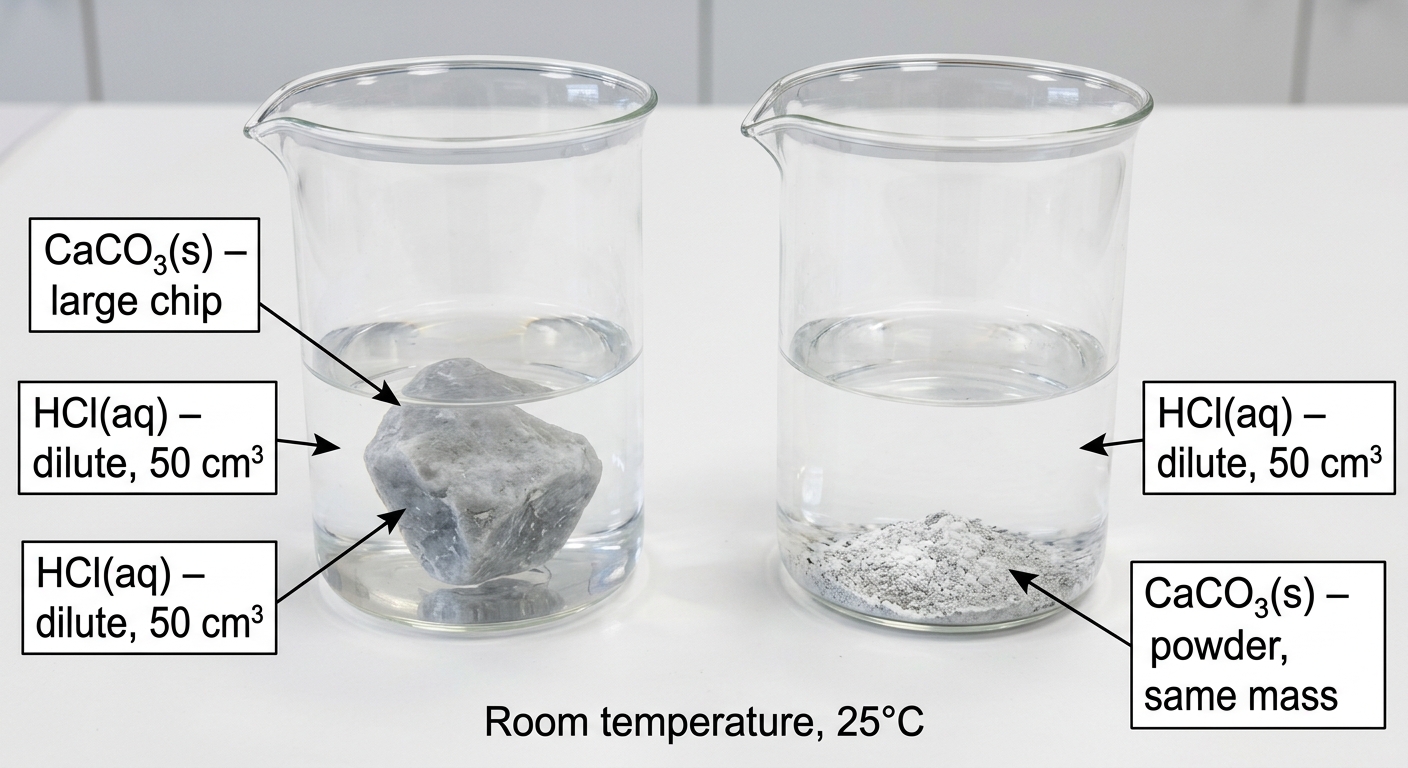
A student adds a large marble chip of calcium carbonate () to a beaker of dilute hydrochloric acid (). In a separate beaker, the same mass of powdered calcium carbonate is added to an equal volume and concentration of hydrochloric acid. The powdered form reacts significantly faster.
a
Construct the balanced chemical equation, including state symbols, for the reaction between calcium carbonate and hydrochloric acid. [1]
b
Explain, using collision theory, why the powdered calcium carbonate reacts faster than the marble chip. [2]

Solutions
2QuestionEffect of temperature on particle energy and collisionsAssessment Practice
5 marks~8 minCriterion C
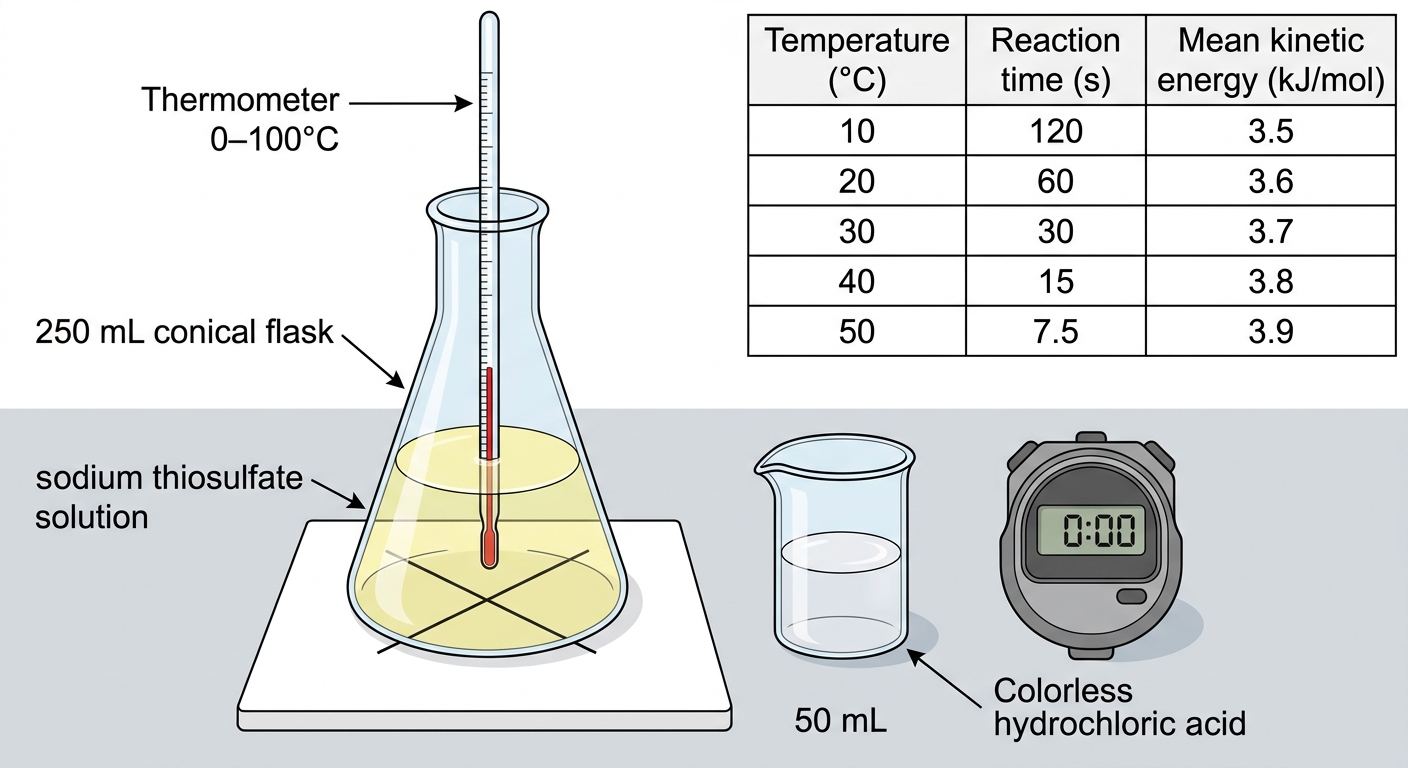
A student investigates the effect of temperature on the reaction between sodium thiosulfate solution and hydrochloric acid, measuring the time for the solution to turn opaque.
The student hypothesises: "The reaction rate doubles every 10°C because particles move twice as fast."
| Temperature (°C) | 10 | 20 | 30 | 40 | 50 |
|---|---|---|---|---|---|
| Reaction time (s) | 120 | 60 | 30 | 15 | 7.5 |
| Mean kinetic energy (kJ mol) | 3.5 | 3.6 | 3.7 | 3.8 | 3.9 |
The student hypothesises: "The reaction rate doubles every 10°C because particles move twice as fast."
a
Calculate the reaction rate at 10°C and at 50°C, and deduce the overall rate increase across this temperature range. [1]
b
Using the kinetic energy data, show that particle speed does not double between 10°C and 20°C, given that . [2]
c
Evaluate the student's hypothesis, explaining the actual cause of the observed rate increase using collision theory and the Maxwell-Boltzmann distribution. [2]
Solutions
3QuestionEffect of temperature on particle energy and collisionsAssessment Practice
6 marks~9 minCriterion D
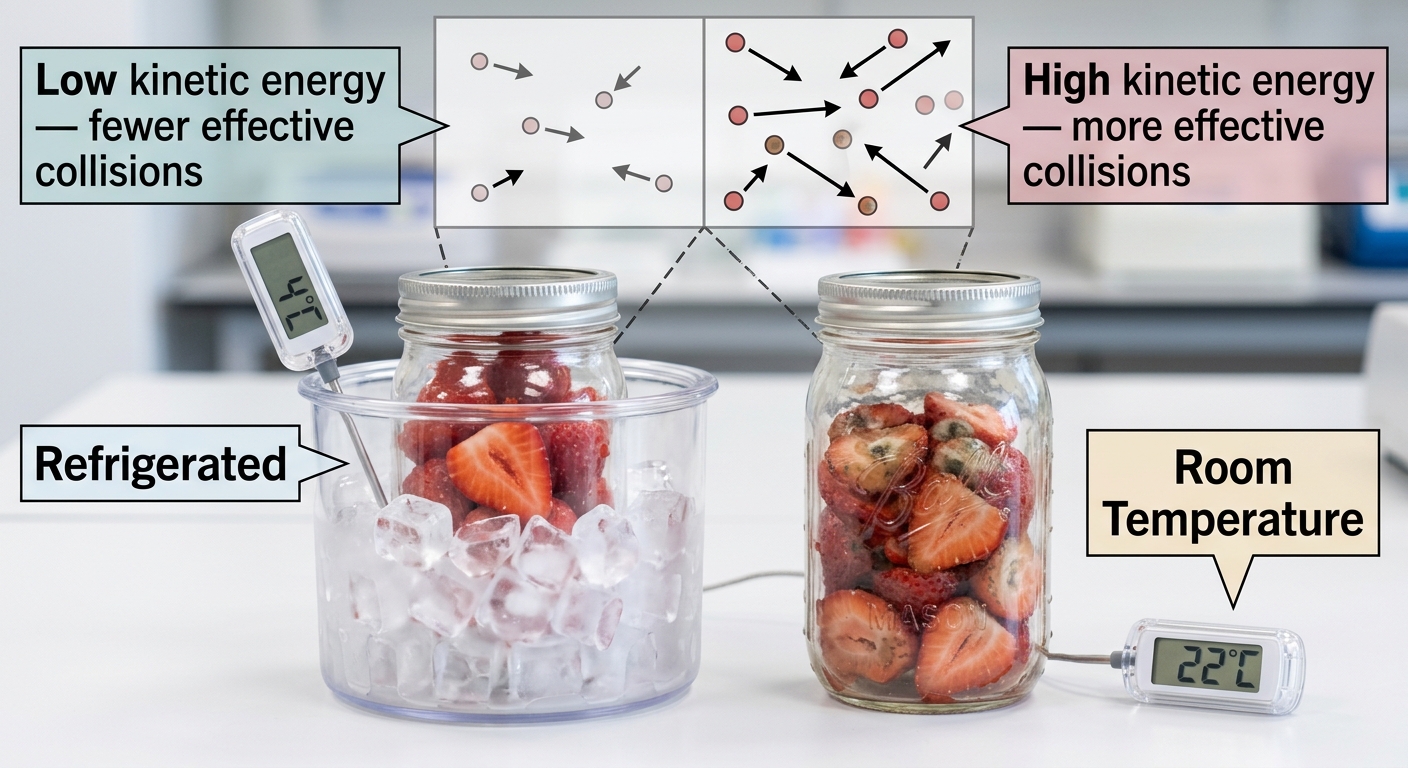
Food spoilage is accelerated by microbial and enzymatic activity. Refrigerators typically maintain an internal temperature of around 4 °C, compared with a room temperature of approximately 22 °C.
a
Explain how lowering the temperature from 22 °C to 4 °C reduces the rate of food spoilage reactions, with reference to particle energy and collision frequency. [2]
b
Analyse the health risks that arise when perishable food is left at room temperature for several hours, linking your answer to reaction rate principles. [2]
c
Evaluate the limitations of refrigeration as a universal food preservation strategy, considering at least two distinct factors. [2]
Solutions
4QuestionEffect of temperature on particle energy and collisionsAssessment Practice
6 marks~9 minCriterion B
A student investigates how temperature affects the rate of reaction between sodium thiosulfate solution and hydrochloric acid. A sulfur precipitate forms, making the solution turn cloudy. The student records the time for the solution to become fully opaque at five temperatures.
| Temperature (°C) | 20 | 30 | 40 | 50 | 60 |
|---|---|---|---|---|---|
| Time (s) | 120 | 60 | 30 | 15 | 7.5 |
a
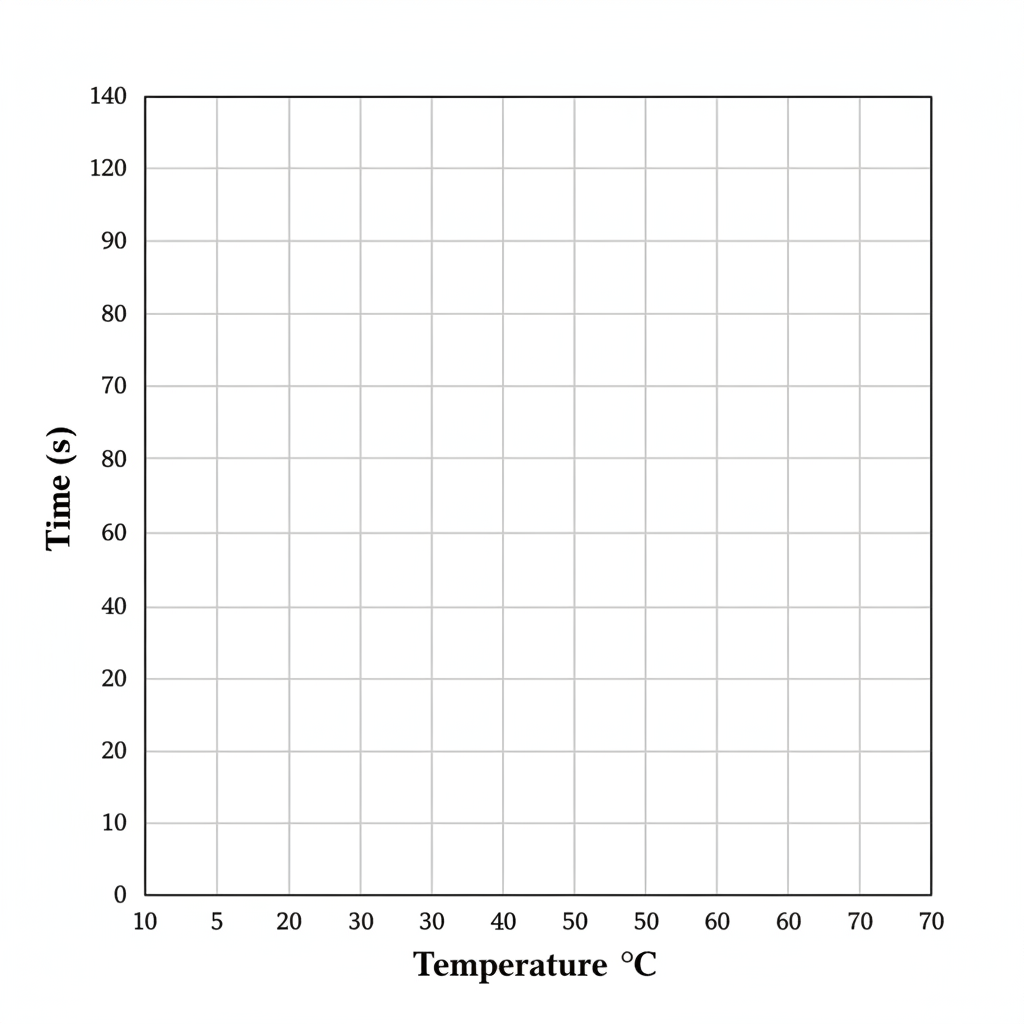
Construct a graph of time (y-axis, 0–140 s) against temperature (x-axis, 20–70°C), plot all five points, and describe the pattern shown. [2]
b
Explain, using collision theory, why increasing temperature increases the rate of this reaction. [2]
c
A second student claims the reaction time at 70°C will be approximately 3.75 s. Evaluate this claim by analysing the pattern in the data and linking it to the behaviour of particles at higher temperatures. [2]
Solutions
That's every free question here — 4 of 84.
+80 more questions, plus Mock Papers & Worksheets, are waiting in Premium.