You're viewing free preview questions — 4 questions previewing here — subscribe to unlock 52 more, plus the Full Question Bank, Mock Papers & Worksheets.Upgrade
Reversible Reactions and Equilibrium (qualitative) — Free MYP4 Chemistry Practice Questions

1QuestionEffect of changes in conditions (temperature, concentration – basic idea)Concept Practice
2 marks~3 minCriterion A
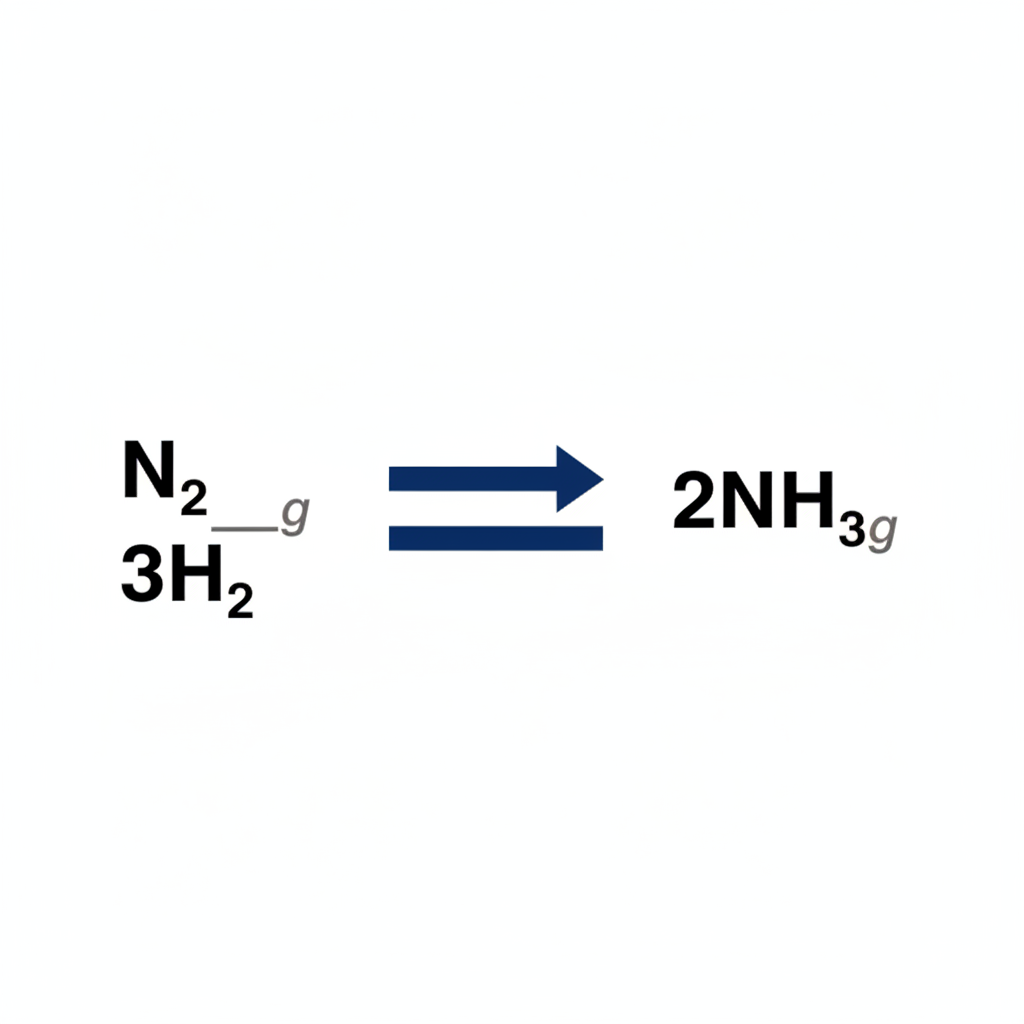
The Haber process produces ammonia via the following reversible reaction:
a
Explain what the symbol indicates about this reaction, referring to the forward reaction and the reverse reaction. Use the state symbols in your answer. [1]
b
Explain what is meant by the term equilibrium in the context of this reaction. [1]

Solutions
2QuestionDefinition of reversible reactionsAssessment Practice
4 marks~6 minCriterion C
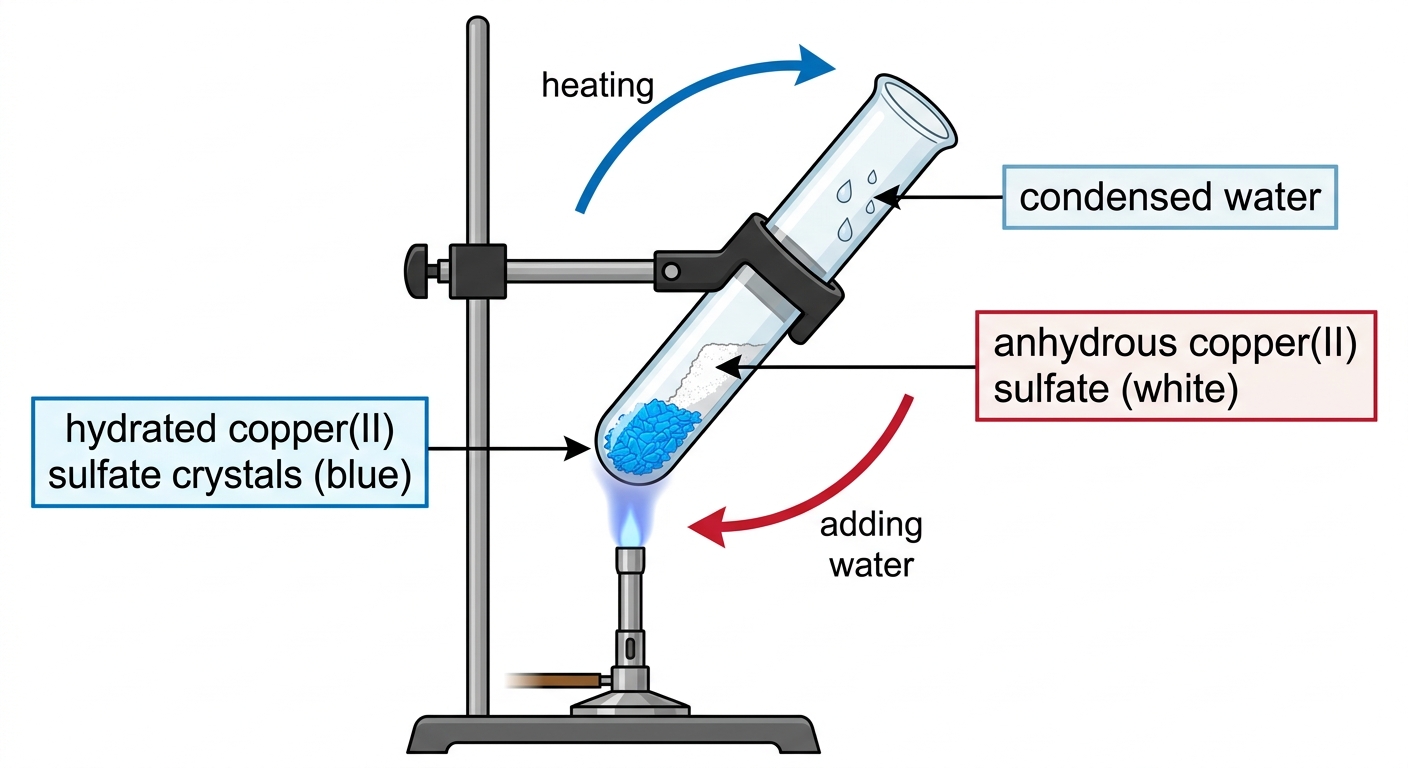
When blue hydrated copper(II) sulfate crystals, , are heated, they decompose to form white anhydrous copper(II) sulfate, , and water vapour. When water is added to the white powder, the blue colour is restored.
The diagram shows both a forward arrow (heating) and a reverse arrow (adding water) between the two forms.
The diagram shows both a forward arrow (heating) and a reverse arrow (adding water) between the two forms.
a
Explain why the copper(II) sulfate reaction shown in the diagram is described as reversible. [2]
b
A student claims that heating alone is sufficient to determine the direction of any reversible reaction. Using the copper(II) sulfate system, explain why this claim is incorrect. [2]
Solutions
3QuestionClosed system requirement for equilibriumAssessment Practice
7 marks~11 minCriterion B
A student investigates the equilibrium between nitrogen dioxide and dinitrogen tetroxide in a sealed syringe:
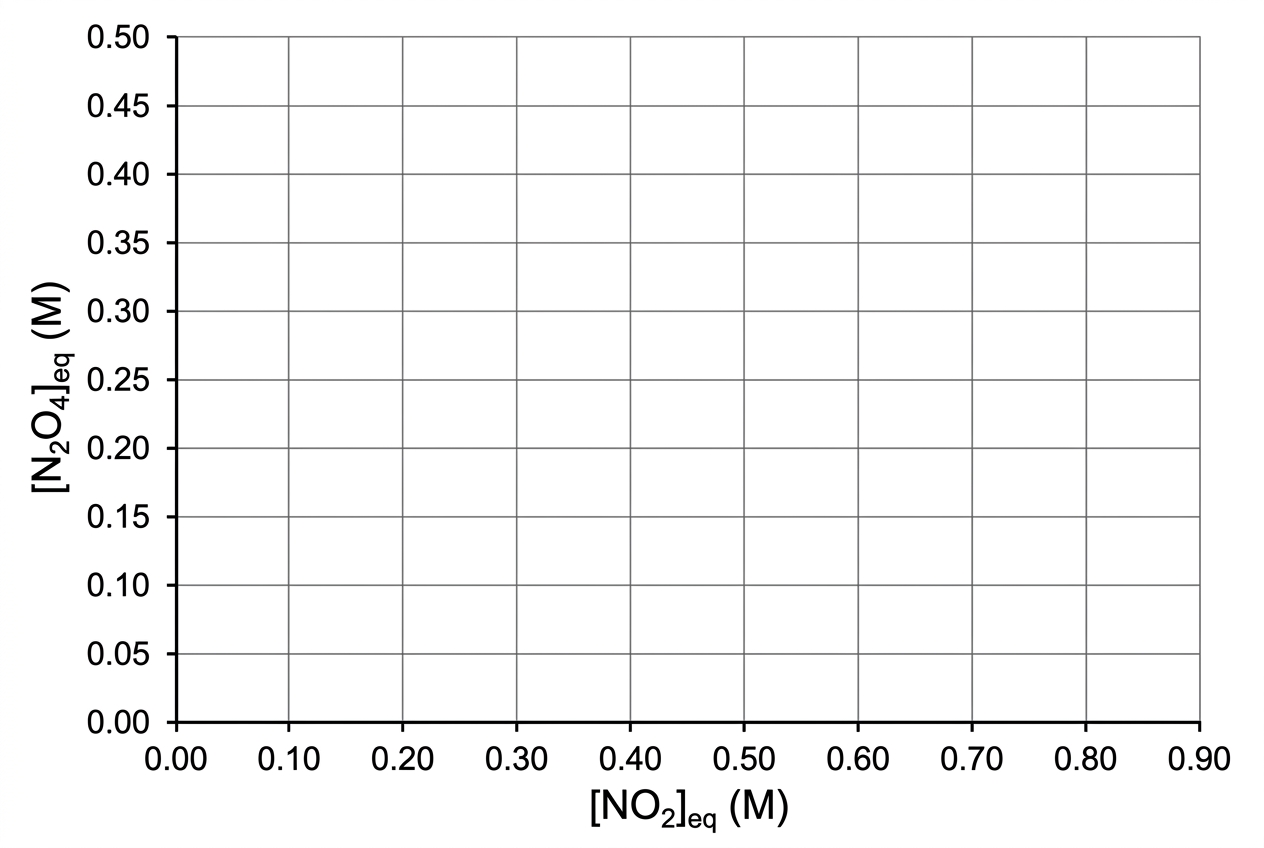
Different amounts of NO are injected and, after equilibrium is reached at constant temperature, concentrations are recorded:
Different amounts of NO are injected and, after equilibrium is reached at constant temperature, concentrations are recorded:
| Injection | 1 | 2 | 3 | 4 | 5 |
|---|---|---|---|---|---|
| (M) | 0.10 | 0.20 | 0.35 | 0.55 | 0.80 |
| (M) | 0.05 | 0.10 | 0.18 | 0.28 | 0.41 |
a
Construct a graph of (y-axis) against (x-axis) and interpret the relationship shown. [2]
b
Deduce the equilibrium concentration of NO when M. Show your method clearly. [2]
c
Analyse why does not increase in direct proportion to , using both the equilibrium expression for this reaction and collision theory. [3]
Solutions
4QuestionClosed system requirement for equilibriumAssessment Practice
10 marks~15 minCriterion D
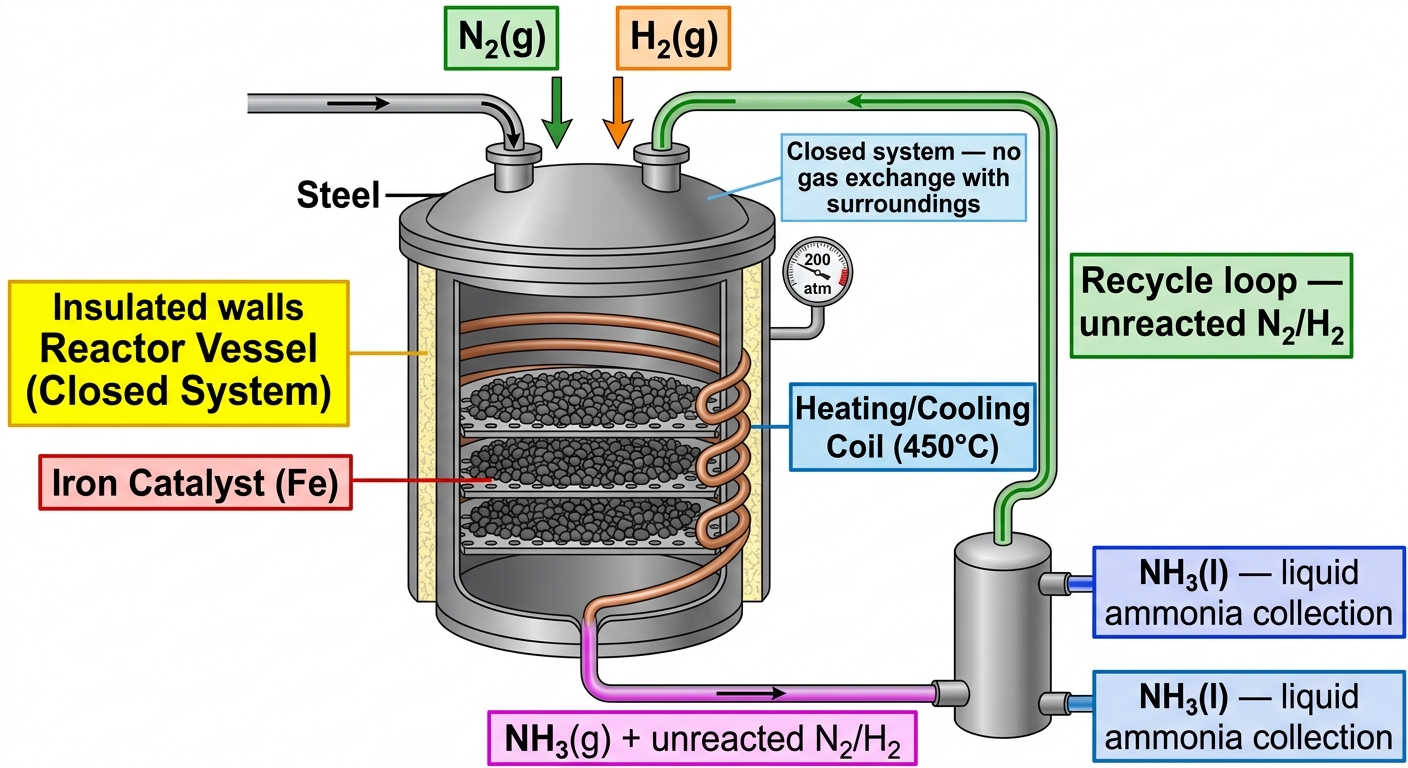
The Haber–Bosch process produces ammonia () for synthetic fertilizers in a closed system at approximately 200 atm and 450°C using an iron catalyst:
Hydrogen is sourced from natural gas via steam methane reforming, releasing approximately 1.9 tonnes of per tonne of produced. The process currently supports food production for roughly half the world's population.
Hydrogen is sourced from natural gas via steam methane reforming, releasing approximately 1.9 tonnes of per tonne of produced. The process currently supports food production for roughly half the world's population.
a
Explain why a closed system is necessary for equilibrium to be established, and explain how operating at 200 atm increases the yield of . [3]
b
Discuss the relationship between the Haber–Bosch process and global food security, referring to both the scale and the mechanism of its contribution. [3]
c
Evaluate the environmental impact of the Haber–Bosch process, considering both energy consumption and emissions, and assess whether the societal benefits justify continuing the process in its current form. [4]
Solutions
That's every free question here — 4 of 56.
+52 more questions, plus Mock Papers & Worksheets, are waiting in Premium.