You're viewing free preview questions — 4 questions previewing here — subscribe to unlock 199 more, plus the Full Question Bank, Mock Papers & Worksheets.Upgrade
Coordinate Geometry and Transformations — Free MYP4 Mathematics (Extended) Practice Questions

1QuestionSymmetry and reflectionAssessment Practice
6 marks~9 minCriterion D
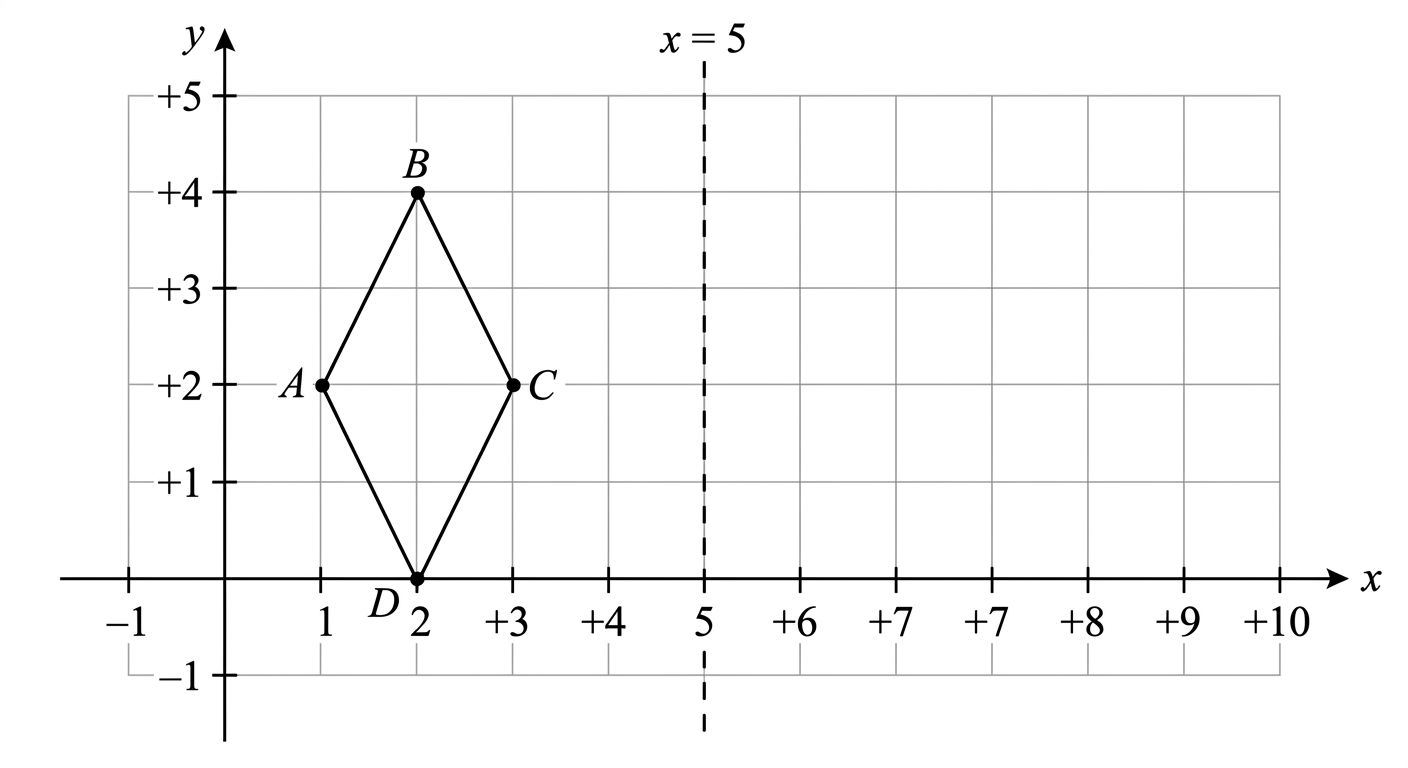
A graphic designer is creating a logo for a café. The left half of the logo is a quadrilateral with vertices , , , , joined in order. The designer reflects this quadrilateral over the line to produce the right half, with images , , , .
The diagram shows the left half plotted on a coordinate grid.
The diagram shows the left half plotted on a coordinate grid.
a
State the coordinates of , , , and after reflection over the line . [1]
b
The designer makes a consistent measurement error: every reflected point is placed units too far to the right of its correct position. Write down the erroneous coordinates of , , , , and calculate the percentage error in the -coordinate of , giving your answer to one decimal place.
[3]
[3]
c
The designer claims the -unit error is small enough that the completed logo still looks symmetric about . Assess this claim, and suggest one limitation of relying on a coordinate grid with -unit spacing to detect this type of error in a real logo design. [2]

Solutions
2QuestionMovement on a plane – isometric transformations, enlargements, tessellationsAssessment Practice
6 marks~9 minCriterion B
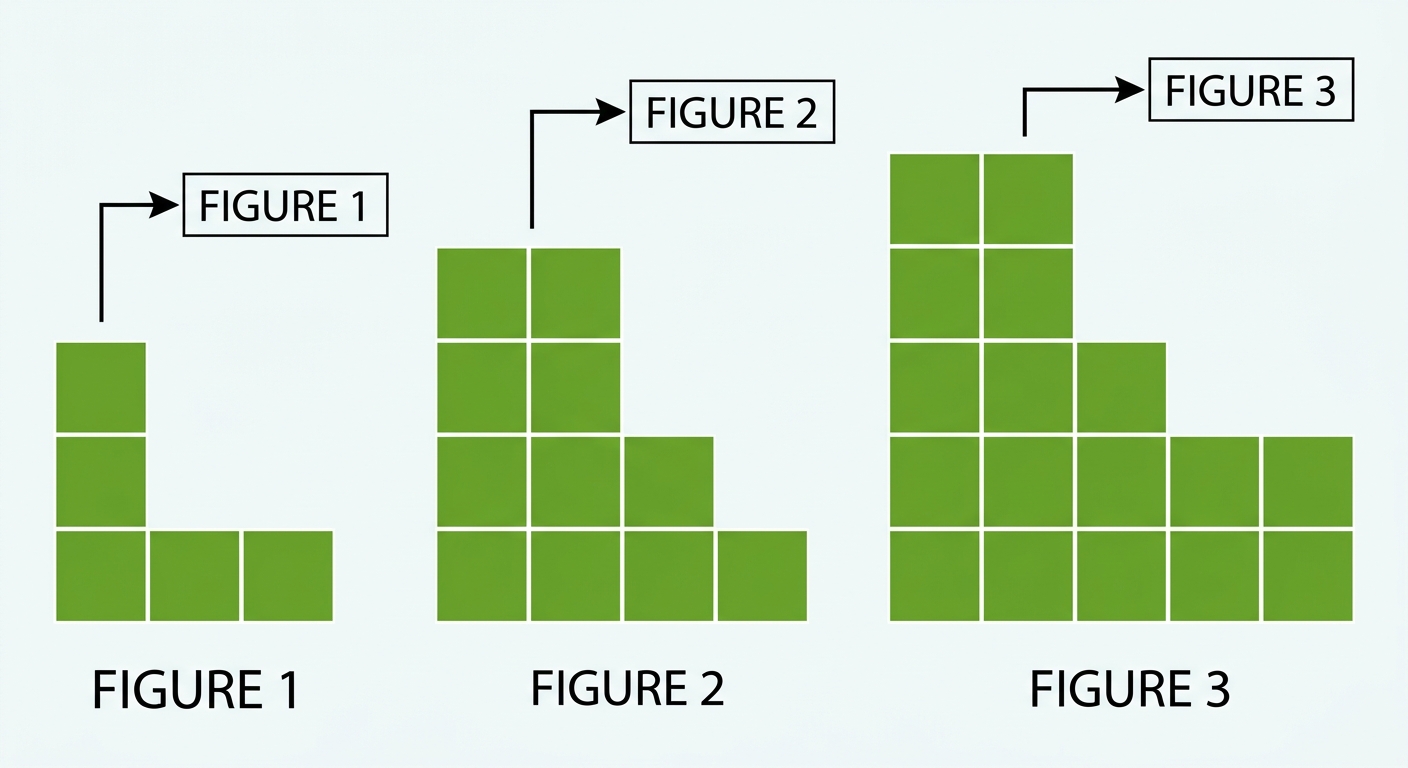
The diagram shows the first three figures of a pattern made from unit squares arranged in an L-shape.
Figure 1 has 3 unit squares, Figure 2 has 7 unit squares, and Figure 3 has 13 unit squares.
Figure 1 has 3 unit squares, Figure 2 has 7 unit squares, and Figure 3 has 13 unit squares.
a
Write down the number of unit squares in Figure 4. [1]
b
Find a rule for the number of unit squares in Figure , giving your answer in the form , where , and are integers. Show clearly how you obtained your values of , and . [3]
c
Show that the total number of unit squares across Figure and Figure can be written as . Hence justify why this total is always even for every positive integer . [2]
Solutions
3QuestionMovement on a plane – isometric transformations, enlargements, tessellationsAssessment Practice
6 marks~9 minCriterion A
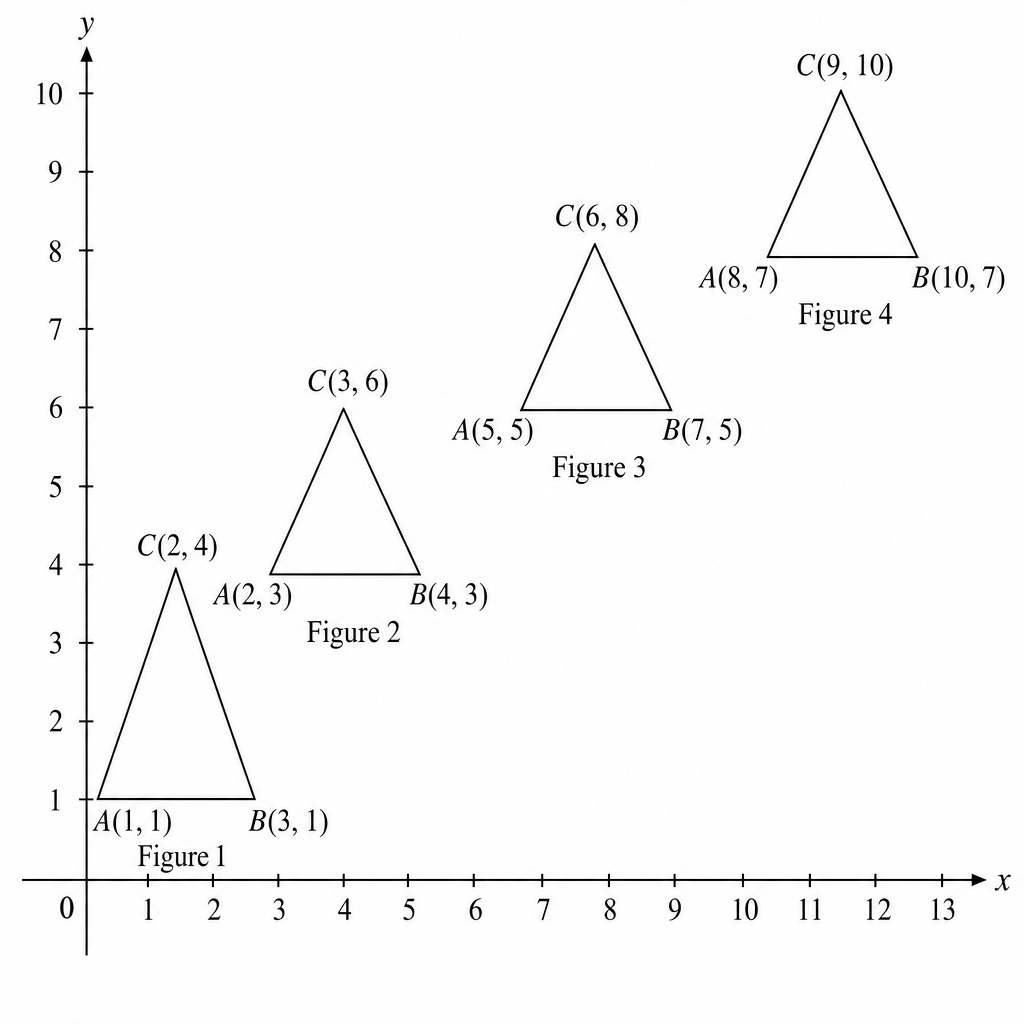
The diagram shows the first four figures of a pattern. Each figure is a triangle with vertices , , . Figure 1 has , , . Each new figure is obtained by translating the previous triangle 3 units in the -direction and 2 units in the -direction.
a
Write down the coordinates of . [1]
b
Find a general rule for the coordinates of , where is a positive integer. [2]
c
A designer claims that Figure 21 is the first figure for which both coordinates of exceed 40. Justify whether this claim is correct. [3]
Solutions
4QuestionCoordinate geometry (distance, midpoint, gradient formulas)Assessment Practice
8 marks~12 minCriterion C
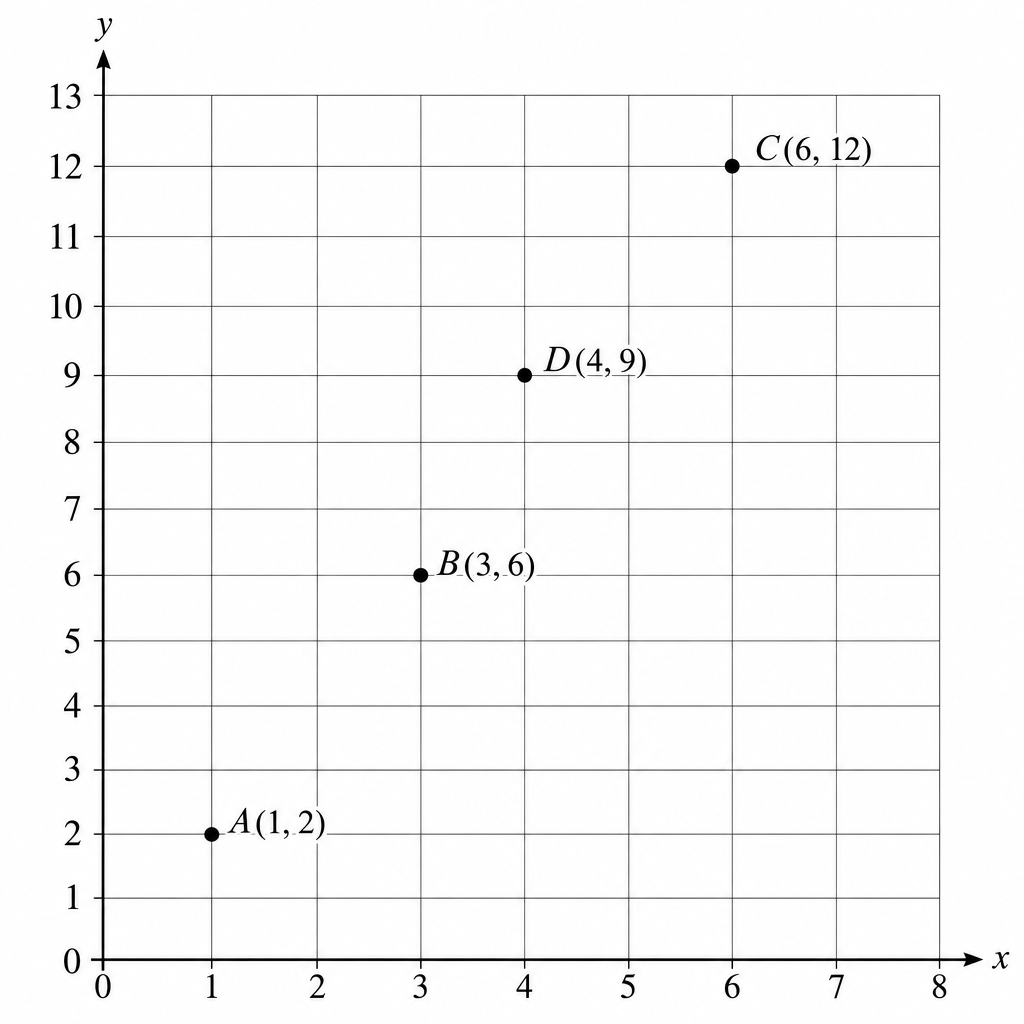
The diagram shows four points , , , and plotted on a coordinate grid.
a
Show that , , and are collinear by calculating the gradients of and , and stating what these values imply. [3]
b
A fifth point lies on the line through , , and . Find the value of . [2]
c
A student claims that because is close to line , the gradient condition for collinearity is "approximately satisfied", so , , , are "approximately collinear". Justify why this reasoning is mathematically invalid, referring to the exact gradient values in your answer. [3]
Solutions
That's every free question here — 4 of 203.
+199 more questions, plus Mock Papers & Worksheets, are waiting in Premium.