You're viewing free preview questions — 4 questions previewing here — subscribe to unlock 106 more, plus the Full Question Bank, Mock Papers & Worksheets.Upgrade
Surface Area and Volume of Composite Shapes — Free MYP4 Mathematics (Extended) Practice Questions

1QuestionCompound Shapes: mixed figures, real-world problemsAssessment Practice
6 marks~9 minCriterion A
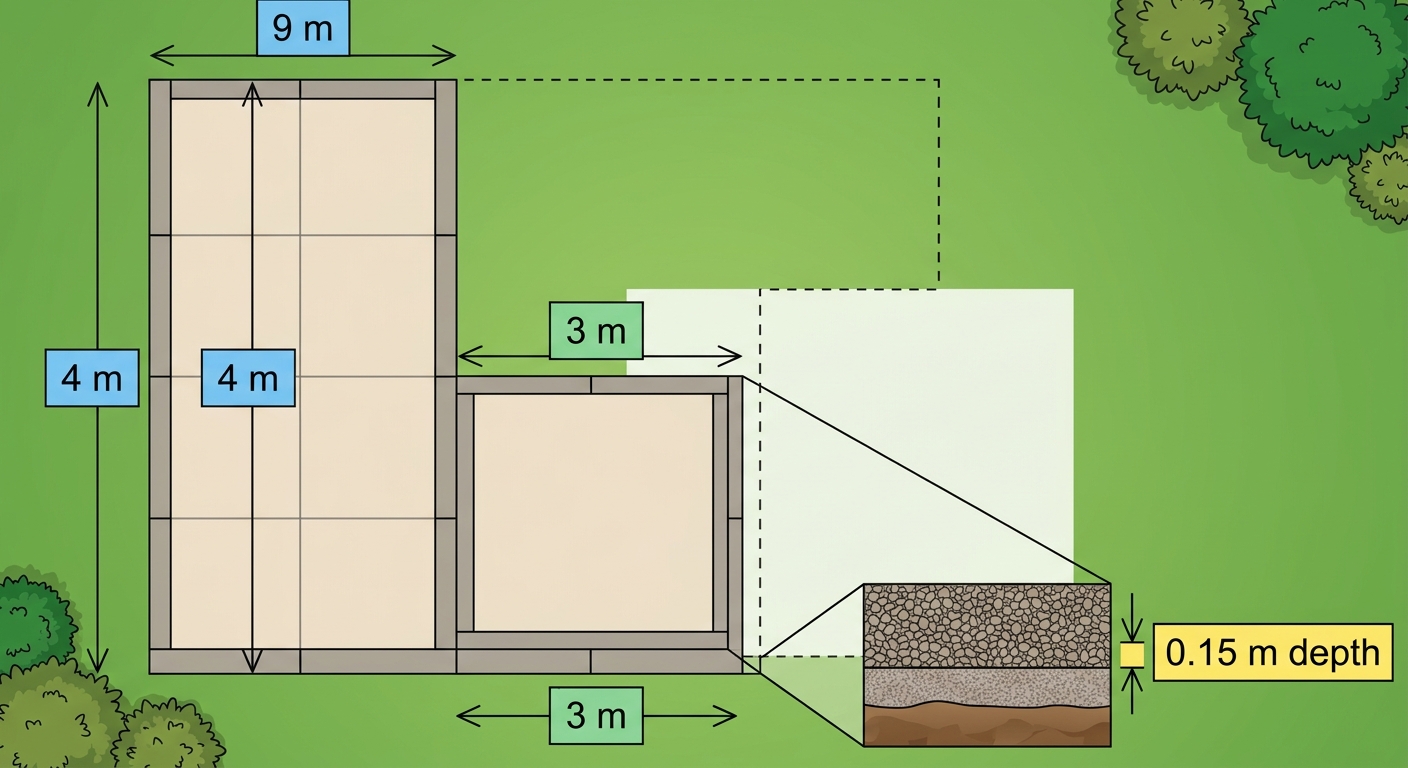
A landscape architect designs a garden path by joining a rectangular section to a square section, forming an L-shaped compound region, as shown in the diagram. The rectangle has length m and width m. The square has side length m.
a
Show that the total area of the L-shaped path is m². [2]
b
A uniform layer of gravel covers the entire path to a depth of m. The cost of gravel is USD per m³. Find the total cost of gravel required. Give your answer in USD, correct to the nearest dollar. [2]
c
The architect proposes enlarging the entire L-shaped path using a linear scale factor , where is a positive integer greater than , so that the new total area is at least m².
(i) Find the smallest integer value of that satisfies this requirement. [2]
(ii) The gravel depth remains m and the cost per m³ remains USD. The project budget for gravel is USD. Evaluate whether the total cost of gravel for the enlarged path, when takes the value found in part (c)(i), is affordable within this budget, justifying your answer with supporting calculations. [2]
(i) Find the smallest integer value of that satisfies this requirement. [2]
(ii) The gravel depth remains m and the cost per m³ remains USD. The project budget for gravel is USD. Evaluate whether the total cost of gravel for the enlarged path, when takes the value found in part (c)(i), is affordable within this budget, justifying your answer with supporting calculations. [2]

Solutions
2QuestionVolume and Surface Area: cube, cuboid, cylinderAssessment Practice
8 marks~12 minCriterion C
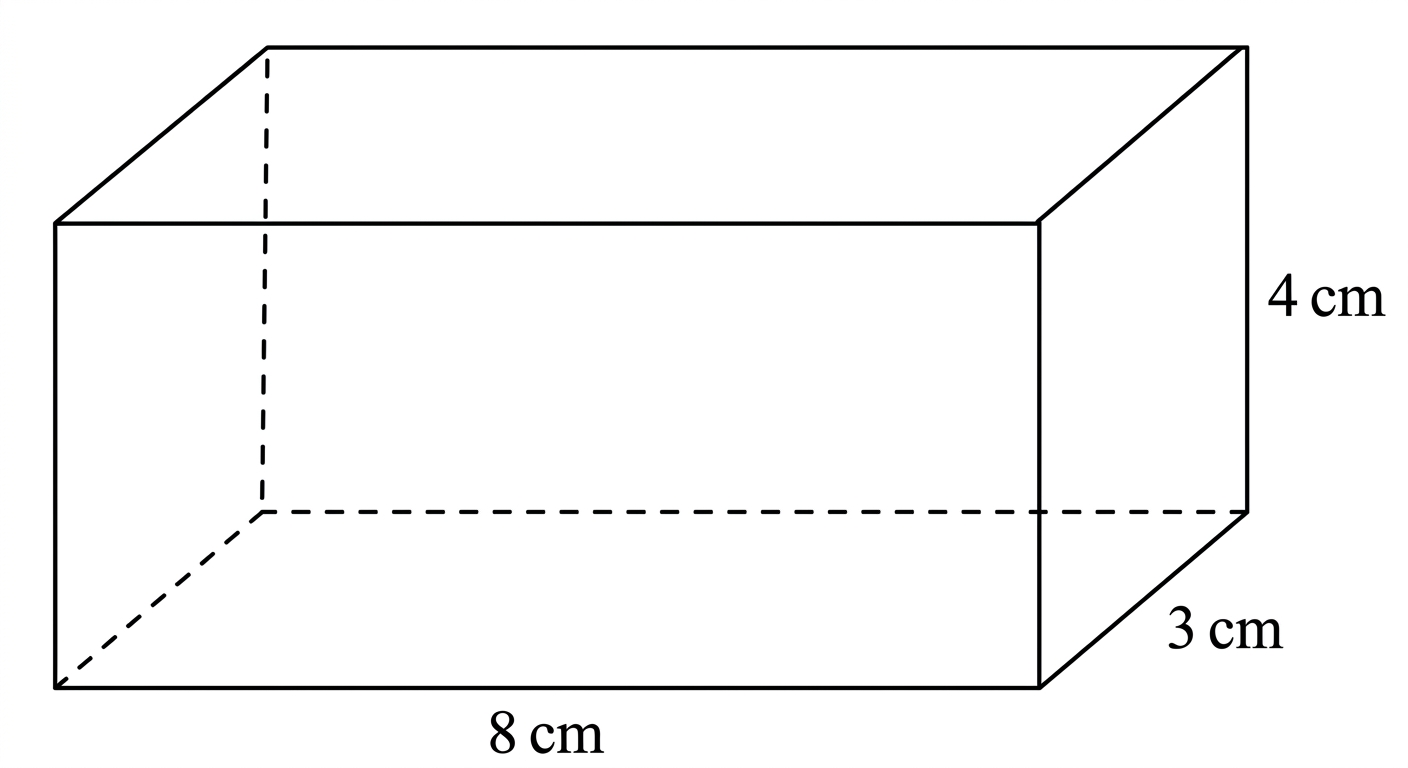
A storage company designs open-top rectangular boxes (no lid). One box has base length cm, base width cm, and height cm.
a
Calculate the total surface area of the open-top box, showing the area of each pair of faces separately. Give your answer in cm². [3]
b
The company scales up the box using an enlargement with linear scale factor . Find the total surface area of the enlarged box. Give your answer in cm². [2]
c
A client claims that scaling a box by linear scale factor multiplies its surface area by . Using your answers to parts (a) and (b), critique this claim and state the correct relationship between the surface area of the original box and the surface area of the enlarged box. [3]
Solutions
3QuestionArea of Plane Figures: triangle, rectangle, square, parallelogram, rhombus, kite, trapezium, circleAssessment Practice
8 marks~12 minCriterion B
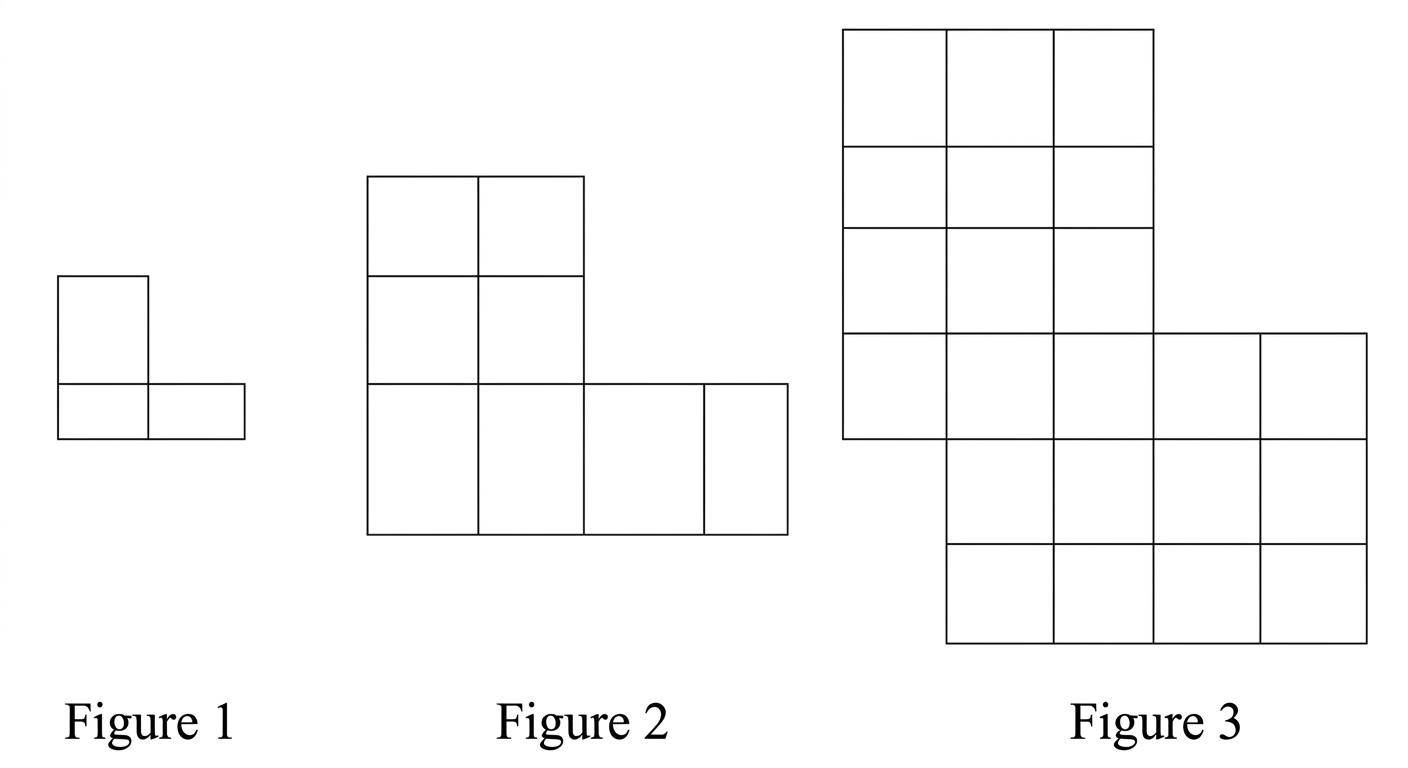
The diagram shows Figures 1, 2, and 3 of a sequence of L-shaped figures made from unit squares. Figure 1 contains 3 unit squares, Figure 2 contains 10 unit squares, and Figure 3 contains 21 unit squares.
a
Write down the number of unit squares in Figure 4. [1]
b
Find a formula for the number of unit squares in Figure , in the form , where and are integers. Show all working. [3]
c
Justify why the formula must contain an term by referring to the structure of the L-shaped figure, and hence deduce the smallest value of for which . [4]
Solutions
4QuestionArea of Plane Figures: triangle, rectangle, square, parallelogram, rhombus, kite, trapezium, circleAssessment Practice
13 marks~20 minCriterion D
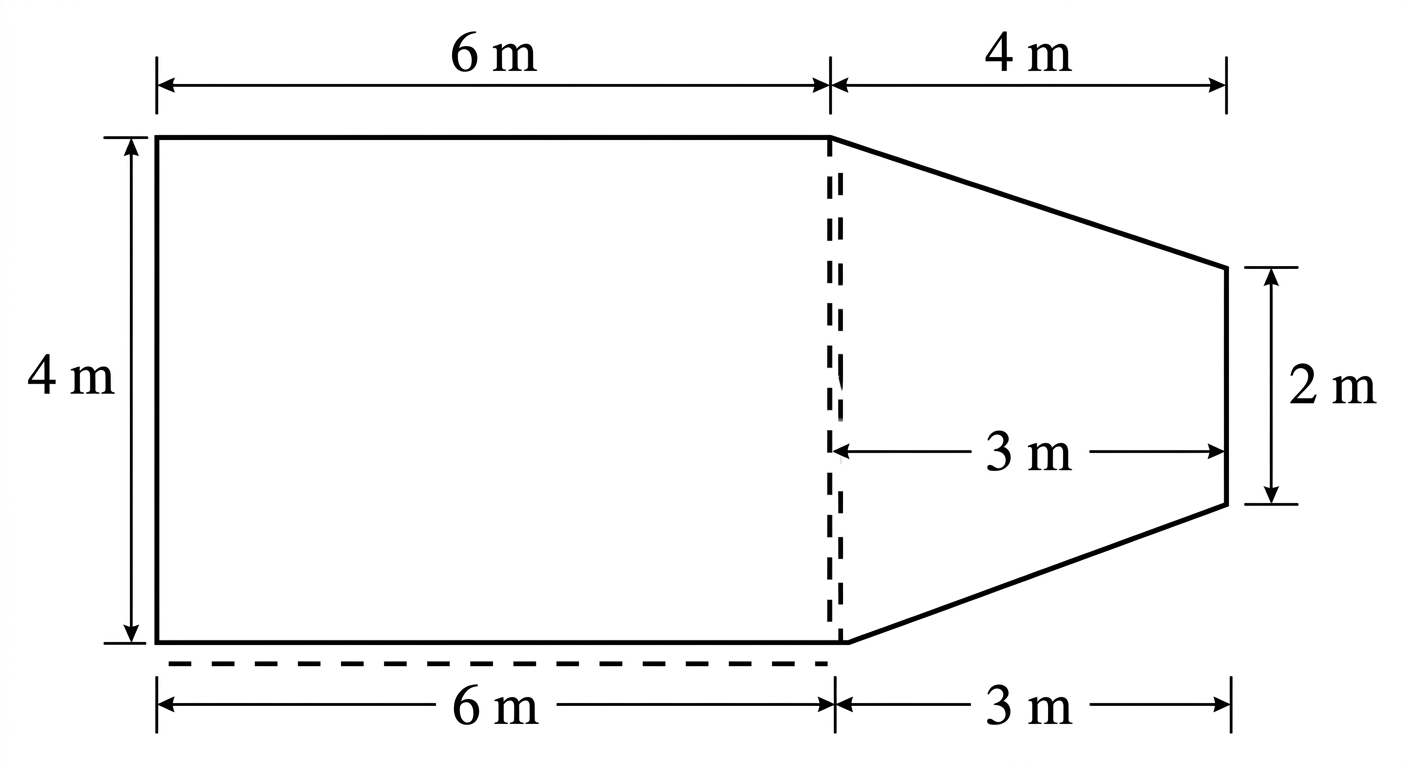
A homeowner is renovating an L-shaped room and needs to order hardwood flooring. The floor plan is divided into a rectangle and a trapezium. The rectangle has dimensions m by m. The trapezium has parallel sides of m and m, and a perpendicular height of m.
The homeowner measures each wall to the nearest cm.
The homeowner measures each wall to the nearest cm.
a
Calculate the total area of the L-shaped floor. Give your answer in m². [3]
b
Determine the maximum possible total floor area, given the measurement tolerances stated above. Give your answer in m² correct to 3 significant figures. [4]
c
The flooring is sold in whole packs, each covering exactly m². The homeowner orders the minimum number of whole packs needed to cover the nominal area from part (a).
Advise the homeowner whether this order is sufficient to cover the maximum possible floor area from part (b), justifying your advice with a calculation. [3]
Advise the homeowner whether this order is sufficient to cover the maximum possible floor area from part (b), justifying your advice with a calculation. [3]
d
Suggest one limitation of modelling the floor as a rectangle and a trapezium, and explain how this limitation could cause the ordered flooring to be insufficient even if the maximum area from part (b) is fully covered. [3]
Solutions
That's every free question here — 4 of 110.
+106 more questions, plus Mock Papers & Worksheets, are waiting in Premium.