You're viewing free preview questions — 4 questions previewing here — subscribe to unlock 84 more, plus the Full Question Bank, Mock Papers & Worksheets.Upgrade
Density Mass and Volume Problems — Free MYP4 Mathematics (Extended) Practice Questions

1QuestionChanging Units in Density ProblemsConcept Practice
2 marks~3 minCriterion B
The density of three substances is given in two unit systems.
Water: and
Aluminium: and
Lead: and
Water: and
Aluminium: and
Lead: and
a
Deduce the relationship between a density value expressed in and the same density expressed in . [1]
b
A sample of iron has a density of . Justify whether this density is greater or less than . [1]

Solutions
2QuestionMulti-Step Problems with Density and VolumeAssessment Practice
2 marks~3 minCriterion D
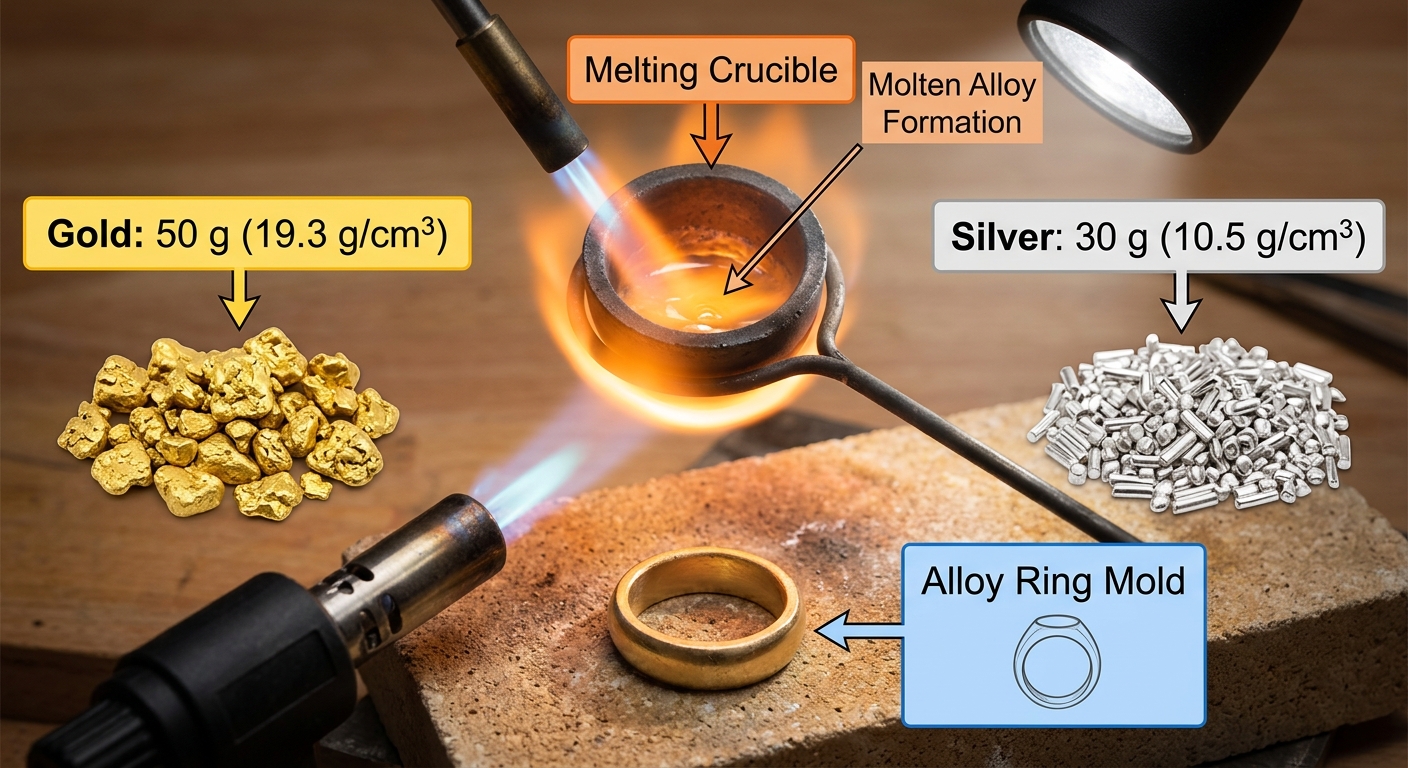
A jeweller melts 50 g of gold (density 19.3 g/cm³) and 30 g of silver (density 10.5 g/cm³) to produce an alloy ring.
a
Calculate the total volume of the alloy. [1]
b
The jeweller claims the alloy ring qualifies for hallmarking as a "high-density gold alloy," which requires a minimum density of 15.0 g/cm³. Using your result from part (a), determine the density of the alloy and advise the jeweller whether the ring meets this requirement. [1]
Solutions
3QuestionMulti-Step Problems with Density and VolumeConcept Practice
2 marks~3 minCriterion A
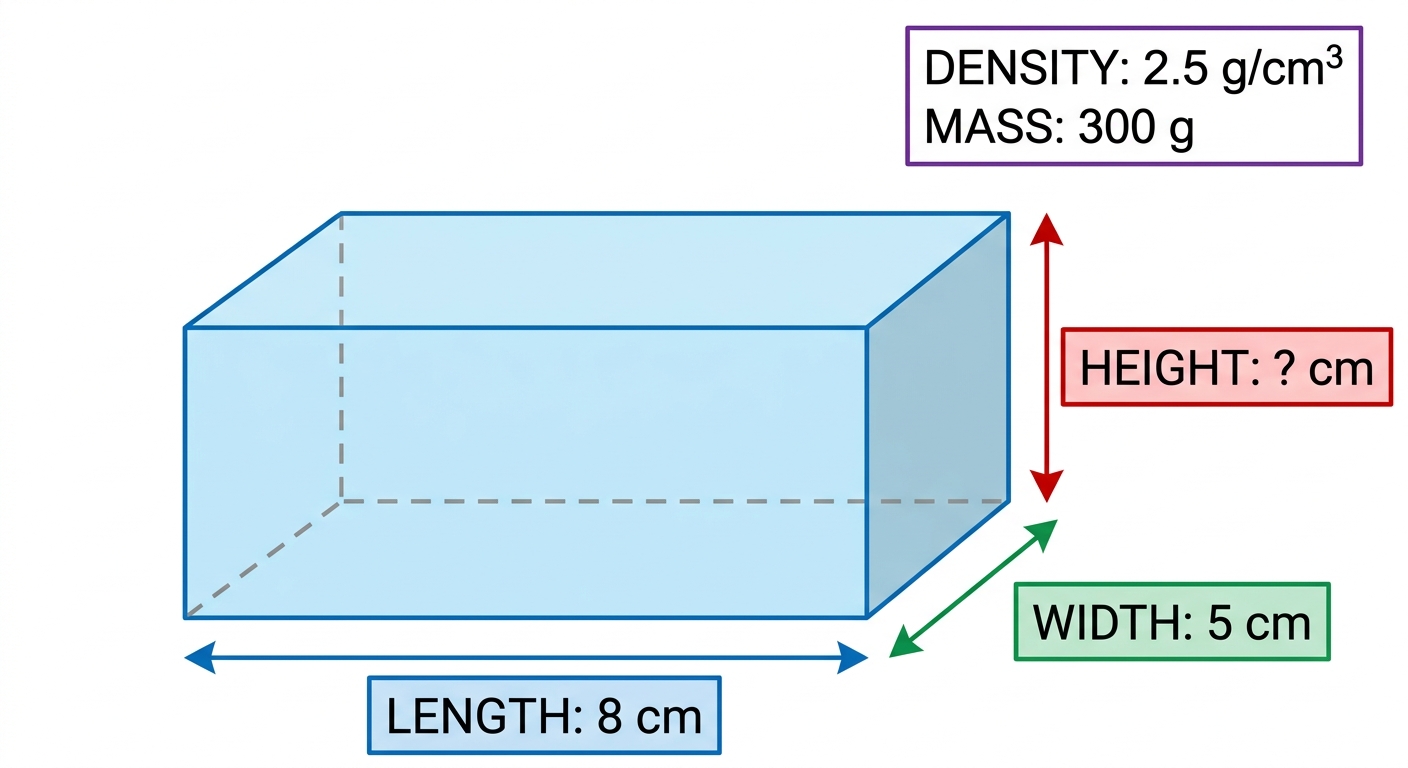
A manufacturer produces solid aluminium blocks for industrial shelving. Each block is a rectangular prism with length 8 cm, width 5 cm, and an unlabelled height. The density of aluminium is and each block has a mass of 300 g.
A storage shelf has a maximum load of 250 g per block.
A storage shelf has a maximum load of 250 g per block.
a
Calculate the height of the block. [1]
b
Advise the manufacturer whether this block is suitable for the shelf. Justify your answer. [1]
Solutions
4QuestionApplying Density to Real-World SituationsAssessment Practice
4 marks~6 minCriterion C
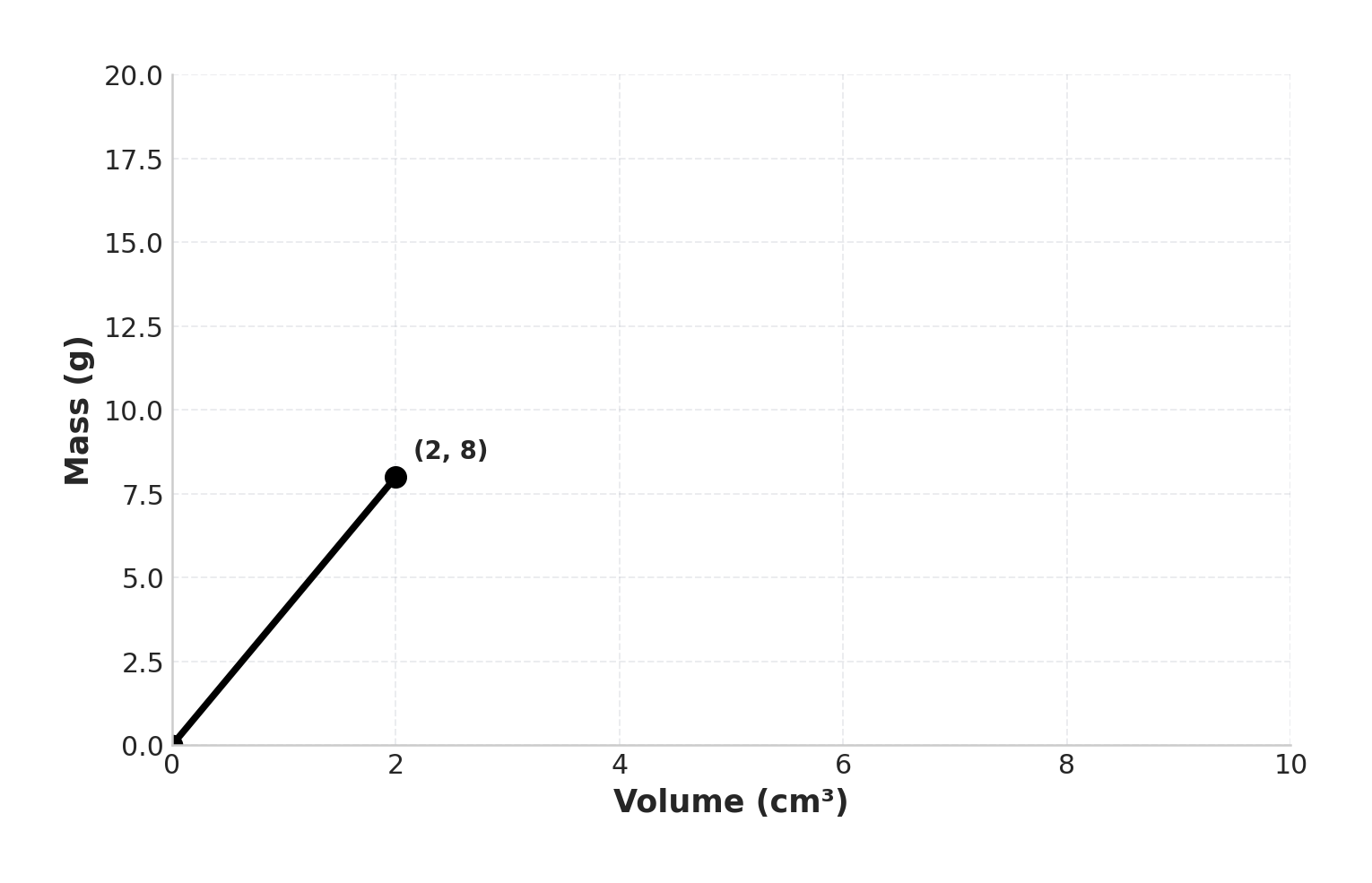
A materials scientist measures the mass and volume of samples of an unknown alloy. The graph shows a straight line through the origin and the point , where the horizontal axis represents volume () and the vertical axis represents mass ().
a
Explain how the gradient of this graph represents the density of the alloy. [1]
b
Calculate the density of the alloy. [1]
c
Titanium alloys used in aerospace components must have a density below to meet structural weight limits. Advise whether this alloy should be approved for use in aerospace structural components, justifying your answer with reference to the density threshold. [2]
Solutions
That's every free question here — 4 of 88.
+84 more questions, plus Mock Papers & Worksheets, are waiting in Premium.