You're viewing free preview questions — 4 questions previewing here — subscribe to unlock 64 more, plus the Full Question Bank, Mock Papers & Worksheets.Upgrade
Perimeter and Area of 2D Shapes — Free MYP4 Mathematics (Extended) Practice Questions

1QuestionArea of Rectangles Triangles and ParallelogramsConcept Practice
4 marks~6 minCriterion B
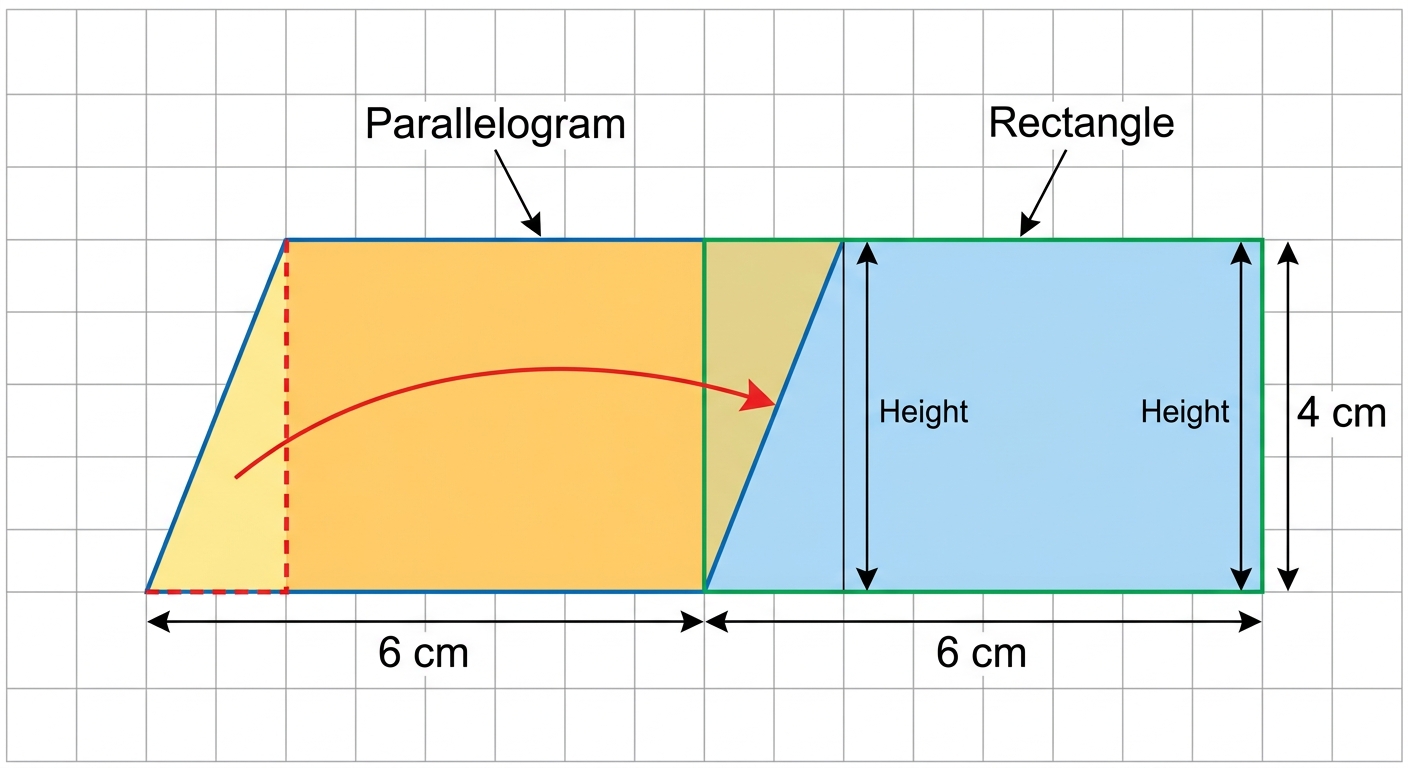
A landscape architect is designing a parallelogram-shaped lawn with a base of 6 m and a perpendicular height of 4 m. She explains to her client that cutting a triangular section from one end of the lawn and repositioning it at the other end produces a rectangular shape with the same area.
a
Calculate the area of the rectangular shape formed. [1]
b
Deduce a general formula for the area of any parallelogram in terms of its base and perpendicular height . [1]
c
A rectangular patio of area 20 m² is planned alongside the lawn. The architect claims the lawn has a greater area than the patio. Justify whether this claim is correct. [2]

Solutions
2QuestionArea of Rectangles Triangles and ParallelogramsAssessment Practice
5 marks~8 minCriterion C
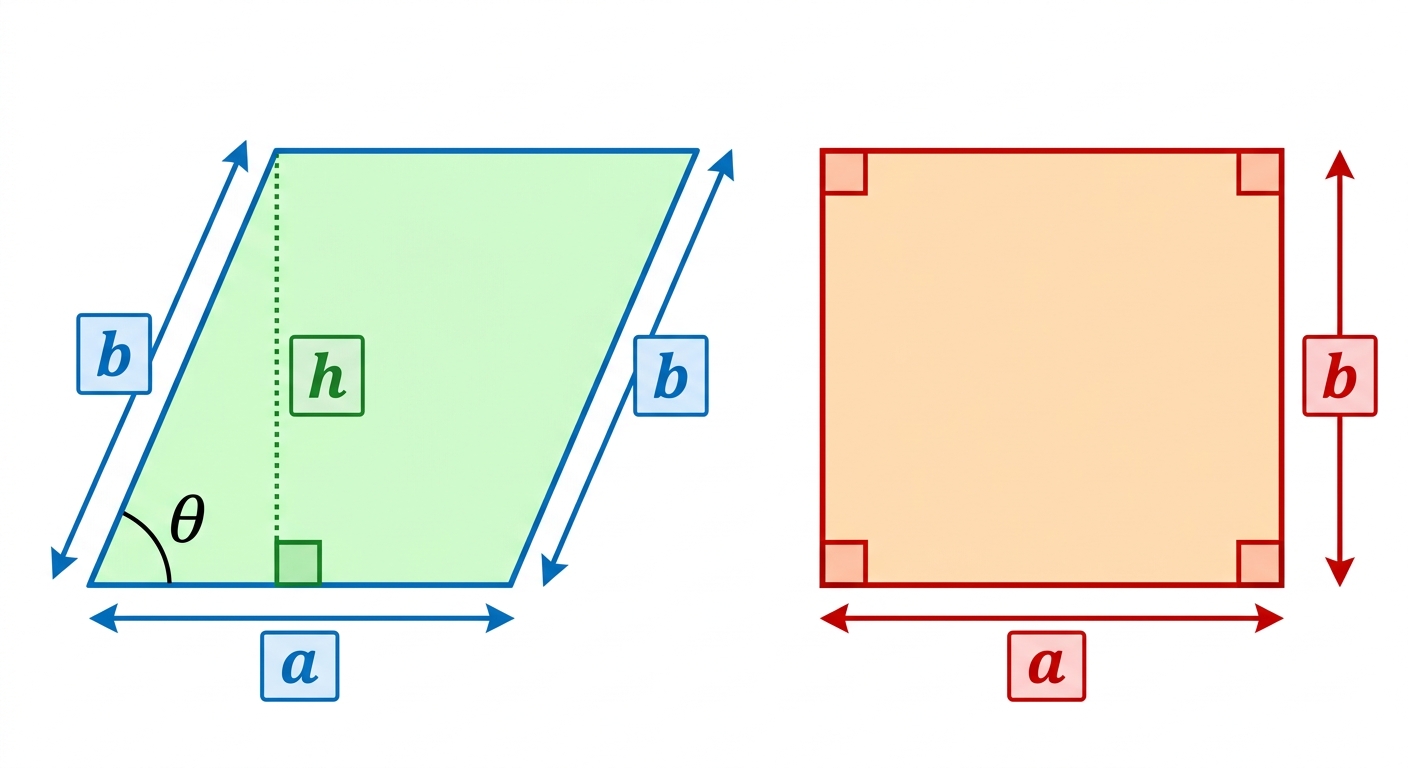
A landscape architect is designing a paved courtyard. Two paving designs are proposed: one uses parallelogram-shaped tiles with base and slant side ; the other uses rectangular tiles with side lengths and . The diagram shows both shapes, with the parallelogram's perpendicular height labelled.
a
State the area formula for each tile shape. [2]
b
Explain why the two tile shapes do not generally cover the same area, even though they share the dimensions and . Refer to , , and the concept of perpendicular height in your answer. [2]
c
The architect claims the two designs are interchangeable for any tile dimensions. Justify whether this claim is correct. [1]
Solutions
3QuestionArea of Rectangles Triangles and ParallelogramsConcept Practice
5 marks~8 minCriterion A
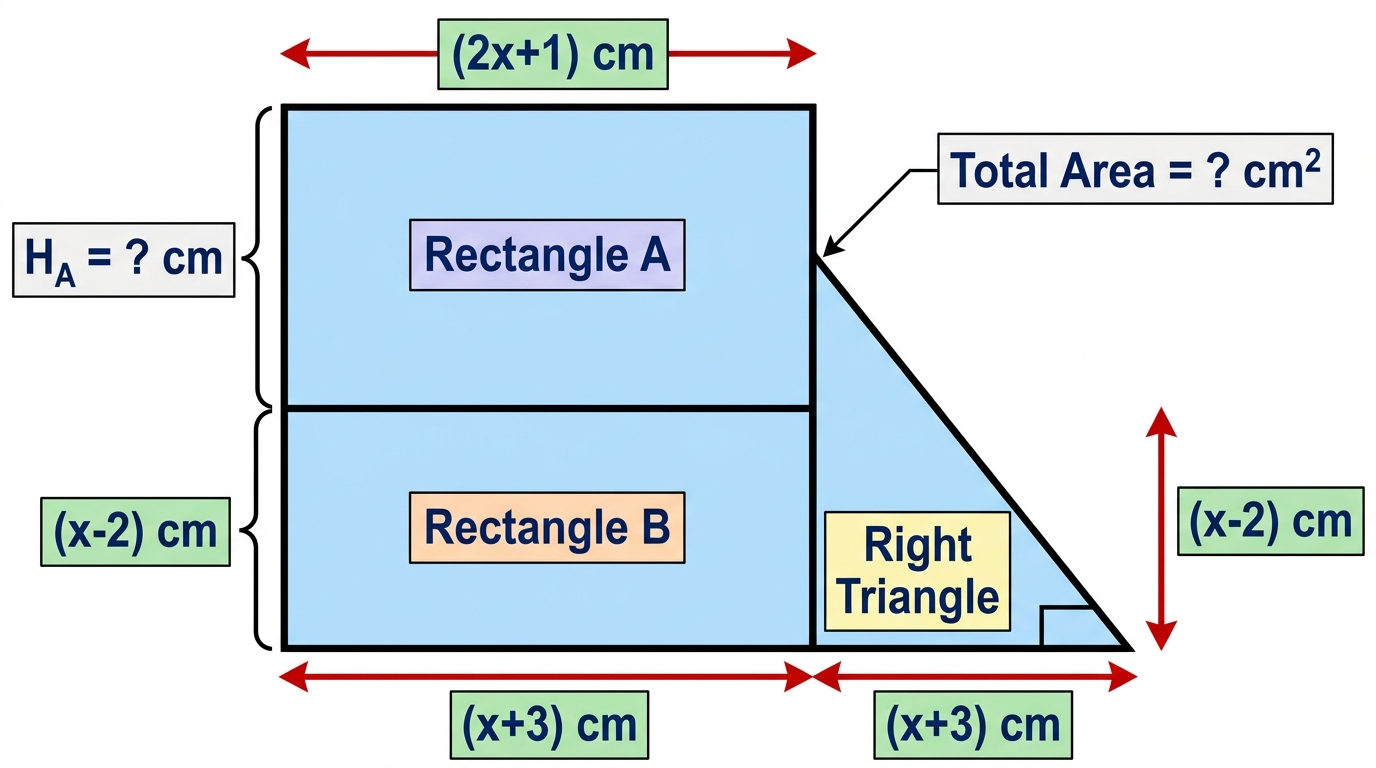
A landscape architect is designing a paved courtyard consisting of two rectangles and a right triangle.
Rectangle A: width cm, height cm
Rectangle B: width cm, height cm
Right triangle: base cm, height cm
Rectangle A sits directly above Rectangle B; the right triangle is attached to the right side of Rectangle B. All dimensions are in centimetres.
Rectangle A: width cm, height cm
Rectangle B: width cm, height cm
Right triangle: base cm, height cm
Rectangle A sits directly above Rectangle B; the right triangle is attached to the right side of Rectangle B. All dimensions are in centimetres.
a
Calculate the area of each shape when . [3]
b
Calculate the total paved area of the courtyard when . [1]
c
The architect states that a courtyard smaller than is too small for the intended use. Advise the architect whether this courtyard is suitable, justifying your answer using your result from part (b). [1]
Solutions
4QuestionArea of Rectangles Triangles and ParallelogramsAssessment Practice
6 marks~9 minCriterion D
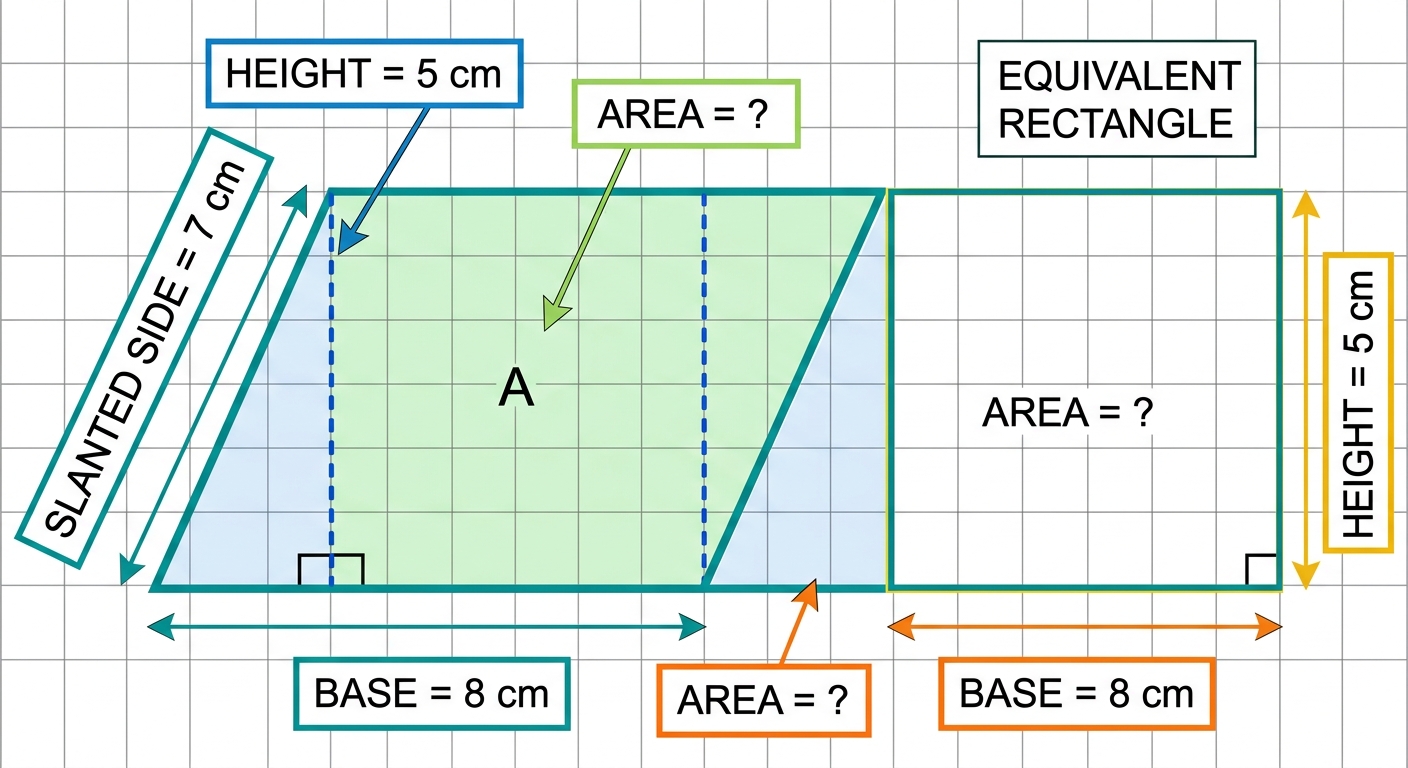
A rooftop garden is being designed on a parallelogram-shaped plot. The plot has a base of m, a perpendicular height of m, and slanted side lengths of m.
a
Decompose the parallelogram into one rectangle and two congruent right-angled triangles by dropping perpendiculars from each top vertex to the base. Use the Pythagorean theorem to find the horizontal leg of each right-angled triangle. [2]
b
Calculate the area of the rectangle and the combined area of the two right-angled triangles. Show that their sum equals . [2]
c
The garden designer claims that using a steeper slanted side of m (keeping base m and perpendicular height m unchanged) would increase the area available for planting. Advise the designer whether this change should be made, justifying your answer with reference to what the slanted side length determines about the shape. [2]
Solutions
That's every free question here — 4 of 68.
+64 more questions, plus Mock Papers & Worksheets, are waiting in Premium.