You're viewing free preview questions — 4 questions previewing here — subscribe to unlock 54 more, plus the Full Question Bank, Mock Papers & Worksheets.Upgrade
Volume and Surface Area of Pyramids Cones and Spheres — Free MYP4 Mathematics (Extended) Practice Questions

1QuestionSurface Area and Volume of PyramidsConcept Practice
4 marks~6 minCriterion A
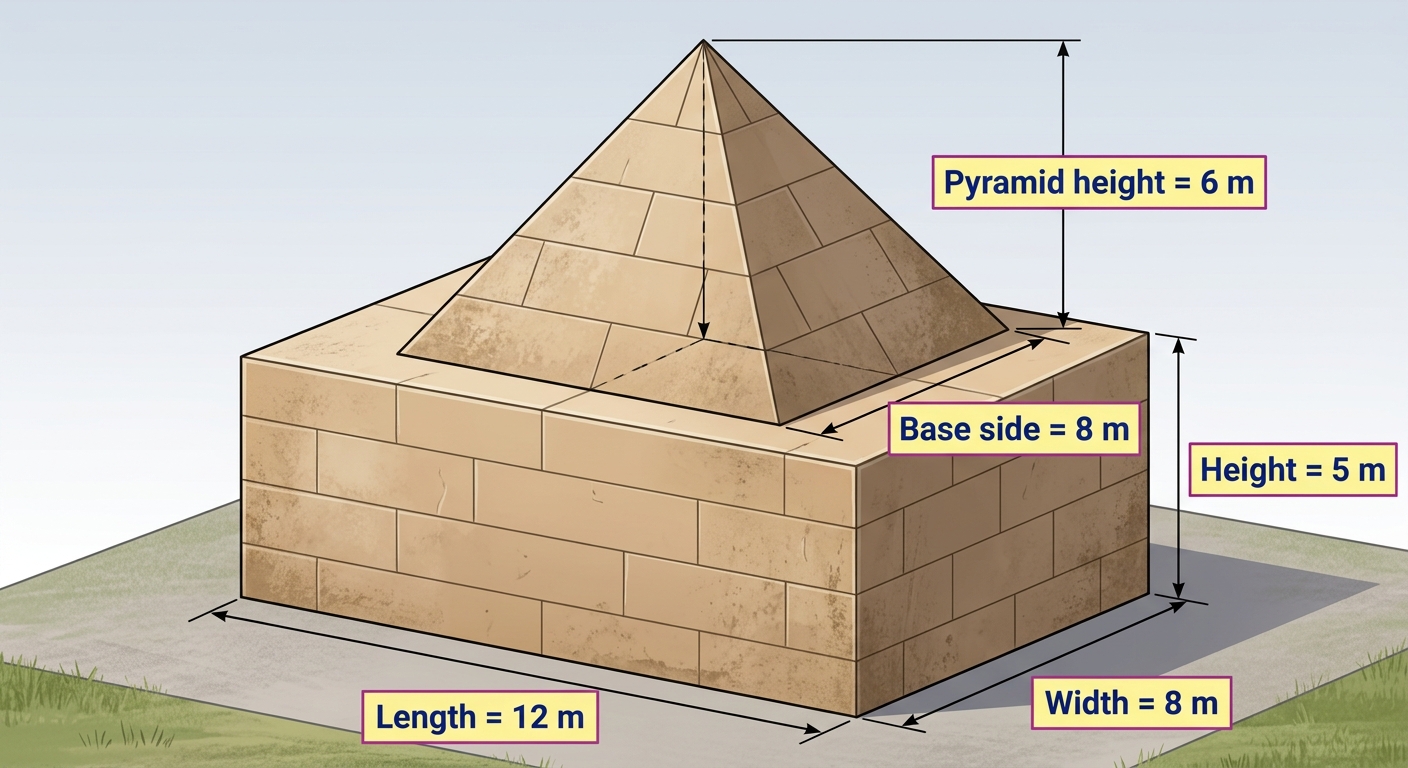
A monument consists of a square-based pyramid sitting on top of a rectangular prism. The rectangular prism has length 12 m, width 8 m, and height 5 m. The pyramid has a square base of side length 8 m and a perpendicular height of 6 m. A construction engineer states that any monument with a total volume exceeding 620 m³ requires a reinforced foundation.
a
Calculate the volume of the rectangular prism. [1]
b
Calculate the total volume of the monument. [2]
c
Advise the engineer whether a reinforced foundation is required for this monument. Justify your answer. [1]

Solutions
2QuestionComparing Volumes of Different SolidsAssessment Practice
2 marks~3 minCriterion B
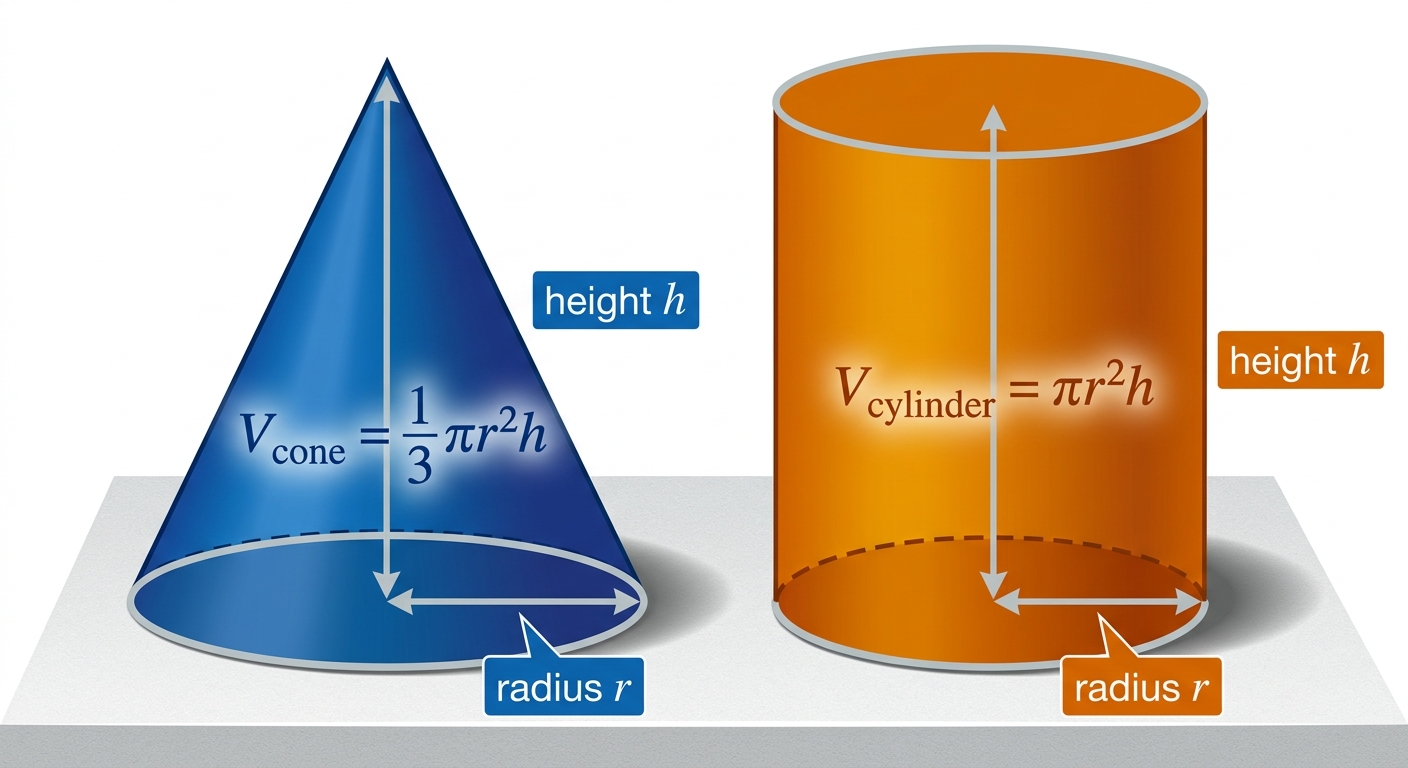
A cone and a cylinder share the same base radius and height .
Justify the relationship between and , using correct mathematical notation and a general statement valid for all values of and . [2]
Justify the relationship between and , using correct mathematical notation and a general statement valid for all values of and . [2]
Solutions
3QuestionSurface Area and Volume of PyramidsAssessment Practice
3 marks~5 minCriterion C
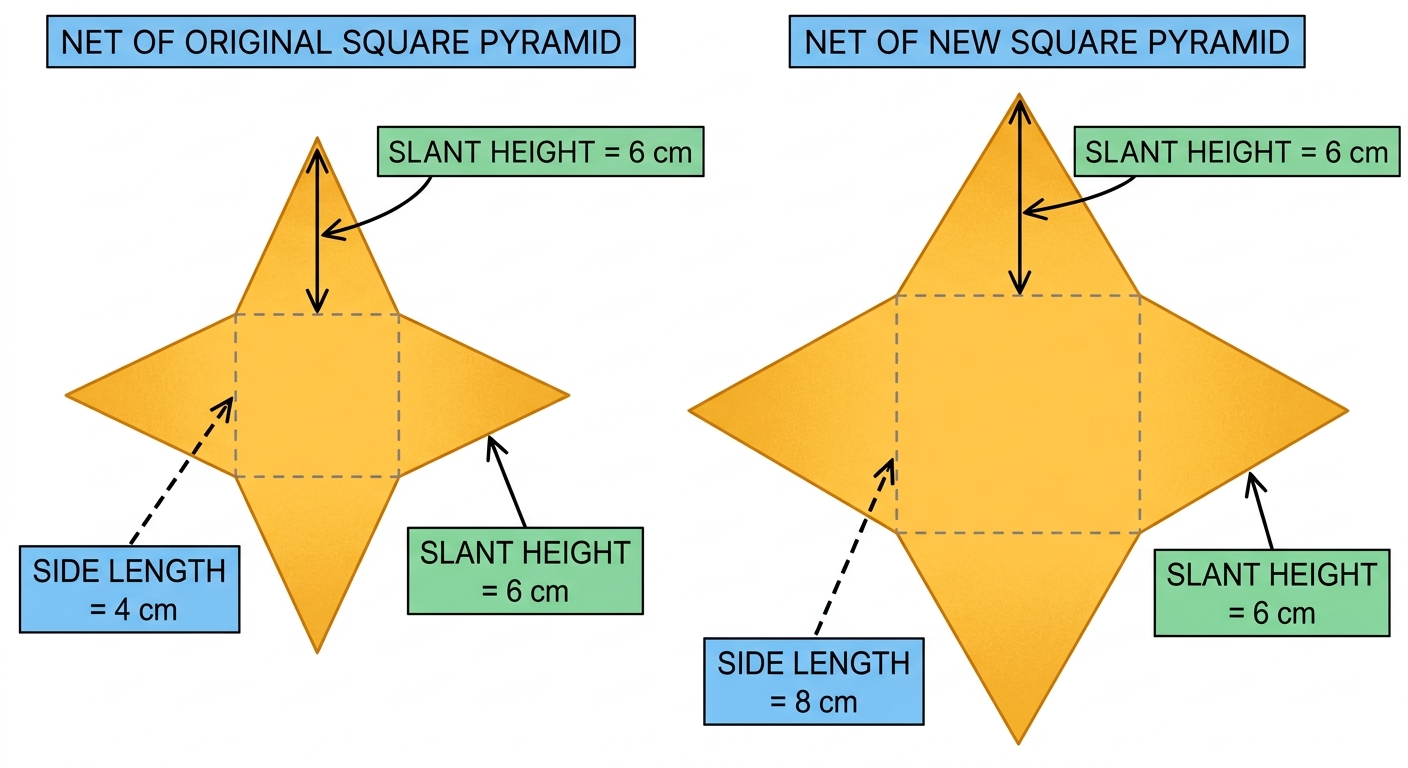
A company manufactures decorative square pyramid gift boxes. The net of each pyramid has a square base with side length cm and four triangular faces, each with slant height cm. The total surface area is:
The standard box has cm and cm. A larger box doubles the base side length to cm, with slant height unchanged at cm.
The standard box has cm and cm. A larger box doubles the base side length to cm, with slant height unchanged at cm.
a
Calculate the total surface area of the standard box. [1]
b
Calculate the total surface area of the larger box. [1]
c
The company claims that doubling the base side length doubles the amount of card needed. Assess whether this claim is correct. [1]
Solutions
4QuestionVolume of Cones Spheres and HemispheresAssessment Practice
10 marks~15 minCriterion D
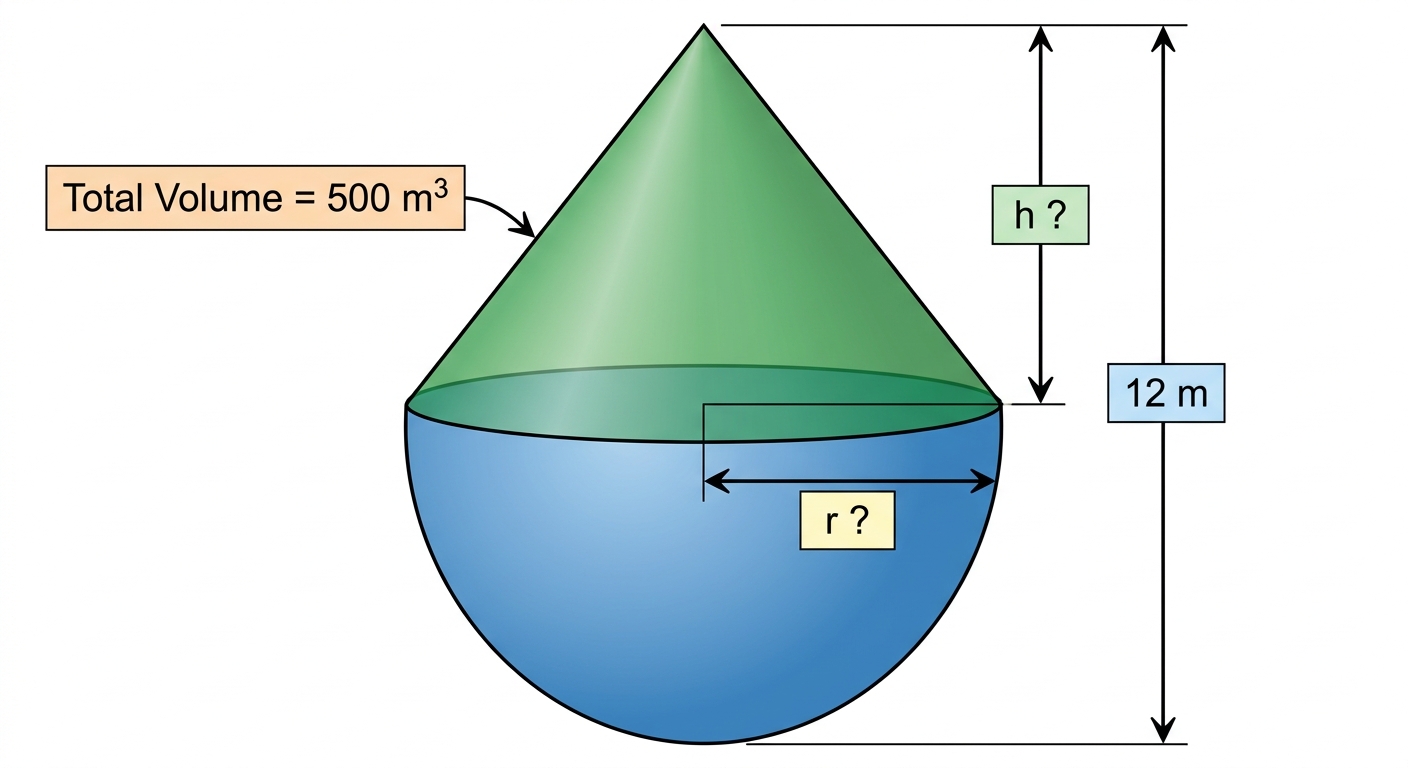
An engineer is designing a spherical water tower with a conical roof. The water tower consists of a hemisphere (the lower part) and a right circular cone (the roof) placed on top of the hemisphere, sharing the same circular base. The total height of the water tower (from the base of the hemisphere to the apex of the cone) is 12 m. The total volume of the water tower must be exactly 500 m³. The engineer uses the following model: The hemisphere has radius (m). The cone has base radius and height (m). The total height: . The total volume: .
a
Using the given equations, determine the radius of the hemisphere (and cone). Show all working.
b
The engineer's model assumes the tank walls have negligible thickness. Discuss one real-world limitation of this assumption and how it would affect the actual water capacity compared to the calculated volume.
c
Suppose the height measurement of 12 m has a possible error of m. Evaluate how this error could affect the calculated radius and the resulting water capacity. In your answer, comment on the potential impact on the water supply for a community relying on this tower.
Solutions
That's every free question here — 4 of 58.
+54 more questions, plus Mock Papers & Worksheets, are waiting in Premium.