You're viewing free preview questions — 5 questions previewing here — subscribe to unlock 359 more, plus the Full Question Bank, Mock Papers & Worksheets.Upgrade
The Big Bang Theory — Free MYP4 Physics Practice Questions

1QuestionSteady State Theory (contrast with Big Bang)Concept Practice
2 marks~3 minCriterion A
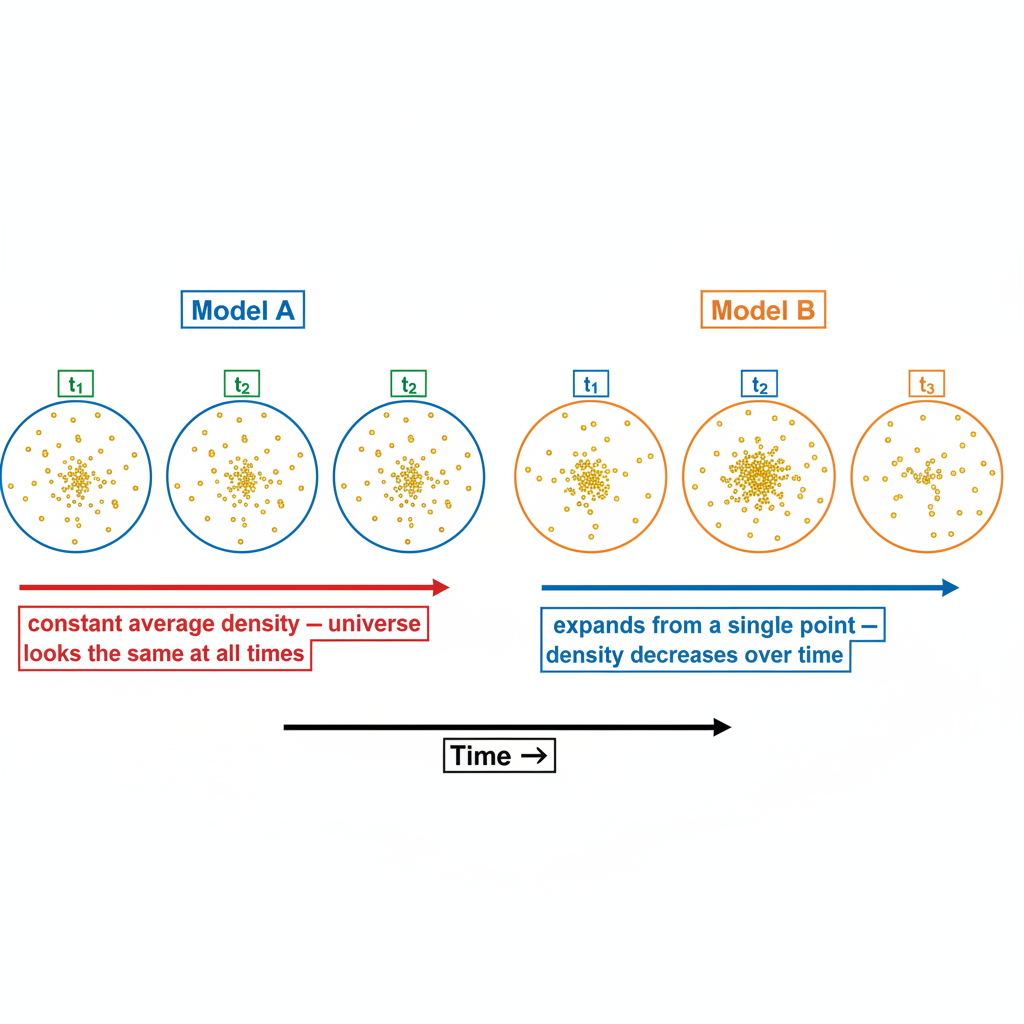
The diagram below shows two models of the universe's evolution over time.
In Model A, the universe maintains a constant average density and appears uniform at all times.
In Model B, the universe expands from a singular point, with density decreasing over time.
Identify which model represents the Steady State theory. [1]
Justify your choice using one feature visible in the diagram. [1]
In Model A, the universe maintains a constant average density and appears uniform at all times.
In Model B, the universe expands from a singular point, with density decreasing over time.
Identify which model represents the Steady State theory. [1]
Justify your choice using one feature visible in the diagram. [1]

Solutions
2QuestionDefinition of CMBAssessment Practice
2 marks~3 minCriterion C
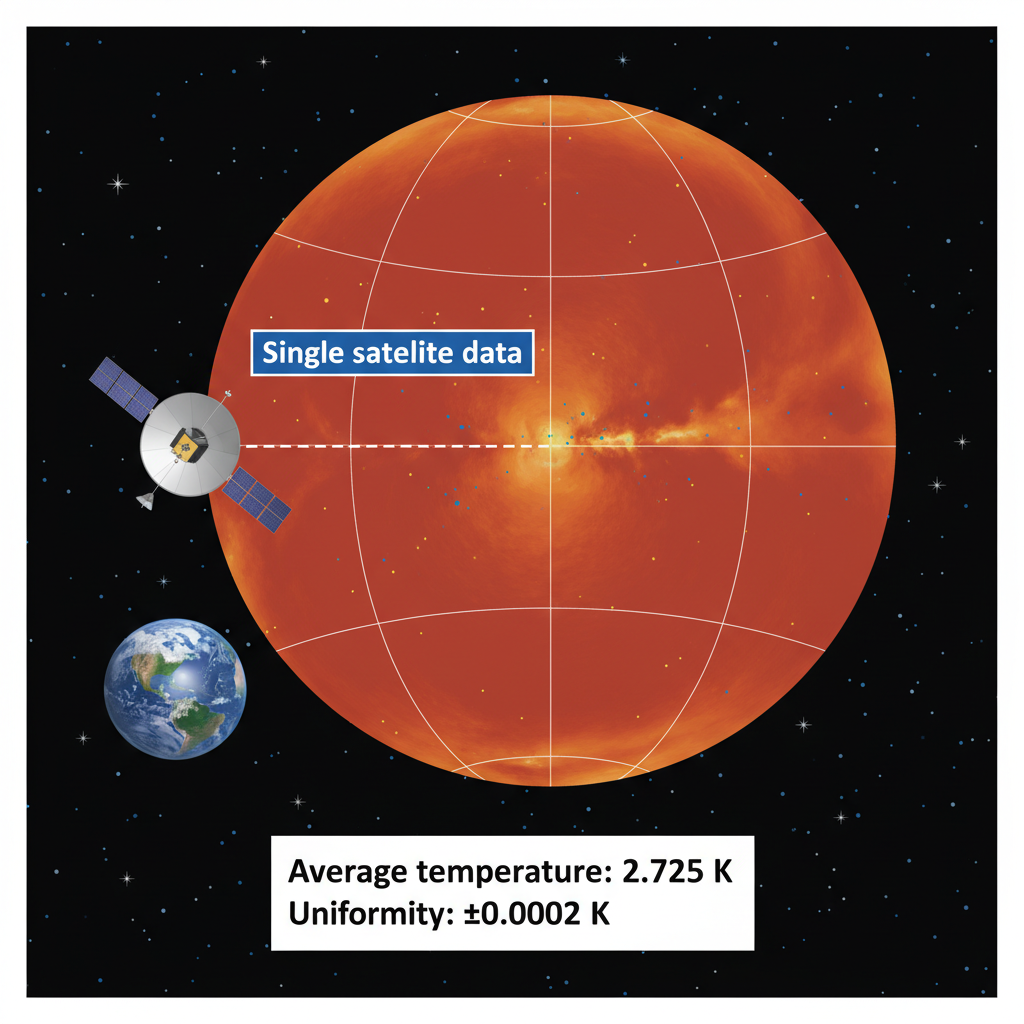
The Cosmic Microwave Background (CMB) has a measured temperature of approximately 2.725 K, uniform across the sky to about 1 part in .
a
State the fundamental cosmological assumption that this near-perfect uniformity supports. [1]
b
Discuss one limitation of relying on data from a single satellite, such as WMAP or Planck, when using CMB measurements to support this assumption. [1]
Solutions
3QuestionFormation of stars and galaxiesConcept Practice
2 marks~3 minCriterion D
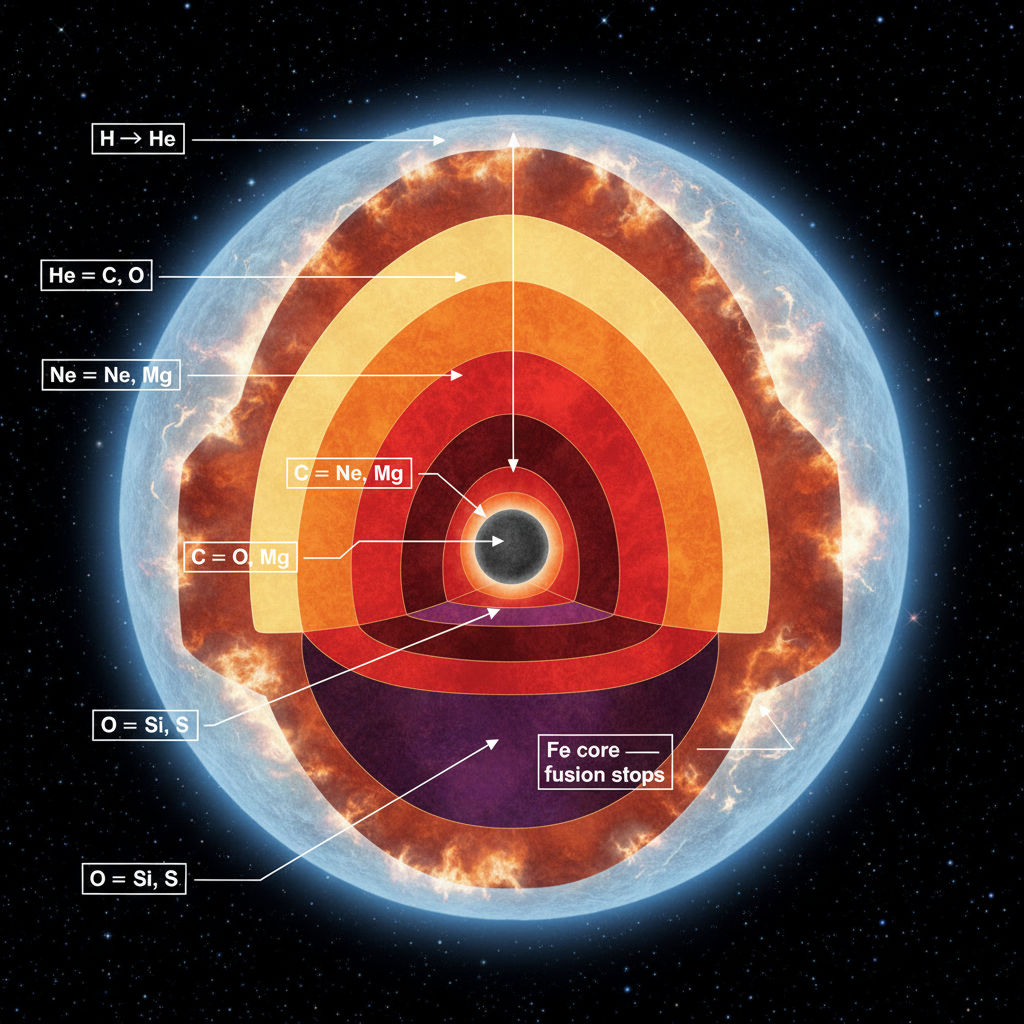
Elements heavier than hydrogen and helium — including iron, nickel, and copper — were forged inside stars through nuclear fusion and dispersed across the universe when those stars exploded as supernovae. These heavy elements are now found throughout Earth and are fundamental to human technology and industry.
a
Outline one way in which heavy elements produced by stellar nucleosynthesis have influenced modern society. [1]
b
Identify one limitation of depending on stellar nucleosynthesis as the source of heavy elements available on Earth. [1]
Solutions
4QuestionSteady State Theory (contrast with Big Bang)Assessment Practice
7 marks~11 minCriterion C
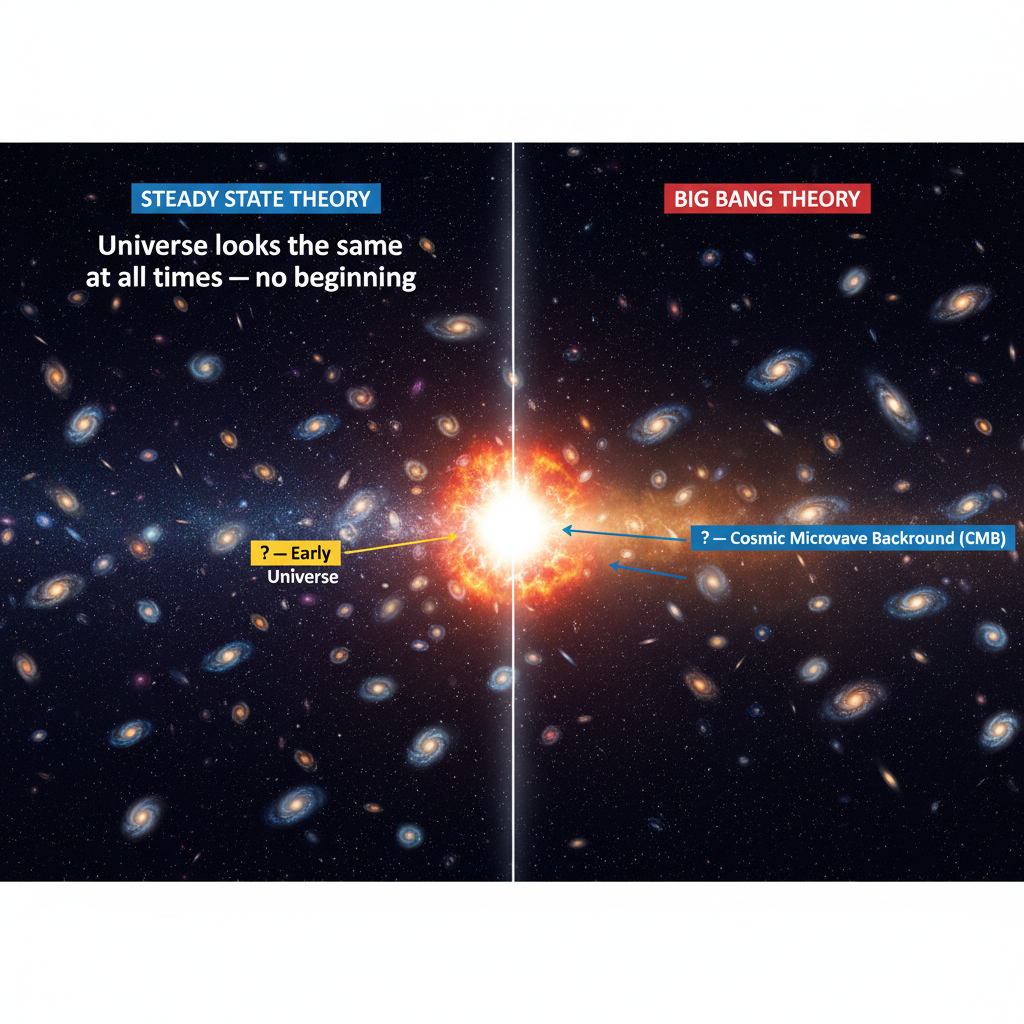
In the 1960s, a team of astronomers is designing a space telescope to study the early universe. They must choose between two competing cosmological models: the Steady State theory, which proposes that the universe has always existed and maintains the same large-scale appearance at all times, and the Big Bang theory, which proposes that the universe evolved from a hot, dense state and predicts that faint remnant radiation — the cosmic microwave background (CMB) — should be detectable across the sky.
a
Identify one key prediction of the Steady State theory about the large-scale appearance of the universe over time. [2]
b
Describe how the detection of the CMB in 1965 challenged the Steady State theory. [2]
c
Analyse the limitations of the Steady State theory as a foundation for the telescope's observation strategy, and justify why the Big Bang theory provides a more dependable framework for planning observations. [3]
Solutions
5QuestionRole of gravity in structure formationAssessment Practice
8 marks~12 minCriterion D
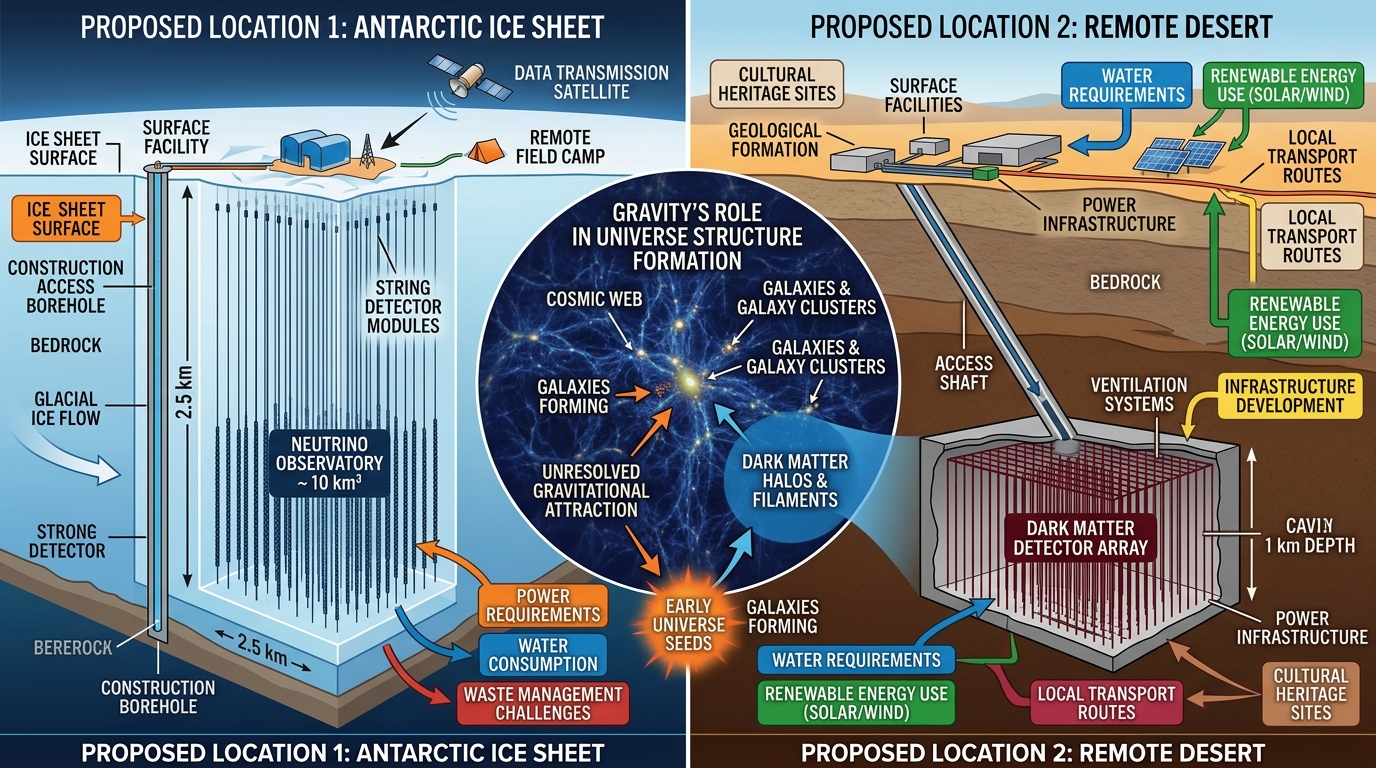
Physicists are proposing a next-generation dark matter detector — a 10 km³ neutrino observatory — to be built either within the Antarctic ice sheet or beneath a remote desert. Construction would require years of drilling or excavation, continuous energy supply, and a permanent research presence in a currently undisturbed environment.
a
Explain why detecting dark matter is scientifically significant in the context of gravity's role in large-scale structure formation. [2]
b
Discuss the ecological disruption and resource consumption that construction of this facility would cause. [2]
c
Analyse the impact on indigenous land rights and local communities in either proposed location. [2]
d
Evaluate whether the ethical justification for building this detector is strengthened or weakened by the uncertainties in current dark matter models. [2]
Solutions
That's every free question here — 5 of 364.
+359 more questions, plus Mock Papers & Worksheets, are waiting in Premium.