You're viewing free preview questions — 5 questions previewing here — subscribe to unlock 355 more, plus the Full Question Bank, Mock Papers & Worksheets.Upgrade
The Solar System - Planets and Satellite — Free MYP4 Physics Practice Questions

1QuestionDefinition of a planetConcept Practice
2 marks~3 minCriterion A
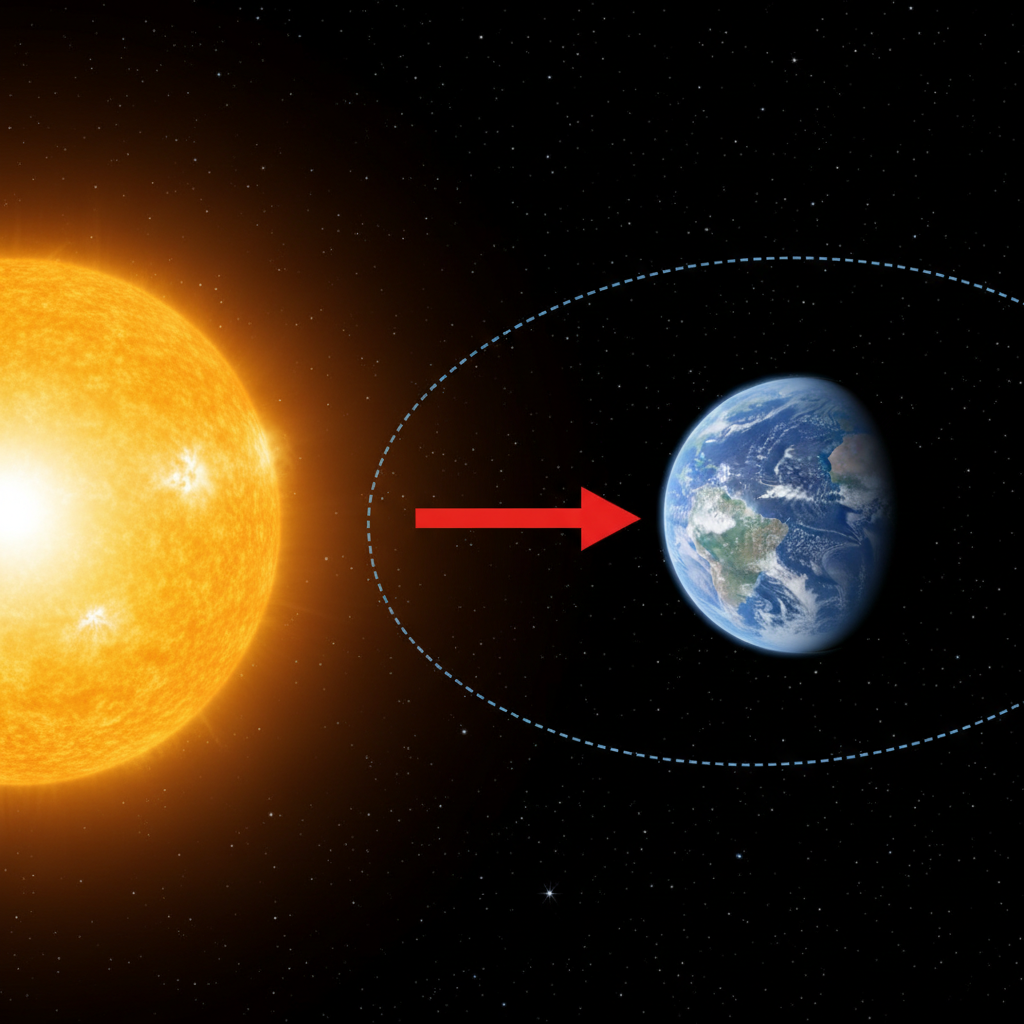
The diagram shows a planet in a circular orbit around the Sun. An arrow is drawn from the planet pointing directly toward the centre of the Sun.
(a) Identify the type of force represented by the arrow and state its direction relative to the planet. [2]
(a) Identify the type of force represented by the arrow and state its direction relative to the planet. [2]

Solutions
2QuestionAssessment Practice
3 marks~5 minCriterion C
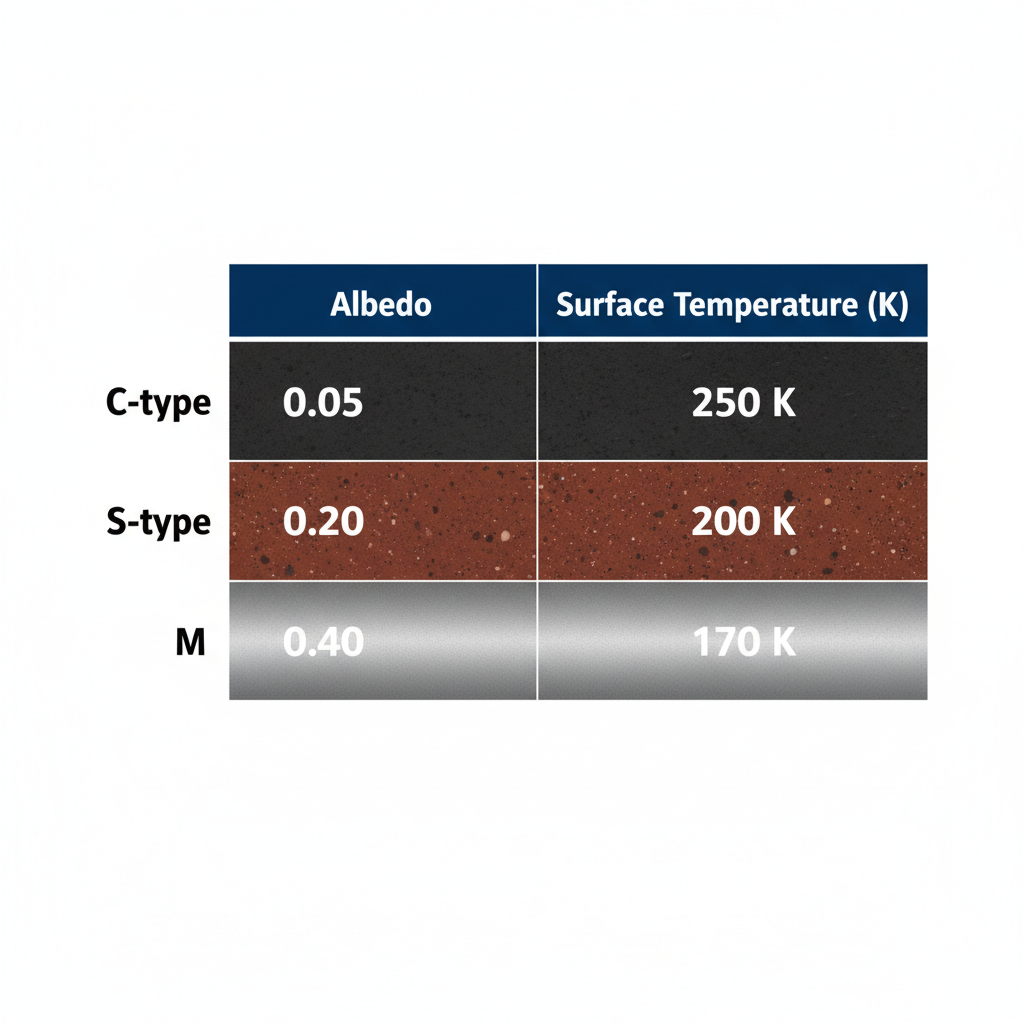
Astronomers classify asteroids by composition. The table below shows albedo and surface temperature for three asteroid types.
| Asteroid Type | Albedo | Surface Temperature (K) |
|---|---|---|
| C-type (carbonaceous) | 0.05 | 250 |
| S-type (silicate) | 0.20 | 200 |
| M-type (metallic) | 0.40 | 170 |
a
State the relationship between albedo and surface temperature shown in the table. [1]
b
Explain why higher albedo produces a lower surface temperature, using the concepts of energy absorption and reflection. [1]
c
An asteroid scientist argues that composition is the root cause of surface temperature differences between asteroid types. Evaluate this claim using evidence from the table and your knowledge of each asteroid type's material properties. [1]
Solutions
3QuestionAssessment Practice
4 marks~6 minCriterion D
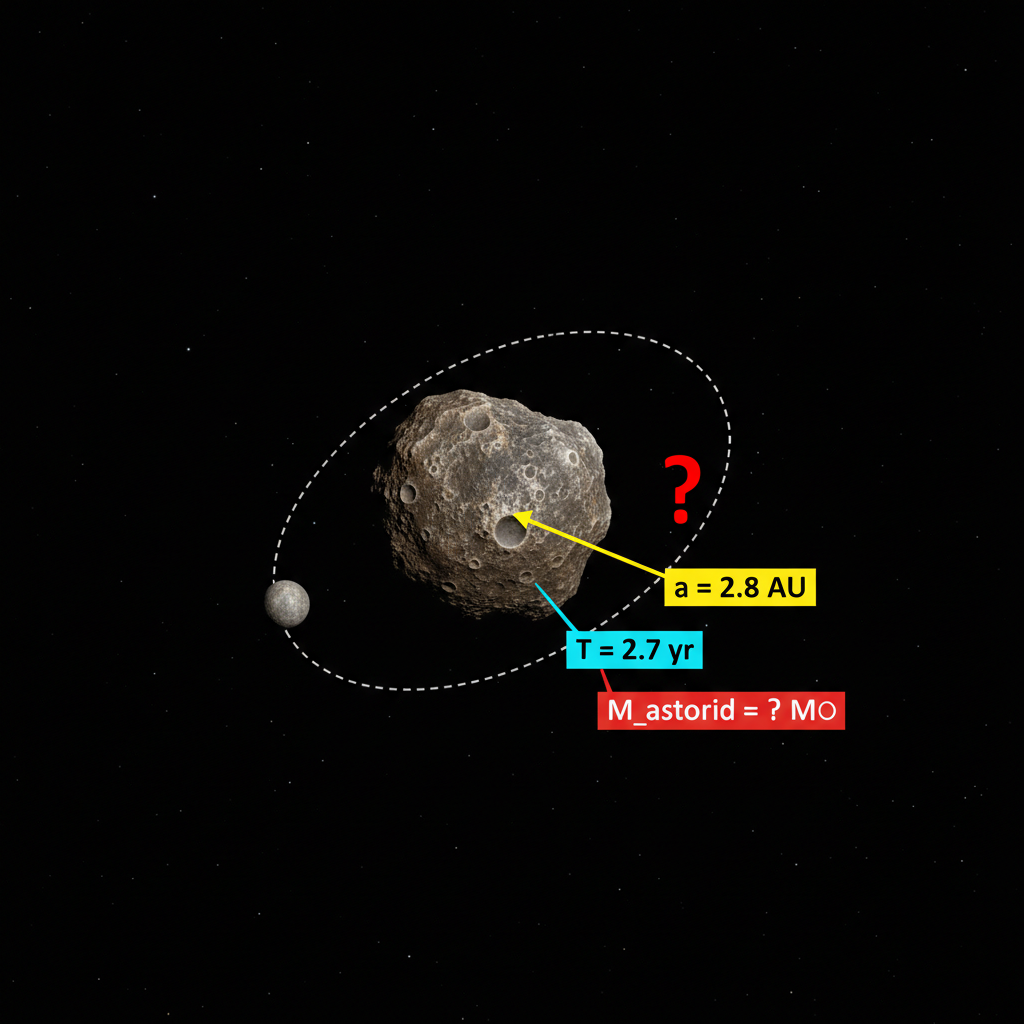
The asteroid Kleopatra has a small moon, Alexhelios, orbiting it in a nearly circular path. Alexhelios has an orbital period of 2.7 years and an average orbital radius of 2.8 AU.
Kepler's Third Law in Newtonian form is:
For the Sun–Earth system: year, AU, .
Kepler's Third Law in Newtonian form is:
For the Sun–Earth system: year, AU, .
a
Show that, using the Sun–Earth system, . [1]
b
Calculate the mass of Kleopatra in terms of . [2]
c
Evaluate whether your answer is physically reasonable for an asteroid. [1]
Solutions
4QuestionFormation of the solar system (nebular hypothesis – basic idea)Assessment Practice
4 marks~6 minCriterion C
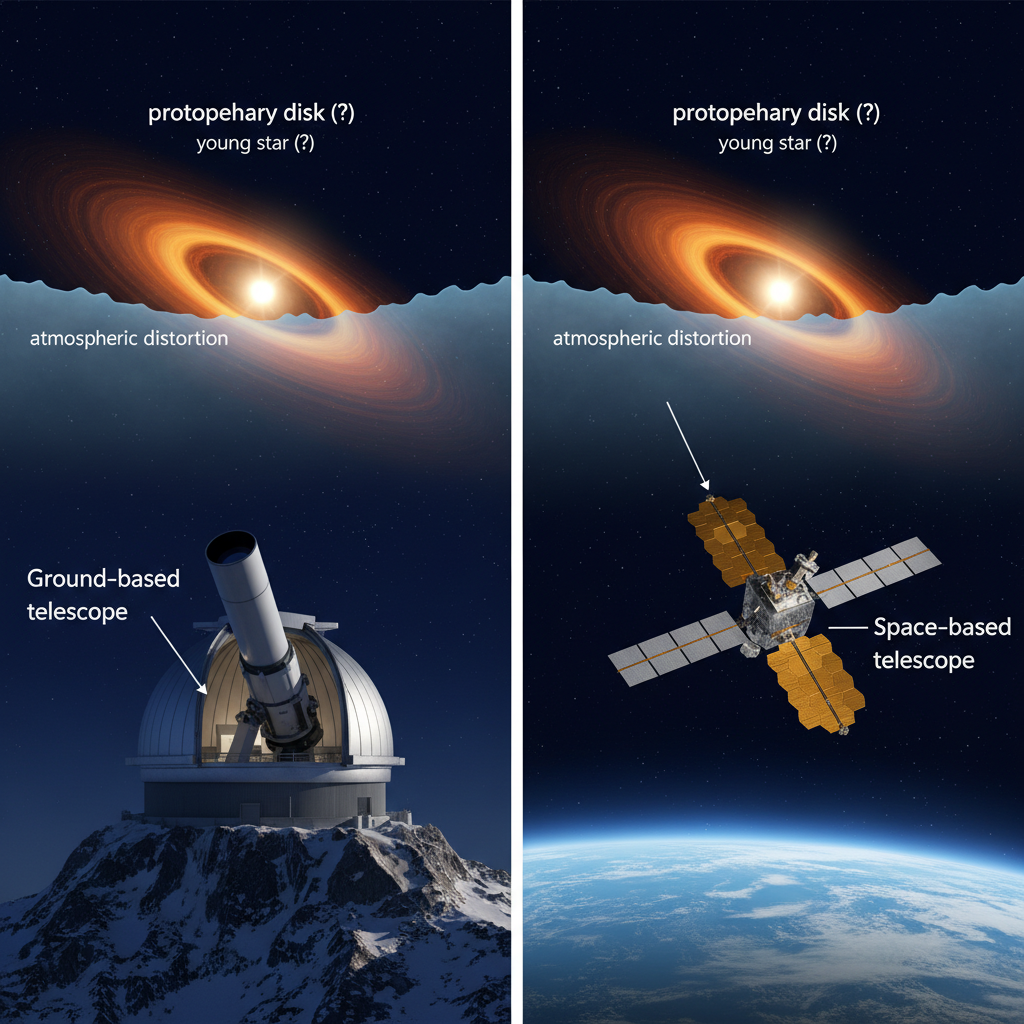
The nebular hypothesis proposes that the solar system formed from a rotating cloud of gas and dust that collapsed under gravity, flattening into a disk from which planets formed. Space telescopes such as Hubble and James Webb observe protoplanetary disks around young stars without atmospheric distortion, revealing structures such as rings and gaps. Ground-based telescopes face resolution limits due to Earth's atmosphere but are far cheaper to build and operate.
a
Discuss one benefit and one limitation of using space-based telescopes to observe protoplanetary disks. [2]
b
Explain how observations of protoplanetary disks support the nebular hypothesis. In your answer, refer to one specific feature visible in these disks. [2]
Solutions
5QuestionRole of gravity in maintaining orbitsAssessment Practice
8 marks~12 minCriterion A
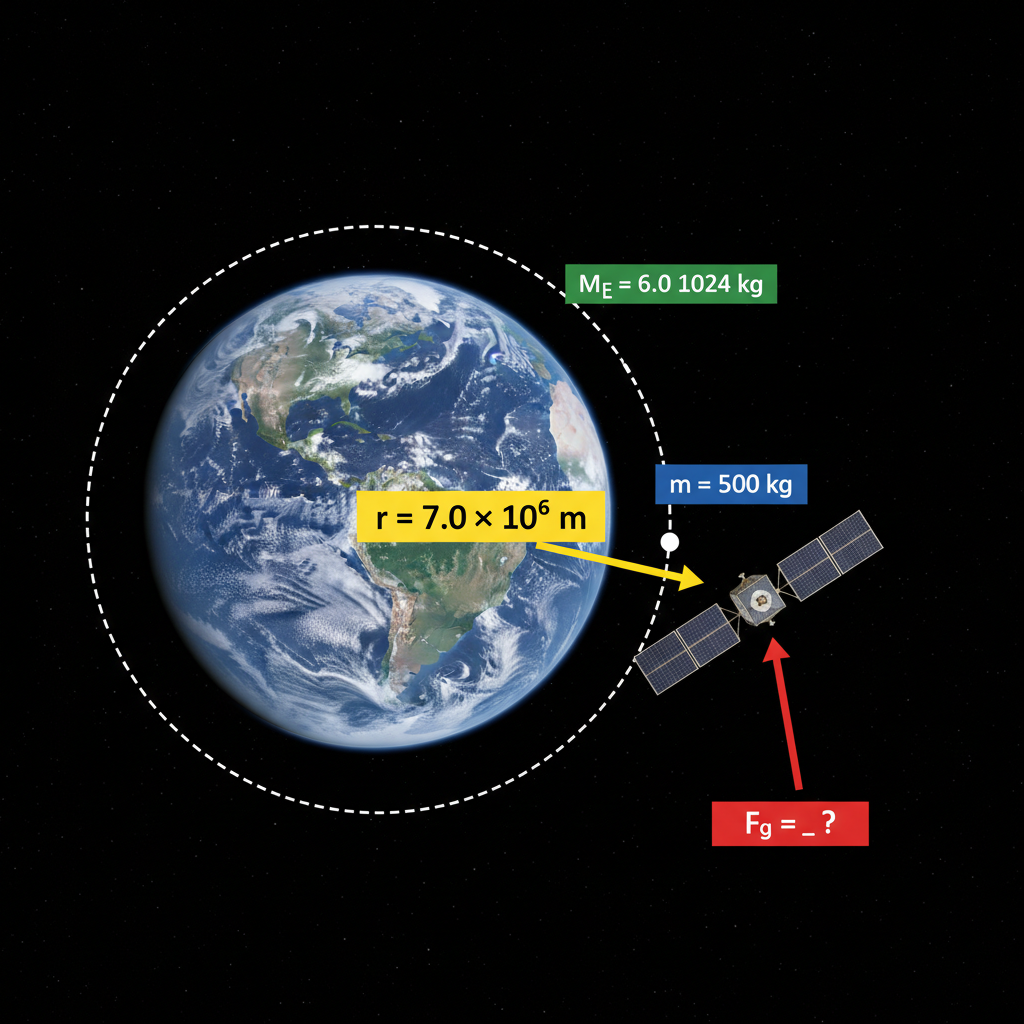
A communications satellite of mass 500 kg orbits Earth in a circular path at an orbital radius of m from Earth's centre. The mass of Earth is kg and the gravitational constant is N m kg.
a
State the equation for the gravitational force acting on the satellite and define each variable. [2]
b
Deduce the orbital speed of the satellite by equating gravitational force to centripetal force, showing all algebraic steps. [4]
c
A second satellite of mass 1000 kg orbits at the same radius. Evaluate how the orbital speed of this satellite compares to the first, justifying your answer with reference to your expression from (b). [2]
Solutions
That's every free question here — 5 of 360.
+355 more questions, plus Mock Papers & Worksheets, are waiting in Premium.