You're viewing free preview questions — 5 questions previewing here — subscribe to unlock 172 more, plus the Full Question Bank, Mock Papers & Worksheets.Upgrade
Atomic Structure, particles, chargers and masses — Free MYP4 Physics Practice Questions

1QuestionRelative charge and mass comparisonConcept Practice
2 marks~3 minCriterion A
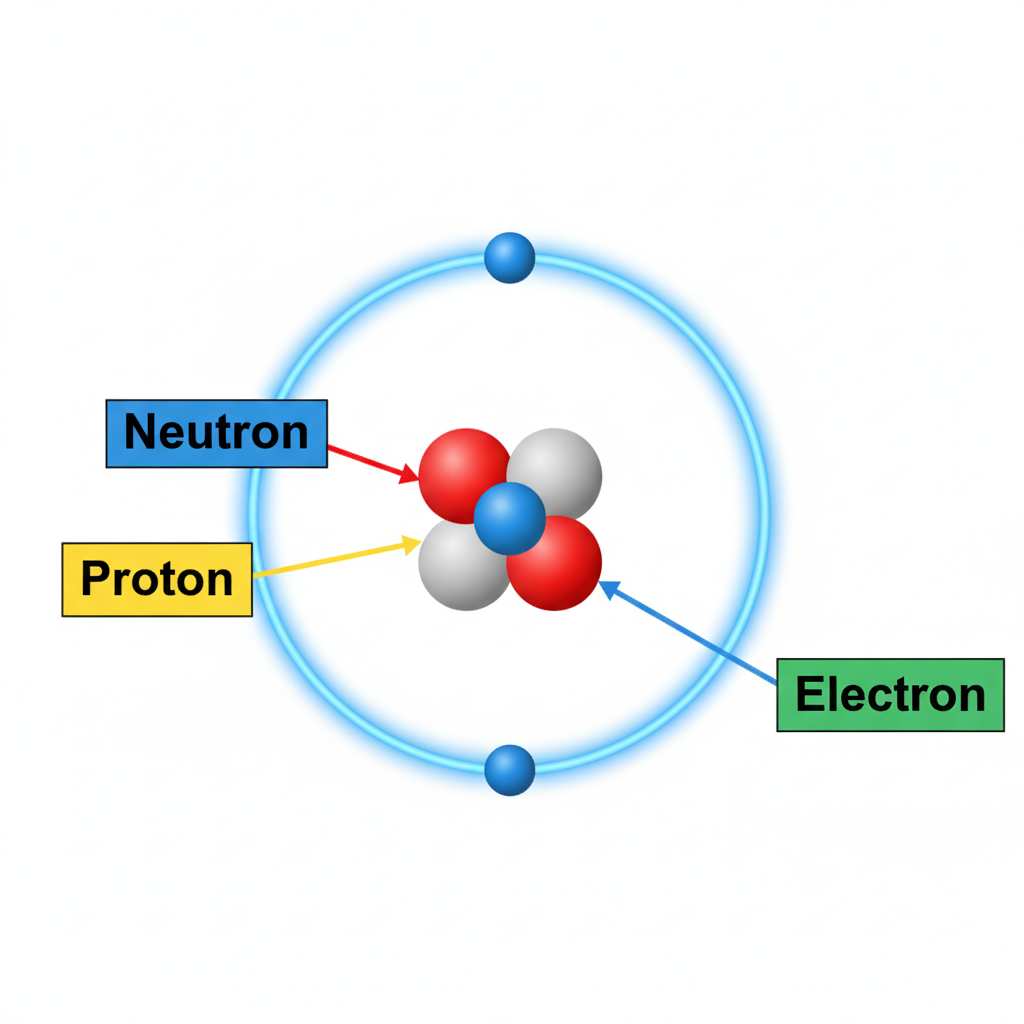
The diagram below shows a helium atom with its subatomic particles labelled X, Y, and Z.
Particle properties:
Particle properties:
| Proton | relative charge | relative mass |
|---|---|---|
| Neutron | relative charge | relative mass |
| Electron | relative charge | relative mass |
a
Identify the particle that has a relative charge of and a relative mass of . [1]
b
A helium atom is electrically neutral. Using the relative charges of its subatomic particles, explain how a helium atom — which contains two protons — achieves an overall charge of zero. [1]

Solutions
2QuestionAtomic number (Z) and mass number (A)Assessment Practice
5 marks~8 minCriterion A
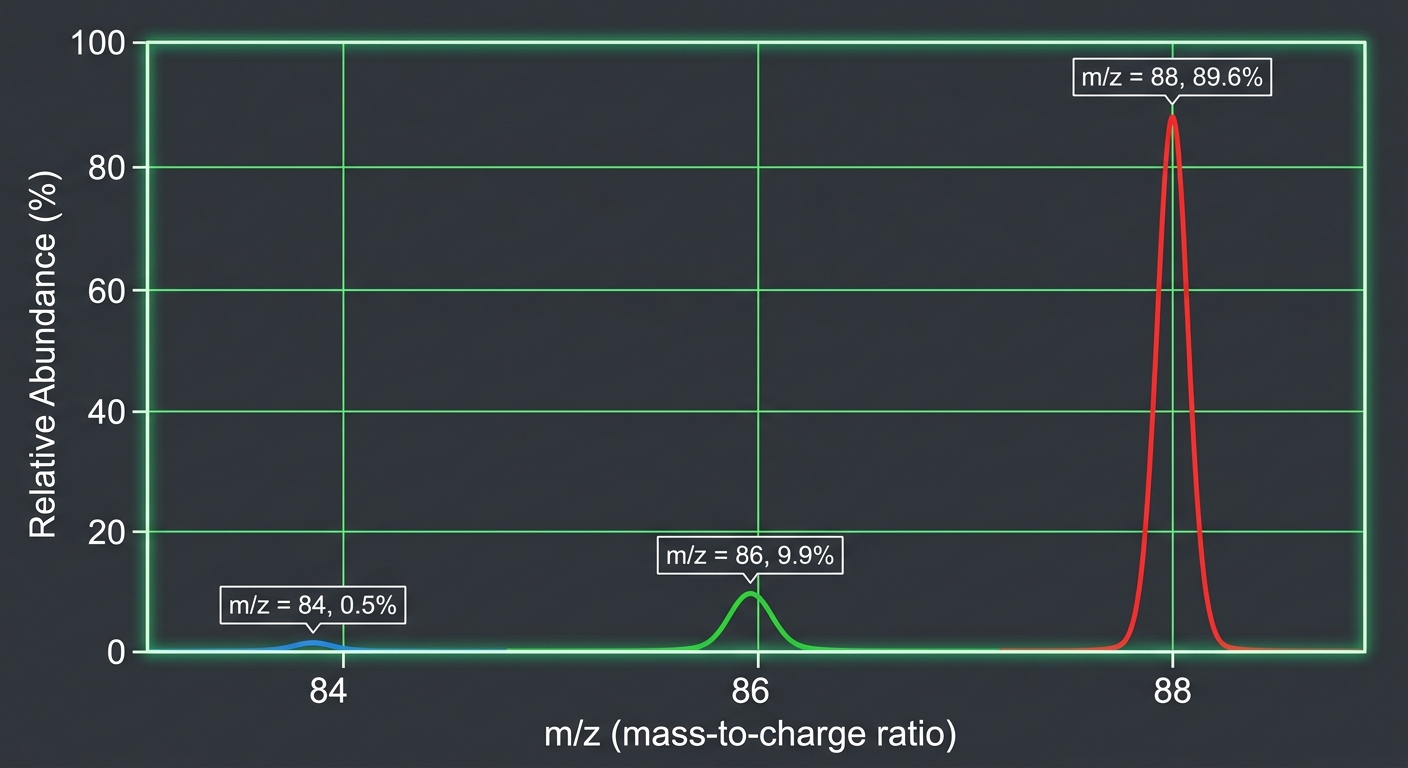
A mass spectrometer analyses element X and detects three isotopes:
| Peak 1 | relative abundance | |
|---|---|---|
| Peak 2 | relative abundance | |
| Peak 3 | relative abundance |
a
Calculate the weighted average atomic mass of element X using:
Show all working. [2]
Show all working. [2]
b
Deduce the identity of element X from your result and state its atomic number . [1]
c
The three peaks all share the same atomic number yet differ in mass number . Analyse how this is possible, and explain why the most abundant isotope does not necessarily determine the value of . [2]
Solutions
3QuestionSubatomic particles: Proton (charge, mass, location) , Neutron (charge, mass, location), Electron (charge, mass, location)Concept Practice
2 marks~3 minCriterion D
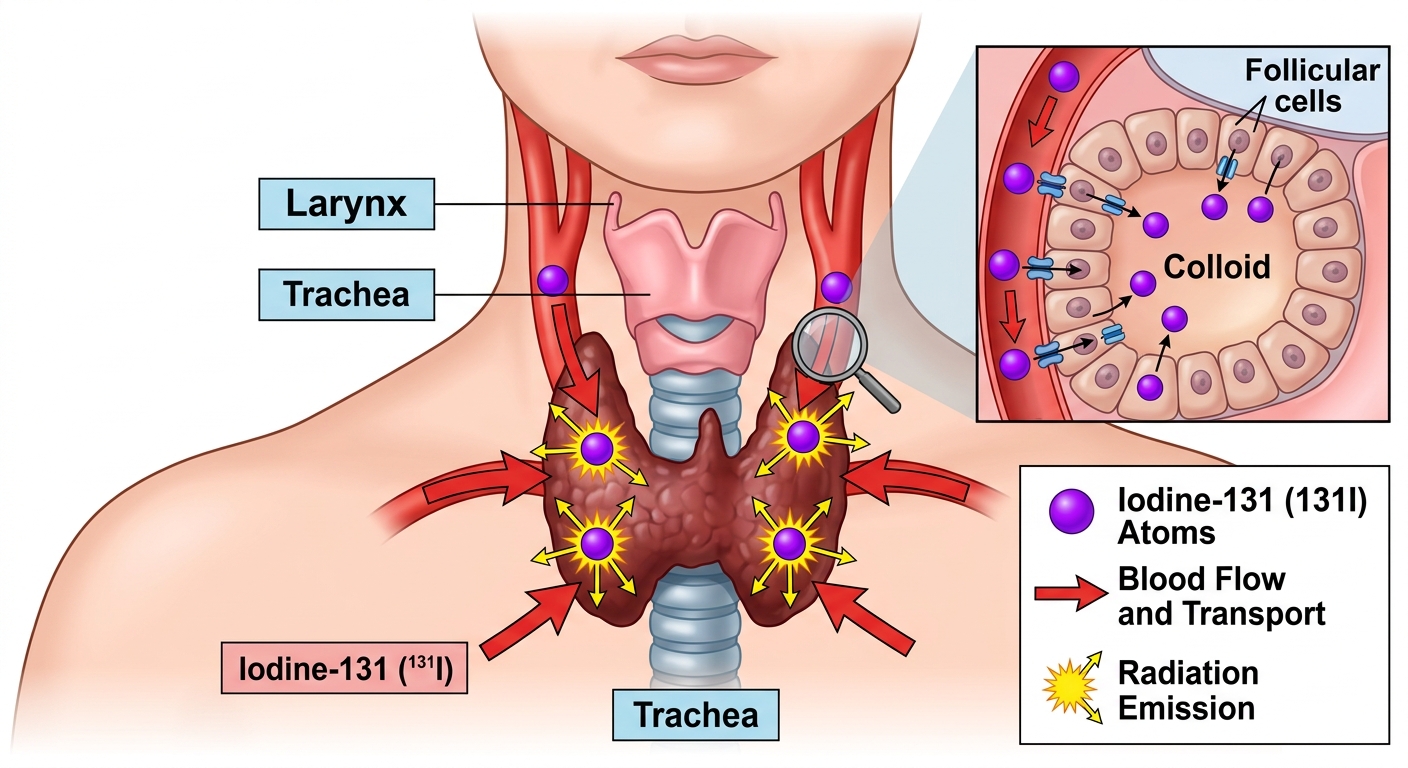
Iodine-131 (I) is a radioactive isotope used in thyroid imaging. The thyroid gland absorbs iodine naturally, concentrating the isotope in thyroid tissue. Iodine-131 emits gamma radiation, which can be detected externally by imaging equipment. However, its use in medicine involves both advantages and hazards.
Outline one benefit and one risk of using iodine-131 in medical imaging. [2]
Outline one benefit and one risk of using iodine-131 in medical imaging. [2]
Solutions
4QuestionEnergy levels and electron transitionsAssessment Practice
8 marks~12 minCriterion B
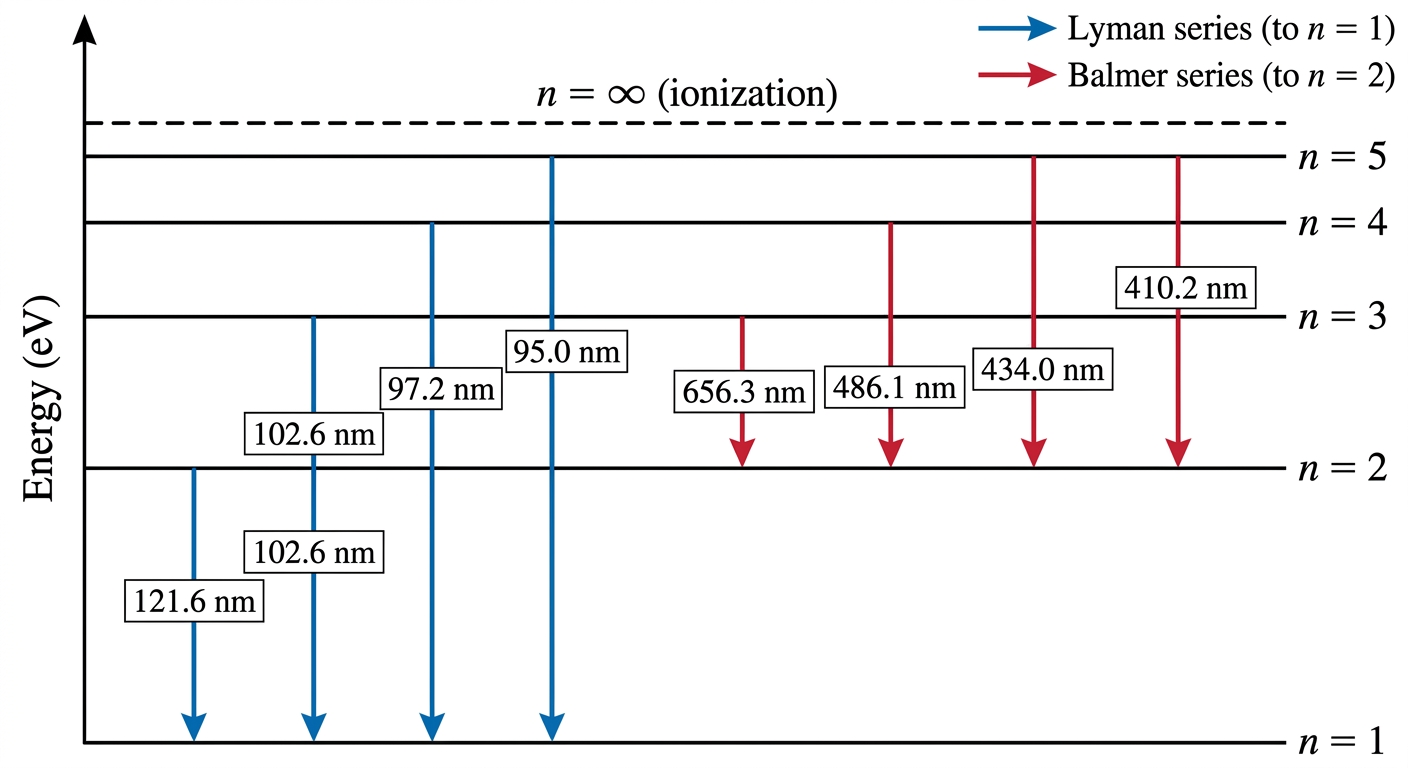
When a hydrogen atom's electron drops to a lower energy level, it emits a photon whose wavelength reveals the energy difference between those levels.
Lyman series (transitions to ):
: 121.6 nm, : 102.6 nm, : 97.2 nm, : 95.0 nm
Balmer series (transitions to ):
: 656.3 nm, : 486.1 nm, : 434.0 nm, : 410.2 nm
Use , where J s and m s.
Lyman series (transitions to ):
: 121.6 nm, : 102.6 nm, : 97.2 nm, : 95.0 nm
Balmer series (transitions to ):
: 656.3 nm, : 486.1 nm, : 434.0 nm, : 410.2 nm
Use , where J s and m s.
a
Calculate the energy of the photon emitted in the transition. [2]
b
Using your answer to (a) and the data above, deduce the energy of the photon emitted in the transition without using the 102.6 nm value directly, then compare your result with the value obtained from 102.6 nm. [3]
c
The Lyman series wavelengths decrease from 121.6 nm to 95.0 nm as the upper level rises from to , yet the decreases get smaller with each step. Analyse how both series together support the conclusion that energy level spacing decreases as increases. [3]
Solutions
5QuestionRutherford’s nuclear modelAssessment Practice
8 marks~12 minCriterion B
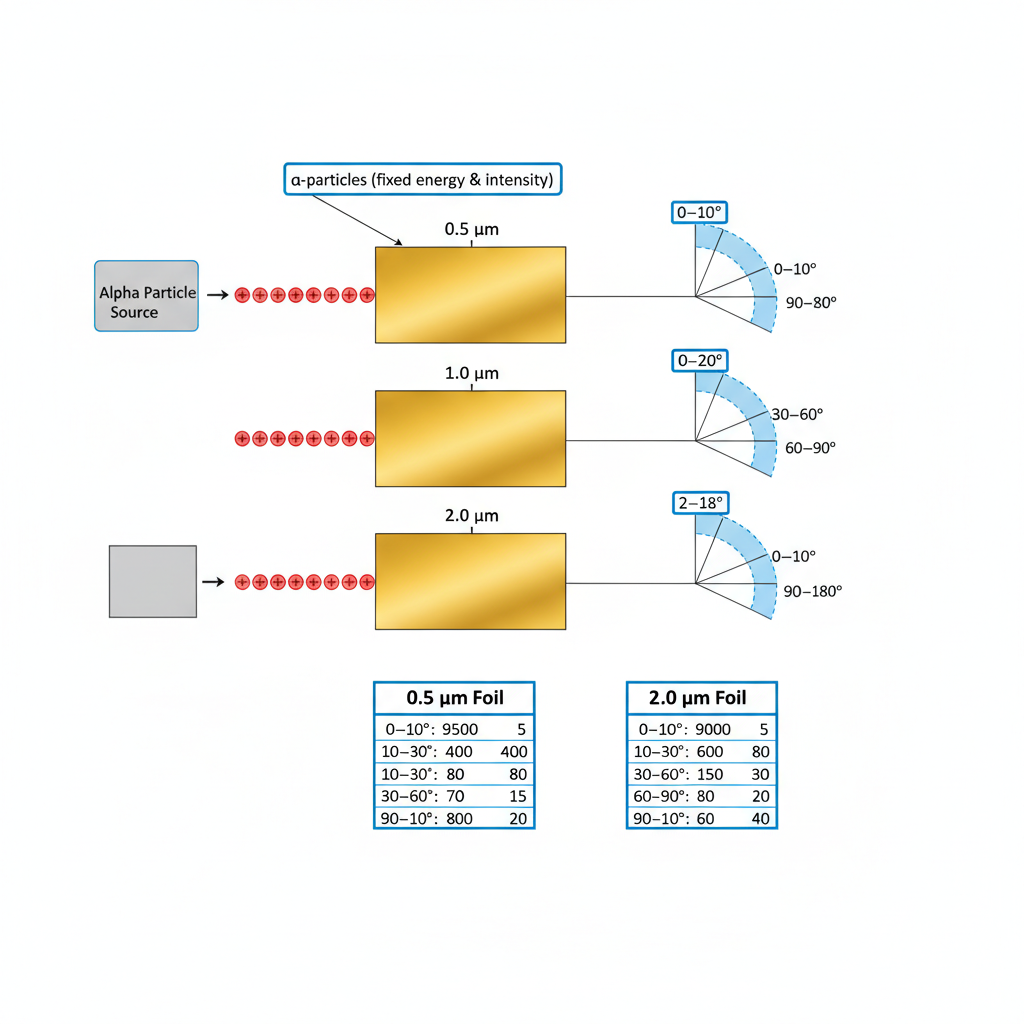
A beam of alpha particles of fixed intensity and energy strikes gold foils of different thicknesses. The table below shows the number of alpha particles detected in each angular range.
Foil thickness 0.5 μm — particles detected: 0°–10°: 9500 | 10°–30°: 400 | 30°–60°: 80 | 60°–90°: 15 | 90°–180°: 5
Foil thickness 1.0 μm — particles detected: 0°–10°: 9200 | 10°–30°: 600 | 30°–60°: 150 | 60°–90°: 30 | 90°–180°: 20
Foil thickness 2.0 μm — particles detected: 0°–10°: 8800 | 10°–30°: 800 | 30°–60°: 300 | 60°–90°: 60 | 90°–180°: 40
Foil thickness 0.5 μm — particles detected: 0°–10°: 9500 | 10°–30°: 400 | 30°–60°: 80 | 60°–90°: 15 | 90°–180°: 5
Foil thickness 1.0 μm — particles detected: 0°–10°: 9200 | 10°–30°: 600 | 30°–60°: 150 | 60°–90°: 30 | 90°–180°: 20
Foil thickness 2.0 μm — particles detected: 0°–10°: 8800 | 10°–30°: 800 | 30°–60°: 300 | 60°–90°: 60 | 90°–180°: 40
a
Describe the trend in the number of alpha particles scattered at angles greater than 90° as foil thickness increases. [2]
b
Deduce the number of alpha particles scattered at angles greater than 90° for a foil of thickness 1.5 μm, showing your reasoning clearly. [3]
c
Analyse how Coulomb repulsion and the probability of close nuclear encounters together account for the trend identified in part (a). [3]
Solutions
That's every free question here — 5 of 177.
+172 more questions, plus Mock Papers & Worksheets, are waiting in Premium.