You're viewing free preview questions — 5 questions previewing here — subscribe to unlock 159 more, plus the Full Question Bank, Mock Papers & Worksheets.Upgrade
Dangers of Radiation & Safety Measures — Free MYP4 Physics Practice Questions

1QuestionSafe handling of radioactive materialsConcept Practice
2 marks~3 minCriterion D
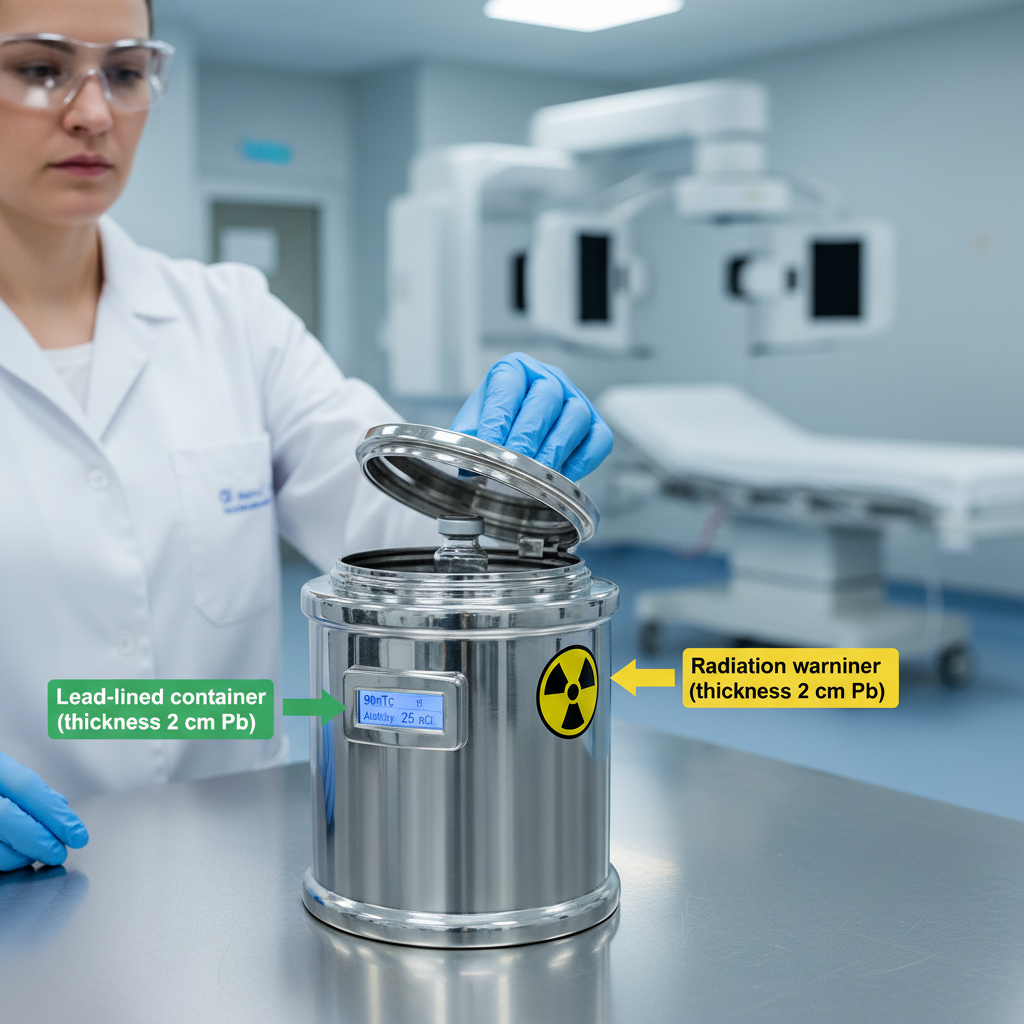
In nuclear medicine, lead-lined containers are used to store and transport radioactive isotopes such as and within hospital environments.
a
Explain how lead-lined containers protect hospital staff and patients from radiation exposure during the handling of radioactive isotopes. [1]
b
Evaluate one limitation of using lead-lined containers as a radiation safety measure in hospitals. [1]

Solutions
2QuestionSafety principles: Time (reduce exposure time), Distance (increase distance), Shielding (lead, concrete)Assessment Practice
3 marks~5 minCriterion B
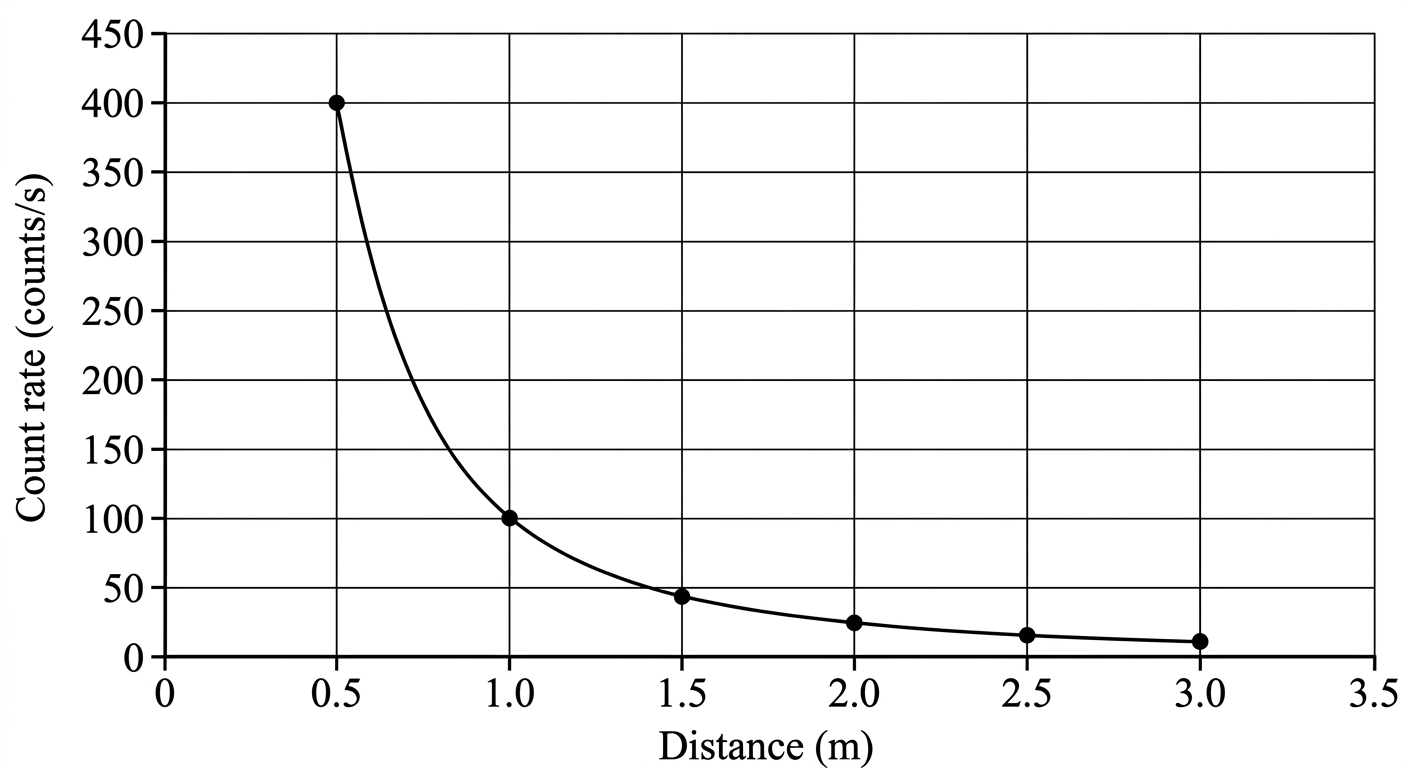
A radiation worker monitors a gamma source. The background count rate has been subtracted from all readings.
Count rate (counts/s) at each distance:
0.5 m: 400 — 1.0 m: 100 — 1.5 m: 44 — 2.0 m: 25 — 2.5 m: 16 — 3.0 m: 11
Count rate (counts/s) at each distance:
0.5 m: 400 — 1.0 m: 100 — 1.5 m: 44 — 2.0 m: 25 — 2.5 m: 16 — 3.0 m: 11
a
State the relationship between intensity and distance described by the inverse square law. [1]
b
Use two values from the data to show that the count rate follows the inverse square law. [1]
c
Explain, using the inverse square law, why increasing distance from the gamma source reduces a worker's radiation exposure. [1]
Solutions
3QuestionSafety principles: Time (reduce exposure time), Distance (increase distance), Shielding (lead, concrete)Assessment Practice
5 marks~8 minCriterion A
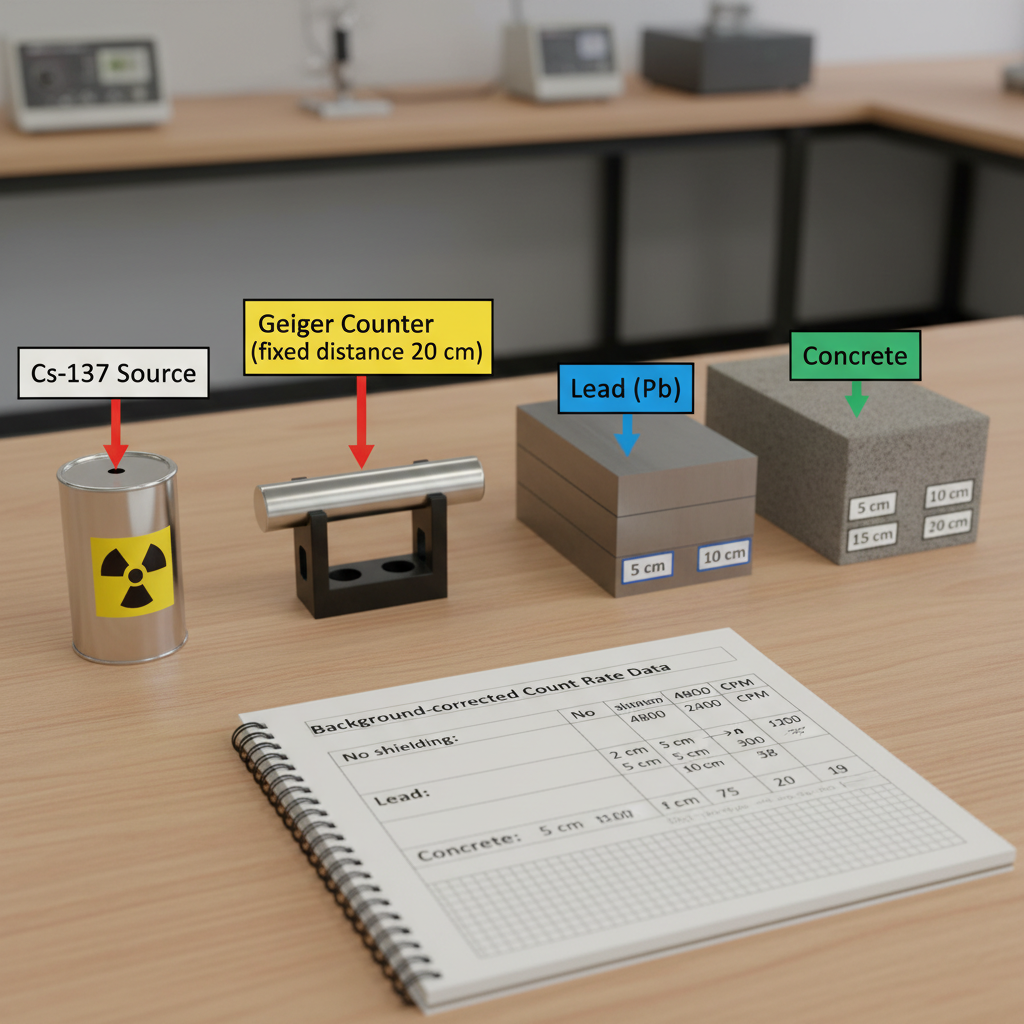
A student measures background-corrected count rates (CPM) at 20 cm from a Cs-137 gamma source using a Geiger counter.
No shielding: 4800 CPM
The student claims both materials follow the exponential attenuation model:
where is the initial count rate, is thickness (cm), and is the attenuation coefficient (cm).
No shielding: 4800 CPM
| Lead thickness (cm) | 2 | 5 | 10 |
|---|---|---|---|
| Count rate (CPM) | 2400 | 600 | 38 |
| Concrete thickness (cm) | 5 | 10 | 15 | 20 |
|---|---|---|---|---|
| Count rate (CPM) | 1200 | 300 | 75 | 19 |
The student claims both materials follow the exponential attenuation model:
where is the initial count rate, is thickness (cm), and is the attenuation coefficient (cm).
a
Calculate the percentage reduction in count rate produced by 5 cm of lead. [1]
b
Deduce the thickness of concrete that produces the same percentage reduction as 5 cm of lead. Show your working. [2]
c
Evaluate the validity of the exponential attenuation model for lead by calculating from the 2 cm and 5 cm data, predicting the count rate at 10 cm, and comparing this prediction with the measured value. [2]
Solutions
4QuestionRisk vs benefit analysis in applicationsAssessment Practice
6 marks~9 minCriterion C
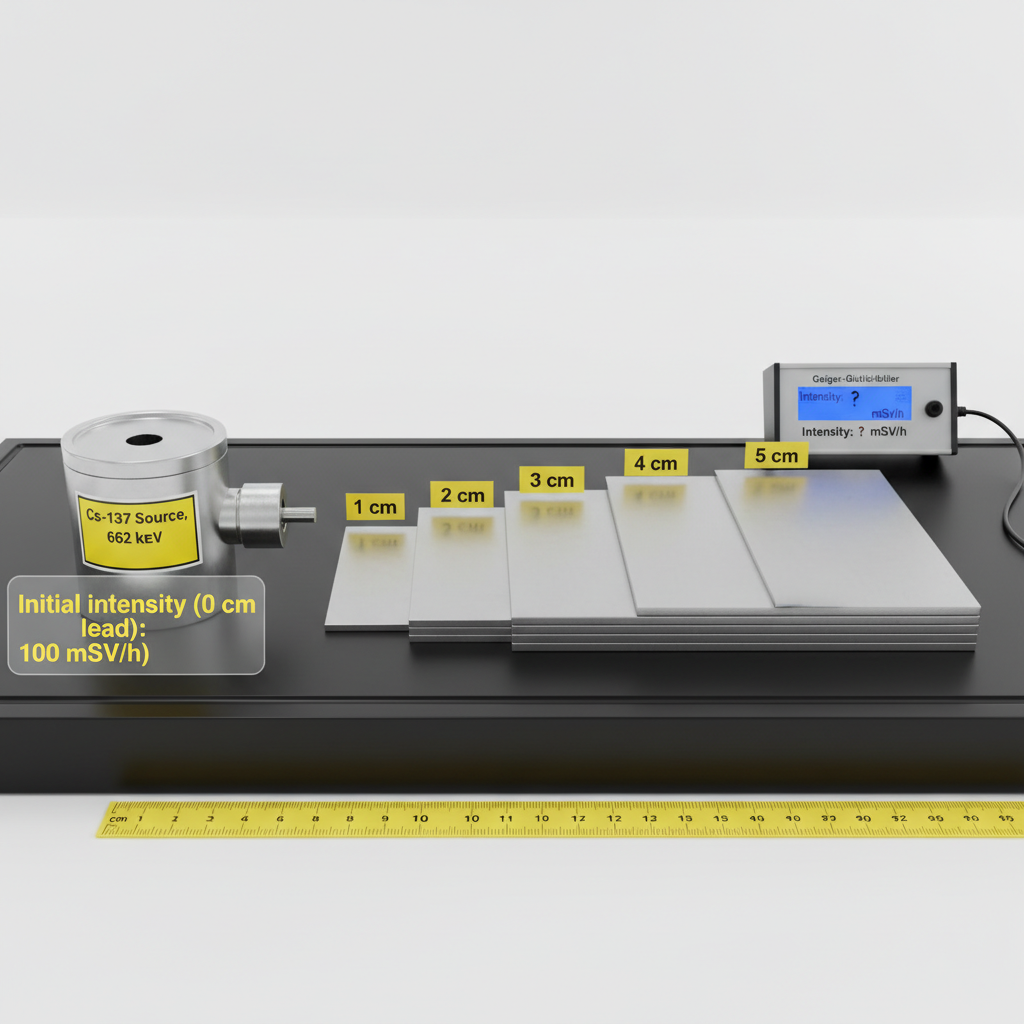
A radiation worker places increasing thicknesses of lead between a Cs-137 gamma source and a detector. The source emits 662 keV gamma rays. Initial intensity without shielding is 100 mSv/h.
The published half-value layer (HVL) for Cs-137 gamma rays in lead is 0.65 cm.
| Lead thickness (cm) | 0 | 1 | 2 | 3 | 4 | 5 |
|---|---|---|---|---|---|---|
| Intensity (mSv/h) | 100.0 | 50.0 | 25.0 | 12.5 | 6.25 | 3.13 |
The published half-value layer (HVL) for Cs-137 gamma rays in lead is 0.65 cm.
a
Deduce the mathematical relationship between lead thickness and measured intensity. Use your relationship to predict the intensity at 7 cm. [2]
b
Show that the intensity predicted by the published HVL at 7 cm differs from your answer in (a). Explain one physical reason for this difference. [2]
c
A hospital physicist must choose between 7 cm of lead shielding (based on the experimental data) and 4.55 cm of lead (based on the published HVL), both claimed to reduce intensity to a similarly safe level. Evaluate which thickness the physicist should recommend, justifying your answer with reference to the two intensity values and the conditions under which each was obtained. [2]
Solutions
5QuestionSafety principles: Time (reduce exposure time), Distance (increase distance), Shielding (lead, concrete)Assessment Practice
6 marks~9 minCriterion D
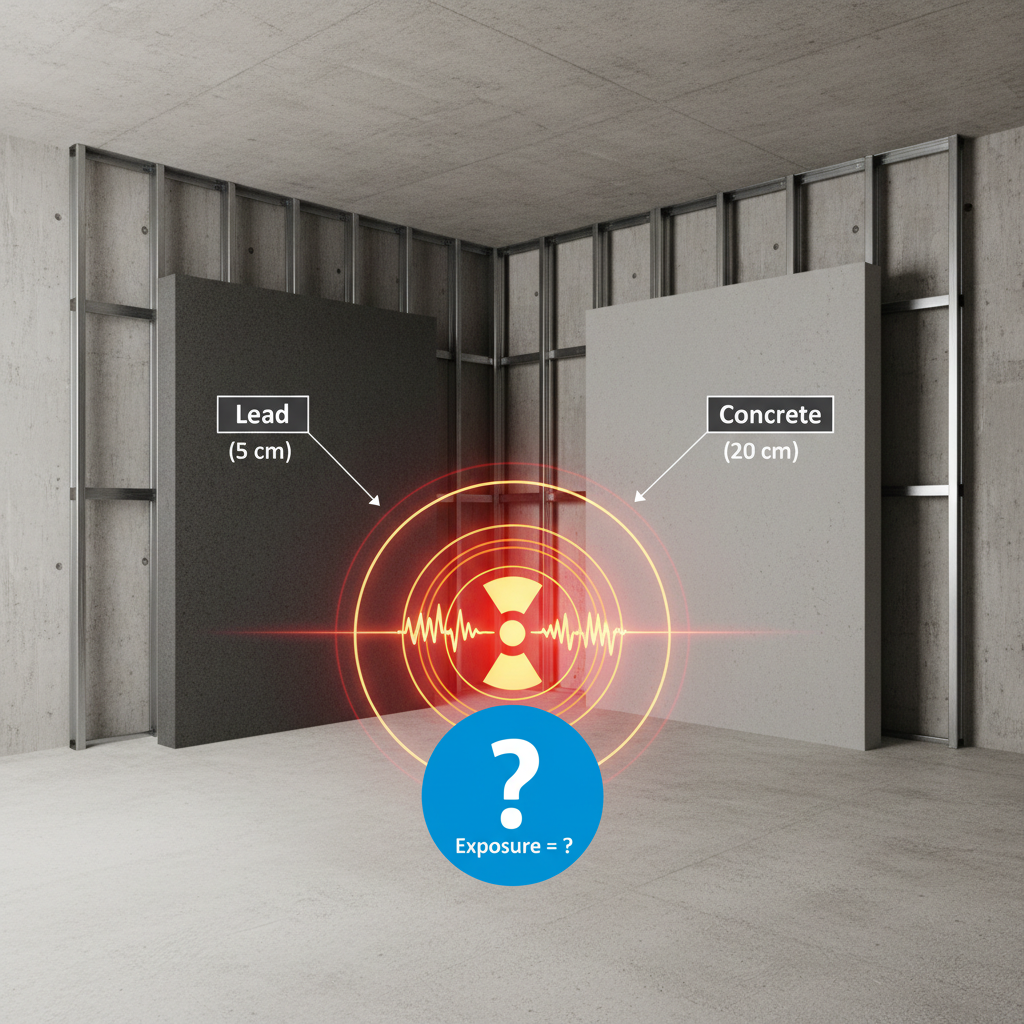
A hospital is designing a radiology room and must choose between two wall-shielding options: 5 cm of lead (density , atomic number ) or 20 cm of concrete (density , ). Lead costs significantly more and adds greater structural load; concrete is cheaper but reduces usable floor space. Both options are claimed to provide equivalent radiation protection.
a
Explain why lead achieves equivalent radiation attenuation to concrete using a much thinner layer, referencing the physical properties of each material. [2]
b
Analyse the limitations of concrete shielding, considering both its physics-based performance and the practical consequences for hospital design. [2]
c
Evaluate which shielding option the hospital should choose, justifying your recommendation by weighing effectiveness, cost, space, and structural load. [2]
Solutions
That's every free question here — 5 of 164.
+159 more questions, plus Mock Papers & Worksheets, are waiting in Premium.